
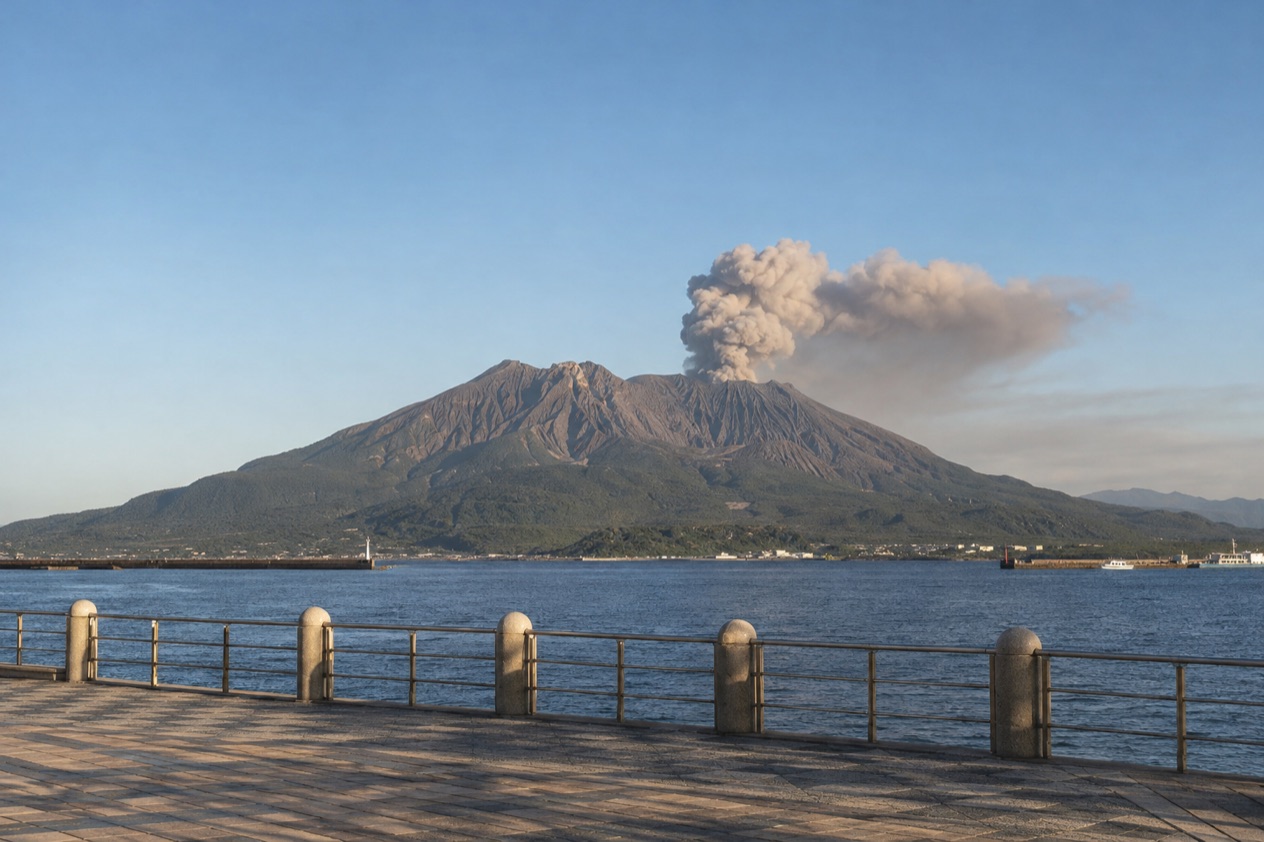
A fine gray dust sits on parked cars and window ledges in Kagoshima, and nobody looks surprised, because across the bay Sakurajima is breathing again. Trams rattle past shopkeepers sweeping the sidewalk, and the smell of sweet potato shochu drifts out of the evening izakaya. This is a southern Kyushu port city built around a volcano, a samurai past and a serious appetite, and it suits travelers who like their sightseeing mixed with hot springs, pork and a little geological drama.
What are the best things to do in Kagoshima?
The best things to do in Kagoshima all circle the same idea: a city that lives with its volcano and has plenty of pride in its own history. Start with the ferry across the bay and let the rest follow from there.
- Ride the Sakurajima Ferry across the bay to stand on the flanks of the volcano that defines the city.
- Walk through Sengan-en, the garden of the Shimadzu family, with the volcano set into the view as borrowed scenery.
- Climb to the Shiroyama viewpoint for the whole sweep of the city, the bay and the smoking cone.
- Follow the story of the Satsuma samurai and the Meiji Restoration in the city’s museums and statues.
- Eat kurobuta black pork, satsuma-age fish cakes and chicken sashimi, the dishes this prefecture is proud of.
- Spend an evening in the Tenmonkan arcades with a glass of sweet potato shochu.
- Take a day to the hot sand baths of Ibusuki or the samurai lanes of Chiran.
- Visit the aquarium on the waterfront with children, then end at a foot bath.
Kagoshima is the capital of its prefecture, on the island of Kyushu, and it sits only four kilometers from Sakurajima. That closeness explains most of what you will do here.
Sights are lined up along the bay, the trams cross the center, and the volcano shows up in nearly every photograph, whether you want it there or not. Some travelers use the city as a single stop between Kumamoto and the south, but it rewards a longer stay, especially if you enjoy food and hot water.
The city has been nicknamed the Naples of the Eastern world, for its bay, its warm climate and its emblematic stratovolcano. The comparison is a fair shorthand. There is the same sense of a lively harbor town sitting under a mountain that could not be ignored if it tried, with the same love of strong flavors and loud, friendly conversation.
Sights and landmarks in Kagoshima
Kagoshima’s landmarks tell the story of the Satsuma domain, the powerful southern clan whose leaders helped bring down the shogunate and shape modern Japan. The stone statues, the museum halls and the gardens all go back to that story, and it is easier to enjoy the city once you know the names. Shimadzu is the family, Saigo Takamori the soldier-statesman whose figure appears all over town.
Sengan-en and the Shimadzu legacy
Sengan-en is the old villa and garden of the Shimadzu lords, the family that ruled this region for generations. The garden is laid out facing the bay, and the designers set Sakurajima into the composition on purpose, so the volcano becomes a backdrop to ponds, stone lanterns, bamboo groves and pine trees. You walk gravel paths past small shrines and a stream channel, and the house itself shows how a feudal lord lived at ease.
Pause at the teahouse corners and the viewpoints that frame the cone, because the scene changes with the wind and the ash. On a clear day the smoke rises in a thin line.
On a heavy day the mountain is just a gray shape, which is its own kind of beauty. This is a place for a slow visit, and it pairs well with a sweet or a local snack in the shops by the entrance.
Shiroyama and the Satsuma story
Shiroyama is the hill above the center where the last stand of Saigo Takamori and his men took place, and it is now the place locals send visitors for the big view. From the observation point the city spreads toward the water, with Sakurajima filling the horizon, and the whole bay reads like a map you can finally understand. Trees cover the slope, and cicadas make the summer air hum.
The hill matters as much for its history as for the outlook. Saigo is remembered here with real affection, as a figure who helped open the Meiji era and then turned against its direction, and you will find his image on statues, on souvenirs and in conversation. A visit to Shiroyama gives the context for the museums in town, and the view tends to look different every time the volcano changes mood.
Museums and the Meiji Restoration
Kagoshima’s museums are built around one question: how did a southern province end up reshaping a nation? The Museum of the Meiji Restoration, near the river, answers with life-size figures, dioramas and stories of young Satsuma men who traveled abroad in secret to study. It is a good place for travelers who like to understand the people behind a city’s streets, and the displays are laid out so you can follow the story without any background.
Around the center you will pass statues of these same figures, including the group of young students who left for Europe. The tram stops, the riverbank and the small plazas all work as an open-air history lesson.
Smaller sights around the center
Beyond the three big stops, the city rewards wandering. Streetcar lines run through the middle of town, and the stops are handy for reaching the river, the old samurai district and the shopping streets. Shrines sit tucked among apartment blocks, and small stone memorials mark places tied to the Restoration. The harbor front has a relaxed promenade with views across the water.
One detail you may notice is the way the city treats ash as an ordinary thing. Special bags for volcanic ash are used for sweeping, and schoolchildren wear helmets to protect themselves from volcanic debris from Sakurajima. It is a small, human sign of how closely people live with the mountain, and it makes the view across the bay feel less like a postcard and more like a neighbor.
Outdoor things to do in Kagoshima
The main outdoor activity in Kagoshima is Sakurajima itself, reached by the Sakurajima Ferry from the city, a short ferry ride across the bay. Once you land, the volcano becomes a landscape of lava fields, viewpoints, foot baths and shoreline paths. Everything else outdoors, from the bay front to the hillside gardens, is arranged around that view.
Sakurajima by ferry
Sakurajima was once an island, and the lava flows of the 1914 eruption connected it to the Osumi Peninsula, turning it into a peninsula. You still cross from the city by ferry, and the crossing is part of the pleasure. Gulls follow the boat, the city shrinks behind you and the cone grows larger with every minute, often wearing a cap of cloud or a plume of ash.
On the other side, the roads circle the mountain past lava fields, small orchards and viewing platforms. Sakurajima is active, and tourists are forbidden to go within two kilometers of its crater. That rule shapes what you see, so the paths and platforms you visit sit outside that zone and give you a view of the crater from a distance. Expect ash in the air on many days, and wear sunglasses if the wind turns.
A foot bath beside the shoreline, heated by the volcanic ground, is a classic way to end the outing. You sit with your feet in warm water, look back across the bay at the city and watch the ferries come and go. Local produce sold on the island, including the large radishes and small oranges Sakurajima is known for, makes a good edible souvenir.
Lava fields and viewpoints
The island’s lava fields are the clearest record of its past, with dark rock stretching toward the sea and pine trees pushing up through the cracks. Walking paths cross some of these fields, and viewpoints let you look up the slope toward the crater. The mix of black rock, green growth and blue water is striking, and the scale of the old flows is easy to feel standing on them.
A visitor center on the island explains how the volcano works, how often it erupts and how residents prepare. The displays suit curious travelers of any age. Bring a light layer for the wind, and be ready for ash on your clothes. The mountain does what it does, and the day plan bends around it.
Gardens, bay front and city hills
Back in town, the bay front offers long stretches to stroll, with benches facing the volcano and ferry terminals close by. Cherry trees, camphor trees and palms give the city a leafy feel that matches the warm climate behind the Naples comparison.
In the evening, locals jog and walk along the water, and families gather near the harbor to watch the light change on the cone. It is an easy way to see the city as residents do, with no ticket needed, just a bench and a view.
Day trips from Kagoshima
The day trips people take from Kagoshima go to hot springs, samurai towns and volcanic highlands, all within southern Kyushu. Transport is a mix of local trains, buses and highways, and the Kyushu Shinkansen opens the way north. It connects Kagoshima to Kumamoto in 42 minutes, which makes Kumamoto and its castle a possible outing in the other direction, and Japan Rail Pass holders can use Kyushu Shinkansen services at no charge, except Mizuho trains.
Ibusuki and the sand baths
Ibusuki is a hot spring town on the coast, known for its sand baths, where bathers in light cotton yukata lie on a beach while attendants shovel warm, naturally heated sand over them. The sand holds the heat from the ground, and the effect is a deep, heavy warmth that locals have enjoyed for generations. The sound of the surf comes with it.
After the sand, people rinse off in an ordinary hot spring bath, then walk the town for grilled fish, sweets and the quiet coastal air. It suits travelers who like onsen culture and do not mind a slightly odd experience. Pack a small towel and an unhurried mood, since the visit is more about lying still than about moving between sights.
Chiran and the samurai lanes
Chiran is a small town with a preserved row of samurai residences, where stone walls, clipped hedges and gardens line a quiet lane. Each house has a garden designed to look good from the veranda, and a few are open to visitors. The stone and the greenery feel carefully tended, and the pace is slow.
The town also holds a museum tied to the last years of the Pacific War, a sober stop that adds weight to the day. Visitors who enjoy gardens and Japanese domestic architecture will find plenty here, and those interested in history can pair the lanes with the museum. Wear shoes that slip off easily, since house interiors usually ask you to remove them at the door.
Kirishima highlands
Volcanic peaks, crater lakes, forest trails and hot spring villages make up the scenery, with mist often drifting over the ridges. Shrines tucked into the trees give it a gentle spiritual feel.
It suits travelers who like hiking, onsen and mountain air. Trail conditions around volcanic zones can change, so treat any hike as dependent on what the day allows. A soak in a mountain hot spring afterward is the usual reward, and a plate of local pork or buckwheat noodles finishes the day well.
Other options
- Kumamoto, reached on the Kyushu Shinkansen, for its castle and city streets.
- Yakushima, the forested island with ancient cedars, for travelers who want a longer stay and a real hike.
- The Satsuma Peninsula, for small fishing towns, tea fields and coastal drives.
What to eat in Kagoshima
Eating in Kagoshima means pork, chicken, sweet potatoes, fish cakes and shochu, all served with a generous hand. The prefecture is known across Japan for its kurobuta, a black pig raised on local farms, and for a way of cooking that favors rich broth and bold seasoning. The food is a big part of why the city feels so warm.
Kurobuta and tonkotsu
Kurobuta, the local black pork, appears as tonkatsu cutlets, as shabu-shabu cooked in a hot pot and as slow-simmered kakuni, soft chunks braised in soy and sugar. The meat is tender and sweet, with a layer of fat that melts in the mouth. A set meal with cutlet, miso soup, rice and pickles is a satisfying introduction.
Local ramen shops serve their own tonkotsu style, with a lighter, slightly sweet broth, often topped with pickled vegetables and thin slices of pork. It is the kind of meal that fits a rainy afternoon or a late evening after the arcades. Slurping is part of the experience and nobody will mind.
Satsuma-age, chicken and local seafood
Satsuma-age is a fried fish cake, made from ground fish paste with a little sweetness, sold hot from small stalls and shops. It is chewy, golden and best eaten while it still steams. Many versions include burdock, sweet potato or cheese, so a small tasting walk can cover several flavors.
Chicken is another local pride, served grilled over charcoal, as a rice dish with shredded chicken and egg, or as sashimi in izakaya that specialize in it. The bay supplies seafood too, including small fish called kibinago that are served as sashimi or fried. Order a plate or two to share and add a bowl of rice.
Sweet potatoes, shochu and shaved ice
Sweet potatoes grow well in the volcanic soil, and they turn up everywhere, in tempura, in sweets, in cakes and above all in shochu, the local distilled spirit. Imo shochu has a round, earthy flavor, and locals drink it with hot water, with cold water or over ice. A bottle shared across a table is part of any good dinner.
For dessert, Kagoshima has its own shaved ice called shirokuma, a mountain of fine ice with condensed milk, fruit and sweet beans, sometimes decorated with a polar bear face. It is a treat for anyone with a sweet tooth. Many cafes and sweets shops serve their own version, so a tasting crawl is part of the fun.
Things to do in Kagoshima at night
Evenings in Kagoshima center on Tenmonkan, the downtown entertainment district of covered arcades, izakaya, bars and small restaurants. Neon signs hang over narrow side streets, and the crowd is a mix of office workers, students and travelers. The mood is easygoing, and conversation with neighbors at the counter is common.
Tenmonkan and the izakaya
A good night starts in an izakaya, the casual Japanese pub where you order small plates and drinks, then add more as the evening goes on. Local specialties show up on every menu, so you can build a meal from black pork skewers, chicken sashimi, fish cakes and tempura. Sweet potato shochu is the natural pairing, poured from a bottle kept at your table.
Smaller bars tucked into side lanes serve shochu by the glass, with staff happy to recommend a bottle. If you prefer something lighter, there are cafes, ramen shops and sweet counters that keep a late schedule. The district rewards wandering with no fixed plan, following the smell of grilled meat.
City lights and the bay
After dark, the view from the Shiroyama hill turns into a field of lights around the bay, with the dark shape of Sakurajima set against the sky. Along the water, the harbor front is a gentle place for a stroll, and the ferry lights move slowly across the surface. Sometimes you may see a faint glow or a plume on the cone, though that is a chance and not a promise.
A nighttime visit to a hot spring is another way to spend the evening. Many hotels in and around the city have baths, and soaking while the city quiets down is a pleasure after a day of sightseeing. Bring a small towel, rinse before you enter the water and keep the mood calm.
Quieter evenings
If bars are not your thing, the evening can be a slow dinner of set-menu pork, a walk along the river and an early night. Tea shops and dessert cafes work well for a last stop, and a bowl of shaved ice after dinner is a local habit. The trams keep running through the center, and watching them cross the streets under the lights is a pleasant way to end the day.
Things to do in Kagoshima with kids
Children in Kagoshima get a real volcano, a ferry ride and an aquarium on the waterfront, which is a lot for one city. The ferry across the bay is an outing in itself, with gulls, a deck to stand on and a cone that grows larger as you cross. Many children are fascinated by the idea of a mountain that smokes, and the visitor center on Sakurajima explains it in plain terms.
Ferry, volcano and foot bath
The ferry ride turns the day into an adventure, and on the island there is plenty to look at, from black lava fields to steam drifting from the ground. A foot bath at the shoreline lets everyone sit down, warm their feet and watch the boats. Keep children on the marked paths and away from the crater zone, since tourists are forbidden within two kilometers of it.
Ash can sting eyes and settle on clothing, so sunglasses and a light jacket help on windy days. It is a small detail that kids often find funny, especially when they learn that local schoolchildren wear helmets against volcanic debris. Seeing how a city lives next to a volcano makes a memorable lesson.
Aquarium, zoo and parks
The city aquarium sits by the bay and shows the marine life of southern Japan, with tanks of colorful fish, jellyfish and larger sea animals, and dolphins in an outdoor area. It is the kind of place where families can spend a relaxed couple of hours. The waterfront around it offers open space for running around and snacks from nearby stands.
The city also has a zoo set on a hillside, with paths that wind among animal enclosures, and several parks with playgrounds and open lawns. Take breaks in the shade, carry water and pace the day, since a volcanic city with a warm climate can tire small legs. Sweet treats like shaved ice and sweet potato snacks make good rewards.
Food and rhythm with children
Kagoshima’s food works well for families. Fried fish cakes, pork cutlets, rice bowls and noodle soups are easy to share, and local sweets give a treat to look forward to. Many casual restaurants have picture menus, and ordering a few dishes to pass around lets children try new things without pressure.
Plan one main activity per day, such as the island, the aquarium or a garden, and leave space for rest. Trams and ferries add variety to the transport, which children often enjoy as much as the sights.
Good to know before you go
Kagoshima Airport is in Kirishima, 22 miles northeast of the city, and domestic flights to Kagoshima depart from Tokyo and take 2 hours. The Kyushu Shinkansen is the rail link from the north, and in town the trams, buses and ferries cover most visits. Ash from Sakurajima can fall on any day, so a light jacket and sunglasses are useful, and the rainy and typhoon seasons of southern Japan can bring wet, windy spells that shape ferry and outdoor plans.
Sources
- Japan National Tourism Organization, Kagoshima (https://www.japan.travel/en/destinations/kyushu/kagoshima/kagoshima-and-around/), checked October 11, 2026
- Wikipedia, Kagoshima (https://en.wikipedia.org/wiki/Kagoshima), checked October 11, 2026
- Wikivoyage, Kagoshima (https://en.wikivoyage.org/wiki/Kagoshima), checked October 11, 2026
- Wikipedia, Sakurajima (https://en.wikipedia.org/wiki/Sakurajima), checked October 11, 2026