
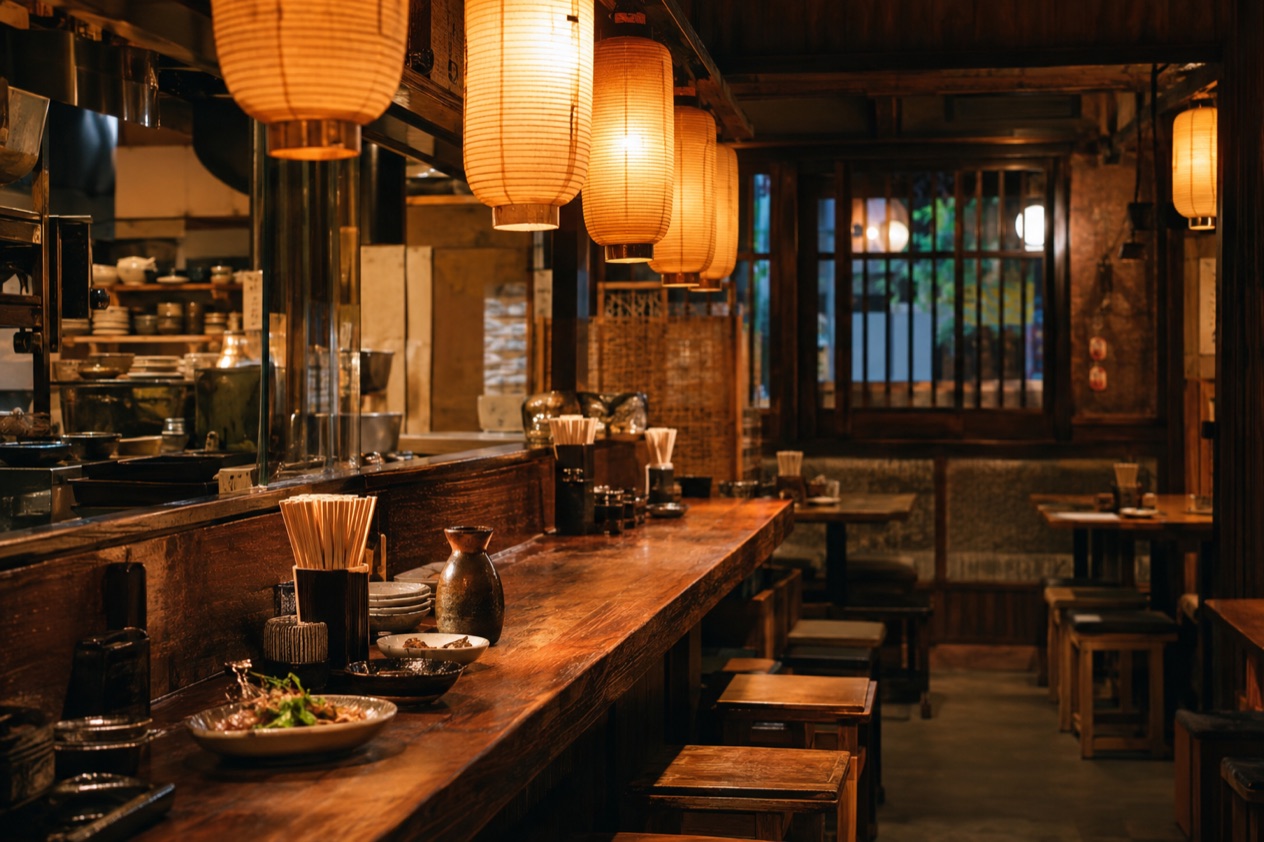
A red paper lantern sways over a sliding door, and behind it comes the clatter of glasses, the hiss of a grill and a chorus of kampai. Someone hands you a damp towel, a plate of small bites lands on the table, and the evening starts without any hurry. Izakaya are Japan’s informal bars with food, found from the alleys of Tokyo to the stands of Fukuoka, and they are where a dinner can turn into a night out.
What is an izakaya?
An izakaya is an informal Japanese bar that serves alcoholic drinks and snacks, a place to sit, order a few plates at a time and keep ordering as the conversation goes. It sits somewhere between a pub, a tapas bar and a neighborhood dining room. The food arrives in small dishes meant to be shared, and the drinks are the reason everyone is there.
The roots are practical. Izakaya grew out of sake shops that let customers sit on the premises and drink instead of carrying the bottle home. That origin still shows in the atmosphere, which feels closer to a shop counter or a living room than to a formal restaurant.
The red lantern outside
Izakaya are often called akachochin, which means red lantern, after the red paper lanterns traditionally hung outside. If you are wandering a side street looking for somewhere to eat, a glowing lantern with handwritten characters is the signal that a bar-restaurant is open and welcoming customers.
Inside, the mood tends to be loose. Colleagues unwind after work, friends split plates, and couples share a corner table. Nobody expects you to know the vocabulary, and a pointed finger at a neighbor’s dish is a perfectly good way to order.
Tatami, chairs or standing
The seating changes the whole feel of the evening. Some izakaya keep to the traditional style, with customers sitting on tatami mats at low tables. Others use ordinary chairs and tables. Then there are the tachi-nomi places, literally drinking while standing, where the room is a counter and a few shelves and the crowd stands shoulder to shoulder with a glass in hand.
Yakitori restaurants show the same range. They run from casual standing bars frequented by office workers to sophisticated sit-down restaurants, so the same grilled skewer can be a quick snack at a counter or the center of a long, quiet dinner.
Where to look in Tokyo, Osaka and Fukuoka
In Tokyo, grilled skewers turn up in a wide variety in Omoide Yokocho, Shinbashi and Koenji, three neighborhoods with very different personalities, from lantern-lit lanes to salaryman streets to a more youthful crowd. In Osaka, many yakitori restaurants stand a short walk from JR Temma Station.
In Fukuoka, yakitori stands are recommended in the Nakasu district, and the Hakata yatai of Kyushu are makeshift counters where you can enjoy a drink with your food, some of them specializing in ramen. Whichever city you are in, the best method is to follow the smell of charcoal and the sound of laughter.
How do you order?
You order in rounds: drinks first, then a few small dishes, then more of whatever the table likes, with no need to decide the whole meal at once. The rhythm is slow, and staff expect you to call out again when you are ready for the next plate.
The towel and the small first plate
Usually you are given an oshibori, a wet towel, to clean your hands. It comes cold in summer and hot in winter, and it is a small pleasure either way. Soon afterward a tiny appetizer arrives that you did not order. It is called otoshi in the Tokyo area and tsukidashi in the Osaka-Kobe area.
That little dish is a local custom, and it is usually charged onto the bill in lieu of an entry fee. Think of it as the price of the seat rather than a mistake, and enjoy whatever it turns out to be, often a bit of pickled vegetables, tofu or simmered something.
Touch screens and illustrated menus
Many izakaya now have touch-screen ordering systems, which makes it easier to order from illustrated menus. If you cannot read the characters, the pictures carry you through. You tap the dish, confirm, and the plate comes to the table.
Where there is no screen, a printed menu with photos, a board on the wall or a friendly gesture toward the counter does the job. Drinks usually come first, and the food follows in no fixed order, so do not be surprised if three plates arrive together.
Yakitori: choosing shio or tare
Yakitori are chicken skewers roasted on a grill, and they can be a small snack with beer before dinner or a full meal with various side dishes. The two main marinades are shio, a salty rice malt seasoning, and tare, a sweet barbecue sauce. When both suit the dish, the server will ask which you prefer.
Negima is chicken breast with green onions, a classic starting point. Sasami wasabi is a lightly grilled chicken breast fillet with a spoonful of wasabi on top, and sunagimo are made from chicken gizzards or hearts, for when you feel adventurous. Yakitori restaurants also serve grilled beef tongue, pork belly and steak bites, so the menu goes well beyond chicken.
What should you know?
The main thing to know is that an izakaya runs on its own conventions: a seat charge, set drinking packages, a smoking exemption and a habit of taking your time. None of it is difficult, and each piece explains why the evening feels the way it does.
All you can drink and bottle keep
Two common styles of izakaya dining are nomi-hodai, all you can drink, and tabe-hodai, all you can eat, usually with a time limit of two or three hours. They suit a group that wants to settle in, order freely and not do arithmetic at the end of the night.
Some establishments also offer a bottle-keep service. A patron buys an entire bottle of liquor, usually shochu or whisky, and the unfinished portion is stored for a future visit. It is a custom of regulars, but it tells you a lot about what an izakaya is: a place people come back to.
Smoke in the room
The National Diet passed an indoor smoking ban in July 2018. It has been fully enforced since April 2020, but izakaya and other small pubs or establishments are exempted from it.
In practice, that means the air in some izakaya can be smoky, and the grill adds its own haze. If that matters to you, glance around when you step through the door before you take a seat.
Yatai, station noodle shops and konbini
Not every drinking night happens indoors. Outdoor food stands called yatai, selling takoyaki, okonomiyaki, yakisoba and other freshly prepared takeaway foods, are common at Japanese festivals. Takoyaki originated in Osaka and is found in almost all shopping arcades and festivals throughout the country.
At soba or udon noodle shops in or around train stations, you may need to first buy a meal ticket from a vending machine. Most konbini, the convenience stores, are open 24 hours a day and offer hot food such as kara-age, onigiri, bento, snacks and drinks, which makes them a handy fallback when an izakaya is full or the night has run late.
Markets and eating on the move
Local markets such as Nishiki Market and Kuromon Market offer an abundance of street food, including fresh and grilled seafood. It is a good way to taste before an evening of drinking.
At some markets you may be required not to eat and drink while walking, so visitors follow local rules. Standing by the stall to finish your skewer is the habit to pick up, and it fits the way izakaya themselves work: you stop, you sit or stand, and you savor.
Good to know before you go
Expect the bill to include the small appetizer that arrived unasked, and expect the evening to be paid for in yen. Shoes come off at the entrance of a tatami room, and a counter seat at a yakitori stand puts you close enough to watch every skewer turn over the coals. If a place has a touch screen, the menu is illustrated, and if it does not, pointing works.
Sources
- Japan National Tourism Organization, street food and budget restaurants (https://www.japan.travel/en/gastronomy/local-street-food-favorites-budget-restaurant-japan/), checked October 11, 2026
- Japan National Tourism Organization, yakitori (https://www.japan.travel/en/guide/yakitori-a-guide-to-chicken-skewers/), checked October 11, 2026
- Wikipedia, Izakaya (https://en.wikipedia.org/wiki/Izakaya), checked October 11, 2026
To plan your stay
- Best Time to Visit Japan: Cherry Blossoms, Autumn Colors, Weather and Festivals
- Where to Stay in Japan: Ryokan, Temple Stays, Capsule Hotels and the Best Cities to Base In
- Sending Luggage from the Airport in Japan: Hands-Free Travel, Hotel Delivery and Coin Lockers
- Know Before You Go to Japan: Entry, Money, Etiquette and Getting Around