
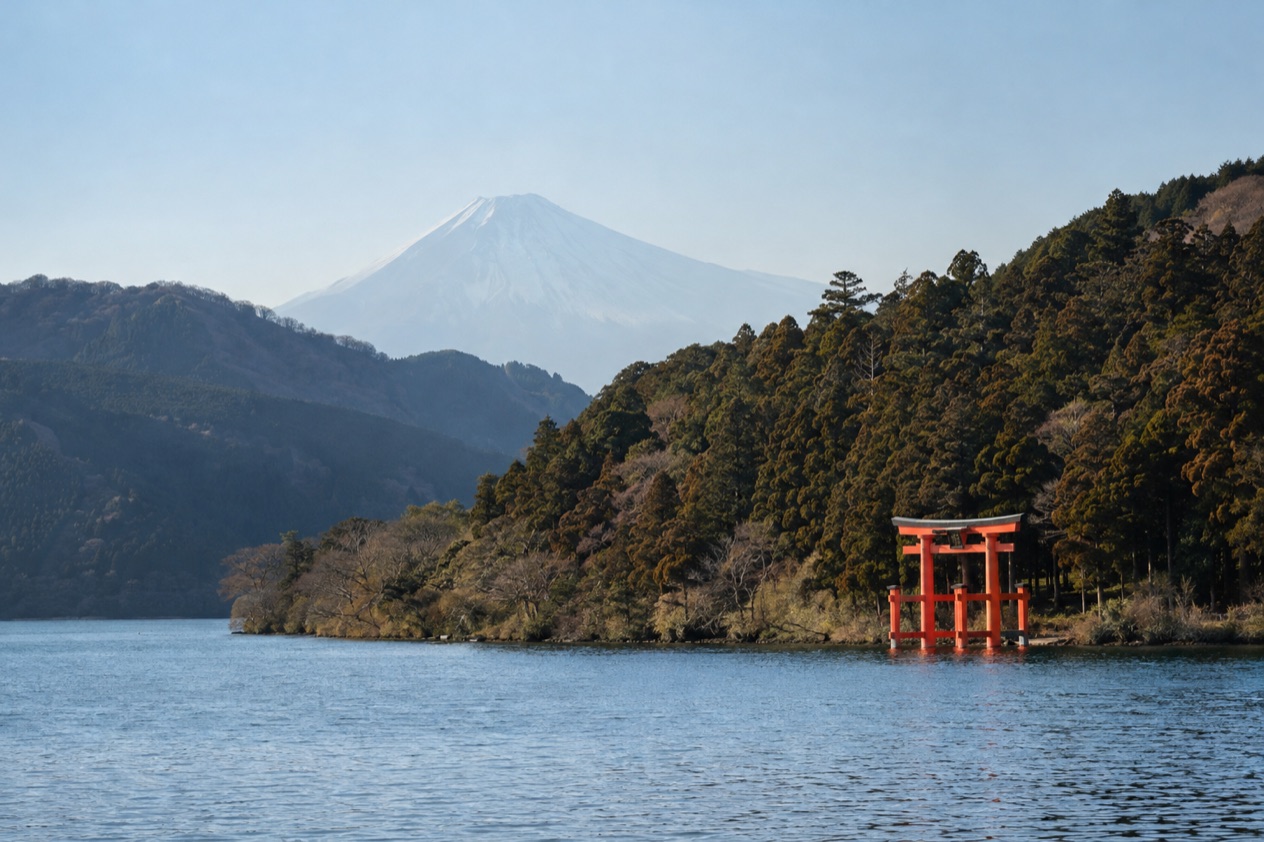
A small red train climbs through wet green hillsides, the steam of a volcanic valley drifts across the ropeway, and somewhere below, a hot spring is waiting at the end of the day. Hakone is a mountain spa town and national park area west of Tokyo, built around Lake Ashi and its views of Mount Fuji. It suits travelers who want to ride a few unusual vehicles, look at sculpture, eat a black egg and then soak.
What are the best things to do in Hakone?
The best things to do in Hakone are to bathe in a hot spring, cross Lake Ashi by boat, ride the ropeway over the sulphur vents and walk among sculptures outdoors, with a ryokan stay tying it all together.
- Soak in a natural hot spring, the reason Hakone became a spa town in the first place.
- Cross Lake Ashi on the Hakone Sightseeing Cruise for views of Mount Fuji.
- Ride the Hakone Ropeway from Sounzan to Togendai, passing over Owakudani.
- Taste the black eggs at Owakudani, said to prolong life.
- Walk the open-air installations of the Hakone Open-Air Museum, Japan’s first.
- Take the Hakone Tozan Line, the first mountain railway in Japan.
- Browse the restaurants and gift shops of Hakone-Yumoto.
- Spend a night in a traditional ryokan, with dinner served at the inn.
Hakone rewards a loop, and the transportation is part of the fun. Train, cable car, ropeway and boat each give a different angle on the same volcanic landscape, so the trip from valley to lake feels like a ride through several small worlds. The Hakone Freepass ties these rides together, and the details are given further down.
Art is the second thread. Sengokuhara is filled with art museums, and the open-air museum places sculpture against the hills. Nature is the third: Hakone sits inside the Fuji-Hakone-Izu National Park, a volcanically active landscape centered on the lake.
Visitors fold all of this into one or two days, which is why the area works as a break from Tokyo.
Sights and landmarks in Hakone
The landmarks of Hakone are mostly landscapes and the things built to cross them: a crater lake, a steaming valley, a mountain railway and a museum set among the hills. Each stands in its own part of the area, so a visit becomes a chain of short transfers between very different scenes.
Owakudani, the volcanic valley
Owakudani is a volcanic valley with active sulphur vents and hot springs. It was created around 3,000 years ago by the explosion of the Hakone volcano, and the ground still smells of sulphur and trails white steam. Bare, pale slopes replace the forest, and the contrast with the green hills around it is sharp.
This is where the black eggs come from. Boiled in the hot spring water, their shells turn dark, and they are said to prolong life. Eating one is the small ritual of the stop, and visitors come mainly for it.
The Hakone Ropeway passes through Owakudani on its route between Sounzan and Togendai, so the valley is usually seen from above first and then on foot.
Lake Ashi
Lake Ashi is a crater lake in the Hakone area, known for its views of Mount Fuji, its hot springs, its historic sites and its traditional ryokan. The Hakone Sightseeing Cruise carries visitors across it, and the boat is one of the eight transportation means covered by the Hakone Freepass.
A crossing is a good way to take stock of the national park, with forested shores and hills all around. Fuji may show itself or may stay behind cloud, as with any mountain view, so treat it as a bonus rather than a promise. The ropeway terminal at Togendai sits on the lake, which makes the boat a natural link in a loop.
Hakone Open-Air Museum
The Hakone Open-Air Museum opened in 1969 and is Japan’s first open-air museum. Its sculptures stand outdoors among the hills, so the art changes with the light and the weather as you walk from piece to piece. It is part of Sengokuhara’s reputation as an area filled with art museums.
It suits a slow stop in the middle of a day of transit. The Hako Ticket Plus pass grants unlimited use of applicable art museums, hot springs and activity facilities, which is where a museum visit and a bath can share one ticket.
Hakone-Yumoto and the Tozan Line
Hakone-Yumoto is known for its many restaurants and gift shops, and it is where the Odakyu train from Tokyo arrives. From here the Hakone Tozan Line, run by Odakyu Hakone and the first mountain railway in Japan, starts climbing into the hills.
Spend a little time here before heading up. Browse the shops for local souvenirs, then choose a place for lunch. The town works as the gateway, and a stroll along its streets is a gentle introduction to the area’s spa-town character.
Outdoor things to do in Hakone
Most of Hakone lies inside the Fuji-Hakone-Izu National Park, so the outdoors here means volcanic slopes, a crater lake and mountain viewpoints reached by lift. The area is easiest to enjoy by moving between them on the cable car, ropeway and boat.
Riding the Hakone Ropeway
The Hakone Ropeway is an aerial lift linking Sounzan and Togendai via Owakudani, operated by the Odakyu Group. Gondolas glide over forest, then over the steaming valley floor, and finally down toward the lake. The ride is the outdoor highlight of many days in Hakone, because it shows the whole volcanic setting in one sweep.
The ropeway is included in the Digital Hakone Freepass, along with the Tozan Cable Car, which brings you up to Sounzan. Together they make a natural ascent: train from the valley, cable car up the slope, then the ropeway across the ridge.
Mount Komagatake
Mt. Komagatake is reached by cable car, and it gives a mountaintop viewpoint above Lake Ashi. Hakone is known for its views of Mount Fuji, and a high point like this is where visitors look for them. The last cable car down leaves at 16:50, so plan the descent with that in mind.
Allow time at the top to look around the national park landscape, with the lake spread beneath you. It is a good choice if you want height and a wide view rather than a museum or a bath.
On and around the lake
Beyond the cruise, the lakeshore is where Hakone’s historic sites and traditional ryokan sit. The boat is the simplest way to see them from the water, and it shows the shape of the crater that holds the lake.
Hakone’s hot springs are scattered through the hills in view of Mount Fuji, so an outdoor bath can be part of the same day. Whether a bath is open to the sky depends on the inn or facility, so choose by what each one offers.
Day trips from Hakone
Hakone itself is the day trip people take from Tokyo, and from Hakone the other outings are mostly a matter of choosing a direction from the transit hub of Odawara or going back toward the capital.
Odawara
Odawara Station is where the JR Tokaido Shinkansen from Tokyo Station meets the Hakone Tozan Railway, and the combined trip to Hakone-Yumoto takes about 55 minutes in total. The Hako Ticket Plus with Odakyu Line ticket includes one return trip on the Odakyu Line between the departure station and Odawara Station.
Odawara is the town at the foot of the mountains, headquarters of Odakyu Hakone. Treat it as a stop on arrival or departure, a place to change trains and, if time allows, to look around before or after the hills.
Tokyo, a return the same day
From Shinjuku Station, the Odakyu Line reaches Hakone-Yumoto in about 1 hour and 30 minutes, and the Romancecar limited express also runs this route. That makes Hakone workable as an outing from Tokyo, though ryokan guests are advised to arrive at least one day after landing in Tokyo to avoid missing dinner or being locked out at curfew time.
Hakone is extremely popular among tourists for its proximity to Tokyo and its good views of Mount Fuji. Staying overnight lets you add a ryokan dinner and an evening bath, which a same-day trip skips.
What to eat in Hakone
The signature bite of Hakone is the black egg of Owakudani, boiled in the volcanic hot spring water until its shell turns dark, and said to prolong life. It is a small, salty-sweet snack, eaten on the spot with steam rising from the valley behind you.
Hakone-Yumoto is known for its many restaurants and gift shops, so it is the easiest place to sit down for a proper meal. Expect the kinds of dishes Japanese mountain towns are known for, such as noodles, rice bowls and set meals, and look for sweets and snacks to take away as souvenirs from the shops.
The great meal of Hakone is the one at a traditional ryokan. Dinner there is a multicourse spread served in your room or a dining hall, and it is timed, which is why guests are advised to arrive early rather than risk missing it. Breakfast follows the next morning in the same unhurried way.
A good rhythm is a light stop for eggs and a snack at Owakudani, a casual lunch in town, and the full ryokan dinner at night. That keeps the day varied and leaves room for the baths in between.
Things to do in Hakone at night
Evenings in Hakone revolve around the ryokan and the hot spring rather than bars or clubs. After the day’s rides, the pleasure is a long soak, a dinner at the inn and an early night in a room with tatami floors.
Ryokan keep a schedule, so dinner is served at a set time and the doors close at curfew. That is why staying overnight means planning to arrive in good time, and why the evening naturally becomes quiet and slow. Many guests change into a yukata, the light cotton robe provided by the inn, and wander in it between bath and meal.
Hot springs are the center of the night. Hakone is renowned for its natural hot springs within view of Mount Fuji, and a bath at the end of a long day of travel is the thing the area is built for.
If you want to go out, Hakone-Yumoto, with its many restaurants and shops, is the place to look for an evening meal before returning to your inn. Keep the last-lift times in mind: the last cable car from Mt. Komagatake leaves at 16:50, so mountain viewpoints belong to the day.
Things to do in Hakone with kids
Children in Hakone are likely to remember the vehicles first: a mountain train, a cable car, a ropeway over steaming vents and a boat across a lake. The area turns transportation into the attraction, and the Hakone Freepass makes it a continuous ride.
The Hakone Freepass departing from Shinjuku has a child price of 1,600 yen for 2 days and 1,850 yen for 3 days. Eight modes of transport are included, among them the Hakone Tozan Train, the Hakone Ropeway and the Hakone Sightseeing Cruise.
Owakudani adds a bit of drama, with its steam and the black eggs to taste. The Hakone Open-Air Museum, with sculptures outdoors among the hills, gives children room to walk between the pieces. The Hako Ticket Plus extends the pass to applicable art museums, hot springs and activity facilities.
On the way from Tokyo, the Romancecar limited express has a child surcharge of 600 yen one way from Shinjuku to Hakone-Yumoto. Keep the day to a few stops, since each change of vehicle takes time, and let the ride itself be part of the outing.
Good to know before you go
Getting around Hakone means using its own web of train, cable car, ropeway, boat and bus, and the Digital Hakone Freepass covers the Hakone Tozan Line, Tozan Bus in designated areas, the cable car, the ropeway, the cruise, Odakyu Highway Bus and Tokai Bus in designated areas and the Kanko Shisetsu-Meguri Bus. The pass is valid for 2 days or 3 days, and September is the wettest month, so a rainy day is worth planning for.
| Hakone Freepass from Shinjuku | Adult | Child |
|---|---|---|
| 2 days | 7,100 yen | 1,600 yen |
| 3 days | 7,500 yen | 1,850 yen |
| Romancecar one-way surcharge to Hakone-Yumoto | 1,200 yen | 600 yen |
Sources
- Japan National Tourism Organization, Hakone (https://www.japan.travel/en/destinations/kanto/kanagawa/hakone-and-around/), checked October 11, 2026
- Hakone Tourist Information (https://www.hakonenavi.jp/international/en/), checked October 11, 2026
- Wikipedia, Hakone, Kanagawa (https://en.wikipedia.org/wiki/Hakone,_Kanagawa), checked October 11, 2026
- Wikivoyage, Hakone (https://en.wikivoyage.org/wiki/Hakone), checked October 11, 2026
- Wikipedia, Hakone Open-Air Museum (https://en.wikipedia.org/wiki/Hakone_Open-Air_Museum), checked October 11, 2026
- Wikipedia, Hakone Ropeway (https://en.wikipedia.org/wiki/Hakone_Ropeway), checked October 11, 2026
- Wikipedia, Ōwakudani (https://en.wikipedia.org/wiki/%C5%8Cwakudani), checked October 11, 2026
- Wikipedia, Lake Ashi (https://en.wikipedia.org/wiki/Lake_Ashi), checked October 11, 2026
- Odakyu Electric Railway, Hakone Freepass (https://www.odakyu.jp/english/passes/hakone/), checked October 11, 2026
- Odakyu Electric Railway, Romancecar (https://www.odakyu.jp/english/romancecar/), checked October 11, 2026
- Wikipedia, Hakone Tozan Railway (https://en.wikipedia.org/wiki/Hakone_Tozan_Railway), checked October 11, 2026
To plan your stay
- Best Time to Visit Hakone: Autumn Leaves, Rainy Season, Weather by Month and Festivals
- Where to Stay in Hakone: Hakone-Yumoto, Lake Ashi, Sengokuhara and Ryokan Stays
- Hakone from Tokyo: Romancecar, Shinkansen, Local Trains and the Hakone Freepass
- Know Before You Go to Hakone: Getting There, the Freepass, Weather and Etiquette