
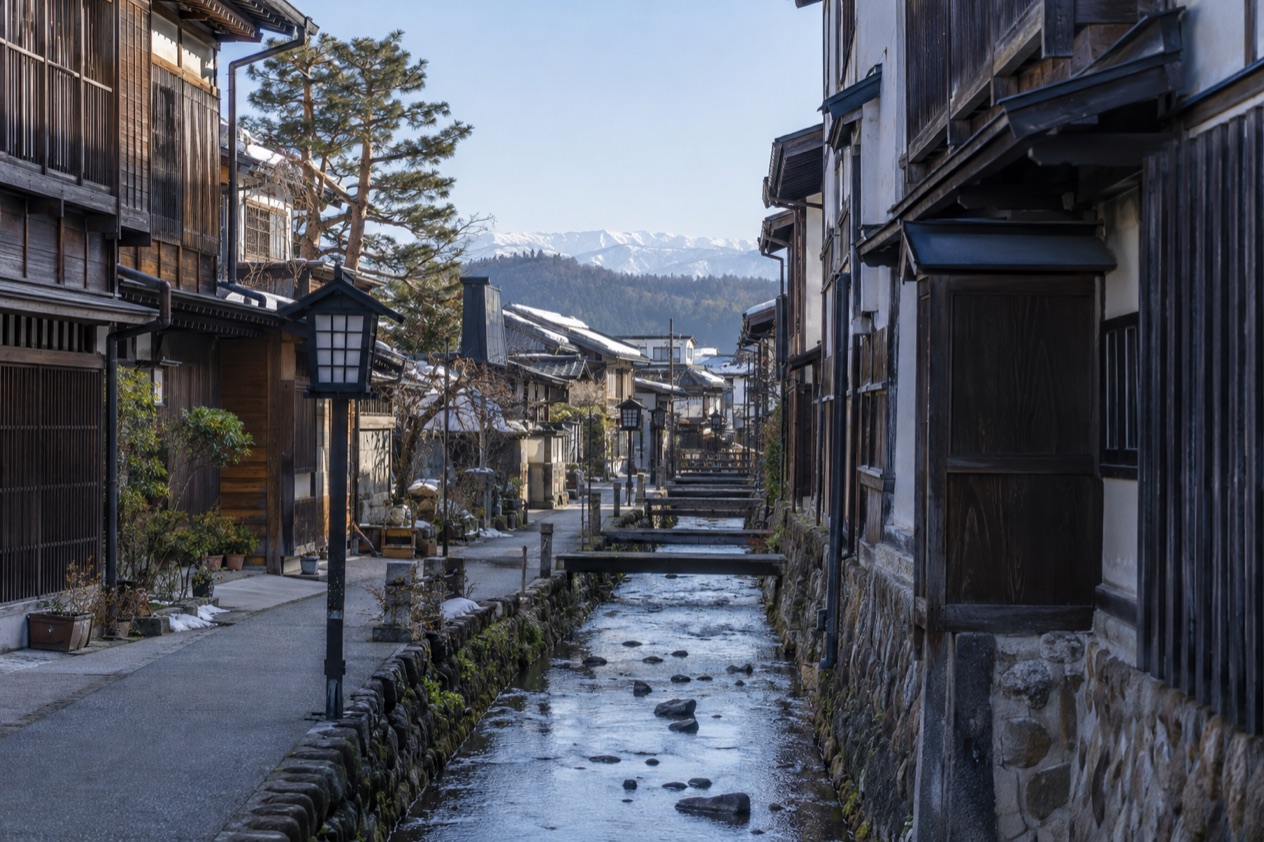
In the old merchant streets of Takayama, dark wooden lattice fronts line the lanes, cedar balls hang above brewery doors, and the smell of grilled beef and sweet soy drifts from small stalls. Locals call the town ‘Little Kyoto of Hida’ for its well-preserved Edo-style quarter, though it keeps a mountain character of its own among the northern Japan Alps. It is a town for slow walking, for eating well and for people who like their sightseeing built from streets, shrines and craft rather than big monuments.
What are the best things to do in Takayama?
The best things to do in Takayama are walking the old town, tasting the local food and sake, and seeing the festival culture that defines the city. Most of it happens on foot among wooden houses, small shrines and the river that cuts through the center.
- Walk the old merchant streets of Sanmachi Suji, where sake breweries, shops and wooden townhouses stand side by side.
- Visit Takayama Jinya, the old government outpost that shows how the Edo-period town was run.
- Browse the morning markets beside the river for pickles, produce, crafts and snacks.
- Eat Hida beef, in a skewer at a stall or grilled at the table.
- Learn the story of the festival floats and their mechanical puppets, the heart of the town’s identity.
- Follow the temples and shrines of the hillside walking course for quiet views over the roofs.
- Take a day out to a thatched farmhouse village or a hot spring valley in the surrounding Hida region.
- Come back after dark for lantern light, izakaya counters and a glass of local sake.
Takayama is the largest city by area in Japan, with a total of 2,177.61 square kilometers, but the part travelers know is the small old quarter where almost everything described here sits close together. The rest of the municipality reaches into forests, valleys and mountain villages, which is why the outings beyond the center feel like a different landscape entirely.
The seasons shape what you do. Spring brings cherry blossoms and a festival, summer opens the surrounding valleys, autumn brings a second festival and colder, clearer days, and winter brings heavy snow that turns the rooftops white. Every one of those moods suits the town’s wooden architecture, and none of them requires a long list of attractions to fill a day.
Sights and landmarks in Takayama
The sights of Takayama are mostly streets, houses and shrines rather than single monuments, and they reward looking closely. Carved eaves, latticed windows, sliding doors and the dark color of aged wood tell the story of a town that grew rich on timber, carpentry and trade in the mountains.
Sanmachi Suji, the old town
Sanmachi Suji is the old merchant quarter, a few lanes of preserved townhouses with deep eaves and latticed fronts. Several of them have been sake breweries for generations, and you can tell them by the round balls of cedar branches hung above the entrance, a traditional sign that the new brew is ready.
Many of the houses now hold shops selling lacquerware, wooden crafts, pickles, sweets and local sake, and a few open their interiors with their heavy beams and indoor gardens. Small channels run along the lanes, with carp swimming in them, and the whole district reads best at a slow pace, stopping to peek into doorways and tasting samples where they are offered.
This is the quarter behind the ‘Little Kyoto of Hida’ nickname. It suits anyone who likes architecture, craft shopping and snacking as they go, and it works in drizzle or snow, when the dark wood looks richer than in bright light.
Takayama Jinya
Takayama Jinya is a former government office from the Edo period, where officials once administered the Hida region. Walking through its long wooden rooms, with tatami floors, formal reception halls and old storehouses, gives a clear picture of how authority and daily paperwork worked in a samurai-era mountain town.
Visitors move through in socks, as in any traditional building, and the pleasure lies in the details: the sliding screens, the wide corridors, the kitchen, the garden views from the rooms. It is an interesting contrast with the merchant streets nearby, because it shows the other side of the old town’s story, the one about rule rather than trade.
Festival floats, Hie Shrine and the rhythm of the year
The Takayama Festival is the town’s great event, held twice a year. The spring edition is centered on Hie Shrine, also known as Sanno Shrine, and is held to pray for a good harvest, while the autumn edition brings its own processions. Elaborate floats called yatai, with carved and lacquered details, are pulled through the streets, and some carry mechanical puppets that perform for the crowd.
Even when no festival is on, the floats are part of the town’s character, and the shrines connected with the celebrations are worth a visit for their quiet grounds and wooden halls. If you happen to be in Takayama on festival days, expect the old streets to take on a completely different energy, with music, costumes and lanterns.
| Festival | Dates |
|---|---|
| Spring Takayama Festival | April 14 and 15 |
| Autumn Takayama Festival | October 9 and 10 |
A museum stop
The Hikaru Museum gives the town an indoor option for a gray or snowy hour, and it fits easily between a morning on the streets and an afternoon at the shrines. Its season is limited, so it is worth planning around the dates below, and it is closed on Wednesdays.
| Site | Open |
|---|---|
| Hikaru Museum | Late February to mid-December, Thursday through Tuesday, 10:00 to 17:00 (last admission 16:00) |
Outdoor things to do in Takayama
Outdoors in Takayama means river walks, market stalls, hillside paths and seasonal scenes, from pale cherry blossoms in spring to deep snow in winter.
The morning markets
Takayama’s morning markets are open-air affairs with stalls selling vegetables, fruit, pickles, flowers, handmade crafts and snacks. One is laid out beside the river, another is in front of the old government office, and strolling between them is a pleasant way to see local life while sampling things as you go.
Look for mountain vegetables, preserved pickles in many colors, rice crackers, sweet dumplings and skewers, plus wooden toys and small crafts. Vendors often chat with visitors, and a few small purchases can add up to a snack-style breakfast that doubles as a first taste of Hida cooking.
Along the Miyagawa river
The Miyagawa river runs through the heart of town, and its banks make a natural walking route, with red bridges, willow trees and the backs of old wooden buildings facing the water. Seasonal color changes the scene entirely: pale blossoms in spring, fresh green in summer, red and gold leaves in autumn and white banks in winter.
A riverside stroll links the market stalls, the old town and the cafés with very little planning. It is also a good place to stop and watch daily life, from cyclists crossing the bridges to shopkeepers sweeping their steps.
Hillside temples, shrines and blossom
Above the old town, a hillside route links temples, shrines and quiet lanes with glimpses of the rooftops and the mountains behind. Along it you pass wooden gates, stone lanterns, mossy steps and small graveyards, a calmer side of Takayama than the shop-lined streets below.
In spring, cherry blossoms appear here from the middle to the end of April, about three weeks later than in Nagoya, so the flowers coincide with the Spring Takayama Festival. In winter, the same paths are covered in snow, since the city receives heavy snowfall, with an annual average of 201 inches. Shoes with a good grip are a sensible choice on cold days.
Day trips from Takayama
The Hida region around Takayama is full of villages, valleys and hot spring towns, which makes it a good base for outings of a day. The destinations below are some of the places travelers commonly combine with a stay in the town, each with a different character.
Shirakawa-go and its farmhouse village
Shirakawa-go is a mountain village known for its gassho-zukuri farmhouses, large homes with steeply pitched thatched roofs that shed heavy snow. The shape of the roofs, said to resemble hands pressed together in prayer, is the source of the name, and the houses cluster among rice fields and mountain slopes.
A visit usually involves walking among the houses, looking inside one or two that are open to visitors, and perhaps climbing to a viewpoint for a wide look over the village. The scene changes dramatically with the season: green fields in summer, golden leaves in autumn and a deep blanket of snow in winter. It suits travelers who enjoy rural architecture and photography, and a good camera or phone helps.
Hida-Furukawa, a smaller old town
Hida-Furukawa is a small town with white-walled storehouses, a canal full of carp and wooden merchant houses, a more modest sibling of Takayama’s old quarter. The atmosphere is local, with traditional candle shops, sake makers and carpenters whose craft has long been tied to Hida’s reputation for fine woodworking.
It is a good fit for people who have enjoyed Takayama’s old streets and want a similar scene at a smaller scale.
Okuhida hot spring villages
Okuhida is the name given to a group of hot spring villages in the high valleys of the Hida mountains. Bathing outdoors in an onsen with mountain views is the main attraction, and many inns offer open-air baths where the air is cold and the water warm, a contrast that is especially memorable when snow is falling.
Onsen etiquette follows familiar habits: washing before entering the bath, leaving towels out of the water and bathing without swimwear. Each inn sets its own rules, so it is best to follow the signs posted at the entrance. The villages suit travelers who want a restful change from sightseeing, with a meal of mountain vegetables and regional dishes alongside.
Other outings in the region
- Gero, a hot spring town known for its bathing tradition, for travelers who prefer an onsen day without a long stay.
- Kamikochi, a mountain valley loved by hikers and nature lovers, for those who want river and alpine scenery.
- Kanazawa and Matsumoto, cities with their own castle, garden or museum highlights, for travelers extending their route beyond the Hida region.
What to eat in Takayama
Eating in Takayama revolves around Hida beef, mountain vegetables, miso, pickles and sake, the foods of a mountain region with long winters. The cooking is hearty and seasonal, built on ingredients that keep well and flavors that warm you up.
Hida beef
It appears in many forms: grilled over charcoal at a yakiniku table, simmered in a hot pot, laid over rice in a bowl, or served as a skewer from a street stall in the old town.
A skewer or a small sushi-style piece of seared beef is a good introduction, while a sit-down meal lets you taste the cuts properly. Pair it with a glass of local sake, whose clean, slightly dry style is often chosen to match the richness of the meat.
Hoba miso and mountain home cooking
Hoba miso is a traditional dish in which miso paste, mushrooms, leeks and sometimes beef are grilled on a dried magnolia leaf over a small burner. The leaf lends a gentle fragrance, and the savory, sweet aroma fills the room as it cooks. Eaten with rice, it is a classic of the Hida kitchen.
Around it you will find pickled vegetables, mountain greens, tofu, river fish and simmered dishes, often served together in a set meal. Ryokan dinners in the region tend to feature this style of cooking, with small dishes arranged by season.
Takayama ramen, snacks and sweets
Takayama ramen is a local style with thin, curly noodles in a light soy-based broth, a clear bowl that suits a cold day. Small shops across town serve it, and a bowl makes a satisfying quick meal between visits.
On the street, look for mitarashi dango, grilled rice dumplings glazed with sweet soy sauce, along with rice crackers, beef croquettes and sweet buns. Several sake breweries in the old town offer tastings, and sampling a few small cups is a pleasant way to compare styles. Cafés also serve coffee, matcha and seasonal sweets, handy for resting between walks.
Things to do in Takayama at night
Evenings in Takayama are about dinner, a drink and a stroll among lit wooden facades, not clubs or late-night crowds. The old town takes on a warm, amber look after dark, and the river reflects the lamps along the banks.
Izakaya and dinner
An izakaya, a casual Japanese pub, is the natural place for an evening meal. Counters and low tables fill with small plates of grilled skewers, pickles, tofu, Hida beef and seasonal vegetables, ordered one after another along with beer, sake or shochu.
Smaller places seat only a handful of people at the counter, and the cook often works right in front of you, which makes for a lively and personal meal. A ryokan dinner is another option, served in your room or a dining room as a series of courses built from local ingredients.
Sake and a quiet walk
After dinner, a sake bar is a good way to try regional brews by the glass, often with a small plate of snacks. Staff will usually explain differences between dry and sweet styles, and a tasting flight lets you compare several cups.
Walking along the river or through the old lanes after dark shows a different side of town, with lantern light on the wood and reflections in the water. In winter, snow falling past a lit doorway is one of the most atmospheric scenes in the region.
Festival evenings and onsen
If you are in town for the festival days, the evening procession has its own character, with floats decorated with lanterns moving through the streets to music.
Another way to spend an evening is a hot bath. Many inns in and around the town have baths for guests, and a soak after a day of walking, with cold air outside, is a pleasure of its own, with the same etiquette as at any onsen.
Things to do in Takayama with kids
Children in Takayama tend to enjoy things they can see, taste and touch: floats with moving puppets, street snacks, carp in the canals, and snow in winter. The town rewards curiosity more than a packed schedule.
Snacks, markets and crafts
The morning markets and the old town lanes are full of small things to look at and taste: dumplings on skewers, rice crackers, sweet buns and colorful pickles. Craft shops sell wooden toys and small souvenirs, and some places let you try making something yourself.
Watching sake brewers hang their cedar balls or seeing carp in the little channels can hold a child’s attention for a while. Letting children pick one snack at each stop turns a walk into a kind of tasting game.
Floats, puppets and stories
The festival floats and their mechanical puppets are the most child-friendly story in town, because the puppets move and perform. Explaining the festival beforehand, with its parades in spring and autumn, gives children something to look for, and the carved details make good material for a small treasure hunt.
Takayama Jinya adds a window into samurai-era life with its long wooden rooms, though shoes come off at the entrance, as in any traditional building. A storytelling approach, imagining who worked in each room, helps younger visitors enjoy it.
Snow, farmhouses and what to keep in mind
Winter brings heavy snow, so children may love the white streets and rooftops, along with the thatched farmhouses of the region. Warm layers, hats, gloves and shoes with good grip make outdoor time more comfortable on cold days.
The old town is best explored in short stretches with breaks for food or a warm drink, since the lanes involve walking and many shops are full of fragile goods. Onsen visits follow the same etiquette for everyone, so it helps to talk it through with children before going.
Good to know before you go
Takayama is in Gifu Prefecture, in the Chubu region, and many of its attractions sit close together in the old town. One detail for getting around: Takayama Station on the JR Takayama Line does not accept IC cards, so local line tickets must be bought in cash. Winters bring heavy snow, and the festival days in April and October shape the town’s calendar, so keep them in mind when choosing your dates.
Sources
- Wikipedia, Takayama, Gifu (https://en.wikipedia.org/wiki/Takayama,_Gifu), checked October 11, 2026
- Wikivoyage, Takayama (https://en.wikivoyage.org/wiki/Takayama), checked October 11, 2026
- Japan National Tourism Organization, festivals and events (https://www.japan.travel/en/see-and-do/festivals-and-events/), checked October 11, 2026
- Wikipedia, Takayama Festival (https://en.wikipedia.org/wiki/Takayama_Festival), checked October 11, 2026
To plan your stay
- Best Time to Visit Takayama: Cherry Blossoms, Autumn Color, Snow and Festivals
- Where to Stay in Takayama: Station Area, Old Town Streets, Morning Market and Ryokan
- Takayama from Nagoya: The Hida Limited Express, Ways to Go and a Day in the Old Town
- Takayama in January: Snow, Weather, Old Town Food and a Two-Day Plan