
A bowl lands on the counter with a little cloud of steam, and for a minute nobody around you speaks. There is only the sound of noodles being pulled up and slurped, which in a ramen shop is a compliment to the cook. Ramen turns up all over Japan, from station-side counters to festival stalls to specialist shops, and each region has its own idea of what the bowl should be.
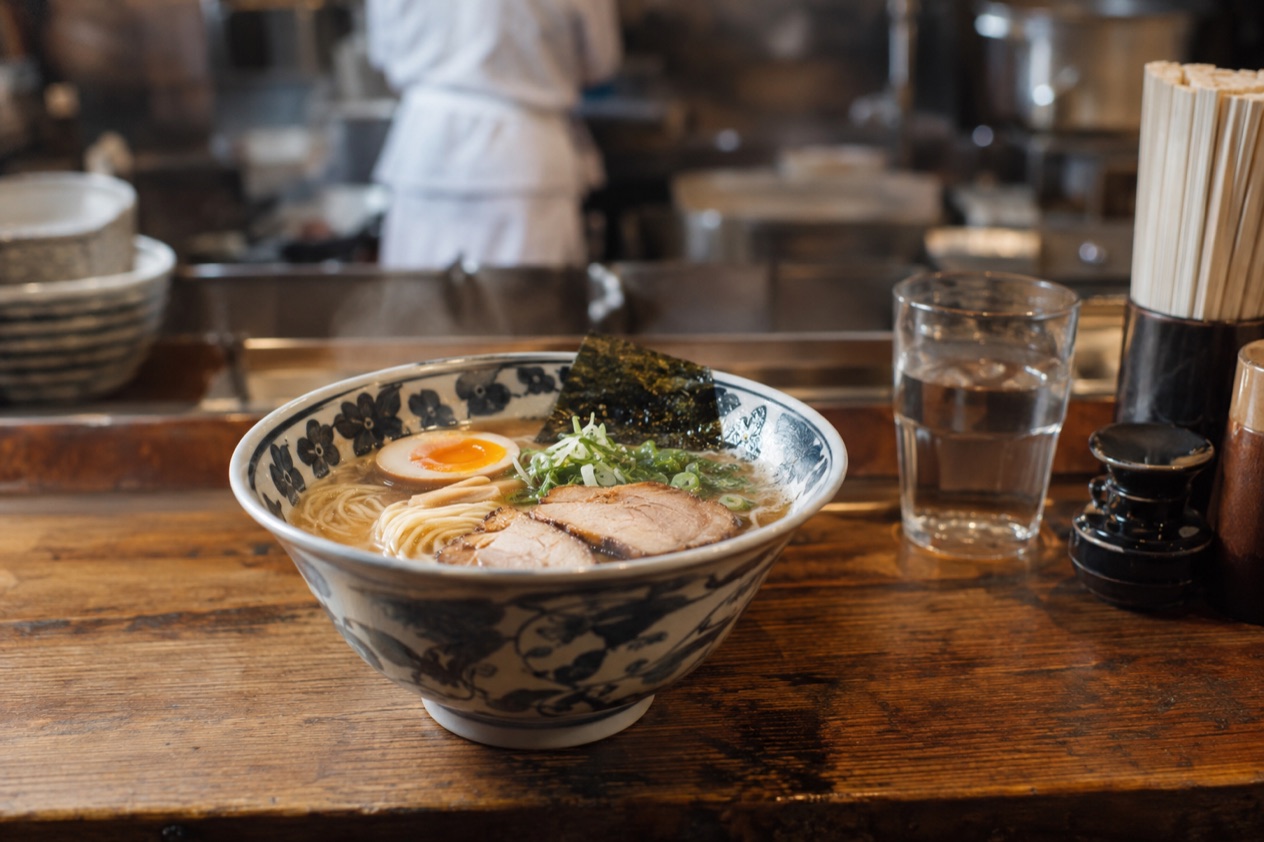
What is ramen?
Ramen is a Japanese-Chinese fusion dish: Chinese-style alkaline wheat noodles served in hot broth. The noodles have a springy, slightly yellow look that sets them apart from soba or udon, and the broth, the seasoning and the toppings decide everything else. It began in Yokohama Chinatown in the late 19th century and has since become one of the dishes most closely tied to everyday eating in Japan.
A bowl is built in layers. At the bottom sits the broth, built from pork bones, chicken, dried fish or a mix, and flavored with soy sauce, salt or miso. The noodles go in next, then the toppings: slices of pork, a soft egg, scallions, sheets of nori, bamboo shoots. What you taste first is the broth, rich and savory, and what you feel is the heat of the bowl on your face.
The ramen shop
The best quality ramen is usually found in specialist ramen shops called rāmen’ya. They tend to be small and focused, often with a counter where you watch the cook lift noodles out of the pot, shake off the water and ladle in the broth. The menu may be a handful of items, because the whole kitchen is devoted to one dish.
A ramen shop suits a solo traveler especially well. You sit at the counter, eat while the bowl is hot, and leave when you are done. It is a meal that fits between sights, and also a good late-evening stop when you want something warm and filling.
Ramen beyond the shop
Ramen sits in a wider world of inexpensive Japanese street food and casual eating, alongside takoyaki, gyoza, okonomiyaki, yakitori, tonkatsu and udon. Outdoor stands called yatai, common at festivals, mostly sell takeaway foods such as takoyaki, okonomiyaki and yakisoba. In Hakata, in Kyushu, the famous yatai have makeshift counters where you can enjoy a drink with your food, and some specialize in ramen.
Convenience stores, open 24 hours a day in most cases, sell hot food such as kara-age, onigiri and bento. They do not replace a proper bowl, but they show how ordinary and constant good food is in Japan.
Markets such as Nishiki Market and Kuromon Market are better for fresh and grilled seafood, a different pleasure from noodles. At some markets you may be asked not to eat or drink while walking, so you stand by the stall to finish.
The Ramen Museum in Yokohama
The Shin-Yokohama Ramen Museum is a museum about ramen, in the Shin-Yokohama district of Kohoku-ku, Yokohama. It fits the story well, since Yokohama is where ramen is said to have begun. For anyone who likes to understand a dish before eating it, it is a natural stop on a trip that includes the city.
Which regional styles are there?
Traveling through the country becomes a tasting tour: the same dish changes with the noodle, the broth and the climate of the place where it is served.
Hokkaido: miso and salt
Sapporo, the capital of Hokkaido, is especially famous for its rich miso ramen, which was invented there and is ideal for Hokkaido’s snowy winters. The broth is hearty and full-bodied, the kind of bowl that makes sense when you come in from the cold with snow on your coat.
Hakodate, another city of Hokkaido, is famous for its salt-flavored ramen. Salt gives a lighter, clearer bowl, a contrast to the weight of Sapporo’s miso. If you are crossing Hokkaido, trying both is an easy way to taste how much the seasoning alone changes a bowl.
Kitakata, Tokyo and Yokohama
Kitakata ramen is known for its rather thick, flat, curly noodles served in a pork-and-niboshi broth, niboshi being small dried fish that add a savory depth. The noodles are the star here, and they catch the broth as you lift them.
Tokyo-style ramen consists of slightly thin, curly noodles served in a soy-flavored chicken broth. It is a bowl of clear, savory flavors. Yokohama’s specialty is called Ie-kei, with thick, straight noodles in a soy-flavored pork broth similar to tonkotsu, so the city that gave ramen its start has a style of its own, hearty and bold.
Hakata and Kyushu: tonkotsu
Hakata ramen originates from the Hakata district of Fukuoka city in Kyushu. It has a rich, milky, pork-bone tonkotsu broth and rather thin, non-curly, resilient noodles. The broth is cloudy and creamy, and the thin noodles cook quickly and keep a firm bite.
Hakata is also where the yatai tradition shines, with stalls where you can eat ramen at a makeshift counter with a drink beside it. Most tonkotsu ramen restaurants offer a system known as kae-dama: once you have finished your noodles, you can request a refill for a few hundred yen more. It is made for thin noodles, which are finished fast, and for the last of that milky broth.
How do you order?
Ordering depends on the kind of place: some have you buy a meal ticket from a vending machine, some use touch screens, and some simply take your order at the counter. Watching what other diners do is the simplest guide, and the system is usually clear the moment you step inside.
Ticket machines and touch screens
At soba or udon noodle shops in or around train stations, you may need to first buy a meal ticket from a vending machine. The same habit is common in many noodle counters, where you choose the dish on the machine and hand the ticket over. Machines often show pictures, so pointing at the bowl you want gets you far.
Many izakaya now have touch-screen ordering systems, making it easier to order from illustrated menus. In an izakaya, a casual pub-style place, you can pair a drink with small plates, and a bowl of noodles often closes the evening. The screens remove the need to call a server and make choosing a quiet, unhurried business.
At the counter
In a ramen specialist’s shop, you choose the style of broth and the toppings, then wait for the bowl while the cook works in front of you. If the shop serves tonkotsu, remember the kae-dama refill: finish the noodles, ask for more, and the cook drops a fresh portion into the remaining broth.
Eat the bowl while it is hot, lift the noodles with your chopsticks and slurp. Slurping cools the noodles as they go in and brings the aroma up with each mouthful, which is why it is part of the meal rather than bad manners. Take your time with the broth, since it is the heart of the bowl.
Eating on the street
At festival yatai and in market lanes, the food is meant to be eaten on the spot. Takoyaki, which originated in Osaka and is found in almost all shopping arcades and festivals throughout the country, comes hot and is a good snack to share between bowls of ramen.
At some markets you may be required to not eat and drink while walking, and visitors must follow local rules. Standing beside the stall, finishing your food, and then moving on is the habit to keep. When in doubt, look at what the people around you are doing.
Good to know before you go
Yen amounts for a bowl differ from shop to shop, and a kae-dama refill adds a few hundred yen more at most tonkotsu restaurants. Konbini, open 24 hours a day in most cases, are a handy fallback for hot food when a ramen shop is closed. Plan ramen stops across regions as you travel, so Sapporo’s miso, Hakata’s tonkotsu and Yokohama’s Ie-kei each get their turn.
Sources
- Japan National Tourism Organization, street food and budget restaurants (https://www.japan.travel/en/gastronomy/local-street-food-favorites-budget-restaurant-japan/), checked October 11, 2026
- Wikipedia, Ramen (https://en.wikipedia.org/wiki/Ramen), checked October 11, 2026
To plan your stay
- Best Time to Visit Japan: Cherry Blossoms, Autumn Colors, Weather and Festivals
- Where to Stay in Japan: Ryokan, Temple Stays, Capsule Hotels and the Best Cities to Base In
- Sending Luggage from the Airport in Japan: Hands-Free Travel, Hotel Delivery and Coin Lockers
- Know Before You Go to Japan: Entry, Money, Etiquette and Getting Around