
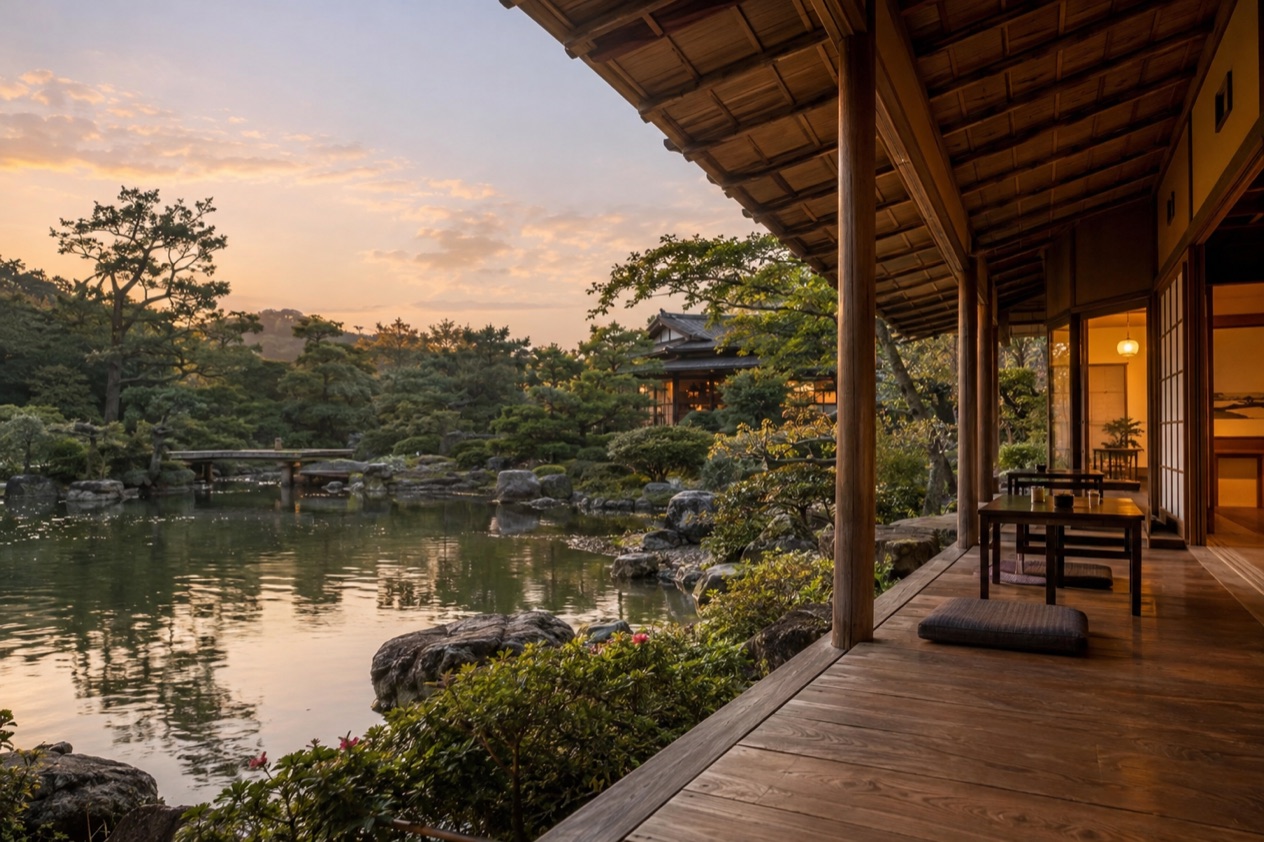
At a ryokan, the evening begins with slippers left at the door, a cotton yukata to change into and a low table where the first small dishes of dinner arrive one after another. Later the futon is laid out on the tatami while you are in the bath. Japan gives newlyweds a rhythm that is easy to share: wandering through a temple garden, eating something unfamiliar, soaking in hot water, and falling asleep in a room that looks like nothing at home.
Is Japan good for a honeymoon?
Yes, because a honeymoon here can change scale from one day to the next. You can spend a morning in a station the size of a small town and the evening in a wooden inn beside a river, and the whole country is an island nation in East Asia with a lot of variety to choose from. Couples who like to share discoveries tend to enjoy it, since almost every meal, street and shrine offers something to point out to each other.
The country is divided into 47 prefectures, each with its own local dishes, crafts and festivals, which means a second trip never repeats the first. For a honeymoon, that matters less than the sense of choice. You can build a week around temples and tea houses, around hot springs and mountain air, or around the long tables of Tokyo, and none of these plans asks you to give up the others for good.
A night in a ryokan
A ryokan is the traditional Japanese inn, and it is the part of the trip that couples remember longest. Shoes come off at the entrance, the rooms are floored with tatami mats, and the bed is a futon that staff lay out after dinner. Many ryokan are built around a hot spring bath, an onsen, where soaking at the end of the day is part of the evening rather than an extra.
Dinner is often kaiseki, a sequence of small seasonal dishes served in a set order, each on its own plate of lacquer or ceramic. It slows the evening down. You taste, you compare, you talk about what the last dish was made of. Breakfast the next morning tends to be just as ceremonial, with grilled fish, rice, miso soup and pickles set out on a tray.
Eating together
Food in Japan is easy to turn into a shared project. Counter seats at a sushi bar put you in front of the chef, an izakaya (a casual pub serving small plates) lets you order a little of everything, and ramen shops reward a late-night walk. Department store food halls and covered markets offer sweets, pickles and bento boxes you can carry to a park bench.
Drinks have their own ritual. Sake comes in small cups and is poured for the other person before yourself, a gesture couples quickly pick up. Matcha and wagashi, the delicate sweets served with it, make a calm break between temples in Kyoto or Kanazawa.
Days that mix cities and gardens
A good honeymoon day in Japan often pairs one busy thing with one slow thing. Walk beneath the vermilion torii gates of Fushimi Inari in the morning, then spend the afternoon in a garden or a teahouse. In Tokyo, the grounds of Meiji Jingu offer a shaded approach to a Shinto shrine, and the neighborhoods around it change character block by block, from fashion streets to narrow lanes of tiny bars.
Evenings are made for strolling. Lanterns glow outside izakaya, shrines are lit in places, and the trains carry you home without any need to plan a drive. The time zone is Japan Standard Time, UTC+09:00, so you will wake early for the first days, and that suits sunrise walks and breakfasts before the day begins.
Which places suit honeymooners?
Kyoto, Hakone, Kanazawa, Nara, Tokyo and Okinawa are the places that fit a honeymoon best, each for a different mood. Kyoto gives you temples and lantern-lit lanes, Hakone gives you hot springs, Kanazawa gives you gardens and craft, and Okinawa gives you the sea. The right choice depends on whether you want to wander, soak or simply rest.
Kyoto
Kyoto is the city for slow days of temples and gardens. Kiyomizu-dera and Kinkaku-ji, the Golden Pavilion, are the names most couples have on their list, and Fushimi Inari adds a walk through hundreds of torii gates. The old teahouse quarters, with their wooden facades, are where geisha and maiko appear in the evening on their way to appointments.
Between sights, the city rewards unplanned time. Sit in a tea room with a bowl of matcha, browse small shops of paper, ceramics and incense, and look for a kaiseki dinner or a stay in a machiya, a traditional wooden townhouse turned into a guesthouse. Kyoto suits couples who love architecture, gardens and the feeling of walking through a place that preserves its past.
Hakone
Hakone is a mountain hot spring area, and it is the clearest answer to the question of where to put a ryokan night. Inns here are organized around onsen water, and the days are about moving gently between a bath, a meal, a museum or a lakeside walk. On a clear day, Mount Fuji can appear on the horizon, which adds a moment worth keeping the camera ready for.
The area suits couples who want to rest after a stretch of city sightseeing. A night or two is enough to feel the shift in pace. Dinners are served in the room or in a dining hall, the evenings are for soaking, and mornings are for a second bath before breakfast. Hakone is a place to do less on purpose.
Kanazawa and Nara
Kanazawa is known for Kenrokuen, one of the garden landscapes the country is proudest of, and for a district of old teahouses and craft studios. Gold leaf is a local specialty, and you will see it on sweets, cosmetics and even soft-serve ice cream. It is a city for couples who enjoy looking closely at made things.
Nara offers Todai-ji, with its great Buddha hall, and a park where deer wander between temples and lawns. Nara and Kyoto sit comfortably in the same trip for couples who want old-capital atmosphere without repeating themselves.
Tokyo
Tokyo is where honeymoons get their energy. Senso-ji, with its lantern gate and market street, sits near neighborhoods of craft shops and old-fashioned cafés, while other districts offer glass towers, department stores, record shops and endless restaurants. The city gives you a different evening every night, from a tiny bar seating a handful of people to a rooftop view over the lights.
Couples who love food will find it hard to run out of options. Sushi counters, tempura kitchens, yakitori alleys and coffee shops with careful menus are all part of the ordinary rhythm of the city. A few nights in Tokyo balance well against the quieter stays in the mountains or in Kyoto.
Okinawa
Okinawa is the island getaway, with its own cuisine, music and Ryukyu traditions that differ from the mainland. Island food includes goya champuru, a stir-fry of bitter melon, and Okinawa soba, served in a clear pork broth. The pace is slower, and the beaches and coast give the trip a resort side that the temple cities do not.
It suits couples who want to finish a trip beside the water after days of sightseeing. Before you plan on the sea itself, remember that conditions vary and that local advice at each beach is worth following.
What kinds of trip do couples take?
Couples usually take one of a few shapes of trip: the classic city circuit, the slow onsen escape, the food-led journey, or a mix of city and island. The shape you pick says more about your honeymoon than any single place does. Most itineraries are variations on these, adjusted to how much each of you wants to move around.
The classic city circuit
The most familiar route links Tokyo, Kyoto and often Osaka, with a stop at Nara or Hakone between them. The Shinkansen, the world’s first high-speed rail line, ties the big cities together, and riding it is part of the experience for travelers. Train stations in Japan are also places to eat, with bento boxes and regional snacks sold on the platforms.
You get temples, neon streets, department stores, markets and gardens. It gives a wide first look at the country, and it leaves the quieter regions for another time.
The slow onsen trip
A second kind of honeymoon trades sightseeing for rest. Ryokan nights become the center of the journey, and each stay has its own dinner, its own garden view and its own morning ritual.
It suits couples who have already had a busy year and want the honeymoon to be a pause. Between baths there is time for reading, walking through town in a yukata, or simply sitting on the veranda with tea. The cost of this plan is seeing fewer places, and for many couples that is exactly the point.
The food-led journey
Some couples plan the whole honeymoon around what they want to eat. Osaka is known for street food such as takoyaki and okonomiyaki, Kyoto for kaiseki and tofu, Tokyo for sushi and everything else, and Fukuoka for ramen stalls. Markets, food halls and tiny counters become the main sights, with a temple or garden between meals.
This style asks for curiosity more than planning. You walk, you point, you sit down, and you try what the person beside you is having. It fits couples who enjoy conversation over a table and are happy to let a day be organized around lunch and dinner.
City plus island or mountains
That might be Okinawa for beaches, Hokkaido for wide landscapes and Sapporo’s food, or a resort area such as Niseko in the mountains. Flying or taking a train between the two halves of the trip is part of the plan.
This works for couples who want both stimulation and rest, and who prefer the honeymoon to have an arc, beginning with energy and ending with calm. It does ask you to accept a longer trip or a tighter schedule, so decide early which half matters more to you.
Good to know before you go
Electricity in Japan runs at 100 volts, so check that the chargers and devices you bring suit it. The country keeps Japan Standard Time, and the emergency numbers are 110 for police and 119 for fire. Keep both in your phone along with the number of your accommodation. The rainy and typhoon seasons vary by region, so keep a little flexibility in the days you plan outdoors, especially on islands and coasts.
Sources
- Wikivoyage, Japan (https://en.wikivoyage.org/wiki/Japan), checked October 11, 2026
To plan your stay
- Best Time to Visit Japan: Cherry Blossoms, Autumn Colors, Weather and Festivals
- Where to Stay in Japan: Ryokan, Temple Stays, Capsule Hotels and the Best Cities to Base In
- Sending Luggage from the Airport in Japan: Hands-Free Travel, Hotel Delivery and Coin Lockers
- Know Before You Go to Japan: Entry, Money, Etiquette and Getting Around