
A cook leans over a griddle of round molds, flicking batter-filled balls with two thin picks until they turn golden, then drizzles them with sauce and a scatter of bonito flakes that seem to wave in the steam. Around the stall, paper boats of takoyaki change hands and toothpicks do the work. This is street food in Japan: a festival lane, a shopping arcade, a market alley, a late-night counter under a string of lanterns.
What street food can you eat in Japan?
You can eat a wide run of inexpensive dishes and sweets: ramen, takoyaki, taiyaki, okonomiyaki, yakitori, tonkatsu, croquettes, gyoza and udon, plus grilled seafood at the markets. Some come off a stall griddle and are eaten on the spot, others are served at tiny counters where you sit for a bowl. The mix changes with the city, because each region has its own specialties and its own way of cooking them.
Much of the appeal comes from watching stall cooks pour batter, turn skewers and serve each order hot. You watch batter poured, skewers turned over charcoal, noodles lifted from broth, and the cook hands it over still hot. It suits anyone who likes to graze, who would rather taste five small things than sit down to one big meal, and who does not mind eating a little improvised.
Takoyaki, okonomiyaki and yakisoba
Takoyaki began in Osaka and is now a beloved street food found in almost all shopping arcades and festivals across the country. The balls are soft in the middle, with a piece of octopus inside, and they arrive glazed with sauce, mayonnaise and a dusting of seaweed and bonito. They come out of the molds very hot, so people blow on them and take small bites.
Okonomiyaki, a savory pancake loaded with cabbage and cooked on a flat iron plate, and yakisoba, stir-fried noodles in a dark sauce, sit in the same family of festival stall food. Together with takoyaki they are the dishes you smell first when you walk toward a matsuri (a local festival). They are sold as freshly prepared takeaway, which makes them easy to eat standing near the stall with a drink in the other hand.
Skewers, croquettes and gyoza
Yakitori, chicken grilled on skewers over charcoal, is the street dish you smell from a block away: fat drips, smoke rises, and the cook brushes each skewer with a glaze or sprinkles it with salt. Croquettes, breaded and fried until the crust shatters, are the kind of snack bought hot in a paper sleeve and finished in a few bites. Tonkatsu, the breaded pork cutlet, belongs to the same fried comfort.
Gyoza, the pan-fried dumplings with a crisp underside, are a point of pride in Utsunomiya, a city known for them. Order a plate with a small dish of soy and vinegar and you have a snack that works at any hour you happen to be hungry. They also pair well with a cold drink at an izakaya, the casual pub where plates arrive one after another.
Noodles: ramen, udon and soba
Ramen comes in a rich broth with noodles and toppings, udon in thick, chewy wheat strands, and soba in thinner buckwheat ones. At the stalls known as yatai, some specialize in ramen and serve it from makeshift counters beside the street.
Soba and udon shops in and around train stations are the everyday version: you stand or sit, eat quickly and move on with your journey. The bowls are hot and plain in the best sense, with a clear broth, a tangle of noodles and perhaps a piece of fried tofu or a few scallions on top.
Sweets: taiyaki and kakigori
Taiyaki is a fish-shaped cake cooked in a mold and sold warm, a sweet that lands in your hand from a stall and is eaten while the outside is still crisp. It sits happily among the inexpensive treats the country offers, and it is easy to pair with a hot drink from a vending machine or a konbini.
Kakigori, shaved ice flavored with syrup or condensed milk, is usually sold and eaten at summer festivals. A mound of fine ice in a paper cup, stained bright with syrup, is as much a part of a summer matsuri as the lanterns and the drums. If you meet a festival in the warm months, this is the dessert to look for.
Where do you find it?
You find it at markets, at festivals, in shopping arcades, in the yatai stalls of cities like Fukuoka, around train stations and in the glowing aisles of convenience stores. Each setting has its own rhythm, so it helps to know what to expect from each before you head out hungry.
Food markets
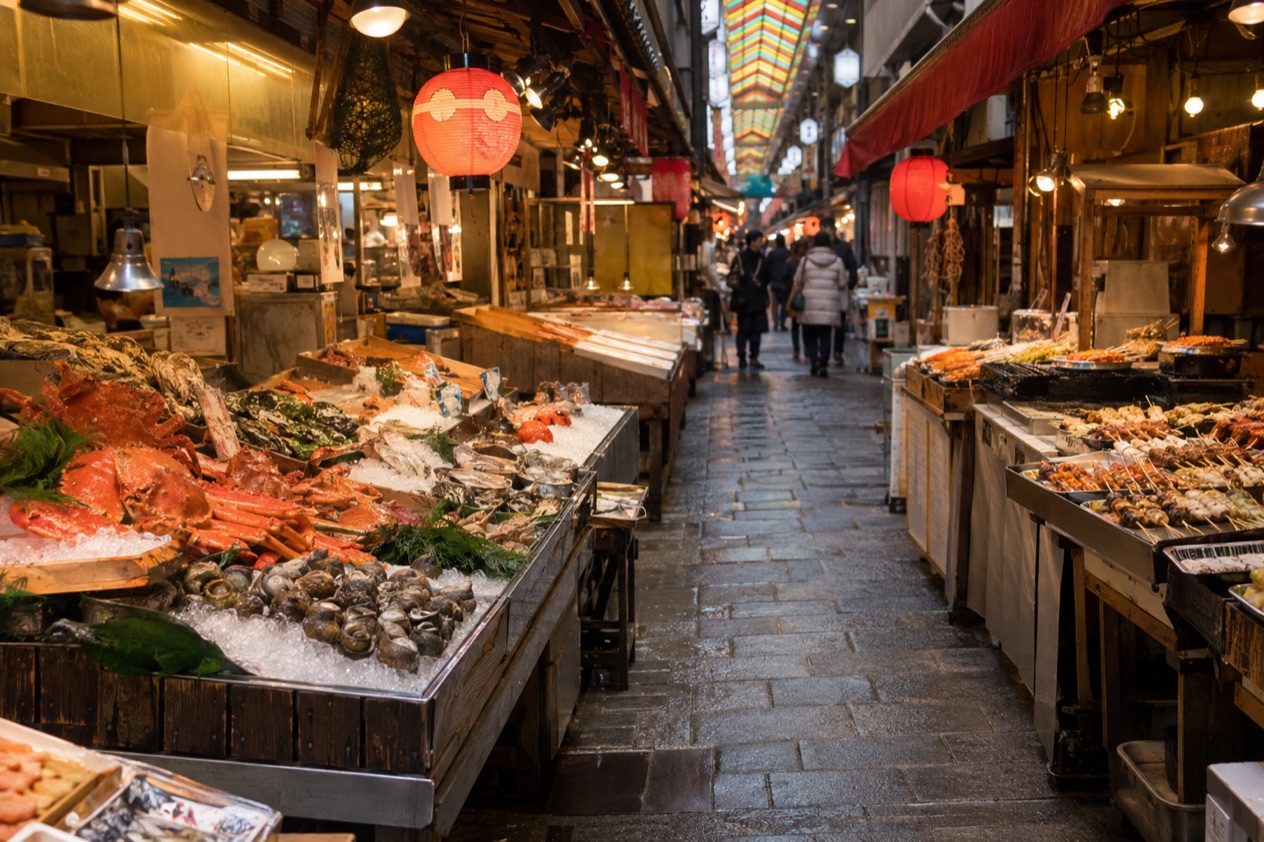
Local markets offer an abundance of street food, including fresh and grilled seafood, and two names come up first: Nishiki Market in Kyoto and Kuromon Market in Osaka. Others typical of the country include Miyagawa Morning Market, Omicho Market, Tsukiji Market and Toyosu Market. You walk narrow aisles lined with stalls, with seafood laid out on ice and skewers grilling beside it.
At some markets you may be asked not to eat and drink while walking, and visitors are expected to follow the local rules. In practice that means stopping beside the stall or in a spot set aside for eating, finishing what you bought and then moving on. It is a small adjustment, and it makes the market feel more like a series of little tasting counters.
Festivals and shopping arcades
Outdoor food stands called yatai are common at Japanese festivals, selling takoyaki, okonomiyaki, yakisoba and other freshly prepared takeaway foods. A festival street becomes a long corridor of stalls, each with a cook, a griddle and a small hand-lettered sign. People browse from stall to stall, then stop where the festival provides space to eat.
The same foods turn up in shopping arcades, the covered lanes that run through many towns. Takoyaki in particular is found in almost all of them, so you can eat it on an ordinary day without waiting for a matsuri. If your trip overlaps with a summer festival, add kakigori to the route.
Fukuoka and the yatai counters
Hakata yatai in Kyushu is a famous yatai, with makeshift counters where visitors can enjoy a drink with their food, and some stalls specialize in ramen. You sit shoulder to shoulder with strangers, the cook working inches from your bowl, and a glass of something cold at your elbow. It is a different kind of street food from a festival snack, closer to a small open-air restaurant.
Fukuoka is one of several cities known for good food. Utsunomiya is known for its gyoza, and Kobe, Otaru, Sapporo, Nagasaki, Kyoto, Matsusaka and Kitakata are named alongside it. If you plan a trip around eating, picking cities for their specialties is a natural way to build the route, because each region cooks its own way.
Stations and convenience stores
Ekiben, the boxed meals sold at stations, are a traditional way to eat on the move. They are bento packed with a mix of rice and small side dishes, and they turn a train ride into a picnic. Soba and udon shops in and around stations offer a hot alternative when you want a bowl before boarding.
Most konbini (convenience stores) are open 24 hours a day, offering hot food such as kara-age (fried chicken), onigiri (rice balls), bento, snacks and drinks. They are the fallback when the stalls have closed or you land hungry at an odd hour. A rice ball and a hot snack from the counter by the register is a real meal in a pinch.
What are the etiquette rules?
They are mostly small habits rather than strict rules: say a few words before and after you eat, follow the local rule about eating while walking, and do not be shy about the noise noodles make. None of it is hard, and most of it comes down to watching what the people around you do.
At the stall and in the market
At some markets you may be required not to eat and drink while walking, and visitors must follow the local rules. When you buy from a stall, look for signs or a designated eating area, and follow the vendor’s directions for disposing of sticks and trays. Look for signs, notice where other people are standing, and do the same.
At a yatai counter, you share a narrow space with other diners and the cook. Order, eat, enjoy a drink with your food and make room when you are done. The setting is relaxed, but it works because everyone keeps to their own small patch of counter.
Words before and after a meal
In Japan it is customary to say itadakimasu before starting to eat a meal, a phrase of thanks for the food. Afterward comes go-chiso-sama deshita, said to the host after the meal and to the restaurant staff when you leave. At a stall, a nod and a quiet thank-you at the end fit the same spirit.
You do not need perfect pronunciation. Cooks and counter staff appreciate the effort, and a smile fills in what the words miss. These two phrases are the most useful ones to learn before you start eating your way around.
Noodles, ticket machines and touch screens
Japanese noodles are traditionally eaten by bringing the bowl close to the mouth and sucking in the noodles with chopsticks. The loud slurping that results is considered normal in Japan, so there is no need to eat quietly.
At soba or udon shops in or around train stations, you may need to first buy a meal ticket from a vending machine, then hand it to the staff. Many izakaya now have touch-screen ordering systems with illustrated menus, which makes ordering simpler when you do not read Japanese. Pointing at a picture works at both.
Sitting down, and eating vegetarian
If a meal takes you into a traditional room with tatami floors, shoes or any type of footwear are always taken off. The formal way to sit there, for both sexes, is seiza, kneeling with legs folded under the thighs and buttocks resting on the heels. People shift to a more comfortable position as the meal goes on.
Vegetarians should not assume that zaru soba is meat-free: its dipping sauce usually contains fish-based dashi, so ask before ordering. Vegans and vegetarians can still expect refined dishes elsewhere in Japan, so it is a matter of choosing the setting carefully.
Good to know before you go
Typical meal times run from 06:00 to 09:00 for breakfast, 12:00 to 14:00 for lunch and 18:00 to 20:00 for dinner, so stalls and counters fit around those rhythms, while konbini stay open around the clock. Sake from a local brewery is a natural companion to a meal, and every region has dishes of its own to try. At Christmas, Kentucky Fried Chicken in Japan requires a preorder several weeks in advance or a wait in line for hours.
Sources
- Japan National Tourism Organization, Japanese gastronomy (https://www.japan.travel/en/gastronomy/), checked October 11, 2026
- Japan National Tourism Organization, street food and budget restaurants (https://www.japan.travel/en/gastronomy/local-street-food-favorites-budget-restaurant-japan/), checked October 11, 2026
- Wikipedia, Japanese cuisine (https://en.wikipedia.org/wiki/Japanese_cuisine), checked October 11, 2026
- Wikivoyage, Japanese cuisine (https://en.wikivoyage.org/wiki/Japanese_cuisine), checked October 11, 2026
To plan your stay
- Best Time to Visit Japan: Cherry Blossoms, Autumn Colors, Weather and Festivals
- Where to Stay in Japan: Ryokan, Temple Stays, Capsule Hotels and the Best Cities to Base In
- Sending Luggage from the Airport in Japan: Hands-Free Travel, Hotel Delivery and Coin Lockers
- Know Before You Go to Japan: Entry, Money, Etiquette and Getting Around