
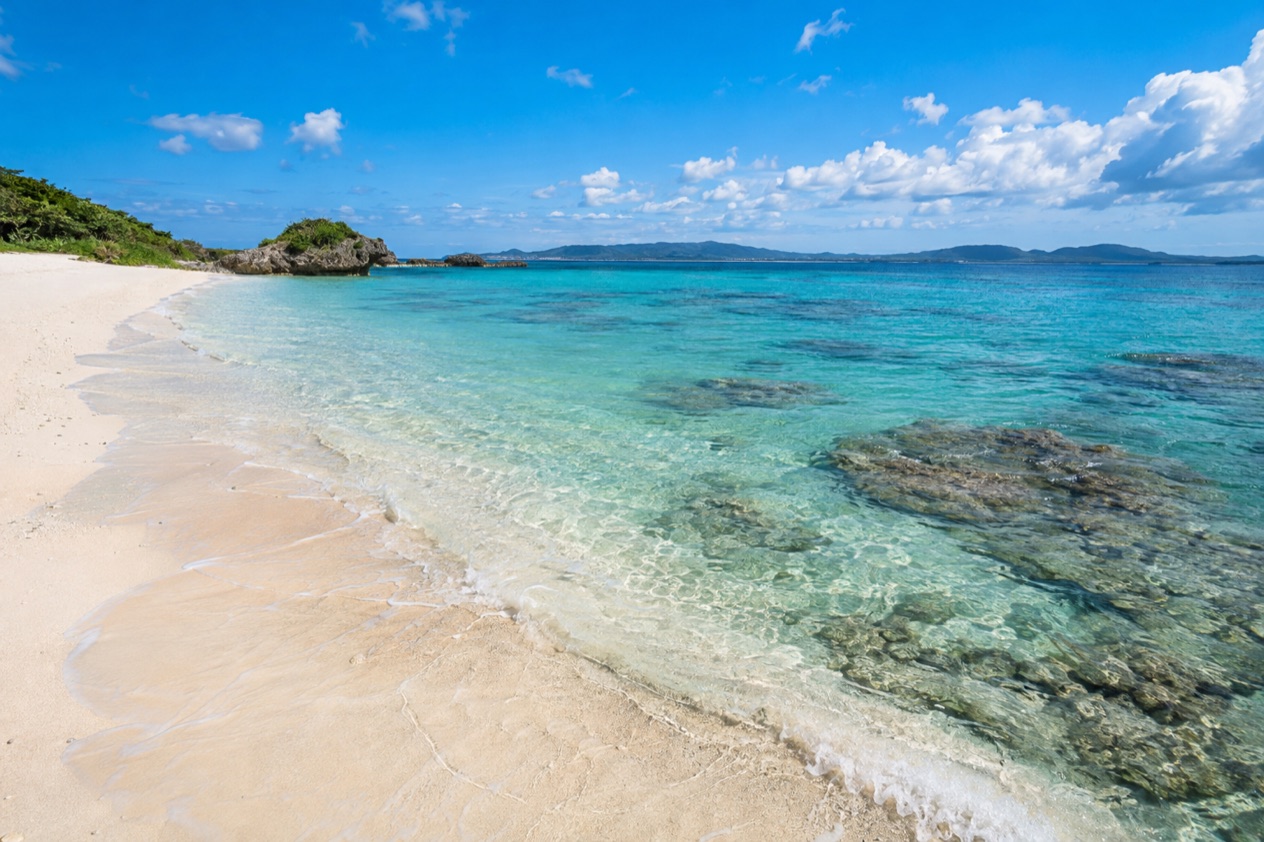
A sanshin, the three-stringed Okinawan lute, twangs from a doorway in Naha while someone inside pours awamori, the local distilled spirit, over ice. Out on the coast, the water changes color from pale jade to deep blue over the reef.
Okinawa is a subtropical island chain with its own language, its own music and a kitchen that tastes unlike the rest of Japan. It suits travelers who want beaches, history and good eating in the same trip.
What are the best things to do in Okinawa?
The best things to do in Okinawa combine a walk through the old Ryukyu Kingdom in Naha, a day with the sea (an aquarium, a reef or a beach) and a lot of eating. The islands were once a kingdom with their own court and customs, and that past still shapes the castle ruins, the festivals, the pottery and the plates in front of you. The sea sets the rhythm of everything else.
The list below gives the essentials in a few words each. The sections that follow tell you what each one is actually like.
- Wander Kokusai-dori in Naha, the long avenue of shops, restaurants and bars that works as the city’s living room.
- Visit the grounds of Shuri Castle, the Ryukyu Kingdom’s royal seat, where part of the site is open even with the main castle closed.
- Spend a morning at Okinawa Churaumi Aquarium, where whole walls of water hold the creatures of the surrounding seas.
- Take to the water around the Kerama Islands, a coral reef area with an international wetland designation.
- Walk into the Yambaru forest, the wild northern end of the main island and one of the last large tracts of subtropical rainforest in Asia.
- Choose a beach among Manza, Emerald, Okuma, Zanpa, Moon and Sunset in Chatan, each with its own setting.
- Eat your way through goya champuru, Okinawa soba, rafute and sea grapes, then finish with awamori.
- Spend an evening where a live sanshin player and a plate of small dishes are all you need.
Few trips need more than these to feel complete. Add the quieter corners (a pottery lane, a roadside stand selling brown sugar sweets, an island ferry) and you have a vacation with a clear shape.
Sights and landmarks in Okinawa
Naha is where Okinawa’s history sits closest to the surface, and it is the base for most landmark visits. The city is the capital of the prefecture and the largest on the island, and its streets mix castle walls, covered markets and modern avenues. Here the old kingdom is easy to read, even for first-time visitors.
Shuri Castle
Shuri Castle was the heart of the Ryukyu Kingdom, the court where the kings of the islands received envoys and held ceremonies. A fire in 2019 destroyed much of the main castle, which remains closed, but the site is partly open and you can still walk through gates, stone walls and grounds that show how the court was laid out.
The color of the buildings tells you something. Red lacquer, carved dragons and sweeping tiled roofs reflect the influence of China, while the stonework, curving and fitted without mortar, is distinctly Okinawan. Walking the open areas, you get a sense of the hill the castle commanded and of the culture that built it.
It suits anyone curious about why Okinawa feels so different from the mainland. Pair it with a meal of Okinawan dishes afterward, since the court’s own cooking influenced what is served today.
Kokusai-dori and the market lanes
Kokusai-dori, also called International Avenue, is a stretch of stores, restaurants and bars that runs for a mile through the middle of Naha. Souvenir shops sell shisa, the lion-dog guardians that sit on Okinawan rooftops, along with red-dyed textiles, brown sugar candy and bottles of awamori. The street changes character with the hours, from shoppers to diners to people heading for a drink.
Narrow covered lanes branch off the avenue, and these are where the city feels most local. Fish stalls, pork vendors, pickle sellers and tiny diners line them, and the smell of grilled food drifts out. Walk without a plan, stop where something looks good, and you will cover this part of Naha properly. The avenue suits first evenings, rainy afternoons and anyone who likes to browse and snack in the same hour.
Other places in Naha and beyond
Naha rewards a slow day with smaller stops. Traditional gardens, tomb complexes of the Ryukyu royal family, craft workshops where potters make glazed ware and dyers work with indigo and local patterns all give a feel for the kingdom’s taste. Many of them are quiet corners tucked between modern blocks.
The Okinawa Urban Monorail, known as Yui Rail, is the island’s only public rail network and links parts of the city. Riding it gives you a view over rooftops and lets you move between districts without a car. Naha Airport is the gateway to all of Okinawa’s islands, and the city is only a 15-minute drive from it, or a few stops on the monorail.
| Site | Open |
|---|---|
| Okinawa Churaumi Aquarium | 08:30 to 18:30, last admission 17:30 |
Beaches and outdoor things to do in Okinawa
Outdoors in Okinawa means the sea, the reef and a green interior that is still wild in places. The main island has several beaches, including Manza Beach, Emerald Beach, Okuma Beach, Zanpa Beach, Moon Beach and Sunset Beach in Chatan. Each sits in a different stretch of coast, so the character shifts from one to the next.
The beaches of the main island
Sunset Beach in Chatan has a name that tells you what people go there for, and it sits close to the town’s restaurants and shops. Manza Beach and Moon Beach are linked in travelers’ minds with resort stays, while Emerald Beach and Okuma Beach have a long-standing reputation among visitors for their settings. Zanpa Beach completes the group with its own stretch of shore.
Look at the beach before you plan a swim. Sea conditions change, and what you can do in the water depends on the day and on the signs and staff at each beach. A walk along the sand, a seat in the shade and a cold drink are always an option.
Diving is open all year round in Japan, and Okinawa’s coral waters draw divers who want warm seas and reef life. It is a good way to see what lies beneath the surface if you are comfortable in the water.
The Yambaru forest
Yambaru is the forested northern part of Okinawa Island, across the villages of Higashi, Kunigami and Ogimi. It holds some of the last large surviving tracts of subtropical rainforest in Asia, with many plants and animals found nowhere else. The mood changes sharply from the busy south: roads narrow, canopies close overhead and the air is thick with green.
You come here for the forest itself. Ferns, giant leaves, birdsong and the sound of streams make the interior feel a long way from the resorts. Okinawa’s humid subtropical climate, which borders on a tropical rainforest climate, is what feeds this growth, so expect moisture in the air and showers that pass. It suits travelers who like nature on its own terms and are happy to explore with patience rather than a checklist.
Mount Omoto and the island’s high ground
The highest mountain on Okinawa Island is Mount Omoto, at 1,724 feet, with Mount Yonaha the second highest. They are not alpine peaks, but they add depth to the island and shape the forests that cover its northern half. Looking at them on a map is a reminder that Okinawa is more than a beach destination.
Pair a forest visit with a coastal drive for contrast. Where green hills meet blue water, the island shows both of its faces at once.
Day trips from Okinawa
The day trips that make the most sense from Okinawa are the aquarium on the main island, the reefs of the Kerama Islands and the forest of Yambaru. Okinawa Island is roughly 400 miles south of Kyushu, so you are already far from the mainland, and these outings go further into the island world.
Okinawa Churaumi Aquarium
The Okinawa Churaumi Aquarium opened on 1 November 2002 and sits on a large site of 200,000 square feet by the sea. Inside, enormous tanks recreate the waters around the islands, from coral reef shallows to the deep open ocean. The aquarium shows how rich the marine world around Okinawa is, which makes it a good first step before you go near the water yourself.
There is news to follow too. A new female Japanese sawshark has arrived in an effort to breed the species, and a baby bottlenose dolphin has been born, with visitors able to watch it swim beside its mother. Look for these animals during your visit.
The aquarium suits families, divers curious about what they will see and anyone who wants a rainy-day plan with real substance. Plan a good part of the day, since there is a lot to take in.
The Kerama Islands
Four of the Kerama Islands are inhabited: Tokashiki, Zamami, Aka and Geruma. The surrounding coral reef, Kerama-shoto, was designated a Ramsar Site, an international wetland of importance, on 8 November 2005. The islands are the kind of place where a day is spent around the water, with small villages, quiet shores and reef scenery.
Diving is open all year round in Japan, and the Keramas are a natural draw for divers drawn to Okinawa’s coral. Even if you do not dive, the islands give a look at island life on a smaller scale than the main island.
It suits travelers who want a break from the road and a day shaped by the sea. Choose one island rather than trying to see them all.
A day in Yambaru
You can spend it among the trees, with stops in villages such as Kunigami and Ogimi, which are part of the forest region. The sounds, smells and light are very different from Naha’s.
What you see depends on the day, but the forest has many species of plants and animals found only here. Move slowly, look up and listen, and bring a light layer for the damp air. It suits nature lovers and anyone who has seen enough beaches and wants a contrast.
Smaller outings
- Island hopping among the other inhabited islands of the prefecture, since forty-nine of the one hundred sixty islands have residents.
- Beach stops along the main island’s coast, choosing among Manza, Emerald, Okuma, Zanpa, Moon and Sunset.
- A long drive through the countryside with a stop at any roadside stand that catches your eye.
What to eat in Okinawa
Okinawan cuisine, also called Ryukyuan cuisine after the old kingdom, is a food culture of its own, and it differs from mainland Japanese cooking because of culture, historical contact, climate, vegetables and other ingredients. Pork, tofu, bitter melon, sweet potato and seaweed turn up again and again. Eating here is one of the main reasons to come.
The dishes to look for
Goya champuru is the dish travelers meet first, a stir-fry of bitter melon with tofu, egg and pork. The bitterness is the point, and it is balanced by the richness of the other ingredients. Rafute, pork belly simmered until it is soft with soy sauce and brown sugar, shows the island’s love of pork.
Okinawa soba is a bowl of wheat noodles in a clear pork and bonito broth, usually topped with slices of braised pork. It is different from the buckwheat soba of the mainland and is eaten as a comforting lunch. Taco rice, a local favorite built from seasoned meat, cheese and lettuce over rice, is a reminder that the island has absorbed influences from many sides.
Umibudo, or sea grapes, are tiny green beads of seaweed that pop in the mouth with a taste of the ocean. They are often served with a light vinegar dressing and make a refreshing side.
Sweets, drinks and snacks
Sata andagi are round, crisp-shelled fried doughnuts, sweet and dense, sold in bakeries and at roadside stands. Beni-imo, a purple sweet potato, shows up in ice cream, pastries and tarts, and its color makes it easy to spot. Brown sugar, from the island’s sugarcane, appears in candy and tea breaks.
Awamori is the local spirit, distilled from rice and served over ice, with water or in a cocktail. Okinawan bars and izakaya, the casual Japanese pubs, often offer many bottles to try. Orion is the beer you will see on tables across the island. Pair a sweet snack with a hot cup of tea in the afternoon, and you have a break that tastes like the island.
Where to eat
In Naha, the market lanes off Kokusai-dori are where visitors begin, with stalls and small diners side by side. Izakaya serve plates for sharing with a drink, and family-run restaurants specialize in a single dish done well. Look for places where the menu is written on the wall and the cooking is done in front of you.
Outside the city, roadside shops and village restaurants offer whatever is local, from fish to vegetables. Eating this way helps you see how the island lives and how its food connects to the land and sea.
Things to do in Okinawa at night
Evenings in Okinawa center on Naha, where Kokusai-dori’s restaurants and bars carry on after the shops have shut. The mood is relaxed, and the island’s own music and drink give nights a flavor you will not find elsewhere in Japan. Outside the city, evenings are quieter and more about the sea and the stars.
Music and bars in Naha
Live Okinawan music is the highlight. Small venues feature a sanshin player, sometimes joined by singers and drummers, performing folk songs that range from slow ballads to songs that bring the room to its feet. Even if you do not understand the words, the rhythm carries you along, and in many places patrons join in.
Pair the music with awamori, either neat, over ice or mixed with water. Izakaya offer plates of pork, tofu and vegetables to share, and the pace of the evening is set by the table. This is a good way to spend a first night after arriving.
At festivals, you may also see eisa, a drumming dance performed by troupes in bright costume. When it happens, it is a strong reminder of how alive local tradition remains.
Evening walks and quieter options
Not every night needs a bar. An evening stroll along Kokusai-dori lets you browse shops, grab a snack and watch the avenue change as lights come on. Side lanes hold small cafés where you can sit with tea or a cold drink.
On the coast, an evening by the water is its own pleasure. Sunset Beach in Chatan is named for the view, and it gives you a place to watch the sky change before dinner. Take a seat, order a drink and let the light do the work.
If you have been in the sun all day, a long dinner followed by an early night is a perfectly good way to end it. The islands reward unhurried evenings.
Dinner as the main event
In Okinawa, dinner can be the evening. Choose a place where locals gather and let the staff suggest dishes. Finish with a sweet, perhaps a brown sugar dessert or a scoop of purple sweet potato ice cream, and walk back through the lit streets.
Things to do in Okinawa with kids
Children in Okinawa get the sea, animals and a few rides, and the aquarium is the natural center of a family trip. The island’s subtropical climate means sun and humidity are part of every day, so plan outdoor time around them and keep water and shade close by.
Okinawa Churaumi Aquarium for families
Few children fail to be impressed by a tank so large it fills the wall. The aquarium shows the sea life around Okinawa, and the news is good for animal lovers: a baby bottlenose dolphin has been born, and visitors can watch it swimming with its mother. A new female Japanese sawshark has also arrived as part of a breeding effort.
The aquarium also cautions visitors about an increase in bite-wound injuries from white-banded triggerfish during their breeding season, so follow any signs and staff instructions near the water. The site is large, so give children breaks between exhibits.
Beaches and the Kerama reefs
Okinawa’s beaches give children room to dig, collect shells and look for small creatures in the shallows. Manza, Emerald, Okuma, Zanpa, Moon and Sunset each offer a different setting, so choose the one that fits your family’s day. Watch the water conditions and the posted guidance on the day.
The Kerama Islands add a further adventure for older children who like the sea, since the reef around them is a protected wetland. A day among the islands shows a different face of Okinawa and is a good way to teach children about coral and the creatures that depend on it.
Small pleasures in Naha
A ride on the Yui Rail, the island’s only monorail, is a small adventure of its own for children who like trains. Kokusai-dori has snacks that appeal to young palates, from sata andagi doughnuts to purple sweet potato ice cream. Watching a craft maker at work in a pottery or dyeing workshop is another way to keep curiosity going.
With children, build the day around one main outing and leave time for rest. The heat and humidity make a break in an air-conditioned café or museum welcome.
Good to know before you go
Okinawa is a subtropical island chain between mainland Japan and Taiwan, and it is one of Japan’s 47 prefectures. Naha Airport is the gateway to all of its islands, served by flights from dozens of cities across Japan, including low-cost carriers. In the city, the Yui Rail monorail is the only public rail network.
The climate is humid subtropical, with a rainy season in late spring, so bring a light rain layer and expect humidity at any time. Okinawa was once the Ryukyu Kingdom with its own language and culture, and you will notice it in the music, the food and the signs you read along the way.
Sources
- Japan National Tourism Organization, Okinawa (https://www.japan.travel/en/destinations/okinawa/okinawa/naha-and-the-main-island/), checked October 11, 2026
- Okinawa Churaumi Aquarium (https://churaumi.okinawa/en/), checked October 11, 2026
- Wikipedia, Okinawa Island (https://en.wikipedia.org/wiki/Okinawa_Island), checked October 11, 2026
- Wikipedia, Okinawa Prefecture (https://en.wikipedia.org/wiki/Okinawa_Prefecture), checked October 11, 2026
- Wikivoyage, Okinawa (https://en.wikivoyage.org/wiki/Okinawa), checked October 11, 2026
- Wikipedia, Shuri Castle (https://en.wikipedia.org/wiki/Shuri_Castle), checked October 11, 2026
- Wikipedia, Naha (https://en.wikipedia.org/wiki/Naha), checked October 11, 2026
- Japan National Tourism Organization, diving (https://www.japan.travel/en/guide/diving/), checked October 11, 2026
- Wikipedia, Kerama Islands (https://en.wikipedia.org/wiki/Kerama_Islands), checked October 11, 2026
- Wikipedia, Yanbaru (https://en.wikipedia.org/wiki/Yanbaru), checked October 11, 2026
- Wikipedia, Okinawan cuisine (https://en.wikipedia.org/wiki/Okinawan_cuisine), checked October 11, 2026
To plan your stay
- Best Time to Visit Okinawa: Weather by Month, Sea Temperatures, Festivals and Seasons
- Where to Stay in Okinawa: Naha, Chatan, the Aquarium Coast and Beach Resorts
- Okinawa from Tokyo: Flying to Naha, Why No Train Goes There and a First Day on the Island
- Know Before You Go to Okinawa: Entry, Money, Getting Around and Local Etiquette