
You pass through the gate, and the traffic of Shinjuku falls away behind a wall of trees. Ahead, lawns open out under tall canopies, paths curve toward ponds, and a greenhouse glints between the branches. Shinjuku Gyoen is a national garden in Tokyo where French, English and Japanese ideas of landscape sit side by side, and it suits a slow wander through the seasons.
Is visiting Shinjuku Gyoen worth it?
Yes, for anyone who wants a long, green stretch of Tokyo to walk through, whether you love gardens, photography, plants or simply need a break from the city. The garden covers 144 acres, enough room for a morning of wandering without retracing your steps, and it changes character with every month on the calendar.
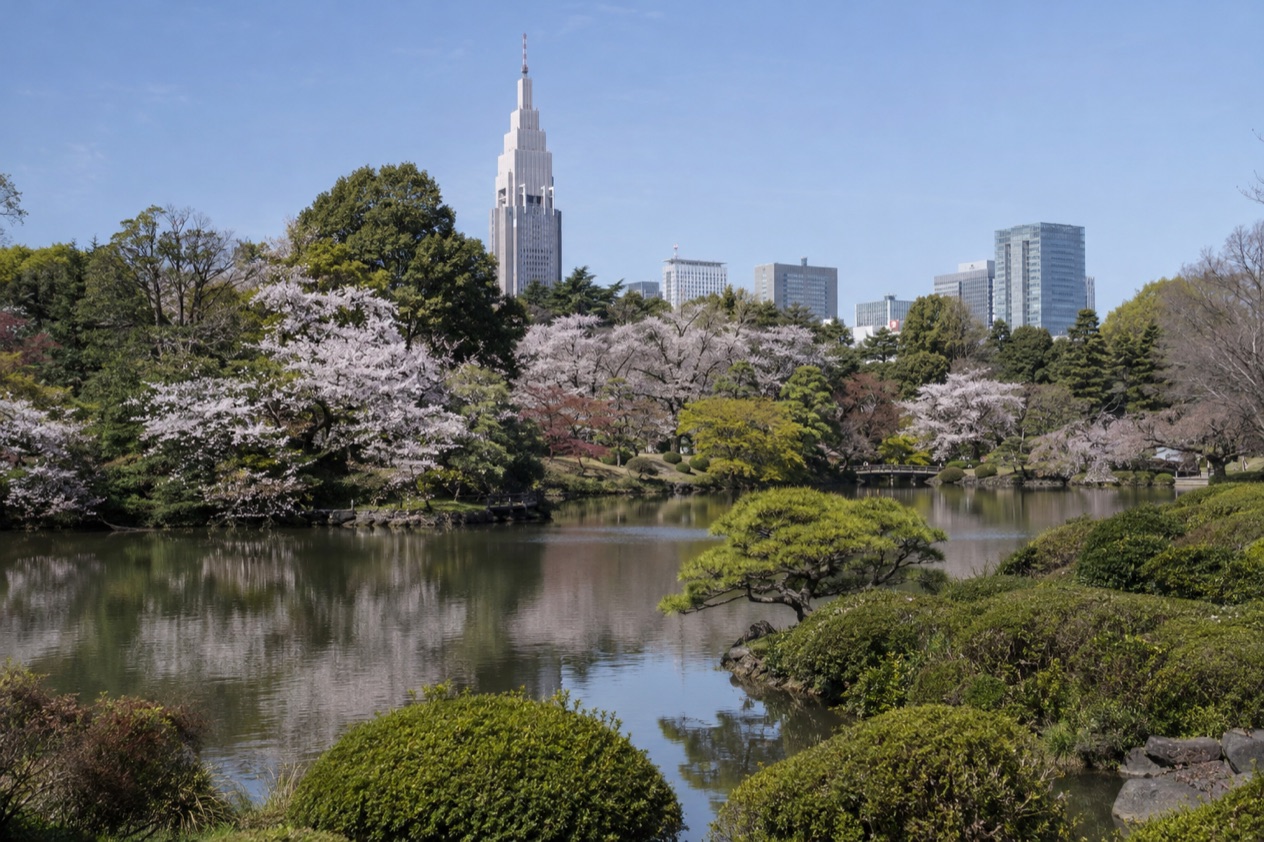
What sets it apart from other green spaces in the city is that it is not one garden but three. The north holds a French formal garden and an English landscape garden, while the south is a Japanese traditional garden. You can cross from one tradition to another in a few minutes on foot, from clipped symmetry to open lawns to ponds and carefully placed trees.
A tropical greenhouse adds another layer for rainy or chilly days, and the trees give each season its own show. Cherry blossoms come in waves from late March into late April, and chrysanthemums take over in the first half of November. Autumn and winter have their own colors and bare-branch outlines, so a return visit rarely repeats the first.
It also rewards people who like to look closely. Japanese garden design is built around the idea that a landscape should seem larger than it is, with paths that bend, widen and narrow, and views arranged in layers. Shinjuku Gyoen gives you the chance to notice those tricks for yourself, and to compare them with the very different logic of a French or English layout.
What to see at Shinjuku Gyoen
The garden is best understood as three areas and a glasshouse, each with its own mood. Visitors walk them in a loop, letting the landscape shift from formal to wild to Japanese without a signpost telling them the style has changed.
The French Formal Garden
In the north, the layout turns geometric. Beds are arranged in orderly patterns, rows of trees line the walkways, and the whole design is meant to be read from end to end as a single composition. It is a very different rhythm from a Japanese garden, where views unfold bit by bit as you move.
Look for the way the paths guide your eye to a distant point, and for the flower beds that change with the season. Roses are the classic plant of this style, and a formal garden like this tends to look its most dressed in spring and early autumn. It is also a pleasant place to sit on a bench and watch the pattern of the lawns.
The English Landscape Garden
Next to the formal section, the English landscape garden loosens everything. Wide lawns roll out under scattered trees, and the edges are softened so the park seems to have grown naturally rather than been drawn on paper. Here the aim is the look of open countryside, tucked inside one of the biggest cities in the world.
The garden holds more than 20,000 trees overall, and in this part of the grounds you see them as individual shapes against the sky. Look at the silhouettes of the larger specimens and the way each one stands alone on the grass. In cherry season, the open lawns are where the blossom is most easily taken in as a whole.
The Japanese Traditional Garden
The southern part follows the older Japanese approach. Water is often the heart of such a garden, whether a pond, a stream or a waterfall, and here ponds anchor the scenery, with paths looping around them and views framed by pines, maples and carefully placed stones.
Slow down and watch how the path bends and how a view suddenly opens or disappears. Designers use sudden changes in the direction or width of a path, and layered perspectives, to make a garden feel bigger than it is. Listen, too, because the rustle of leaves and the sound of moving water are part of the experience. Historically, such gardens hosted poetry gatherings and Noh performances, and it is easy to picture why.
The greenhouse
The greenhouse was built in the 1950s and keeps more than 1,700 tropical and subtropical plant species on permanent display. Inside are palms, orchids and leafy plants that you would never see growing in the open in Tokyo. It is a warm, humid interlude, and a useful shelter if the weather turns.
Walk through it slowly and take in the layers of foliage, from tall fronds overhead to blooms at eye level. The greenhouse keeps its own hours, slightly shorter than the garden itself, so plan to go in before it closes rather than at the end of your walk.
The cherry trees
About 1,500 of the trees are cherries, and they bloom in stages. Weeping cherries open first in late March, the Somei (Tokyo) cherries follow in early April, and the Kanzan cherries carry the season into late April. This staggering means the garden holds blossom for weeks rather than a single weekend.
Each variety has its own look. The weeping trees drape in long curtains, the Somei trees make pale clouds, and the Kanzan trees bear heavier, deeper-colored flowers. Walking among them across the weeks shows how many kinds of cherry there are.
Hours, tickets and rules
The garden opens in the morning and closes in the late afternoon, with the closing time moving through the year. Closing is earliest in the cooler months and latest in high summer, and the greenhouse follows the same pattern about half an hour ahead of the garden. In October, as now, the garden closes earlier than in summer.
The garden is closed on Mondays, except during cherry blossom season (late March to late April) and chrysanthemum season (the first half of November), when it opens seven days a week. If Monday is a public holiday, the closure moves to the following day.
| Site | Open |
|---|---|
| Garden, mid-March to end of September | 9:00 to 17:30 |
| Garden, July to late August | 9:00 to 18:30 |
| Garden, October to mid-March | 9:00 to 16:00 |
| Greenhouse, mid-March to end of September | 9:30 to 17:00 |
| Greenhouse, July to late August | 9:30 to 18:00 |
| Greenhouse, October to mid-March | 9:30 to 15:30 |
During cherry blossom season, prior reservations are required for several dates. Beyond the closing days and those reservations, the rules that apply to visitors are not spelled out here, so the sections on timing and planning stick to what the garden itself offers.
How to get to Shinjuku Gyoen
Three train stations serve the garden, on three different lines, so you can arrive from whichever direction your day began. The garden sits in Shinjuku and Shibuya, and each station puts you at its edge on foot.
Shinjuku-gyoemmae Station, on the Tokyo Metro Marunouchi Line, is a short walk from the garden. Sendagaya Station, on the JR Chuo-Sobu Line, is also a short walk away. If you are on the Tokyo Metro Fukutoshin Line, get off at Shinjuku-sanchome Station and take exit C1, from which the garden is a four-minute walk.
Visitors flying into Tokyo arrive at Haneda Airport (officially Tokyo International Airport) or at Narita Airport, Japan’s largest international airport. Either way, the rail network brings you into the city and onto one of the three lines above.
Because the garden has its own gates and the stations are on different lines, you can enter at one side and leave near another, which makes a one-way walk through the garden possible. That suits anyone linking the garden with the next stop on a Tokyo day.
When to visit Shinjuku Gyoen
Spring is the obvious draw, because the cherry trees bloom in sequence from late March to late April and the garden opens every day of the week in that window. Reservations are required on several dates, so spring plans need a little forethought. The first half of November brings chrysanthemums, again with seven-day opening.
Beyond those peaks, each season has something to offer. Summer stretches the hours, with a later closing from July to late August, and the shade of the large trees matters in the heat. Autumn and winter bring earlier closing, so the visit is best built around the daylight hours. Tokyo’s own weather gives a feel for each season.
| Month | Average high (°F) | Average low (°F) | Days with rain | Sunshine (hours) |
|---|---|---|---|---|
| January | 49.6 | 34.2 | 4.5 | 193 |
| April | 66.9 | 49.6 | 9.5 | 179 |
| July | 85.8 | 72.3 | 10.5 | 151 |
| October | 71.6 | 58.6 | 10.5 | 129 |
April is mild and a little damper, which fits the blossom season. July is hot and humid, so the long summer hours help. October, the current month, is mild, with a fair amount of rain, so a gray day is a good moment for the greenhouse.
As for the time of day, the garden opens in the morning and closes in the afternoon or early evening depending on the season. Plan the walk around the closing time, and remember that the greenhouse closes earlier than the garden.
Tips for your visit
Arrive with the opening time in mind and the closing time in view, since the hours shift with the seasons and the greenhouse closes before the garden.
Comfortable shoes make sense for a garden of this size, and in October a light layer suits the mild days. A rain jacket is worth carrying in a month with a fair number of wet days, since the greenhouse is the only roofed refuge on the grounds that the garden lists.
A good way to organize the walk is by style. Begin in the formal north, move through the lawns of the English landscape area, then finish in the Japanese garden with its ponds. That order takes you from the most structured design to the most subtle one, and ends at the part of the garden where listening matters as much as looking.
Once you leave, Shinjuku itself offers department stores, ramen counters, izakaya (casual Japanese pubs) and coffee shops for a meal. Tokyo has other districts worth a separate day, such as Ginza, with its luxury shops and high-end restaurants, and Nihonbashi, known for its heritage and as the main financial district of Japan. Roppongi and Akasaka make another outing.
If you are visiting during cherry blossom season, build the day around your reservation date. If you are visiting in the first half of November, remember the chrysanthemum displays and the seven-day opening.
Good to know before you go
Shinjuku Gyoen is easy to fold into a day of sightseeing in Tokyo, and the three station options mean you can start or end the visit wherever your route requires. Spring brings the most reservations, and the Monday closure applies for most of the rest of the year, so check the day of the week before you set out. In October the rain comes on about a third of days, so a compact umbrella is a sensible companion.
Sources
- Japan National Tourism Organization, Japanese gardens (https://www.japan.travel/en/see-and-do/japanese-garden/), checked October 11, 2026
- Wikipedia, Shinjuku Gyoen (https://en.wikipedia.org/wiki/Shinjuku_Gyoen), checked October 11, 2026
- Japan National Tourism Organization, Tokyo (https://www.japan.travel/en/destinations/kanto/tokyo/), checked October 11, 2026
- Japan Meteorological Agency (JMA), Normal values 1991-2020, monthly (https://www.data.jma.go.jp/stats/etrn/view/nml_sfc_ym.php?prec_no=44&block_no=47662), station Tokyo, elevation 25 m, checked October 11, 2026
To plan your stay
- Best Time to Visit Japan: Cherry Blossoms, Autumn Colors, Weather and Festivals
- Where to Stay in Japan: Ryokan, Temple Stays, Capsule Hotels and the Best Cities to Base In
- Sending Luggage from the Airport in Japan: Hands-Free Travel, Hotel Delivery and Coin Lockers
- Know Before You Go to Japan: Entry, Money, Etiquette and Getting Around