
You step through a towering wooden torii gate, and the roar of Shibuya drops away behind a wall of trees. Gravel crunches underfoot on the wide path, and the air under the canopy feels cooler and smells of cedar and damp earth. Meiji Jingu is a Shinto shrine set in a planted forest in the middle of Tokyo, and a visit here is a slow walk toward a place of prayer rather than a sightseeing sprint.
Is visiting Meiji Jingu worth it?
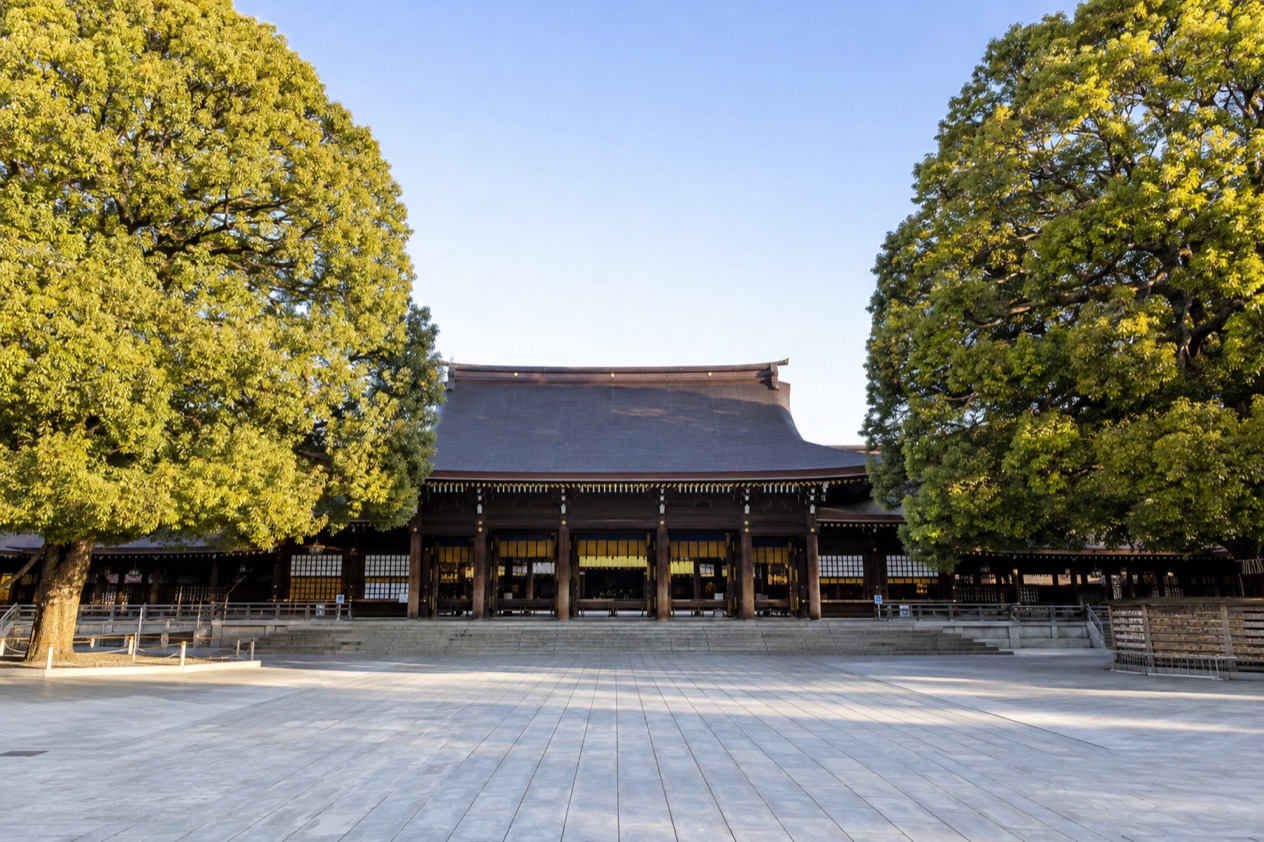
Yes, if you want a stretch of Tokyo where the main event is walking, looking up and watching how people pray, and it suits first-time visitors and repeat travelers alike. The shrine is dedicated to the deified spirits of Emperor Meiji and Empress Shoken, and everything about the approach is designed to prepare you for that: the gates, the long path, the purification fountain before the main hall.
What sets it apart from the temples and gardens elsewhere in the city is the forest itself. It covers 70 hectares (170 acres), and its trees were donated by people from all over Japan, so the whole green mass is a kind of national gift to the two people the shrine honors. Where Senso-ji is lined with market stalls and incense smoke, Meiji Jingu offers shade, gravel and the hush of tall trees.
It also rewards a certain kind of traveler: someone who likes to see a living religious site rather than a museum piece. You may come across a wedding procession or a family in formal clothes, and the rhythm of bowing, clapping and offering is part of what you came to see. If your idea of a good day in Tokyo includes a breather between neighborhoods such as Harajuku and Shibuya, this is the place to take it.
What to see at Meiji Jingu
The forest and the approach
The forest holds 120,000 trees of 365 different species, planted by hand and left to grow into something that looks entirely natural. As you walk, notice how the light changes: broad leaves overhead, evergreens at the edges, and a path wide enough that it never feels crowded by the trunks.
Along the way you pass massive torii gates made of wood, which mark the passage from the everyday world into sacred ground. Visitors bow slightly before walking through, and walking along the side of the path rather than down the middle is a common courtesy, since the center is traditionally left for the deities.
The Naien, the inner precinct
The Naien is the heart of the shrine, centered on the main buildings where worshippers stop to pray. Before the hall, a water pavilion lets visitors rinse their hands and mouth, a small act of purification that precedes any Shinto visit. At the hall you will see people toss a coin, bow twice, clap twice and bow once more.
The inner precinct also includes a treasure museum housing articles of Emperor Meiji and Empress Shoken. It adds personal detail to a place that otherwise speaks mostly through architecture and landscape, and it is worth including if you like to put a human story behind what you see.
The Gaien, the outer precinct
Inside are 80 large murals depicting the lives of Emperor Meiji and Empress Shoken, a pictorial biography that fills in the reign the shrine commemorates.
The Gaien has also been in the news: in February 2023, the Tokyo Metropolitan Government approved a plan to develop 28.4 hectares of Meiji Jingu Gaien, including a new sports stadium, a hotel and three skyscrapers. The plan has been controversial, which is a reminder that this green space is part of an ongoing conversation about how Tokyo grows.
Hours, tickets and rules
The gates follow the sun: the entrances open at sunrise and close at sunset, so the hours shift through the year. In summer the shrine stays open into the evening, and in winter it closes early, which matters when you plan around daylight. The grounds are at 1-1, Kamizono-cho, Yoyogi, Shibuya, Tokyo 151-0053.
| Site | Open |
|---|---|
| Meiji Shrine entrances | Sunrise to sunset |
Beyond the opening times, the sources give no admission amounts or specific rules for visitors, so the practical picture is simple: you come during daylight, and you follow the customs of a place of worship as you walk, bowing at the gates and keeping to the side of the path.
When to visit Meiji Jingu
Because the gates open at sunrise and close at sunset, the first question is daylight. Spring and autumn give comfortable walking weather under the trees. April has highs in the mid-60s and about nine rainy days, while October has highs around 72 degrees but is among the wetter months, with a mix of gray and bright days.
Summer under a forest canopy is a relief from the heat of the streets, though July is warm and humid, with highs in the mid-80s and showers on about ten days. Winter is crisp: January days are cool and dry, with highs near 50 degrees, and snow is possible but light. The tree cover makes the walk pleasant in nearly any season, but a rainy day turns the gravel path dark and the air heavy with the scent of wet cedar.
Festivals and ceremonies
The Autumn Grand Festival runs from October 31 to November 3, and on November 3 it includes the Anniversary of Emperor Meiji’s Birthday Festival. It is the shrine’s most ceremonial stretch of the autumn, and the fall air under the trees suits it well.
A Yokozuna, a sumo grand champion, performs a ring-entering ceremony called Dezuiri here in January, usually around January 5 to 7, and again during the Autumn Festival. New Year brings Saitaisai, the New Year’s Day ritual held on January 1, a national holiday. Other dates on the calendar include the Shodoten calligraphy exhibition in January and the Empress Shoken Memorial Ceremony in April.
Tips for your visit
Plan to walk, and wear shoes that suit gravel. The path from gate to main hall is long enough that it becomes part of the visit rather than a means of getting there, and the forest invites you to slow down and look up. Bring a layer in cooler months, since the shade keeps the air a few degrees below the street.
Meiji Jingu sits in Shibuya, so it pairs naturally with the neighborhoods around it. Shibuya Station is the usual transit point for this part of Tokyo, and from there you can reach Roppongi and Akasaka in about 10 minutes by train if you want to continue to a different side of the city. Roppongi Station is served by the Tokyo Metro Hibiya Line and Toei Oedo Line.
If you arrive in Tokyo through Haneda or Narita, the shrine makes a good first or last outing, a quiet counterweight to the city’s pace.
Good to know before you go
Tokyo’s rainy spells and typhoon-season weather can reshape an outdoor day, so a folding umbrella is a sensible companion on a forest walk. Treat the shrine as a place of worship: keep your voice low, bow at the gates and follow the lead of those praying around you.
Sources
- Wikipedia, Meiji Shrine (https://en.wikipedia.org/wiki/Meiji_Shrine), checked October 11, 2026
- Japan National Tourism Organization, Tokyo (https://www.japan.travel/en/destinations/kanto/tokyo/), checked October 11, 2026
- Japan Meteorological Agency (JMA), Normal values 1991-2020, monthly (https://www.data.jma.go.jp/stats/etrn/view/nml_sfc_ym.php?prec_no=44&block_no=47662), station Tokyo, elevation 25 m, checked October 11, 2026
To plan your stay
- Best Time to Visit Japan: Cherry Blossoms, Autumn Colors, Weather and Festivals
- Where to Stay in Japan: Ryokan, Temple Stays, Capsule Hotels and the Best Cities to Base In
- Sending Luggage from the Airport in Japan: Hands-Free Travel, Hotel Delivery and Coin Lockers
- Know Before You Go to Japan: Entry, Money, Etiquette and Getting Around