
The first thing you meet is the Kaminarimon, a great gate hung with an enormous red lantern, and beyond it a street of stalls selling sweets and souvenirs that leads toward a temple wrapped in incense smoke. Senso-ji is Tokyo’s oldest-established temple, dedicated to Kannon, the bodhisattva of compassion. A visit here is a slow walk through two gates, a market street and a main hall, with plenty of people moving along beside you.
Is visiting Senso-ji worth it?
Yes, for almost anyone spending time in Tokyo, and especially for travelers who want to see a working Buddhist temple rather than only a museum piece. People come to pray, to draw a fortune, to buy a snack and to walk through the gates, and you can join in at whatever level you like.
Senso-ji is described as the most widely visited religious site in the world, with over 30 million visitors a year. That scale shapes the experience: this is a place of motion, of coins tossed, bells and chatter, not of silence. If you picture a hushed garden temple, other corners of Japan will suit you better. If you want to see devotion and everyday commerce sitting side by side, this is the place.
What sets it apart from other sights in the city is the approach. Instead of arriving at a single building, you pass through the outer Kaminarimon, then along Nakamise-dori with its traditional goods, then through the inner Hozomon gate, and only then reach the main hall.
The temple has also lived through loss: the main hall was destroyed in the air raid of March 10, 1945 and was rebuilt, so what you see today is a postwar reconstruction standing on a very old site. That layering of old purpose and rebuilt walls is part of its story.
Asakusa itself rewards the extra time. Around the temple you find old-style snack shops, small streets of eateries and the pull of a neighborhood that still centers on its shrine and temple. Senso-ji makes a good first stop on a first day in the city, and it works just as well as a return visit during a festival.
What to see at Senso-ji
Kaminarimon, the Thunder Gate
The Kaminarimon is the outer of two large entrance gates, and its huge red lantern is the picture most people carry home. The current gate was dedicated in December 1960, after the previous one was destroyed in a fire in 1865. That gap explains why Asakusa old-timers talk about the gate as something the community wanted back.
Look up at the lantern and at the carved details beneath it, then step through into the crowd of the market street. Photographs from just outside the gate catch the whole frame, while standing underneath lets you see the woodwork up close.
Nakamise-dori, the shopping street
Nakamise-dori is about 250 metres (820 ft) long and holds around 72 shops. The stalls sell traditional Japanese toys, cakes and souvenirs, and the smell of baking and grilled sweets follows you along the way. Rice crackers, sweet bean treats and folding fans are typical of what fills the counters.
Treat it as part of the approach rather than a detour. Buy a snack to eat as you walk, look at the small toys and crafts, and keep going toward the second gate. Many people come back along the same street after visiting the hall, when they know what they want to buy.
Hozomon, the Treasure-House Gate
The Hozomon is the inner gate, and it marks the step from market to temple grounds. It was rebuilt in 1964 with a donation by Yonetaro Otani, which is why its modern construction sits so comfortably with traditional forms. The upper floor serves as a storehouse, as the gate’s name suggests.
Pause beneath it and look at the large sandals and lanterns hung on it, then continue into the courtyard. From here the main hall rises ahead of you.
The Main Hall and the grounds
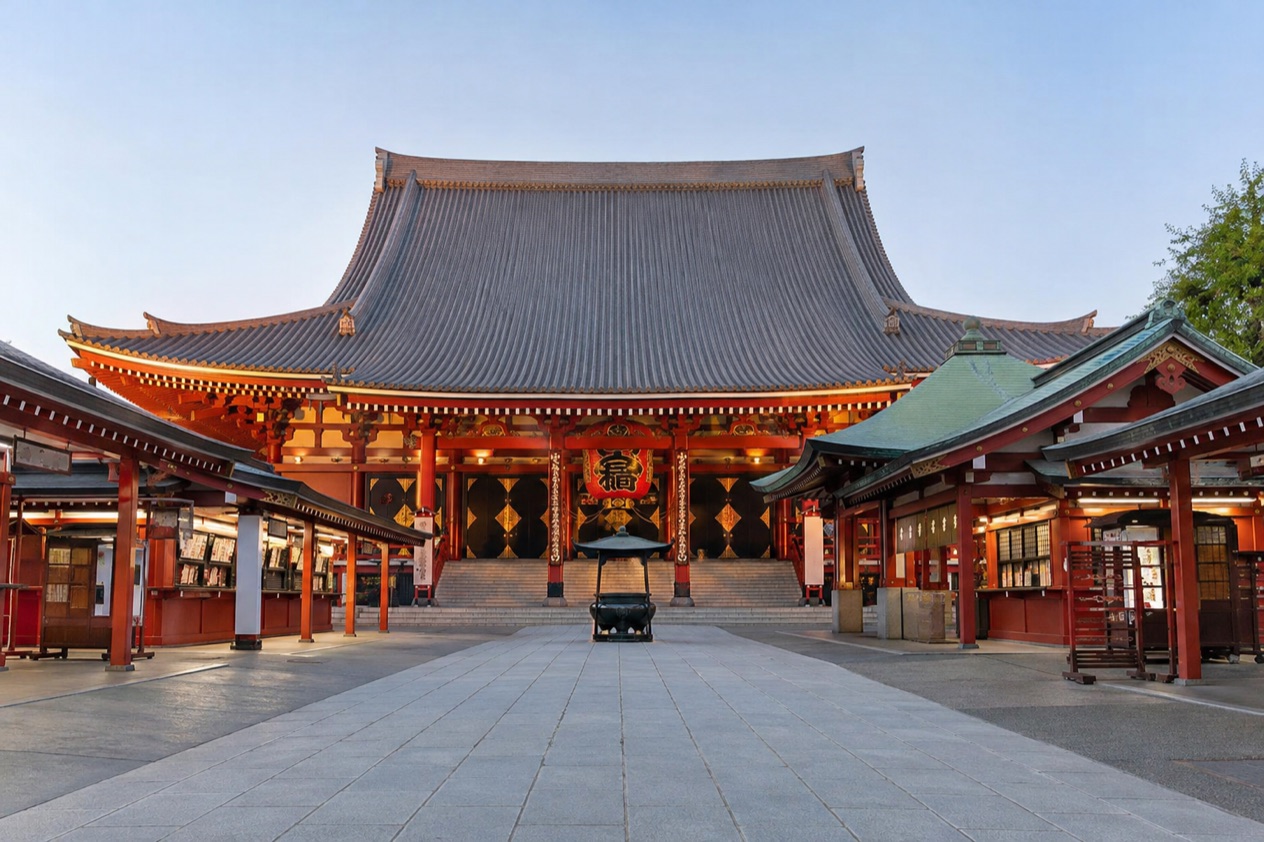
The Main Hall is the heart of Senso-ji, dedicated to Kannon. It was destroyed in the Great Tokyo Air Raid on March 10, 1945 and rebuilt in 1958. Visitors approach, toss a coin, bow and pray, and many wave incense smoke over themselves from the great burner in front.
Niten-mon Gate, restored to its original state in 2010, is another part of the grounds worth finding. The garden of the Denboin is closed to the public, so do not plan on it. Instead, spend your time watching the rituals in the courtyard and looking at the roofline of the hall.
Hours, tickets and rules
The sources for this visit give no opening hours and no admission fee, so there is no table of times or prices to show. What they do give is the shape of the visit: a temple approached through two gates and a market street, with a main hall at the end and a courtyard where people pray.
The one access limit that is stated is that the garden of the Denboin is closed to the public. Everything else, the gates, Nakamise-dori and the hall courtyard, is what you walk toward and look at as part of the visit.
During Sanja Matsuri, the festival centered on Senso-ji, surrounding streets are closed to traffic from dawn until late evening. That affects how you move around the neighborhood on those days, whether on foot or by other means.
When to visit Senso-ji
The great draw of the calendar is Sanja Matsuri, Tokyo’s largest and most popular festival, which takes place over 3 to 4 days in late spring. Senso-ji is its focus, and the surrounding streets close to traffic from dawn until late evening. If you like festivals, plan around it. If you want the temple at its calmest, avoid those days.
Two other dates belong to the temple’s year. Setsubun, the spring celebration, takes place around February 3rd, and Hana Matsuri, the celebration of Buddha’s birthday, takes place on April 8. Both give the grounds a ceremonial atmosphere that a plain visit does not.
As for weather, January in Tokyo has cool, dry days with some sunshine, and a little snow can fall. April is milder, with more rain days. July is hot and humid, so a walk along an open street feels heavy. October brings comfortable temperatures but also wet days.
| Month | Average high (°F) | Average low (°F) | Precipitation (inches) | Days with rain (1 mm+) |
|---|---|---|---|---|
| January | 49.6 | 34.2 | 2.35 | 4.5 |
| April | 66.9 | 49.6 | 5.26 | 9.5 |
| July | 85.8 | 72.3 | 6.15 | 10.5 |
| October | 71.6 | 58.6 | 9.24 | 10.5 |
Pick the month that suits your tolerance for heat or rain, and bring layers for the cooler months.
Tips for your visit
Plan the visit as a walk in order: Kaminarimon, Nakamise-dori, Hozomon, then the hall. That sequence gives the temple its sense of arrival, and it lets you decide how long to linger at each step. A light snack from the market street keeps you going.
Bring something for the weather of your month: a light layer for January, an umbrella for April or October, and water and a hat for July. With the number of people who visit, expect to move at the pace of the crowd in the busiest stretches.
Asakusa pairs well with other parts of Tokyo. Ginza is an upscale downtown area with high-end restaurants and luxury shops, and Nihonbashi is known for its heritage and is the main financial district of Japan. Both are in Tokyo and make a contrast with the temple’s market street.
If you are arriving from abroad, Tokyo’s nearest airports are Haneda Airport, officially Tokyo International Airport, and Narita Airport, Japan’s largest international airport. For families, the market street’s toys and sweets give children something to look at, though the sources give no details on strollers or step-free routes.
Good to know before you go
Senso-ji is a place of worship as well as a sight, so it is natural to keep your voice low near the hall and to wait your turn at the offering box. Prices at the market stalls are up to each shop, and the sources give no fee for the temple grounds. In rainy months, a compact umbrella is useful for the open courtyard and the long approach.
Sources
- Asakusa Kannon Sensoji (https://www.senso-ji.jp/english/), checked October 11, 2026
- Wikipedia, Sensō-ji (https://en.wikipedia.org/wiki/Sens%C5%8D-ji), checked October 11, 2026
- Japan National Tourism Organization, Tokyo (https://www.japan.travel/en/destinations/kanto/tokyo/), checked October 11, 2026
- Japan Meteorological Agency (JMA), Normal values 1991-2020, monthly (https://www.data.jma.go.jp/stats/etrn/view/nml_sfc_ym.php?prec_no=44&block_no=47662), station Tokyo, elevation 25 m, checked October 11, 2026
To plan your stay
- Best Time to Visit Japan: Cherry Blossoms, Autumn Colors, Weather and Festivals
- Where to Stay in Japan: Ryokan, Temple Stays, Capsule Hotels and the Best Cities to Base In
- Sending Luggage from the Airport in Japan: Hands-Free Travel, Hotel Delivery and Coin Lockers
- Know Before You Go to Japan: Entry, Money, Etiquette and Getting Around