
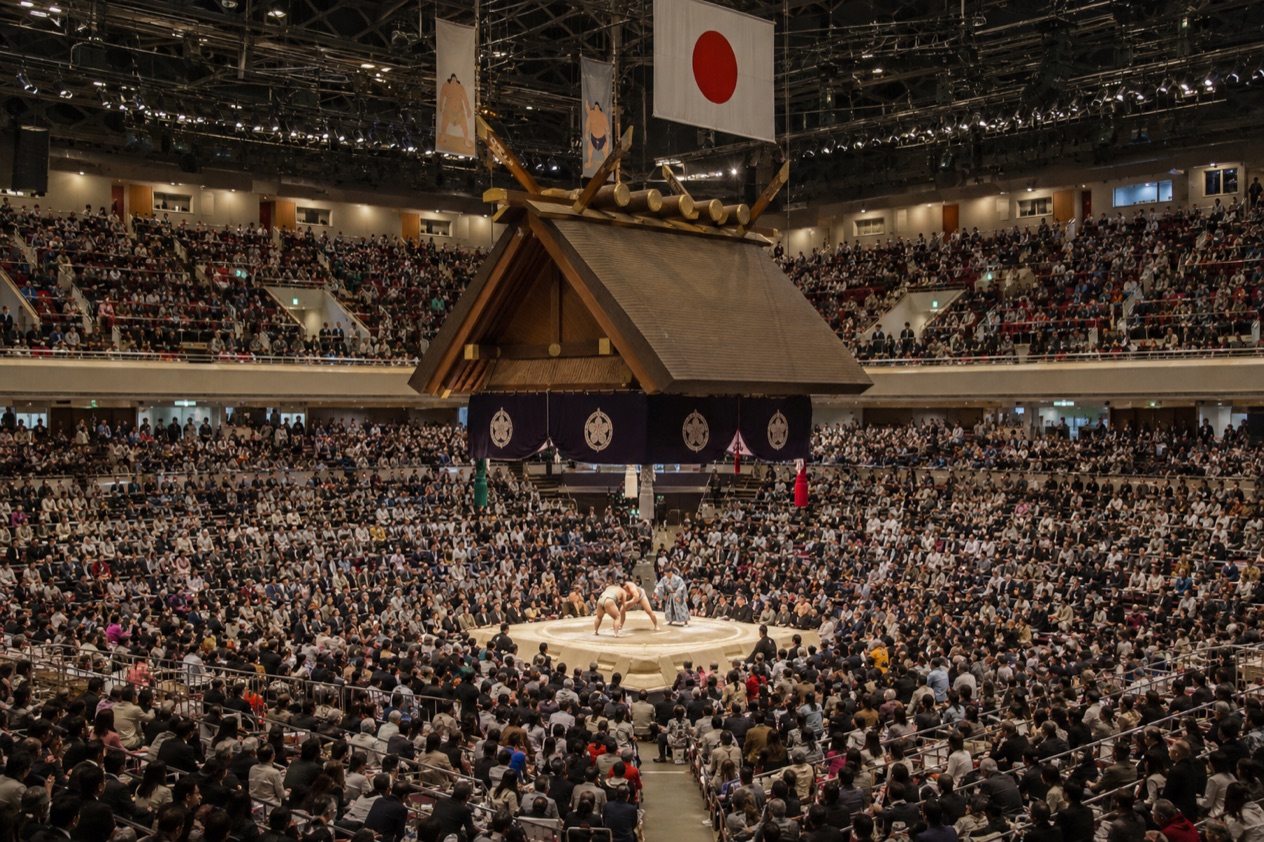
Near Ryogoku, the day begins with a drum and ends with a wrestler’s bow. Inside the Kokugikan, the roof of the ring hangs over a clay platform, and the youngest wrestlers step up first while the seats are still filling. Tokyo hosts sumo in three months of the year, and a day in the arena is part sport, part ritual, part long, unhurried afternoon.
Is visiting sumo in Tokyo worth it?
Yes, for anyone curious about Japan beyond its temples and food halls, and especially for travelers who like to understand what they are watching as it unfolds. Sumo is considered the national sport of Japan, and the country is the only one where it is practiced professionally, so a tournament day in Tokyo is a look at something that exists nowhere else in the same form.
What sets a tournament apart from other cultural outings in the city is how it builds. Kabuki and Noh follow a script. Takigi Noh, the firelit Noh performance, belongs to Kofukuji in Nara and Heian-jingu in Kyoto, and Kagura dance belongs to Takachiho in Miyazaki Prefecture. Sumo in Tokyo is a live contest with no script, played out over fifteen days, in a single arena in the Yokoami neighborhood of Sumida.
Bouts are brief and the ceremony around them is long, which is half the pleasure. Wrestlers throw salt, stamp, crouch and stare, and then the clash is over in moments.
The top division caps a match at four minutes, so a long afternoon is a string of small dramas that rise toward the yokozuna bouts at the end. It suits curious first-timers, families with older children who like spectacle, and anyone who enjoys learning the rules as the day goes on.
What to see at sumo in Tokyo
The bouts and the dohyo
The center of everything is the dohyo, the ring, a circle of packed clay with a diameter of 4.55 meters (14.9 feet). Women are not permitted to enter the ring or compete in professional sumo, a tradition tied to the sport’s Shinto roots that you will see reflected in the rituals around the platform.
Watch the lower ranks early in the day, when the arena is quieter and the wrestlers are young. Wrestling starts in the morning with the jonokuchi wrestlers, the newest rank, and builds toward the top division.
Look for the salt thrown before a bout and the long staredowns, then the sudden clash that decides it. Wrestlers from the same training stable, or brothers, do not face each other in regular play, which shapes who meets whom.
The Sumo Museum
The Kokugikan includes a Sumo Museum on its premises, a good place to understand the sport’s history and its objects between bouts or before the day begins. Expect displays that explain the ranks, the ceremonial aprons and the lineage of champions. It adds context to what you then see in the ring, and it is easy to pair with a stroll around the building.
Chankonabe and Tea House Street
Chankonabe is the hearty stew that wrestlers eat to build their size, a pot of broth with chicken or fish, tofu and plenty of vegetables. The Kokugikan has restaurants or a banquet hall for chankonabe tasting, so you can try the dish where sumo lives.
A corridor called Tea House Street, or Chaya-dori, holds souvenir shops, and it is where you pick up small keepsakes tied to the sport. Near the main entrance stand two Inari shrines, Toyokuni Inari and Shusse Inari, worth a quiet moment before you go in.
Hours, tickets and rules
A tournament day runs from the morning bouts of the lowest ranks to the yokozuna bouts around 6:00 p.m. Sumo elders announce the following day’s matchups around 12 p.m. each day, and the final day’s matchups come later, on day 14. Each tournament begins on a Sunday and ends fifteen days later, on a Sunday.
| Site | Open |
|---|---|
| Ryogoku Kokugikan, tournament days | Morning to around 6:00 p.m. |
Beyond the schedule, the rules in play are those of the sport itself. Women do not enter the ring. Wrestlers from one stable or one family do not meet in regular bouts, except in a playoff to decide the championship. A top-division bout lasts four minutes at most.
How to get to sumo in Tokyo
The Kokugikan stands in the Yokoami neighborhood of Sumida, next to the Edo-Tokyo Museum. Tokyo sits on Tokyo Bay in the Kanto region, and its nearest airports are Haneda Airport, officially Tokyo International Airport, and Narita Airport, Japan’s largest international airport.
From central districts, the arena is reached within the city itself. If you are staying in Roppongi or Akasaka, those districts connect to Shibuya Station in about 10 minutes by train. Roppongi Station has the Tokyo Metro Hibiya Line and Toei Oedo Line, Nogizaka Station the Tokyo Metro Chiyoda Line, and Roppongi-Itchome Station the Tokyo Metro Namboku Line.
Ginza and Nihonbashi, with their luxury shops and financial heritage, are also districts of the same city, so a day that starts there and ends at the arena stays within Tokyo. The arena’s address and its neighbor, the Edo-Tokyo Museum, are the landmarks to hold on to when you plan your route.
When to visit sumo in Tokyo
Tokyo hosts tournaments in January, May and September. Elsewhere in the year, Grand Sumo moves to Osaka in March, Nagoya in July and Fukuoka in November, so Tokyo’s three months are the ones to aim for if you are in the capital.
January is cold and bright in Tokyo, with highs near 50°F, lows in the mid-30s and about 193 hours of sunshine over the month. Snow is possible, with 1.6 inches in an average January, so a warm coat suits the walk to the arena. September, by contrast, follows the warm months and the rain of the season, so a lighter layer and an umbrella fit the days.
Within a tournament, the early hours bring the lower ranks and the late afternoon brings the top division, ending around 6:00 p.m. with the yokozuna. Each tournament starts on a Sunday and ends on a Sunday, and the final day, day 15, is when the championship is decided. A charity event, the NHK Welfare Sumo Tournament, is held at the Kokugikan each February.
Tips for your visit
The arena seats 11,098, and it opened on January 9, 1985, so it is a modern building with the feel of a traditional hall. You can come for the afternoon and still catch the top-division bouts toward the end of the day.
Arrive with time for the surroundings. The Sumo Museum is on the premises, Tea House Street holds souvenir shops, and the restaurants serve chankonabe. The two Inari shrines near the main entrance are a short pause before you step inside.
The arena also hosted the boxing competition at the 2020 Summer Olympics, a fact that says something about its size and standing in the city. Pairing the visit with the Edo-Tokyo Museum next door turns the outing into a broader look at the neighborhood. A rainy day does not change the plan, since the bouts are held indoors.
Good to know before you go
Tournament days are long, so pace the day with a meal at the arena and time at the museum rather than trying to watch every bout. The rainy stretches of early autumn and the cold of January are the weather to dress for, since you walk to and from the building outdoors. The sport has its own customs, and following the rituals around each bout is part of the enjoyment.
Sources
- Japan National Tourism Organization, performing arts (https://www.japan.travel/en/things-to-do/art-and-design/performing-arts/), checked October 11, 2026
- Wikipedia, Ryōgoku Kokugikan (https://en.wikipedia.org/wiki/Ry%C5%8Dgoku_Kokugikan), checked October 11, 2026
- Wikipedia, Sumo (https://en.wikipedia.org/wiki/Sumo), checked October 11, 2026
- Japan National Tourism Organization, Tokyo (https://www.japan.travel/en/destinations/kanto/tokyo/), checked October 11, 2026
- Japan Meteorological Agency (JMA), Normal values 1991-2020, monthly (https://www.data.jma.go.jp/stats/etrn/view/nml_sfc_ym.php?prec_no=44&block_no=47662), station Tokyo, elevation 25 m, checked October 11, 2026
To plan your stay
- Best Time to Visit Tokyo: Cherry Blossoms, Autumn Leaves, Weather by Month and Festivals
- Where to Stay in Tokyo: Shinjuku, Shibuya, Asakusa, Ginza and Roppongi
- Tokyo from the airport: Narita and Haneda, the Skyliner, Local Trains and Taxis
- Know Before You Go to Tokyo: Entry, Money, Getting Around and Local Etiquette