
In a Tokyo station, among commuters in suits and travelers dragging suitcases, the idea of a soak in water that comes straight off a volcano starts to sound very good. Kusatsu Onsen sits in the mountains of Gunma Prefecture, northwest of the capital, and a bus from Shinjuku or Tokyo Station goes there directly. A second route links a rail station and the resort by local bus.
How do you get from Tokyo to Kusatsu Onsen?
The most direct way is the Joshu Yumeguri bus, which runs from Shinjuku Station or Tokyo Station to the Kusatsu Onsen Bus Terminal by way of Ikaho Onsen. You board in the city, ride out of the capital and arrive in the middle of a hot spring town without changing vehicles. For anyone who dislikes juggling luggage between platforms, that single line is the simplest picture to hold in your mind.
The other route has two parts. You reach Naganohara-Kusatsuguchi Station, then take the Kusatsu Line bus from there up to Kusatsu Onsen. It is a way of arriving by rail for the first part of the trip and by road for the last.
The bus from Shinjuku or Tokyo Station
Two Tokyo starting points are named for the Joshu Yumeguri bus, and they suit different travelers. Shinjuku Station is the hub of the west side of the city, a maze of JR, private and subway lines, so it works if you are staying in that part of town. Tokyo Station, in the business district near Nihonbashi and Ginza, suits those arriving from the Shinkansen platforms or staying in the center.
The route passes through Ikaho Onsen, another hot spring town, before it ends at the Kusatsu Onsen Bus Terminal. That stop is a hint of what the region is about. Gunma Prefecture is a place of baths, and the road you take is a chain of them.
Once you step off at the terminal, you are in the town itself. Many visitors head straight for the baths on foot, carrying a small towel and a change of clothes.
Rail to Naganohara-Kusatsuguchi, then the Kusatsu Line bus
The Kusatsu Line bus leaves from Naganohara-Kusatsuguchi Station and ends in Kusatsu Onsen. It suits travelers who prefer to spend the first stretch on a train, watching the Kanto plain give way to hills. Japanese trains have a reputation for being always on time, which lets you plan the handoff from rail to bus to the minute.
Tokyo has several railway families, including JR trains, Tokyo Metro lines and Toei Subway lines. To start this route you first need to reach a JR or other long-distance platform from wherever you sleep, and the city’s subway network usually gets you there. Then the station named above becomes your pivot point.
Which options are there?
There are two: a direct bus from Tokyo, and a rail-then-bus combination via Naganohara-Kusatsuguchi Station. Each ends in the same place, a town built around its hot water, so the choice comes down to how you like to travel.
| Option | Starts at | Ends at | Route |
|---|---|---|---|
| Joshu Yumeguri bus | Shinjuku Station or Tokyo Station | Kusatsu Onsen Bus Terminal | Via Ikaho Onsen |
| Rail, then Kusatsu Line bus | Naganohara-Kusatsuguchi Station | Kusatsu Onsen | Bus from the station |
Choosing the direct bus
The direct bus is one vehicle from city to resort, with a stop at Ikaho Onsen on the way. You carry your bags once, and you arrive in Kusatsu without having to read a timetable at a connecting station. For a first visit to Japan’s hot spring towns, that makes the plan easy to hold in your head.
It also gives you a choice of departure point. If your hotel is near Shinjuku, you do not need to cross town to Tokyo Station, and the reverse holds if you are staying near Ginza or Nihonbashi.
Choosing rail and the local bus
Rail suits travelers who like to see the landscape change from a train window, and who are comfortable with a transfer. Local trains in Japan stop at every station, which makes them a fit for short distances, while rapid trains skip smaller stations without charging a supplement. Which kind you ride depends on the line and the service you board.
The last part is the Kusatsu Line bus from Naganohara-Kusatsuguchi Station. After the platform, you look for the bus stop, and the road takes you up into the mountains where the town sits.
Driving and road signs
If you are thinking of going by road, two things are worth knowing from the start. Traffic in Japan moves on the left side of the road, which takes some adjustment for American drivers. And if you do not read Japanese, you will have trouble understanding road signs. For many visitors those two facts are reasons to let a bus driver handle the mountain roads and spend the trip looking out of the window instead.
What should you know before you travel from Tokyo to Kusatsu Onsen?
Know that you are heading to a hot spring resort in the mountains, where the baths are the reason for the trip. Kusatsu Onsen sits in Gunma Prefecture, northwest of Tokyo, and the town itself stands about 1,200 meters above sea level. The altitude is part of its character, and it is the reason you will be climbing on the last stretch of the journey.
What the baths are like
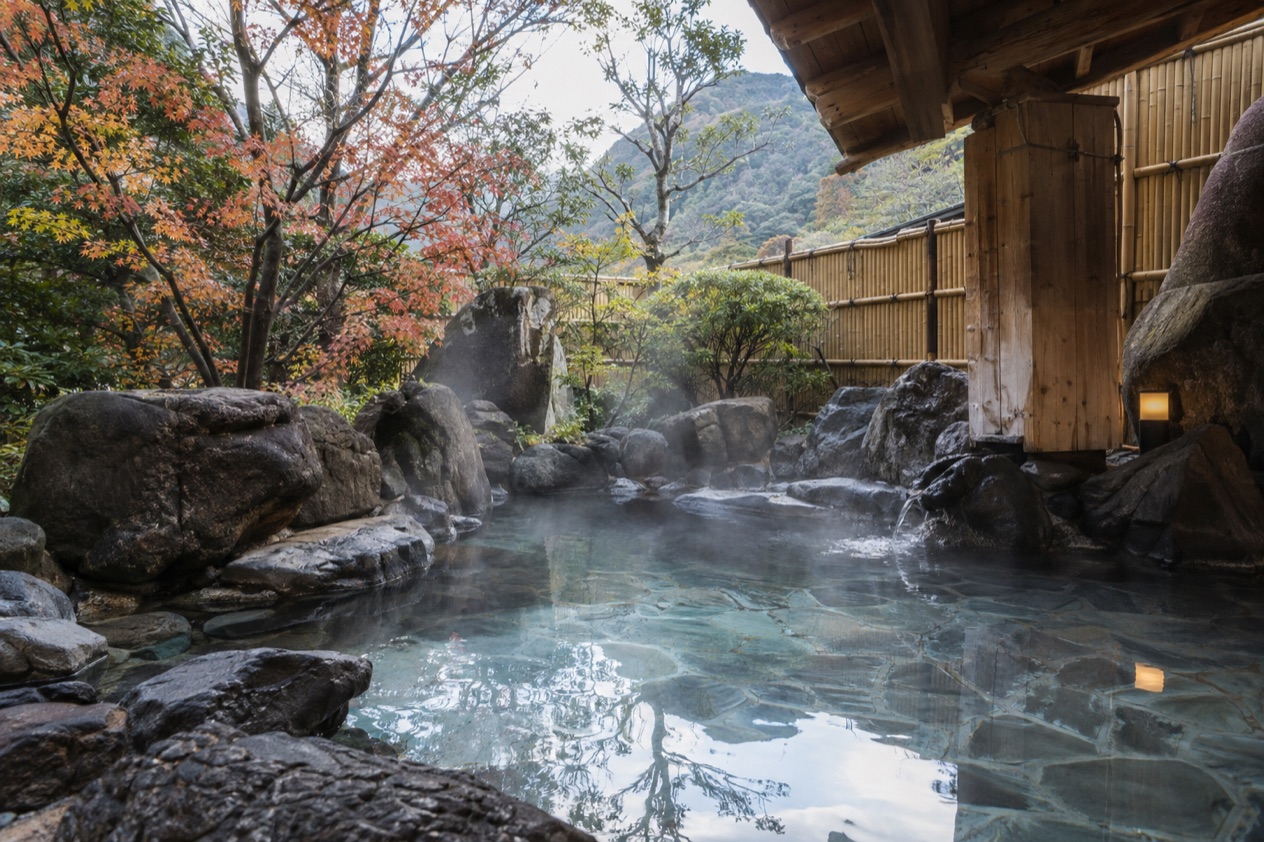
Kusatsu Onsen has 13 public baths. The hot water comes from nearby Mount Kusatsu-Shirane, and the baths do not all rely on the same sources, so the water looks different from place to place, from cloudy to clear. Moving between baths in a single stay is a way to see that for yourself.
There are also small bathhouses managed by the townspeople themselves. They are free for both town residents and tourists, which makes them a pleasant glimpse into how the town lives with its water. Towels, a change of clothes and a light step help when you move from one bath to the next.
A resort with a reputation
Kusatsu became well known after Erwin von Balz, a German doctor who taught medicine at Tokyo University, recommended the water for its health benefits. Locals like to say that the springs can cure all forms of ailments, other than lovesickness. Guests have claimed that pain disappears while soaking in the hot water.
Those are the stories you hear in town, told with a smile. The flow behind them is real enough. Water for the town originates from Mt. Shirane at more than 32,000 liters per minute, one of the largest natural outputs of hot spring water in Japan, and the town is described as one of the most famous hot spring resorts in the country.
Planning around the transfers
If you choose the rail route, plan the handoff at Naganohara-Kusatsuguchi Station with care. The Kusatsu Line bus is a separate vehicle from the train, and you will want your bags and your onward plan ready when you step onto the platform.
If you choose the Joshu Yumeguri bus, the plan is simpler. You pick Shinjuku Station or Tokyo Station, settle into your seat and let the route carry you through Ikaho Onsen to the Kusatsu Onsen Bus Terminal.
Good to know before you go
Kusatsu Onsen is a popular tourist destination, and a mountain town with its own pace, so it is worth thinking about what you carry. Small items for the baths, such as a towel and a change of clothes, are enough for many visits to the public bathhouses.
The free small bathhouses run by the townspeople invite a respectful, low-key approach, as guests in a place that residents use every day. Whichever route you pick from Tokyo, the town gives you a reason to slow down once you arrive.
Sources
- Wikipedia, Kusatsu Onsen (https://en.wikipedia.org/wiki/Kusatsu_Onsen), checked October 11, 2026
- Japan National Tourism Organization, Tokyo (https://www.japan.travel/en/destinations/kanto/tokyo/), checked October 11, 2026
- Wikipedia, Kusatsu, Gunma (https://en.wikipedia.org/wiki/Kusatsu,_Gunma), checked October 11, 2026
- Wikivoyage, Kusatsu (https://en.wikivoyage.org/wiki/Kusatsu), checked October 11, 2026
- U.S. Department of State, Japan travel information, travel and transportation (https://travel.state.gov/content/travel/en/international-travel/International-Travel-Country-Information-Pages/Japan.html), checked October 11, 2026
- Japan National Tourism Organization, trains and buses (https://www.japan.travel/en/guide/how-to-travel-by-train-and-bus-in-japan/), checked October 11, 2026
- Japan National Tourism Organization, traveling by rail (https://www.japan.travel/en/guide/traveling-by-rail/), checked October 11, 2026