
Somewhere between the ticket gates of Shinjuku and the first glimpse of a white cone above the rooftops, most trips to Mount Fuji begin with a small puzzle: which train, and which ticket? The answer is a direct limited express called the Fuji Excursion, which runs from Shinjuku Station to Kawaguchiko Station at the foot of the mountain. Slower routes on local and rapid trains exist too, and the right choice depends on the pass in your pocket.
How do you get from Tokyo to Mount Fuji?
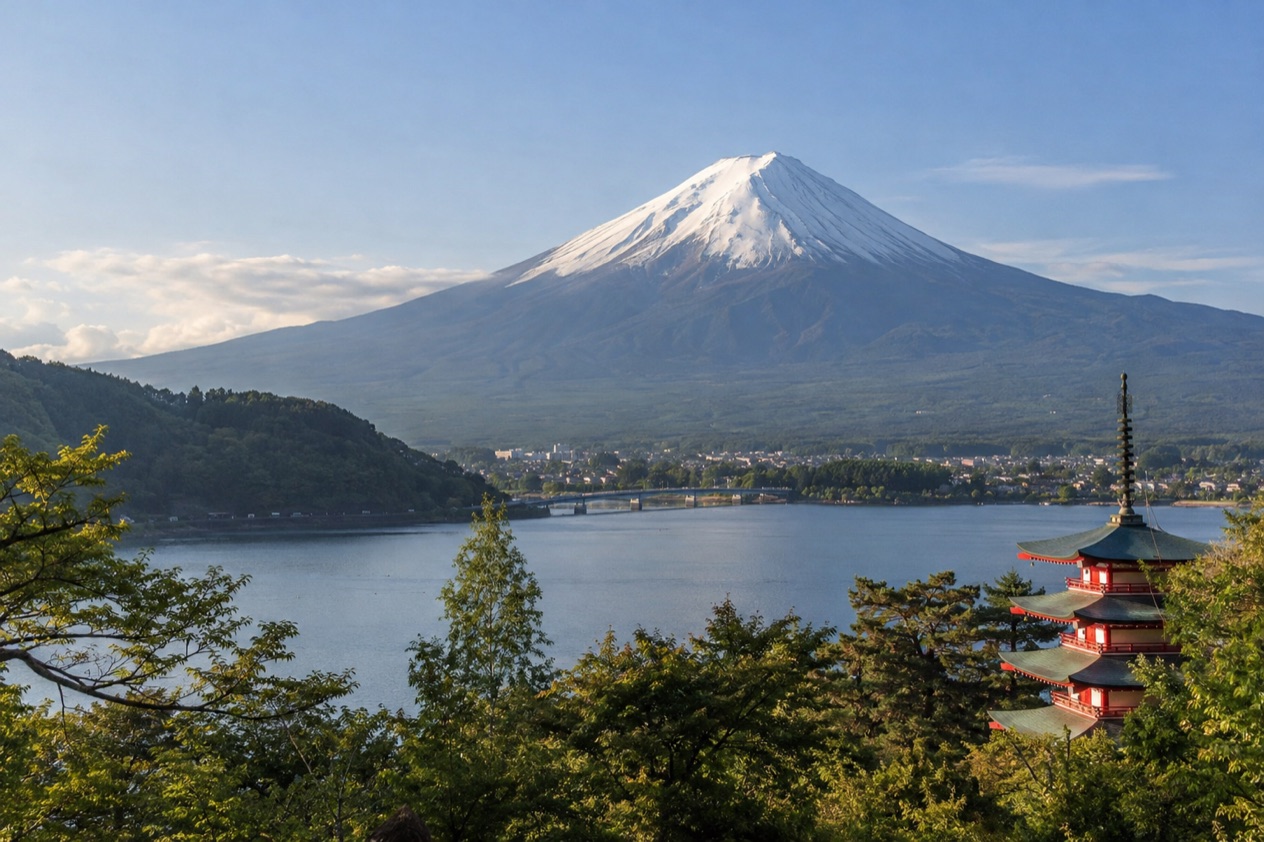
The most direct way is the Fuji Excursion, a limited express that runs from Shinjuku Station in Tokyo to Kawaguchiko Station in Yamanashi Prefecture, on the Chuo Line and then the Fujikyuko Line. Kawaguchiko is the gateway to the northern Yamanashi side of the mountain and to the Fuji Five Lakes, which belong to Fuji-Hakone-Izu National Park. You leave the Tokyo skyline behind and arrive in a lakeside town with the mountain overhead.
Boarding at Shinjuku
Shinjuku is one of the stations where Tokyo’s operators meet. JR trains, Tokyo Metro lines and Toei Subway lines all serve the city, so reaching the Fuji Excursion platform from wherever you are staying usually means a ride on one of them first. Japanese trains have a reputation for running on time, which lets you plan a morning around a departure to the minute.
The Fuji Excursion runs four round trips a day, so the departure you pick shapes the rest of your plan. The trains are E353 series electric units of three cars, short and bright, and the service has run since March 2019. Between Otsuki and Shinjuku the Fuji Excursion is coupled with an Azusa or Kaiji limited express, and the cars separate at Otsuki to go their own ways.
Stops along the way
The train calls at Shinjuku, Tachikawa, Hachioji, Otsuki, Tsurubunkadaigakumae, Shimoyoshida, Mt. Fuji, Fujikyu-Highland and Kawaguchiko. The names tell the story of the trip: first the western suburbs of Tokyo, then the junction at Otsuki, then the small stations of the Fujikyuko Line that lead to the mountain.
A station called Mt. Fuji and another named for the Fujikyu-Highland amusement park sit just before the terminus. Kawaguchiko itself is the end of the line, so there is no risk of riding past it. From there you are in the town of Fujikawaguchiko, with the lakes and the mountain around you.
The Fujikyuko Line from Otsuki
After Otsuki the route belongs to the Fujikyuko Line, a private railway run by Fuji Kyuko, and the landscape changes. The line climbs steadily into the hills, and in many places along it Mount Fuji can be seen from the train. Sit by a window if you have a choice.
| Fujikyuko Line | Value |
|---|---|
| Length, Otsuki to Kawaguchiko (km) | 26.6 |
| Elevation at Otsuki Station (m) | 358 |
| Elevation at Kawaguchiko Station (m) | 857 |
| Local trains, stopping at all stations | About every 30 minutes |
The line’s roots go back to the Tsuru Horse-drawn Tramway, which began running in 1900. It is the only railway to reach this side of the mountain and the Five Lakes, which is why every rail route to Kawaguchiko ends on it.
Which options are there?
There are three main ways to make the trip: the direct Fuji Excursion, ordinary trains that stop at stations along the way, and the road. Each suits a different kind of day, and your rail pass, if you carry one, matters more than anything else.
The Fuji Excursion
This is the direct limited express described above, and it is the option that keeps you in one seat from Shinjuku to the lake. It needs a limited express ticket in addition to the basic fare ticket. You choose between a Reserved Seat Ticket and an Unreserved Seat Ticket, and the lamps above the seats show which is which.
| Ticket | What it gives you |
|---|---|
| Reserved Seat Ticket | A specific seat, marked by a green overhead lamp |
| Unreserved Seat Ticket | Any unreserved seat, marked by a red overhead lamp |
| Yellow lamp above a seat | The seat is reserved for a later part of the journey |
Local and rapid trains
Local trains in Japan stop at every station, which suits short distances, and rapid trains skip the smaller stations without asking for a supplement. On the Fujikyuko Line the local trains run about every 30 minutes. Taking them means leaving the Chuo Line at Otsuki and continuing on the Fujikyuko Line, where the hillside stations pass slowly by.
Several Fujisan Tokkyu limited express services also run on the Fujikyuko Line in addition to the local trains. These are the Mount Fuji express trains of the line itself, separate from the Fuji Excursion that starts in Shinjuku.
By road
Traffic in Japan moves on the left side of the road, and if you do not know Japanese you will have trouble understanding the road signs. Those two facts are worth weighing if you are considering a drive from Tokyo, a city on Tokyo Bay in the Kanto region of Honshu with a dense network of expressways and rail lines of its own.
The rail routes above end at Kawaguchiko with the mountain in view and nothing to navigate. Those who do take the wheel can treat the mountain as a compass, since it dominates the horizon as you approach.
Passes and the Fuji Excursion
| Pass | Fuji Excursion coverage |
|---|---|
| Japan Rail Pass | Free of charge only between Shinjuku and Otsuki |
| JR East Pass | Free of charge only between Shinjuku and Otsuki |
| JR East Tokyo Wide Pass | Includes the Fujikyuko section between Otsuki and Kawaguchiko |
Beyond Otsuki, holders of the first two passes need a supplementary ticket for the Fujikyuko section. It can be purchased in advance at Fuji Kyuko stations or on the train.
What should you know before you travel from Tokyo to Mount Fuji?
Know your ticket, know where your pass stops working, and keep in mind that you are traveling toward the mountain, not onto it. The tickets are the part that surprises people most, because a limited express adds a layer on top of the ordinary fare.
Tickets and seats
A passenger boarding the Fuji Excursion must hold a limited express ticket in addition to the basic fare ticket. Once aboard, the lamps above the seats do the explaining: green for a seat reserved for the holder of a Reserved Seat Ticket, red for a free seat that Unreserved Seat Ticket holders may take, and yellow for a seat reserved for a later stretch of the journey.
The yellow lamp matters because the train fills and empties as it runs. A seat that looks free may be held for someone boarding further along the line, so look at the lamp before you settle in with your bags.
Paying on the Fujikyuko Line
Fuji Kyuko railway and bus lines accept Pasmo, Suica and other IC farecards, and the railway has done so since March 2015. For travelers who already carry a card for Tokyo’s trains and subways, that means no separate paper ticket for the basic fare on the line, though the Fuji Excursion’s own ticket requirements still apply.
Seeing and climbing the mountain
Mount Fuji is the highest mountain in Japan and a UNESCO World Heritage site. From the Fujikyuko Line you see it through the window, and from Kawaguchiko you are at the edge of the Five Lakes with the mountain behind them. A train ride and a walk by the water are an outing in themselves, and nothing about it requires going up the slopes.
Visitors planning to climb are strongly advised to check the latest information on the Official Website for Mt. Fuji Climbing before they go.
Arriving in Tokyo first
Most travelers reach Tokyo through Haneda Airport, officially Tokyo International Airport, or Narita Airport, Japan’s largest international airport. Whichever you land at, the journey to Shinjuku is the first step of the trip to Fuji. Neighborhoods such as Ginza, with its luxury shops and high-end restaurants, and Nihonbashi, the main financial district, are good reminders that the capital has plenty to hold you before or after the mountain.
Good to know before you go
IC cards such as Suica and Pasmo work on Fuji Kyuko railway and bus lines, which keeps small payments simple once you are in the Fuji Five Lakes area. The mountain, the lakes and the town of Kawaguchiko are all part of Fuji-Hakone-Izu National Park, and the weather around a peak this size can shift from one hour to the next, so a layer in the bag is a sensible habit. Japanese trains keep their schedules closely, and on a day with only a few Fuji Excursion departures, that precision is what lets you plan around them.
Sources
- Wikipedia, Fuji Excursion (https://en.wikipedia.org/wiki/Fuji_Excursion), checked October 11, 2026
- Wikipedia, Fujikyuko Line (https://en.wikipedia.org/wiki/Fujikyuko_Line), checked October 11, 2026
- Japan National Tourism Organization, Tokyo (https://www.japan.travel/en/destinations/kanto/tokyo/), checked October 11, 2026
- Japan National Tourism Organization, Mount Fuji guide (https://www.japan.travel/en/fuji-guide/), checked October 11, 2026
- Official website for Mt. Fuji climbing, about the climb (https://www.fujisan-climb.jp/en/about/), checked October 11, 2026
- U.S. Department of State, Japan travel information, travel and transportation (https://travel.state.gov/content/travel/en/international-travel/International-Travel-Country-Information-Pages/Japan.html), checked October 11, 2026
- Japan National Tourism Organization, trains and buses (https://www.japan.travel/en/guide/how-to-travel-by-train-and-bus-in-japan/), checked October 11, 2026
- Japan National Tourism Organization, traveling by rail (https://www.japan.travel/en/guide/traveling-by-rail/), checked October 11, 2026