
The doors of the arrivals hall slide open, and the first thing you notice is how orderly everything feels: signs in Japanese and English, luggage trolleys lined up, travelers pulling suitcases toward the station level. If you came for the castle, the parades and the churro carts of Tokyo Disney Resort, the trip begins here, at the airport in Narita, in Chiba. Before you reach the park gates there is a choice to make among the rail lines that run from the airport into Tokyo.
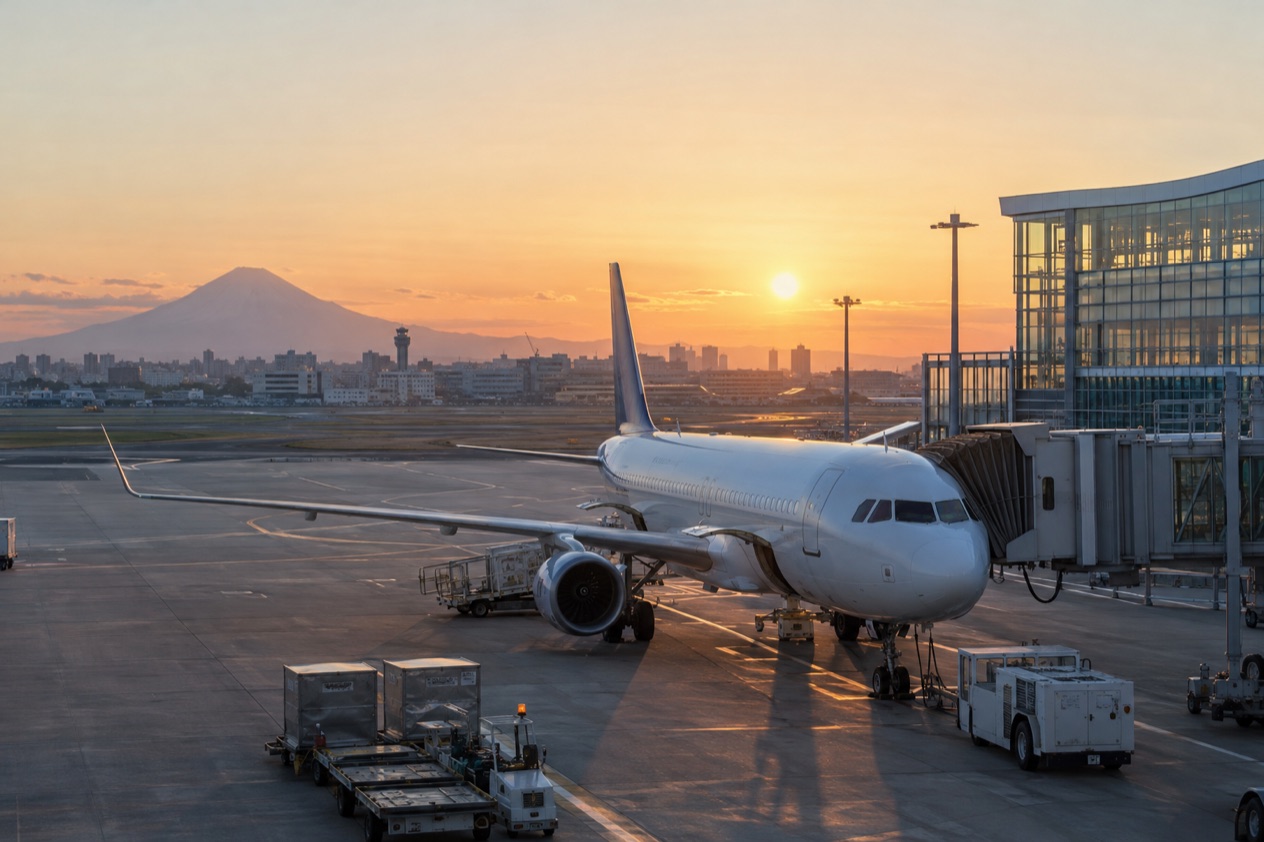
How do you get from the airport to Tokyo?
By train, on one of three rail lines: the Narita Sky Access line, the Keisei line and the JR line. Narita International Airport is about 37 miles east of central Tokyo, in Narita, so the ride into the city is a real journey and not a hop. Each line has its own named trains, its own stations and its own way of reaching the capital.
The JR side brings you in on the Narita Express, which stops at Tokyo Station, Shinagawa, Shibuya, Shinjuku, Yokohama and Ofuna. The Keisei side runs the Skyliner, the Access Express and the Keisei Main Line toward Nippori and Keisei Ueno. Which one suits you depends on where you are heading first, how much luggage you carry and which terminal you land at.
A traveler heading for Tokyo Disney Resort and a traveler heading for a hotel in Shinjuku may leave the airport by different trains. For the resort, the question is which big station you want to pass through on the way. Tokyo Station and Shinagawa sit on the JR route, while Nippori and Keisei Ueno sit on the Keisei route. From any of them you continue on Tokyo’s rail network.
Your arrival terminal matters too. Narita has three, and the trains do not call at them in the same way. Reading the station names on the signs before you board saves a wrong turn after a long flight.
Your options from the airport
The JR Narita Express
The Narita Express, often shortened to NEX, is the JR-East train built for airport passengers. It stops at Narita Airport Station for Terminal 1 and at Airport Terminal 2 Building Station for Terminals 2 and 3, then runs on through Narita Station and Chiba Station before reaching Tokyo Station.
After Tokyo Station it continues to Shinagawa, Shibuya and Shinjuku, and farther on to Yokohama and Ofuna. That makes it a fit if your hotel is in Shibuya or Shinjuku, or if you plan to change at Tokyo Station for the rest of the trip. The train serves Tokyo, Shibuya, Shinjuku and the West Tokyo area.
The Keisei Skyliner
The Skyliner is the Keisei company’s airport train. It calls at Narita Airport Station for Terminal 1 and Airport Terminal 2 Building Station for Terminals 2 and 3. In the city its stops are Nippori Station and Keisei Ueno Station, with some trains also stopping at Aoto Station and Shin-Kamagaya Station.
Nippori is a junction station, and Ueno is a neighborhood of museums, a large park and the Ameyoko market streets. If your Tokyo stay is on the Ueno side of town, this is the line whose stations match your plans.
Keisei Access Express and the Keisei Main Line
The Keisei Access Express serves both airport stations and then Shin-Kamagaya, Higashi-Matsudo, Keisei Takasago, Aoto, Nippori and Keisei Ueno. It is the Keisei route with the most stops between the airport and the city, which suits travelers whose hotel is near one of those smaller stations.
The Keisei Main Line is the other Keisei track. It reaches Keisei Narita Station, Keisei Funabashi, Keisei Takasago, Aoto, Nippori and Keisei Ueno. It runs through ordinary suburban stations, so you see the neighborhoods that sit between the airport and the capital.
The JR line
The JR line from Narita serves Tokyo, Shinagawa, Shibuya, Shinjuku, Ikebukuro, Yokohama and Ofuna. Ikebukuro is the one stop on this list that the Narita Express itself does not name, so it is the station to look for if your hotel is there.
All of these stations are major junctions with connections onward across the city. IC cards such as Suica and Pasmo work on trains, buses and boats, so one card can carry you from the airport platform to the rest of the trip.
Airport transfer options compared
| Option | Operator | Airport stations | Tokyo-area stops |
|---|---|---|---|
| Narita Express (NEX) | JR-East | Narita Airport Station (Terminal 1), Airport Terminal 2 Building Station (Terminals 2 & 3) | Tokyo, Shinagawa, Shibuya, Shinjuku, Yokohama, Ofuna |
| JR line | JR | Narita Airport Station (Terminal 1), Airport Terminal 2 Building Station (Terminals 2 & 3) | Tokyo, Shinagawa, Shibuya, Shinjuku, Ikebukuro, Yokohama, Ofuna |
| Skyliner | Keisei | Narita Airport Station (Terminal 1), Airport Terminal 2 Building Station (Terminals 2 & 3) | Nippori, Keisei Ueno (some trains also Aoto, Shin-Kamagaya) |
| Access Express | Keisei | Narita Airport Station (Terminal 1), Airport Terminal 2 Building Station (Terminals 2 & 3) | Shin-Kamagaya, Higashi-Matsudo, Keisei Takasago, Aoto, Nippori, Keisei Ueno |
| Keisei Main Line | Keisei | Narita Airport Station (Terminal 1), Airport Terminal 2 Building Station (Terminals 2 & 3) | Keisei Narita, Keisei Funabashi, Keisei Takasago, Aoto, Nippori, Keisei Ueno |
The real trade-off is which side of Tokyo you want to arrive on. The JR trains put you at Tokyo Station, Shinagawa, Shibuya or Shinjuku, which are the stations most travelers already have in mind, and they let you stay on one train for a long stretch of the journey. The Keisei trains bring you to Nippori and Keisei Ueno, which suits a hotel on that side of the city.
If you are going straight to the resort, think about which junction you would rather change at. Tokyo Station and Shinagawa are large interchanges where you can step off the airport train and onto another line. Nippori and Ueno work the same way on the Keisei side. The choice comes down to the line you will board next, and that is worth looking up for your own hotel and park day before you travel.
Within the Keisei family, the Skyliner, the Access Express and the Keisei Main Line differ in the stops they make between the airport and Nippori. Pick by looking at the station names on your itinerary and matching them to the train that calls there.
Arriving at the airport
Narita has three terminals, and the trains reach them through two stations. Terminal 1 is a 5-minute walk from Narita Airport Station. Terminals 2 and 3 share Narita Airport Terminal 2・3 Station on the platform side of the airport. Terminal 2 is a 5-minute walk from that station, and Terminal 3 is a 10-minute walk from it.
The trains use their own names for these stops. The Skyliner, the Narita Express and the Keisei lines all list Narita Airport Station (Terminal 1) and Airport Terminal 2 Building Station (Terminals 2 and 3). If you land at Terminal 3, you will see the Terminal 2 name on the train signs.
The terminals differ in size. Terminal 1 has 40 gates, and Terminal 2 has 32 boarding gates.
Terminal 3 is the one set up for low-cost airlines, and it was voted the best terminal for low-cost airlines in Asia by Skytrax in 2024. It also has a food court that stays open around the clock and is the largest airport food court in Japan, which is useful to know if you land at an odd hour.
Narita has a mandatory late-night curfew that prohibits aircraft operations between midnight and 6 a.m. For a Disney trip this means flights arrive and depart within the hours around that window. Plan your first night and your hotel check-in with that in mind.
Good to know before you go
An IC card such as Suica or Pasmo is worth having for this trip. These cards work on trains, buses and boats, in vending machines and convenience stores, and in some taxis. Most regions have their own cards with different names and characters, and they can be used throughout Japan, so a card from Tokyo also works in Kyoto or Osaka later.
Walking between a terminal and its station takes a few minutes, so keep luggage manageable. The train stations are built to be walked through, and the signs name each terminal.
Sources
- Narita International Airport, Access by rail (https://www.narita-airport.jp/en/access/train/), checked October 11, 2026
- Wikipedia, Narita International Airport (https://en.wikipedia.org/wiki/Narita_International_Airport), checked October 11, 2026
- Japan National Tourism Organization, Tokyo (https://www.japan.travel/en/destinations/kanto/tokyo/), checked October 11, 2026
- Japan National Tourism Organization, IC cards, Suica, Pasmo, ICOCA, how to use (https://www.japan.travel/en/plan/ic-card/), checked October 11, 2026