
Step out of Shibuya Station and the first thing you meet is the crossing, hundreds of people spilling in every direction under screens and signs, and above it a glass-and-steel tower that seems to hold the whole district in its shadow. Shibuya Sky sits on the roof of that tower, an open-air deck where the same crowd you were just part of shrinks to a pulse of tiny figures. It is a visit built around the view of Tokyo, with the building’s shops and restaurants close at hand.
Is visiting Shibuya Sky worth it?
Yes, if you want to understand how big Tokyo is and how Shibuya fits into it, and it suits first-timers, photographers and anyone who likes to see a city from above before walking it.
What sets it apart from other high places in the city is where it stands. The building rises straight above Shibuya Station and a few steps from the famous scramble crossing, so you look down on the very intersection that gives the tower its name.
It is also the tallest building in the Shibuya area, which means nothing nearby blocks the sightline. Other observation decks in Tokyo look out over offices, bay or harbor. Here the foreground is a living street scene, the neon, the shop fronts and the pulses of the crosswalk, and beyond it the long skyline of the capital.
Because the deck is part of a complex with shops, offices and restaurants, you can fold it into a longer afternoon and evening in the neighborhood rather than treat it as a single stop. That makes it a good fit for a first day in Tokyo, for a last evening before a flight home, or for an hour when you want to get your bearings between train rides.
What to see at Shibuya Sky
The rooftop deck and its 360-degree view
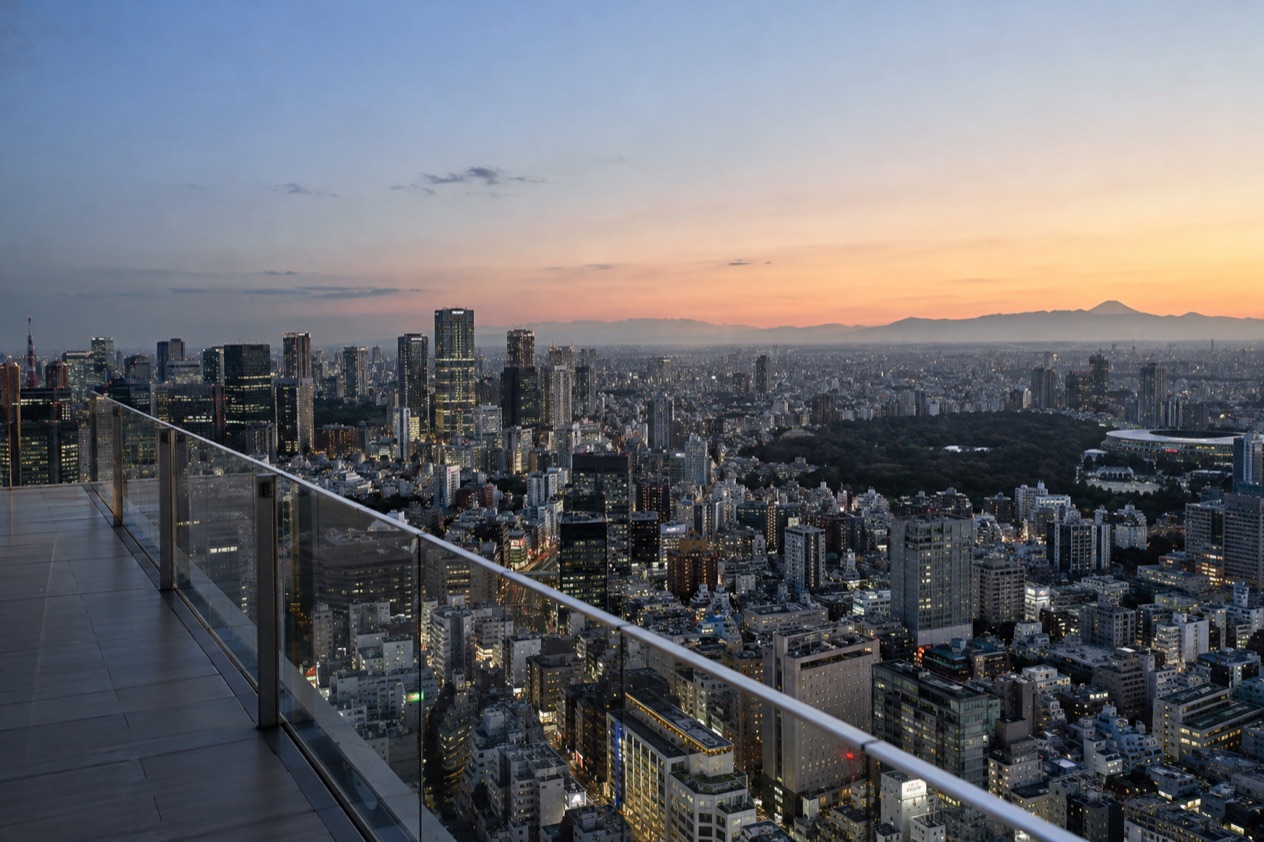
The deck is the reason to come. It occupies the roof of the tower, with the city spreading out on all sides at about 229 meters above Shibuya. Walk the full circle and the character of Tokyo changes with every quarter turn: dense blocks of low buildings, clusters of towers, dark patches of park and shrine forest, and the hazy line where the metropolis finally gives way to the sky.
Look for the landmarks that help you read the map, such as Tokyo Tower and Tokyo Skytree if the air is clear, and the green mass of the Meiji Jingu woods and Yoyogi Park. On a bright day the horizon can stretch far, and Mount Fuji sometimes appears as a pale shape on the edge of the view, though it is a chance rather than a promise. As the light fades the skyline fills with windows and signs, and the deck changes from a daytime lookout into a field of lights.
The scramble crossing from above
Shibuya Scramble Square takes its name from Shibuya Scramble Crossing, the world-famous pedestrian crossing only a few meters from the building. From the deck you see its logic at once. Traffic signals turn red in every direction, and waves of people cross at the same moment on straight lines and diagonals, meeting in the middle and flowing on without a pause.
It is worth lingering over this view. Watching a few cycles of the lights gives you a feel for the rhythm of the place, and visitors find that it is more striking from here than from street level, where you are simply inside it. Afterward, when you do walk the crossing yourself, you will know exactly what the pattern looks like from above.
The tower itself: shops, offices and restaurants
Shibuya Scramble Square is a complex with shops, offices, an observation deck and a parking area, and its eastern building rises 47 floors above ground. It was completed in October 2019 and opened on November 1 that year, when it overtook Cerulean Tower to become the highest skyscraper in the district. The underground level connects directly to Shibuya Station, so your visit begins inside the same structure as the trains.
Restaurants fill the 12th and 13th floors, a convenient place to turn the view into a meal, whether a late lunch before the deck or dinner once the city is lit. Lower floors hold shops and the duty-free counter, and a stroll through them is a natural way to fill the time before or after you go up.
SHIBUYA QWS
SHIBUYA QWS is another space inside the same complex, open from early morning into the evening. It is a place to know about if you are spending a longer stretch in the building, and it adds a different side to the tower, one that is about work and ideas more than views.
Hours, tickets and rules
The deck stays open late into the evening, with the last entry roughly an hour and a half before closing, so sunset and the hours after dark both fall inside a visit. The restaurants on the 12th and 13th floors run a little later than the deck. The table gives each place in the building with its hours.
| Site | Open |
|---|---|
| SHIBUYA SKY observation deck | 10:00 to 22:30 (final admission 21:20) |
| Restaurants, 12th and 13th floors | 11:00 to 23:00 |
| SHIBUYA QWS | 9:00 to 22:00 (weekdays, Saturdays, Sundays and national holidays) |
| MUFG Bank ATM, 5th floor | 10:00 to 21:00 |
| Seven Bank ATM, 7th floor | 10:00 to 21:00 |
| Duty-free counter, 4th floor | 10:00 to 21:00 (final orders 15 minutes before closing) |
Free Wi-Fi is available in the complex and works for two hours per connection, after which you can reconnect and keep going. Duty-free service applies to purchases of 5,000 yen or more, excluding tax.
How to get to Shibuya Sky
By train, the tower is right above Shibuya Station, with direct access from the station including the B6 subway exit, and the underground floor of the complex connects straight to the station. You do not need to cross the street to reach the building, which makes the arrival part of the same journey as the ride in.
The address is 2-23 Shibuya, in Shibuya, Tokyo. If you walk out of the station and look up, the tower is hard to miss, and it rises above the surrounding buildings.
If you are arriving in Tokyo from abroad, the nearest airports to the city are Haneda Airport (officially Tokyo International Airport) and Narita Airport, Japan’s largest international airport. From either, you reach Shibuya Station and the tower through the city’s rail network. Roppongi and Akasaka, two other districts with their own high views and restaurants, are about 10 minutes by train from Shibuya Station, which makes it possible to pair Shibuya Sky with an evening there.
When to visit Shibuya Sky
The deck is open from the morning into the late evening, so you can choose between daylight, the turn to dusk or the lit city after dark. Each gives a different picture.
Daytime shows the shape of Tokyo in its widest sweep, dusk shows the shift from daylight to a glowing skyline, and the evening brings out the signs and towers around the crossing. Last entry is well before closing, so plan your evening visit around that.
As for the months, October, the month of this writing, brings highs in the low 70s and mild nights, with a good deal of humidity and showers on about ten days. Sunshine is more limited than in spring, so a gray sky is a real possibility, and a clear, bright day is a bonus rather than a given. The deck is above the street, so rain and cloud change what you see and how far you see.
April is a gentler month, with highs in the upper 60s and more sunshine than October, and showers on fewer days. January is cold, with highs near 50 and a small chance of snow or sleet, though it is the sunniest of the four months we track and the air is drier, which can help with the view.
July is hot and humid, with highs in the mid-80s and nights that stay warm. If you can pick, spring and autumn bring a more comfortable day on an open deck, while January suits you if you can bundle up and want to be up high when the evening comes early.
Tips for your visit
Bring a light layer, because an open rooftop feels different from the street, and wind and temperature are not the same up there. A phone or camera is useful for the skyline and the crossing, and free Wi-Fi in the complex can help if you need to share a photo or look up a landmark. Keep your phone charged, since the view tends to invite more pictures than you plan.
Restaurants on the 12th and 13th floors let you pair the deck with lunch or dinner, and the shops on the floors below give you somewhere to wander. If you need cash, the ATMs on the 5th and 7th floors are in the same building, and the duty-free counter on the 4th floor serves visitors who qualify.
Nearby, the crossing itself is the obvious companion. See it from above, then walk it. After that, Roppongi and Akasaka are a short train hop away for a second skyline or a dinner. Ginza, an upscale downtown district with luxury shops and high-end restaurants, and Nihonbashi, known for its rich heritage and as Japan’s main financial district, make a different kind of evening, one about shopping and history instead of neon.
Good to know before you go
The ATMs and the duty-free counter close before the deck does, so handle cash and tax-free shopping early in your visit. Tokyo is a city of crowds, and the usual habits of a big station area apply: keep your things close and stay aware of your surroundings as you move between the station and the tower.
| Fee | Amount | Who pays |
|---|---|---|
| Duty-free handling charge | 1%, deducted from the refund amount | Visitors using the duty-free service |
Sources
- Shibuya Scramble Square, official site (https://www.shibuya-scramble-square.com/en/), checked October 11, 2026
- Wikipedia, Shibuya Scramble Square (https://en.wikipedia.org/wiki/Shibuya_Scramble_Square), checked October 11, 2026
- Japan National Tourism Organization, Tokyo (https://www.japan.travel/en/destinations/kanto/tokyo/), checked October 11, 2026
- Japan Meteorological Agency (JMA), Normal values 1991-2020, monthly (https://www.data.jma.go.jp/stats/etrn/view/nml_sfc_ym.php?prec_no=44&block_no=47662), station Tokyo, elevation 25 m, checked October 11, 2026
To plan your stay
- Best Time to Visit Japan: Cherry Blossoms, Autumn Colors, Weather and Festivals
- Where to Stay in Japan: Ryokan, Temple Stays, Capsule Hotels and the Best Cities to Base In
- Sending Luggage from the Airport in Japan: Hands-Free Travel, Hotel Delivery and Coin Lockers
- Know Before You Go to Japan: Entry, Money, Etiquette and Getting Around