
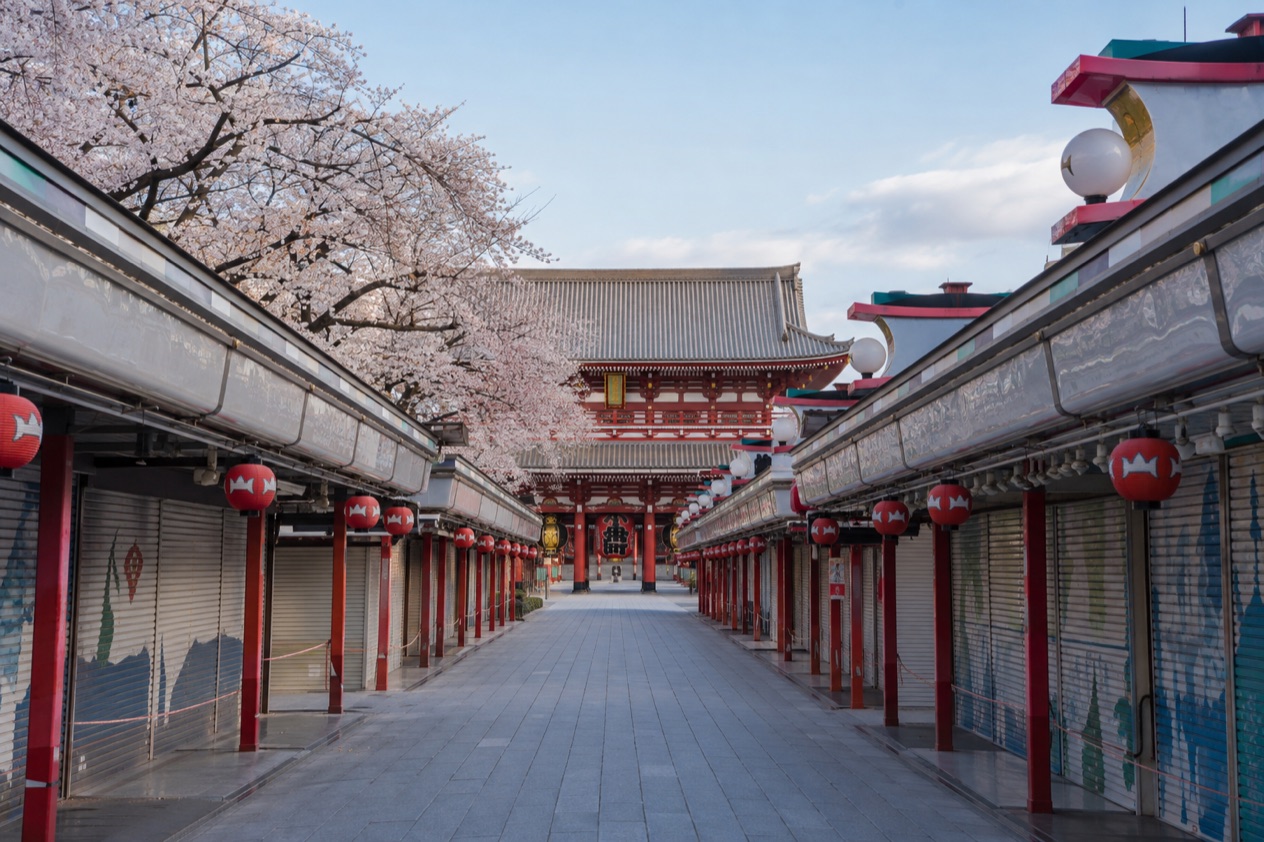
The approach to Senso-ji is a lane of small stalls where the smell of sweet bean paste and grilled rice crackers drifts out over the counters, and where toys, fans and trinkets hang in rows under the roofs. At the far end the temple gate rises above the crowd. Nakamise Street is the shopping lane that leads into Senso-ji in Asakusa, and it suits anyone who likes to snack, browse and arrive at a temple slowly.
Is visiting Nakamise Street worth it?
Yes, for anyone spending time in Asakusa, and especially for travelers who enjoy a market atmosphere on the way to a temple rather than a quiet approach. Nakamise Shopping Street at Senso-ji sells traditional Japanese toys, cakes and souvenirs, so it works as a first taste of old Tokyo shopping and a place to pick up small gifts.
What sets it apart from the other shopping areas of the city is its purpose. Ginza is an upscale downtown area with high-end restaurants and luxury shops, and Nihonbashi is known for its heritage and its role as the main financial district. Nakamise is neither of those.
It is a short procession of stalls that belongs to a working temple, one that draws 30 million worshippers every year. You are walking the same route as people who come to pray, and the shops are part of that walk.
If your idea of a good day is a snack in one hand and a paper bag of souvenirs in the other, it will please you. If you prefer to see the temple in stillness, treat the lane as a passage and take your time once you are through the gate.
What to see at Nakamise Street
The stalls along the lane
The stalls are the point of the street. Look for traditional toys, the cakes sold fresh from small counters, and the usual souvenirs that visitors carry home: fans, chopsticks, small charms and printed cloth. The variety is easy to judge by simply walking slowly and looking left and right before you buy anything.
Many stalls sell cakes and rice-based snacks that you can eat as you walk, and the habit of tasting a little at several counters rather than sitting down for one meal suits the lane well.
The gate at the end and Hozo-mon
At the end of the shops stands the Hozo-mon Gate, which leads into the main temple precinct. It was rebuilt in 1964 with a donation by Yonetaro Otani, a reminder that much of what you see here is a modern rebuilding of older structures. The gate frames the temple behind it and gives the lane its sense of destination.
Pause under the gate before going on. From there you can look back along the lane and see how the stalls line up, then turn toward the main buildings.
The Main Hall of Senso-ji
Senso-ji is a Buddhist temple dedicated to the bodhisattva Kannon, and it is described as the oldest temple in Tokyo. Its Main Hall was destroyed in the Great Tokyo Air Raid on March 10, 1945, and rebuilt in 1958. That history gives the hall a particular weight: it is a postwar rebuilding that has become the center of daily worship.
Watch what the visitors around you do. Many stop to offer a prayer, and the mood changes from the cheerful bargaining of the lane to something more attentive.
Niten-mon Gate and the temple’s quieter corners
Niten-mon Gate was restored to its original state in 2010, and it is one of the gates worth finding once the main hall has been seen. The garden of Senso-ji’s Denboin is closed to the public, so do not plan a visit to it. Both details help you shape the visit: spend your time on the gates, the hall and the lane, and leave the garden off your list.
Hours, tickets and rules
What can be said is that the lane is a shopping street attached to a temple, and that one part of the complex, the Denboin garden, is closed to the public.
| Site | Open |
|---|---|
| Denboin garden (Senso-ji) | Closed to the public |
The one rule stated for the site is that the garden of Senso-ji’s Denboin is closed to the public. Beyond that, there is nothing further to report on what you may or may not do on the lane or in the precinct.
How to get to Nakamise Street
Nakamise Street is reached through Asakusa, a district in Taito, Tokyo, and the usual way in is by subway or train to one of the two stations called Asakusa. One is Asakusa Station on the Tobu Skytree Line (TS-01), the Toei Asakusa Line (A-18) and the Tokyo Metro Ginza Line (G-19).
The other is Asakusa Station on the Tsukuba Express (TX-03). Because the names are the same, it helps to know which line you are riding.
The Ginza Line reaches Asakusa at its eastern end. Ueno, a major railway and subway interchange, lies approximately one mile west of Asakusa, which gives you a point of reference if you are connecting from elsewhere in the city.
For arrivals from outside Tokyo, the nearest airports to the city are Haneda Airport (officially Tokyo International Airport) and Narita Airport, Japan’s largest international airport. From either, you continue into the city and on to Asakusa by rail.
If you arrive by water, cruises down the Sumida River depart from a wharf a five-minute walk from Senso-ji temple in Asakusa. That makes the river a second way to arrive or to leave once you have seen the lane.
When to visit Nakamise Street
Choose by season and by festival. The lane is a lively place on any day, but a few dates change its character. Senso-ji’s Setsubun, the spring celebration, takes place around February 3rd, and Hana Matsuri, the celebration of Buddha’s birthday, takes place on April 8. In May, Asakusa hosts the Sanja Matsuri, and during its three days 1.5 million people come out to celebrate.
Weather shapes the walk. In January the average high is about 50°F with few rainy days, and the air is dry. April is milder, with highs in the upper 60s and a good number of showery days. July is hot and humid, with highs in the mid-80s, and October is mild, with highs around 72°F but a rainier month.
| Month | Average high (°F) | Average low (°F) | Rain days |
|---|---|---|---|
| January | 49.6 | 34.2 | 4.5 |
| April | 66.9 | 49.6 | 9.5 |
| July | 85.8 | 72.3 | 10.5 |
| October | 71.6 | 58.6 | 10.5 |
Spring and autumn bring the most comfortable temperatures for a stroll between stalls, while January is cold enough that a warm snack becomes part of the pleasure. July asks for patience with the heat and humidity.
Tips for your visit
Bring a small bag for what you buy and wear comfortable shoes, since the visit is a walk on foot through the lane and across the temple grounds. In wet months an umbrella is worth carrying, and in July light clothing suits the humidity.
Pair Nakamise with the rest of Asakusa. Next to the Senso-ji grounds is a small amusement park called Hanayashiki, which claims to be the oldest in Japan. Kappabashi-dori, a street with a major cluster of domestic kitchenware stores, is visited by many Tokyoites for essential supplies, and it is a good place to look at knives, dishes and cooking tools.
Asakusa also has a geisha tradition. It is Tokyo’s oldest geisha district and still has 45 actively working geisha, a detail that adds depth to a stroll through its older streets. The Sumida River cruise gives a change of pace after the crowd of the lane. Asakusa is a popular accommodation choice for budget travelers because of its colorful location, downtown credentials and relaxed atmosphere by Tokyo standards, so staying nearby lets you see the lane and the temple at different moments of the day.
Good to know before you go
Nakamise is a place to spend small amounts on snacks and souvenirs, and it rewards a slow pace. In the rainy months, showers come often enough that a light rain layer is useful. Keep in mind that the Denboin garden is closed to the public, and plan the rest of your time around the lane, the gates and the main hall.
Sources
- Asakusa Kannon Sensoji (https://www.senso-ji.jp/english/), checked October 11, 2026
- Wikipedia, Asakusa (https://en.wikipedia.org/wiki/Asakusa), checked October 11, 2026
- Japan National Tourism Organization, Tokyo (https://www.japan.travel/en/destinations/kanto/tokyo/), checked October 11, 2026
- Japan Meteorological Agency (JMA), Normal values 1991-2020, monthly (https://www.data.jma.go.jp/stats/etrn/view/nml_sfc_ym.php?prec_no=44&block_no=47662), station Tokyo, elevation 25 m, checked October 11, 2026
To plan your stay
- Best Time to Visit Japan: Cherry Blossoms, Autumn Colors, Weather and Festivals
- Where to Stay in Japan: Ryokan, Temple Stays, Capsule Hotels and the Best Cities to Base In
- Sending Luggage from the Airport in Japan: Hands-Free Travel, Hotel Delivery and Coin Lockers
- Know Before You Go to Japan: Entry, Money, Etiquette and Getting Around