
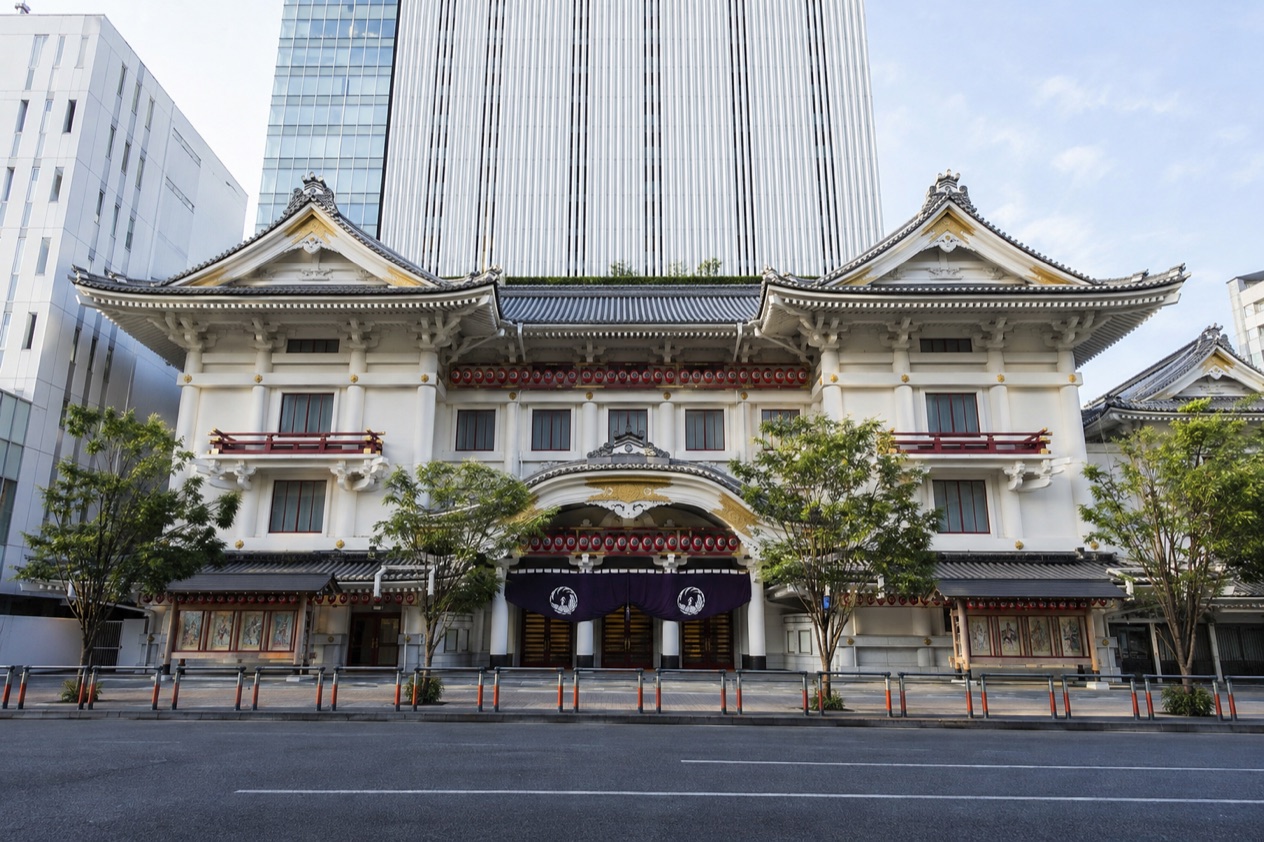
Step out of the Ginza subway and the Kabuki-za announces itself with a sweeping tiled roof and a wide, curved gable set among the glass boutiques of the neighborhood. Inside, a painted curtain parts, wooden clappers sound, and a story that has been told on stage for centuries begins again.
Is visiting Kabuki-za worth it?
Yes, if you want to see kabuki performed in the place built for it, and it suits curious first-timers as well as people who already love Japanese theater. Kabuki-za in Ginza is the principal theater in Tokyo for the form, and the program changes from month to month, so a visit is a real performance and not a museum display.
What sets it apart from the other stages nearby is the way it is organized for visitors. Performances are held nearly every day, and tickets are sold for individual acts as well as for each play in its entirety.
That means you can sample a single act without committing to a whole afternoon. The theater also provides devices with plot information and commentary in English, which matters when the dialogue is delivered in stylized classical speech and the stories rest on legends and history that visitors have never met.
Around it, Ginza is an upscale downtown area with high-end restaurants and luxury shops, so the theater sits in a neighborhood made for a long day out. The National Theatre of Japan also offers kabuki in Tokyo, but the Kabuki-za is the one with a program built around the monthly cycle, a daytime show and an evening show, and a building designed to be part of the occasion.
If you are looking for a quiet temple garden, this is not it. If you want color, music, costume and a story, it is.
What to see at Kabuki-za
The performance itself
Kabuki began in the early 17th century in Kyoto, where according to legend a young woman from the Izumo Grand Shrine began performing a new form of dance theater. Women were later banned from the stage, and all roles came to be played by men. Male actors who play female characters are called onnagata, and watching how they shape a gesture, a walk or the tilt of a head is one of the quiet pleasures of the evening.
At Kabuki-za, programs are organized monthly, with a set of plays and dances for the afternoon performance and a different set for the evening show. Each program repeats on a nearly daily schedule for three to four weeks. Look for the contrast between dance pieces, where movement and music carry the mood, and plays, where the plot drives the scene. The English commentary device helps you follow which is which.
The doncho curtains
With the latest reconstruction, Kabuki-za was outfitted with four new front curtains called doncho. They were created by renowned Japanese artists in the Nihonga style, the tradition of painting with mineral pigments on paper or silk, and they reflect the different seasons. The curtain is the first thing the audience sees on the stage, so it sets the mood before an actor appears.
If you arrive in your seat before the show begins, take a moment with the painting in front of you. Notice how the season it shows plays against the season outside the doors. It is a small thing, but it is the kind of detail that makes the theater feel like a place built with care.
The building and its history
The original Kabuki-za opened on 21 November 1889, and the theater is now run by the Shochiku Corporation, which took over in 1914. The new theatre complex opened on 28 March 2013, so the building you see today is the latest chapter in a long story of rebuilding on the same site.
The address is 4-12-15 Ginza, in Chuo-ku. The roofline is the feature to look at from the street, since it echoes the traditional theater architecture of earlier eras while rising above a modern complex. Photograph it from across the street before you go in, because the interior lobby is where the pace of the visit starts to slow.
The shops and the roof garden
The building contains shops in the basement and a roof garden on level 5. The basement is a handy place to browse before curtain time or between acts, and it gives you something to do if you arrive early or want a break from the seats.
The roof garden is a pause above the city, a place to step outside between the heavy velvet of the auditorium and the street below. Treat it as a short intermission, a place to look out over Ginza and let the story you have just watched settle.
Hours, tickets and rules
Tickets are sold for individual acts as well as for each play in its entirety, which gives you the choice between a full program and a single taste of kabuki.
| Site | Open |
|---|---|
| Kabuki-za, Ginza | Performances nearly every day, with an afternoon show and an evening show |
One point stands out from the rules: the theater provides devices with plot information and commentary in English, so foreign visitors can follow the story without knowing the language.
When to visit Kabuki-za
The choice that matters first is the time of day. The afternoon performance and the evening show carry different sets of plays and dances, so one is not a repeat of the other.
Because each monthly program runs for three to four weeks, the month you travel decides which plays you see. That makes the calendar part of the plan. Look at what is on in the month of your trip, since the same program will not appear in the next one.
The weather around the theater shifts through the year, and that changes how the walk to and from your seat feels. In January, highs average in the upper 40s and lows fall to the mid-30s, with a little snow or sleet possible on some days, so a coat is welcome.
April is mild, with highs in the mid-60s and rain on about nine or ten days. July is hot and humid, with highs in the mid-80s, and the air-conditioned auditorium becomes a refuge. October brings highs in the low 70s, and the month is on the wet side, with rain on about ten days, so an umbrella is a sensible companion.
Since the theater is indoors, a rainy day need not spoil the plan. A long afternoon performance is a good answer to a gray forecast, and you can stay dry between the subway, the lobby, the shops in the basement and your seat.
| Month | Avg high (°F) | Avg low (°F) | Precipitation (in) | Days with rain |
|---|---|---|---|---|
| January | 49.6 | 34.2 | 2.35 | 4.5 |
| April | 66.9 | 49.6 | 5.26 | 9.5 |
| July | 85.8 | 72.3 | 6.15 | 10.5 |
| October | 71.6 | 58.6 | 9.24 | 10.5 |
Tips for your visit
Plan the visit around the program. Decide whether you want a full play or a single act, since both are sold, and pick the afternoon or the evening show accordingly. Ask for the English commentary device when you arrive, because it carries plot information and explanations that make the stylized acting much easier to follow.
Build in time before and after. The shops in the basement and the roof garden on level 5 turn the building into more than a seat in a dark room. Ginza itself is an upscale downtown area with high-end restaurants and luxury shops, so a meal before or after the show fits naturally into the day.
If you want more of Japanese theater while in Tokyo, the National Theatre of Japan also offers kabuki and provides audio guides for certain performances, and the National Noh Theatre in Tokyo hosts noh, the oldest form of Japanese theater, whose protagonist wears a mask to help interpret the story. Noh performances are generally very long, a different rhythm from kabuki’s lively spectacle, so the two make a good pair on separate days.
Ginza and Nihonbashi are neighbors in Tokyo, and Nihonbashi is known for its rich heritage and is the main financial district of Japan. It is a way to add a walk with a different character to the same day.
Good to know before you go
Ginza is a district of luxury shops and restaurants, so budget for a meal or a coffee around the show as you would in any upscale downtown. Tokyo’s rainy stretches are real, particularly in the wetter months, and since the theater is indoors, a wet day is a good one for a performance. Haneda Airport and Narita Airport are the nearest airports to Tokyo, which is where most international visitors begin their trip.
Sources
- Japan National Tourism Organization, kabuki, noh, bunraku (https://www.japan.travel/en/guide/theater/), checked October 11, 2026
- Japan National Tourism Organization, performing arts (https://www.japan.travel/en/things-to-do/art-and-design/performing-arts/), checked October 11, 2026
- Wikipedia, Kabuki-za (https://en.wikipedia.org/wiki/Kabuki-za), checked October 11, 2026
- Japan National Tourism Organization, Tokyo (https://www.japan.travel/en/destinations/kanto/tokyo/), checked October 11, 2026
- Japan Meteorological Agency (JMA), Normal values 1991-2020, monthly (https://www.data.jma.go.jp/stats/etrn/view/nml_sfc_ym.php?prec_no=44&block_no=47662), station Tokyo, elevation 25 m, checked October 11, 2026
To plan your stay
- Best Time to Visit Japan: Cherry Blossoms, Autumn Colors, Weather and Festivals
- Where to Stay in Japan: Ryokan, Temple Stays, Capsule Hotels and the Best Cities to Base In
- Sending Luggage from the Airport in Japan: Hands-Free Travel, Hotel Delivery and Coin Lockers
- Know Before You Go to Japan: Entry, Money, Etiquette and Getting Around