
The sliding doors of the arrivals hall open, and Tokyo begins with a wall of signs in Japanese and English pointing to trains, monorails, buses and taxis. Shinjuku, with its glowing towers, department stores and tangle of railway lines, is where travelers are heading first. Haneda sits close to the center of the city, and the choice in front of you is which wheels or rails to take to get there.
How do you get from the airport to Tokyo?
From Haneda Airport you can reach Shinjuku by train, monorail, bus or taxi, and the airport’s own route search shows departure and arrival times and fares for the trains, monorails and buses from the Passenger Terminal to your destination.
What decides is mostly a short list of questions. How much luggage are you carrying, and how people are in your group? Which terminal did you land in, and does the hour of your arrival matter?
Terminal 3 and the international area of Terminal 2 are open around the clock, so a very late or very early arrival is not a dead end. You can also arrange a taxi by app or phone before you land, which changes where you walk once you are outside.
Shinjuku itself shapes the answer too. It is a railway hub where many lines meet, and it also has a large bus terminal near its south exit. Where your hotel sits relative to the station, and which exit you will use, can matter as much as the ride from the airport.
Your options from the airport
Trains and monorails
Rail is the first thing the airport’s route search offers, and it covers both trains and monorails. You follow the signs from the arrivals lobby, and the airport publishes a video of the walk from the Terminal 2 International Arrivals lobby to each transport option, with another for the Terminal 3 Arrivals lobby. Watching the right one before you fly takes some of the guesswork out of your first minutes in Japan.
At the other end, Shinjuku Station is the connecting hub for rail traffic between central and eastern Tokyo and the western side of the city. In 2018 an average of 3.59 million people passed through it each day.
Plan on following signs carefully once you arrive, because the station has many exits, and an east-west passageway opened in 2020 links the east and west sides. If you carry an IC card, it works on the trains.
Buses
Buses are included in the same route search at the Passenger Terminal, so you can see their times and fares next to the rail options. Shinjuku has a large expressway bus terminal, Busta Shinjuku, near the south exit of the station, and a good number of coaches and airport buses depart from it. Whether a bus suits you depends on the route the search gives you for your hotel and your terminal.
A bus makes sense for travelers who prefer to sit down with their bags and watch the city arrive, rather than step on and off escalators in a station. IC cards can be used on buses as well, which saves you from sorting out coins when you board.
Taxis
Haneda has two kinds of taxi stands, general stands and stands for taxis dispatched by app or reserved in advance. If you have arranged your ride through an app or by phone, you must use the dedicated reserved-taxi stand. If you simply want a cab, the general stand is the one to look for.
A taxi suits a group that wants to go door to door with its luggage and not think about stations. Some taxis accept IC cards, though not all do. Once you reach Shinjuku, tell the driver your hotel or a nearby landmark, since the streets around the station are busy and the area is large.
Driving your own car
Spaces in parking lots P2 through P5 at Haneda can be reserved in advance, with details on each lot’s reservation page. That matters if you are meeting someone who is driving, or dropping off a car at the airport.
For a visitor heading into Shinjuku, a car is rarely the starting point of the trip, since the station area is organized around rail and buses. The airline services JAL MaaS and ANA TRAVEL CUBE can help you search for and book transportation to Haneda, which is useful on the return trip.
Airport transfer options compared
| Option | Where you find it | How to arrange it |
|---|---|---|
| Train or monorail | Signs from the arrivals lobby | Route search at the Passenger Terminal for times and fares |
| Bus | Signs from the arrivals lobby | Route search at the Passenger Terminal for times and fares |
| Taxi, general | General taxi stand | Join the stand outside |
| Taxi, app or phone | Dedicated stand for reserved taxis | Arrange through an app or by phone beforehand |
| Your own car | Parking lots P2 to P5 | Reserve in advance on each lot’s reservation page |
The trade-offs are about what you carry and how much you want to decide. Rail and buses put you in the flow of the city and let you compare fares and times in the route search. A taxi takes the thinking out of the ride, and if you have booked it through an app or by phone it has its own stand, which keeps you from queuing at the wrong place.
A group of several people with large bags will weigh the taxi differently from a solo traveler with a backpack. If your hotel is a long walk from Shinjuku Station, a door-to-door ride may be worth more to you than a transfer through a busy hub.
If your hotel is close to a station exit, a train or bus may fit well. Either way, the airport’s video of the route from the arrivals lobby to each option can help you picture the first steps.
Arriving at the airport
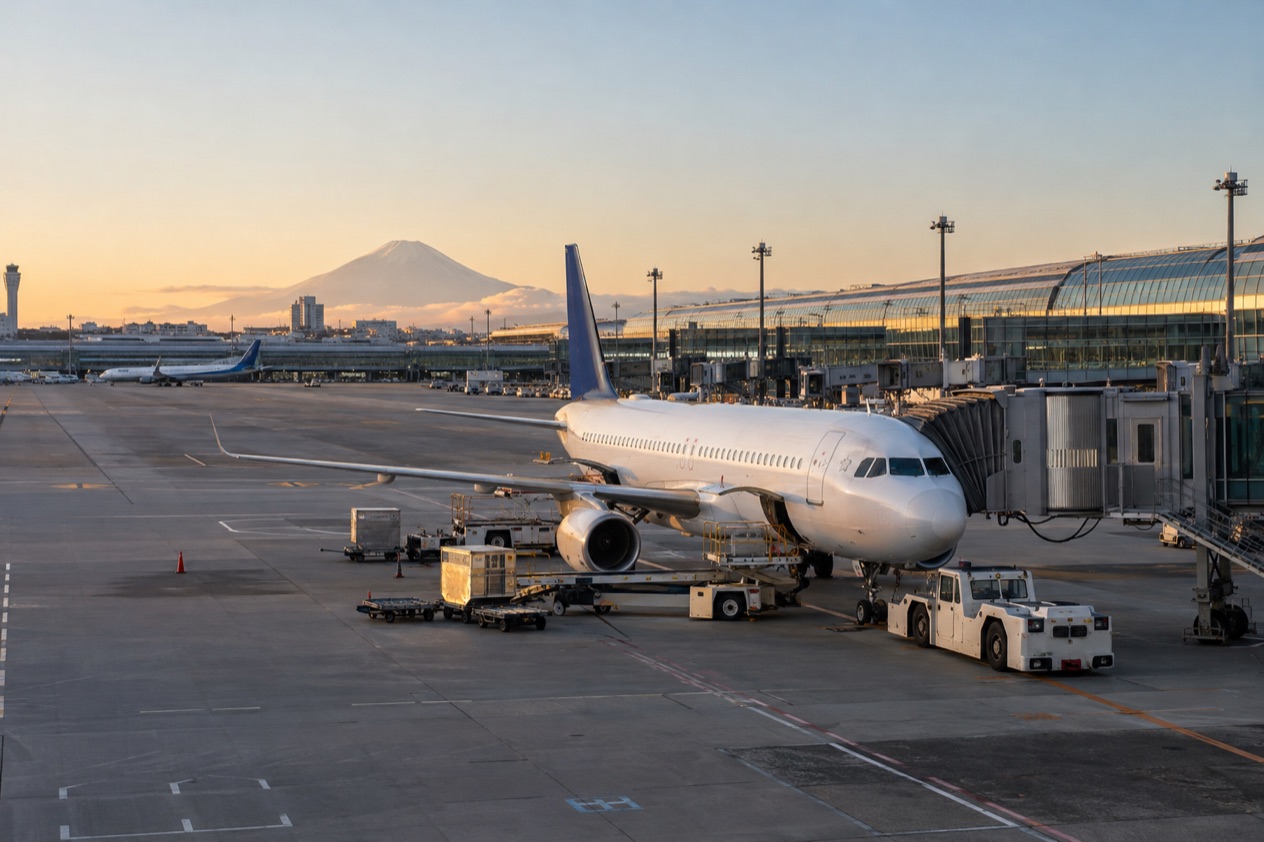
Haneda has three passenger terminals with 71 gates with jet bridges. Terminal 2 serves domestic flights of All Nippon Airways, Air Do and Solaseed Air, and it also has an international flight area. International arrivals come through Terminal 2 or Terminal 3, and the airport publishes a route video for each arrivals lobby.
| Terminal area | Open |
|---|---|
| Terminal 1 and the domestic flight areas of Terminal 2 | 5:00 am to 12:00 am |
| Terminal 3 and the international flight area of Terminal 2 | 24 hours a day |
The terminals are linked. An underground walkway connects Terminals 1 and 2, and a free inter-terminal shuttle bus connects all the terminals on the landside. If you land in one terminal and your transport leaves from another, that shuttle is how you cross.
Haneda is officially Tokyo International Airport, and it is one of the two airports nearest the city. The other is Narita, Japan’s largest international airport. Narita Express services to and from Narita begin and end at Shinjuku Station, which is a useful thing to know if your trip ends at Narita after starting at Haneda.
Good to know before you go
IC cards cover a lot of ground in Japan: trains, buses and boats, plus vending machines, convenience stores and some taxis. Regional cards carry different names and characters, but they can be used throughout the country. Shinjuku gives you plenty of reasons to use one, from the train lines west toward Hakone to the department stores and small bars that fill the streets around the station.
Shinjuku Station is large enough that giving yourself time to find the right exit makes the first evening calmer. Travelers who land at Haneda carry a hotel name written out in both English and Japanese, which helps with a taxi driver or a station attendant.
Sources
- Haneda Airport Passenger Terminal, Access (https://tokyo-haneda.com/en/access/index.html), checked October 11, 2026
- Wikipedia, Shinjuku Station (https://en.wikipedia.org/wiki/Shinjuku_Station), checked October 11, 2026
- Wikipedia, Tokyo International Airport (https://en.wikipedia.org/wiki/Tokyo_International_Airport), checked October 11, 2026
- Japan National Tourism Organization, Tokyo (https://www.japan.travel/en/destinations/kanto/tokyo/), checked October 11, 2026
- Japan National Tourism Organization, IC cards, Suica, Pasmo, ICOCA, how to use (https://www.japan.travel/en/plan/ic-card/), checked October 11, 2026