
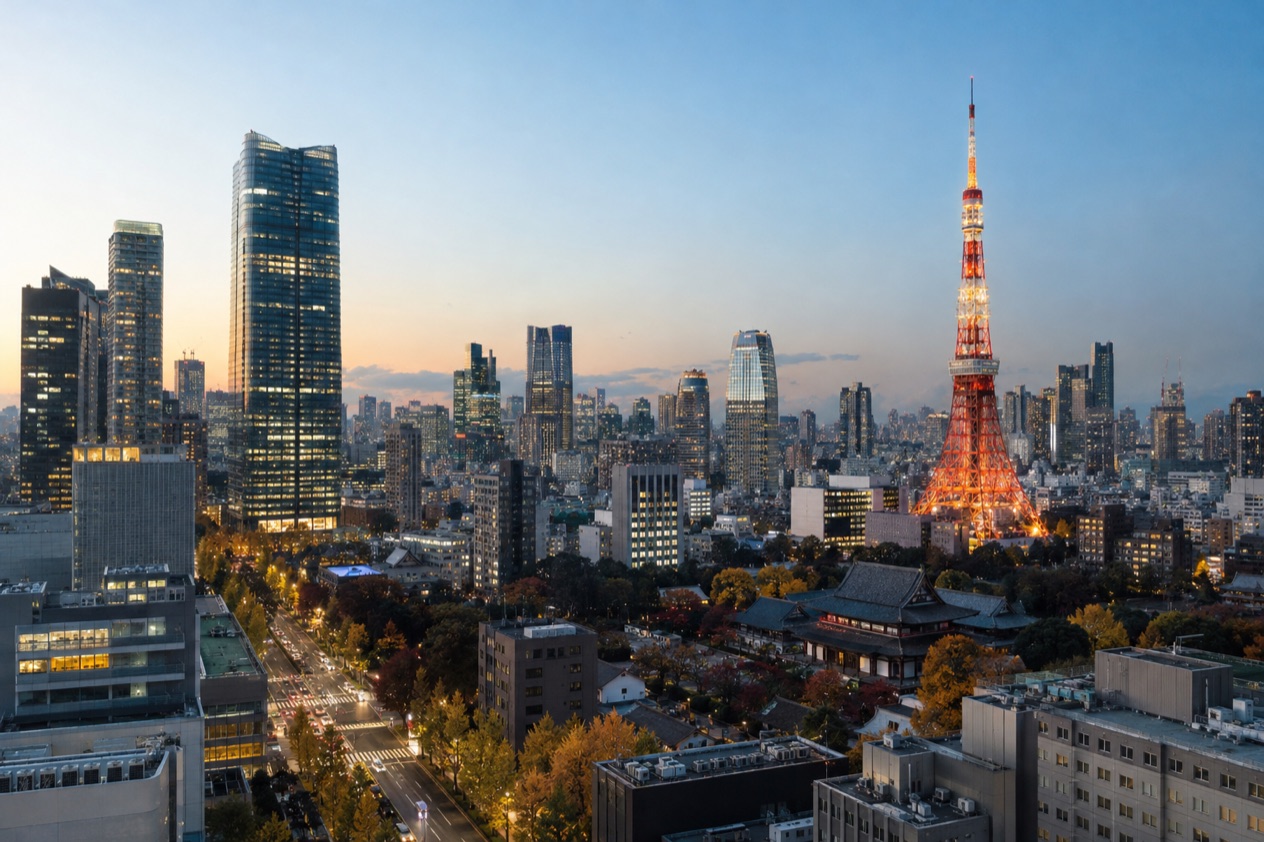
In October, the smoke of charcoal-grilled saury drifts along the Meguro River, and in Ikebukuro the sound of wooden clappers and shouted chants carries down the streets as dance teams arrive in bright costumes. The city has shaken off the heat of summer and settled into its autumn routines of festivals, used-book browsing and long walks through the parks. This is Tokyo in October for travelers who want comfortable days outdoors and a calendar full of neighborhood events.
What is the weather like in Tokyo in October?
October in Tokyo is mild and a little damp, warm enough for T-shirt afternoons yet cool enough that you want a layer once the light fades. The heavy, sticky air of late summer is gone, and winter is still a month or more away.
| Month | Average high (°F) | Average low (°F) | Precipitation (in) | Days with 1 mm or more of precipitation | Hours of sunshine | Daylight on the 15th |
|---|---|---|---|---|---|---|
| September | 81.5 | 68.5 | 8.85 | 11.0 | 127 | 12 h 27 min |
| October | 71.6 | 58.6 | 9.24 | 10.5 | 129 | 11 h 21 min |
| November | 62.1 | 47.8 | 3.79 | 7.4 | 150 | 10 h 19 min |
What the table changes for you is the wardrobe. After a September that still feels like summer, October brings sightseeing weather: you can cross Shinjuku Gyoen or wander the lanes of Yanaka without wilting. The city’s own advice is to carry a light jacket, since nights can turn chilly. Humidity also keeps easing as the month goes on, so the last week feels crisper than the first.
Rain is part of the month. October is wetter than September on the totals and far wetter than November, so a compact umbrella earns its place in your bag. Expect gray, drizzly spells rather than a monsoon, with sunny stretches in between that make the parks inviting. Days are visibly shorter than in September, which means dinner is eaten under city lights and the evening glow of Ginza and Shibuya arrives early.
If your plans reach the mountainous areas of west Tokyo, bring extra layers, because they are cooler than the center of the city. Back among the towers, sleeves and a light jacket will do most days.
What to do in Tokyo in October
October is a month of neighborhood festivals, and Tokyo handles them the way it handles everything: each ward has its own. Japanese festivals, called matsuri, are traditional occasions often marked by dance and music, and the capital’s autumn ones tend to come with food stalls, street performances and a good deal of local pride. Add the first autumn flavors on the menu and weather that suits long days on foot, and the month plans itself around events.
Fukuro Matsuri and Tokyo Yosakoi in Ikebukuro
Tokyo Yosakoi is held in October as part of the Fukuro Matsuri, an Ikebukuro autumn tradition. It brings about 5,000 dancers from teams across Japan into the streets around the station, and it is one of the most energetic things the city does all year.
Yosakoi is a dance style that blends traditional steps with modern choreography. Each team wears its own matching costume and dances in formation to a lively soundtrack, and dancers often carry naruko, small wooden clappers that rattle with every move. The teams range from neighborhood groups to university squads, so the styles shift from block to block, from crisp and synchronized to loose and theatrical.
Watching is enough to feel swept along. This suits anyone who likes to see a city at play rather than only in its museums.
Jimbocho and the Kanda Used Book Festival
The Kanda Used Book Festival is held annually in Jimbocho, Tokyo’s book town, with bookshelves lining Yasukuni-dori. The street becomes an open-air library, and the Tokyo Antiquarian Book Hall hosts talk shows and special sales alongside.
Even if you do not read Japanese, the district rewards a slow look. Old shops stack woodblock-print volumes, vintage magazines, maps and illustrated books, and many of the covers and prints are worth browsing for their art alone. Jimbocho is also known for its old-fashioned coffee shops and curry houses, so a pause between shelves comes naturally.
Cool autumn air is made for this kind of day, spent drifting from stall to stall and ducking into a café when a shower passes. It suits browsers, collectors and anyone who enjoys the smell of old paper.
Meguro no Sanma Matsuri and the taste of autumn
At the Meguro no Sanma Matsuri, the Pacific Saury Festival, charcoal-grilled saury from Kesennuma in Miyagi Prefecture is served for free, though advance registration is required. Sanma is the fish of Japanese autumn, long and silver, and it is traditionally eaten grilled whole with grated daikon and a squeeze of citrus.
The smoke and the line of people waiting for their plate give the Meguro neighborhood a festive feel that has little to do with sightseeing. Away from the festival, October menus across the city move to other seasonal flavors, including chestnuts in sweets and rice dishes, persimmons, roasted sweet potatoes and matsutake mushrooms in more formal meals. Izakaya, the casual pubs, add sake and seasonal small plates to the evening.
Beyond the festivals, October suits the city’s classic sights, which you can walk without feeling the summer heat. Senso-ji in Asakusa, Meiji Jingu among its trees and the museums and ponds of Ueno Park all take a long afternoon. The leaves are still green in most of the city, since the maples in Tokyo usually turn toward the end of November, so the color you see this month comes from lanterns, food stalls and festival costumes.
The Yamanote Line loop defines central Tokyo, and travelers organize their days around the neighborhoods it connects. Evenings are pleasant for a walk to a lit-up crossing or a drink in a lane of small bars, with a jacket over your arm.
A two-day itinerary for Tokyo in October
Day 1 is about the old city and the festival side of the month. Start in Asakusa at Senso-ji and the shopping lane leading to it, where fried sweets and rice crackers make a snack breakfast. Move on to Ueno Park for its ponds and museums, and take lunch at a small noodle shop or a tonkatsu counter near the park.
In the afternoon, go to Jimbocho for the used bookshops and the old coffee houses, then continue to Ikebukuro for the dance teams of the Fukuro Matsuri if the festival falls during your stay. Evenings are cool and the days short, so finish with grilled fish and sake at an izakaya, where the autumn menu is likely to feature saury. If rain sets in, the museums of Ueno and the covered shopping streets of Ikebukuro keep the plan intact.
Day 2 turns to green space and the modern city. Begin at Meiji Jingu, walking its forested approach and its shrine grounds, then continue to Shinjuku Gyoen for lawns and ponds that are comfortable in October’s temperatures. Lunch can be ramen or a set meal in Shinjuku, the administrative center of the city.
Spend the afternoon in Shibuya and Harajuku, among the side streets, the shops and the crossing, then head to the Meguro River for the evening, where the sanma festival adds its smoky aroma to the neighborhood. Dinner can be yakitori or a bowl of seasonal rice with chestnuts. For a wet day, swap the gardens for the department-store food halls and the many galleries around Shibuya and Harajuku.
Is Tokyo busy in October?
October in Tokyo is lively without being a leaf-peeping or blossom month, since the cherry trees bloom from late March to early April and the maples turn at the end of November. The energy this month comes from festivals and street events rather than a single seasonal draw.
That shapes the pace of the city. The big October gatherings are the Fukuro Matsuri with its Yosakoi dancers, the Kanda Used Book Festival in Jimbocho and the saury festival in Meguro, and each pulls people into its own corner of Tokyo. Outside those neighborhoods, the capital goes about its business at its usual rhythm, and the pleasant air draws people into the parks and onto the sidewalks.
With so many local events, you will notice that the city feels different from district to district. Ikebukuro rings with drums and chants during its festival, Jimbocho is full of browsers with tote bags, and Meguro fills with people holding plates of fish.
What to pack for Tokyo in October
October asks for layers that can come off and go back on, plus something for the damp. These are the items that earn their space:
- A light jacket, because nights can turn chilly after warm days.
- A compact umbrella or a light rain shell, since the month brings a fair number of wet days.
- Comfortable walking shoes for the parks, shrine grounds and festival streets.
- T-shirts or thin long sleeves to layer under the jacket.
- An extra warm layer if you head to the mountainous areas of west Tokyo, which are cooler than the center.
- A tote bag for the finds at the used book festival in Jimbocho.
Good to know before you go
October is a wet month, with many gray days, so keep a plan B for each outdoor day, such as a museum or a department-store food hall. The Japan Meteorological Agency issues Emergency Warnings when natural phenomena of extraordinary magnitude threaten catastrophe, and the Japan National Tourism Organization runs a Japan Safe Travel Information page with safety tips and government information for travelers.
For the Meguro saury festival, the free grilled fish requires advance registration, so look into that before you plan your evening around it. Festival dates move from one year to the next, so confirm them against your travel days.
Tokyo in October vs September and November
Going four weeks earlier puts you in September, when afternoons are still hot and humid and the nights stay warm. The rain totals are close to October’s, but the air is heavier and the days are longer, so you get more light for sightseeing at the cost of more sweat. The autumn flavors and festivals of October are only starting to appear.
Going four weeks later lands you in November, which is much drier and cooler, with more sunshine hours and noticeably shorter days. Tokyo’s maples usually change color around the end of the month, so the city begins to look like autumn in the way postcards show it. Nights need a proper coat rather than a light jacket, and the festivals of October are behind you.
Choose September if you do not mind summer weather. Choose November if color on the trees and dry, cool days matter most. Stay with October if you want mild weather and the Yosakoi dancers, the book fair and the saury festival.
Is October a good time to visit Tokyo?
Yes, October is a good time for travelers who like to walk, eat and join in neighborhood events, and who are happy to carry an umbrella. The weather is mild, the humidity eases through the month and the calendar is full of street festivals.
It suits food lovers, who get saury, chestnuts and persimmons in season, and book and print hunters, who get the Jimbocho festival. It also suits those who enjoy lively crowds of dancers rather than blossoms. Travelers who want the red and gold of maple leaves are better off waiting for the end of November, and anyone who dislikes damp days should accept that October brings a good share of them.
On arrival, start with the festival that matches your dates, since each one changes the character of its neighborhood. October in Tokyo is about the smoke of grilled saury along the Meguro River, the rattle of clappers in Ikebukuro and shelves of old books spilling into the street in Jimbocho.
Sources
- Japan Meteorological Agency (JMA), Normal values 1991-2020, monthly (https://www.data.jma.go.jp/stats/etrn/view/nml_sfc_ym.php?prec_no=44&block_no=47662), station Tokyo, elevation 25 m, checked October 11, 2026
- Computed from the date and the latitude of the place (sunrise equation, solar elevation -0.833 degrees), October 11, 2026
- Japan Meteorological Agency, Emergency Warnings (https://www.jma.go.jp/jma/en/Emergency_Warning/ew_index.html), checked October 11, 2026
- Japan National Tourism Organization, safety information (https://www.japan.travel/en/japan-safe-travel-information/), checked October 11, 2026
- Japan National Tourism Organization, weather and seasons in Japan (https://www.japan.travel/en/plan/weather/), checked October 11, 2026
- Japan Meteorological Agency, maple color-change dates 2025-2026 with difference from the 1991-2020 normal (https://www.data.jma.go.jp/sakura/data/phn_014.html), checked October 11, 2026
- Japan Meteorological Agency, kaede2020.pdf (https://www.data.jma.go.jp/sakura/data/kaede2020.pdf), checked October 11, 2026
- Japan National Tourism Organization, festivals and events (https://www.japan.travel/en/see-and-do/festivals-and-events/), checked October 11, 2026
- Wikipedia, Matsuri (https://en.wikipedia.org/wiki/Matsuri), checked October 11, 2026
- Wikipedia, Takayama Festival (https://en.wikipedia.org/wiki/Takayama_Festival), checked October 11, 2026
- GO TOKYO, best things to do and see in Tokyo in October (https://www.gotokyo.org/en/story/guide/october/index.html), checked October 11, 2026
- GO TOKYO, Tokyo in spring (https://www.gotokyo.org/en/story/guide/spring/index.html), checked October 11, 2026
- GO TOKYO, Tokyo in summer (https://www.gotokyo.org/en/story/guide/summer/index.html), checked October 11, 2026
- GO TOKYO, Tokyo in winter (https://www.gotokyo.org/en/story/guide/winter/index.html), checked October 11, 2026
- Wikipedia, Tokyo (https://en.wikipedia.org/wiki/Tokyo), checked October 11, 2026
- Wikivoyage, Tokyo (https://en.wikivoyage.org/wiki/Tokyo), checked October 11, 2026