
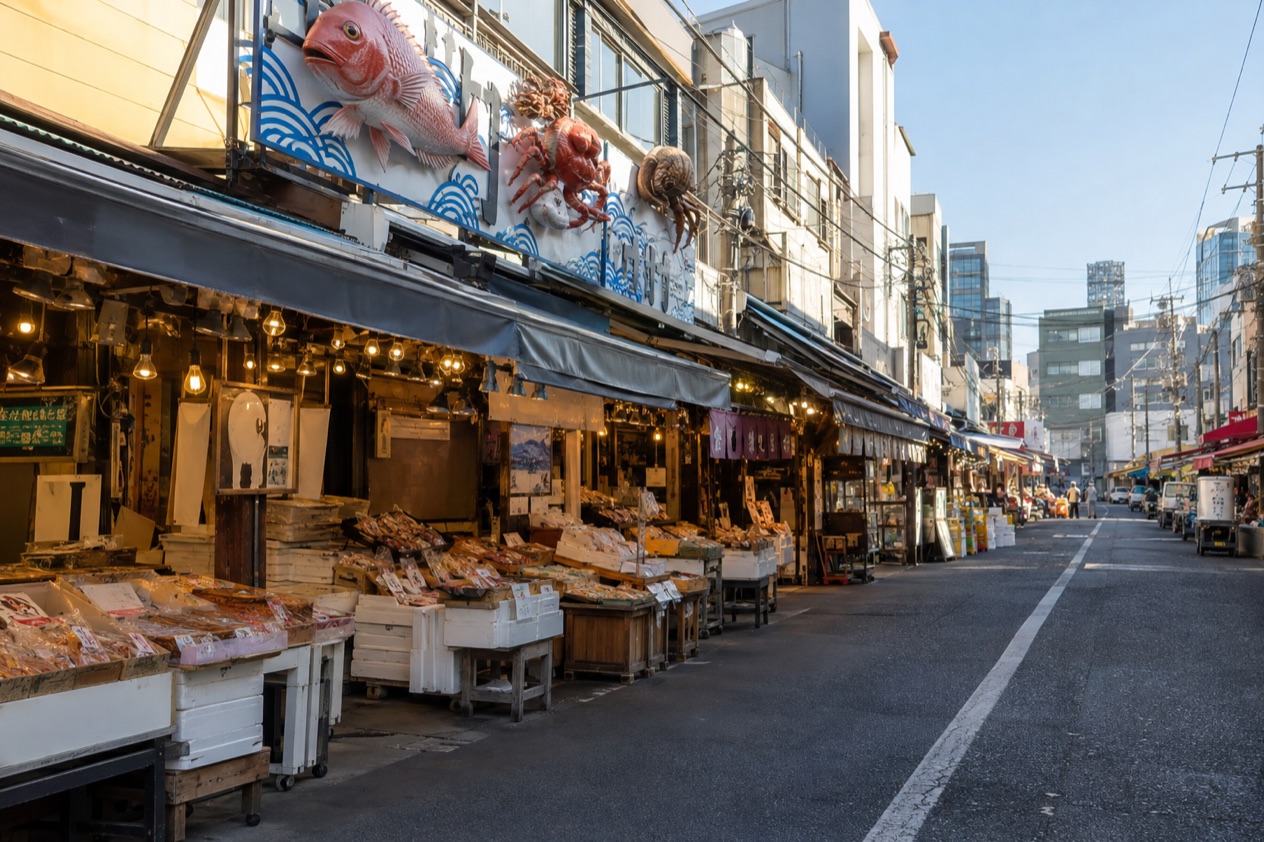
The first things you notice at the Tsukiji Outer Market are the smells: grilled scallops, sweet rolled omelet, soy and the cold mineral scent of fresh seafood on ice. Narrow lanes run between tiny shops, and cooks in rubber boots and white aprons call out to passersby. This is the part of Tsukiji that stayed after the wholesale market moved away, and it is a place to wander with an appetite, a browse among knives and tableware, and a long look at how Tokyo shops for food.
Is visiting the Tsukiji Outer Market worth it?
Yes, if you like food and like to see how it is sold, because the outer market is a working mix of shops and restaurants where the food is the whole point. It suits travelers who enjoy eating sushi at a counter, picking up a snack from a stall and poking around shelves of kitchen gear. It suits less well anyone who wants a sightseeing monument with a gate and a ticket, since this is a place of shopping and meals.
The outer market is a blend of wholesale and retail businesses. Shops sell Japanese kitchen tools, restaurant supplies, groceries and seafood, and a good share of the restaurants are sushi restaurants.
That mix is what sets it apart from a department store food hall or a modern shopping street: a professional cook and a curious visitor can stand in the same aisle looking at the same knife or the same box of dried goods. The inner wholesale market, where the big fish auctions took place, moved to the new Toyosu Market, so Tsukiji today is about the shops and the meals rather than the auction floor.
There is also a simple pleasure in the format. You do not need a reservation-style plan or a set itinerary. You walk, you look, you stop when something smells good, and you leave with a bag of something you did not expect to buy.
For many travelers a visit to Tokyo feels incomplete without at least one meal built around seafood, and Tsukiji is where that meal happens in a setting that still looks like a market. Keep expectations tied to the shops and restaurants, and the visit pays off.
What to see at the Tsukiji Outer Market
Seafood stalls and sushi counters
Seafood is the core of the outer market, and the restaurants lean heavily toward sushi. You see trays of tuna in deep red, pale sea bream, glossy salmon roe and sea urchin sitting in small wooden boxes. Some shops sell raw fish to take home, others grill shellfish on the spot, and the sushi counters serve rice topped with fish cut moments before.
Look at how the knives move and how the fish is displayed. The care given to a single slice of tuna tells you a lot about why Japanese cooks treat seafood with such attention. Even if you do not sit down for a full sushi meal, a skewer of grilled scallop or a small seafood rice bowl gives you the flavor of the place.
Tamagoyaki, snacks and groceries
Between the fish shops you find the groceries and prepared foods that make browsing so easy to turn into a meal. Tamagoyaki, the rolled omelet cooked in a rectangular pan, comes warm and lightly sweet on a stick. Other shops sell pickles (tsukemono), dried bonito shavings, seaweed, dried fish, tea and sauces, many of them neatly packed and easy to carry home.
This is the part of the market for souvenirs that you can actually eat. A bag of seaweed, a jar of pickled vegetables or a packet of dried bonito shows you what goes into a Japanese kitchen. Look for the small tasting portions, a bite of this and a sip of that, which let you try before you settle on a meal.
Kitchen tools and restaurant supplies
The outer market is not only food. Shops sell Japanese kitchen tools and restaurant supplies, so you will see rows of knives, pans, ceramic bowls, chopsticks, lacquerware and the small gadgets that professional cooks rely on. Many of these shops serve working restaurants, which gives the shelves a practical, no-frills feel.
Even if you have no room in your suitcase, it is worth a look. The variety of knives, each shaped for a different kind of cutting, is a small lesson in how specialized Japanese cooking is. A set of chopsticks or a small dish makes a gift that costs little space and carries the market home.
The former inner market and Toyosu
The inner wholesale market closed on 6 October 2018, with operations moving to the new Toyosu Market. For years visitors were admitted to the inner market only after the morning rush, by which time activity had reduced significantly. A small number of visitors were once allowed in the early morning to see the tuna auction, and after May 2010 the auctions reopened to the public with a limit of 120 visitors per day on a first-come, first-served basis.
That history explains why the outer market matters today. The wholesale trade moved, but the shops and restaurants that grew up around it stayed in Tsukiji, still selling food and other goods. When you walk the lanes, you are walking through the part of the old market district that kept going.
Hours, tickets and rules
The outer market is a collection of shops and restaurants rather than a single site with one gate, so there is no one entry ticket to describe, and the timing that matters most is when the shops close. Most shops close by early afternoon, which shapes the whole visit: you arrive with time to browse, eat and shop before the lanes wind down.
| Site | Open |
|---|---|
| Tsukiji outer market (shops) | Most shops close by early afternoon |
| Former Tsukiji inner wholesale market | Closed on 6 October 2018, operations moved to Toyosu Market |
The outer market remains in Tsukiji, Tokyo, selling food and other goods, even though the inner market moved to Toyosu. Because individual shops and restaurants run their own business, the practical picture is one of many small operators sharing a district.
The old inner market, by contrast, had visitor entry that was prohibited until after 11:00 a.m. in its final years, and at times it was closed to visitors entirely. Those rules belong to the market that has closed and no longer apply to the shops you walk past today.
When to visit the Tsukiji Outer Market
Plan the visit around the morning and the lunch hour, because most shops close by early afternoon. That is the main clock of the market: arrive with the day still ahead of you, browse the stalls, eat a seafood meal and be done before the lanes empty out. A visit that starts late in the afternoon would find most of the shops already closed.
Tokyo’s seasons change what the walk feels like, since the lanes are open to the air. Spring and autumn bring mild temperatures that suit a stroll between stalls.
Summer is hot and humid, and a cold drink or an indoor sushi counter becomes part of the plan. Winter is cooler, with a dry feel and the occasional day of snow or sleet, and a hot bowl of something from a stall tastes better for it.
| Month | Average high (°F) | Average low (°F) | Precipitation (inches) | Days with rain (1 mm or more) |
|---|---|---|---|---|
| January | 49.6 | 34.2 | 2.35 | 4.5 |
| April | 66.9 | 49.6 | 5.26 | 9.5 |
| July | 85.8 | 72.3 | 6.15 | 10.5 |
| October | 71.6 | 58.6 | 9.24 | 10.5 |
October brings the mildest air of the four months in the table, comfortable for walking outside in a light layer. It is also the wettest of them, with rain falling on about a third of the days, so an umbrella belongs in the bag.
Sunshine is less plentiful than in January, and the air is more humid. Rain in October often means a gray day with showers, which suits a market where much of the browsing happens under awnings and at covered counters.
January is the driest month in the table, with cold, clear days and some sunshine, and the snow or sleet that does fall is light. April sits in between, with mild highs and a fair number of rain days.
July is warm and humid, with the highest humidity of the months shown. No festival or fixed date in the information for this market sets a special moment in the year, so the season is mostly about comfort and the food you feel like eating.
Tips for your visit
Come hungry and keep the plan loose. The outer market rewards grazing: a skewer here, a rolled omelet there, then a sit-down sushi meal once you have seen what the lanes offer. Because most shops close by early afternoon, the order of the day is browse first and eat in the stretch around lunch, rather than leaving the meal for the end of a long afternoon.
Bring an umbrella on rainy days and wear shoes that are comfortable for standing and walking on hard ground. A small bag helps for the things you are likely to pick up, such as seaweed, tea, dried goods or a pair of chopsticks. Leave room in the suitcase if the kitchen shops tempt you, since the knives, bowls and gadgets are the kind of purchase that is hard to resist once you have held them.
Tokyo is reached through Haneda Airport, officially Tokyo International Airport, or Narita Airport, Japan’s largest international airport. Once in the city, the market is a morning or midday stop that fits into a day with other districts.
Ginza, also in Tokyo, is an upscale downtown area with high-end restaurants and luxury shops, and it offers a very different kind of meal and shopping from the stalls of Tsukiji. Nihonbashi, known for its rich heritage, is the main financial district of Japan and gives another side of the city for the afternoon.
For a family or a group, treat the market as a food outing and let everyone pick something to try, one stall at a time. The old tuna auction visits belong to the inner market that has closed, so there is no early wake-up to plan around today. If you want to see the wholesale trade itself, remember that it now runs at Toyosu Market, while Tsukiji keeps the shops, the restaurants and the lanes.
Good to know before you go
Treat the outer market as a place for food and small purchases, and carry a way to pay that suits shops and restaurants of every size. Keep an eye on your belongings in the busy lanes, as you would in any crowded market, and hold your food away from other people as you walk.
October sits in the rainy part of the year in Tokyo, so showers are likely and a rain jacket or umbrella is part of a sensible plan. The market’s own schedule matters more than the weather, since most shops close by early afternoon.
Sources
- Wikipedia, Tsukiji fish market (https://en.wikipedia.org/wiki/Tsukiji_fish_market), checked October 11, 2026
- Japan National Tourism Organization, Tokyo (https://www.japan.travel/en/destinations/kanto/tokyo/), checked October 11, 2026
- Japan Meteorological Agency (JMA), Normal values 1991-2020, monthly (https://www.data.jma.go.jp/stats/etrn/view/nml_sfc_ym.php?prec_no=44&block_no=47662), station Tokyo, elevation 25 m, checked October 11, 2026
To plan your stay
- Best Time to Visit Japan: Cherry Blossoms, Autumn Colors, Weather and Festivals
- Where to Stay in Japan: Ryokan, Temple Stays, Capsule Hotels and the Best Cities to Base In
- Sending Luggage from the Airport in Japan: Hands-Free Travel, Hotel Delivery and Coin Lockers
- Know Before You Go to Japan: Entry, Money, Etiquette and Getting Around