
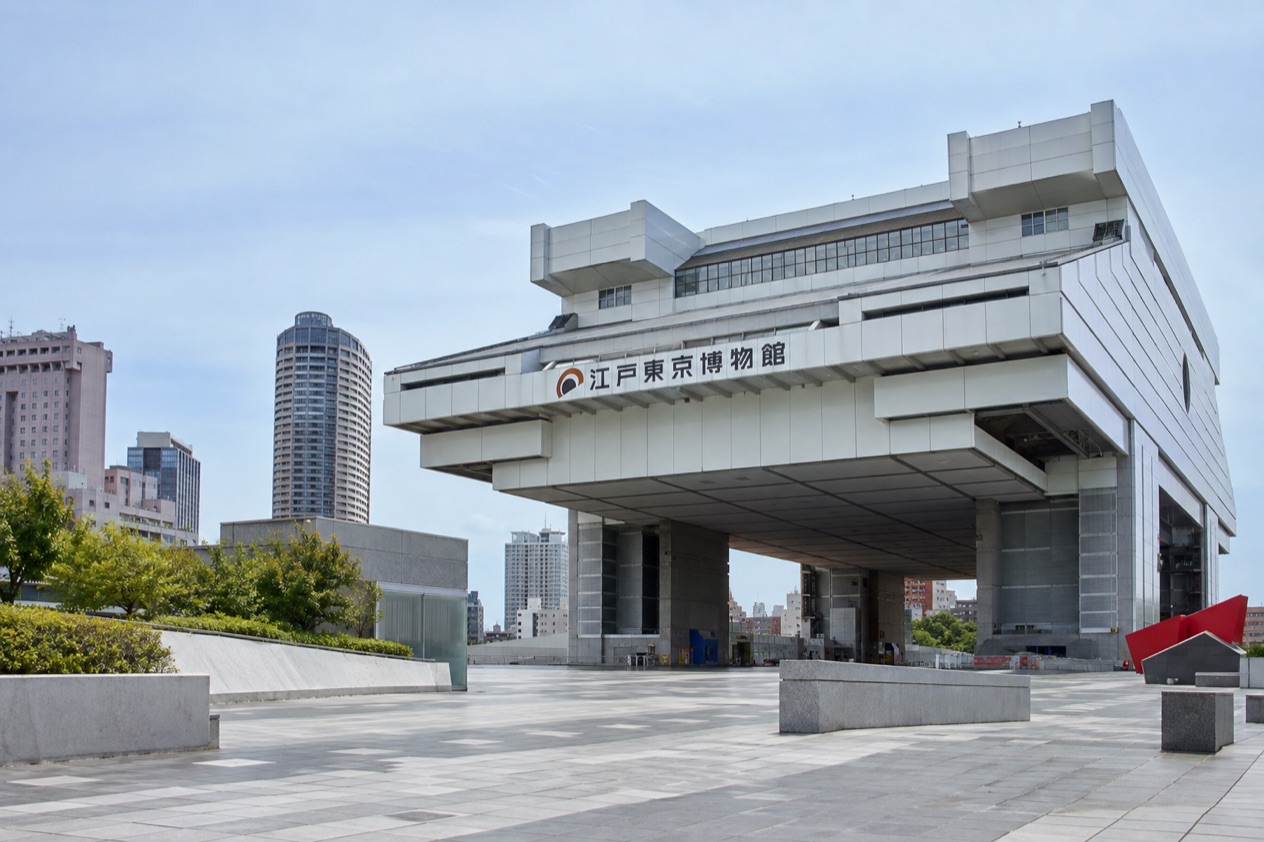
Walking toward the Edo-Tokyo Museum in Ryogoku, you pass a line of red installations whose screens flicker with scenes from one era after another, each a little closer to the Edo of the shoguns. Then the building itself rises ahead, a huge raised hall on stilts that looks nothing like the city around it. Inside, the visit is a long, slow walk through the story of a city that became Tokyo, told with models, replicas and the objects of everyday life.
Is visiting the Edo-Tokyo Museum worth it?
Yes, if you want to understand how Tokyo came to be, and it suits curious travelers, families with children who like to look closely at miniatures, and anyone who has stood in Shibuya or Ginza and wondered what was there before. The museum was opened in March 1993 to preserve the cultural heritage of Edo, the name the city carried before it became the capital we know.
The core of the collection is its city models of Edo and Tokyo, which follow the place from 1590 to 1964. Seeing a town shrink and swell, burn and rebuild, in small scale is a different experience from reading a plaque in a temple. You come away with a picture of the whole city across time, not a single monument.
That is what separates it from the other ways of meeting Tokyo’s past. A temple shows you one sacred corner, and the glass towers of Nihonbashi or the boutiques of Ginza show you the present, with only traces of history. Here the past is the whole subject, laid out in rooms you walk through at your own pace, with the streets and neighborhoods of old Edo rebuilt around you.
It also asks for some curiosity. Those who enjoy a quick look and a photo will find a large museum that rewards patience, with small details in the models, tools and theater props that reveal themselves only to a slow eye.
What to see at the Edo-Tokyo Museum
The permanent exhibits are the reason to come, and they are built around walking through space rather than reading panels. Three parts stand out: a bridge, a set of town models and a theater.
The life-size Nihonbashi replica
A life-size replica of Nihonbashi greets you as you enter the history galleries. In the Edo era the original bridge was the point from which the great roads out of the city were measured, so stepping onto its wooden span is like standing at the center of the old country’s map. Nihonbashi today is a district of banks and offices, known for its rich heritage and as the main financial district of Japan, which makes the contrast striking.
Look at the railings and the planks, then at the painted scenes of the river and the merchants’ warehouses nearby. Imagine porters, travelers and peddlers streaming across, because that crowd is exactly what the bridge was built to carry.
Scale models of Edo, Meiji and Showa towns
The models of towns and buildings from the Edo, Meiji and Showa periods are the heart of the museum. Tiny figures crowd the streets, rows of merchant houses line the lanes, and the change from wooden Edo to the brick and gas lamps of Meiji and then to the postwar city is visible from one case to the next.
Take your time at each one. The charm lies in small things: a laundry line on a rooftop, a signboard over a shop, a firefighter’s ladder, the shape of a canal. Children often enjoy hunting for tiny details, and adults tend to linger longer than they planned.
The Nakamura-za theatre
The Nakamura-za was a kabuki theater of Edo, and the museum recreates it among the permanent exhibits. Kabuki was the popular entertainment of the townspeople, with stage stars, painted posters and audiences who came to be thrilled as much as to see the play. Seeing the theater’s front and its details helps explain how deeply the art was woven into daily life.
Pair this with the models of the same neighborhoods, and the picture of an Edo day fills in: the market in the morning, the stage in the evening, the river between them.
The approach and the building
Even before you enter, the museum starts to talk. Twenty-four red installations line the approach, with digital displays that project imagery from periods that grow steadily closer to the Edo era as you advance.
The building was designed by Kiyonori Kikutake, and its raised, bold form makes it easy to spot from the surrounding streets of Ryogoku. Take a moment to look up at it before going in.
Hours, tickets and rules
The museum stands at 1-4-1 Yokoami in Sumida, in the Ryogoku district of Tokyo. It is a large building covering a wide site, so expect to move through it in stages rather than in a single sweep.
For understanding the exhibits, the museum offers multilingual guidance through QR codes that you scan with a smartphone. Information on the exhibits appears in 13 languages, which means English-speaking visitors can follow the story without a printed guide. Bring a phone that is charged and, if you like, headphones, so you can read and listen as you walk.
The district itself gives a sense of place. Ryogoku is the part of Tokyo with the strongest sumo associations, and the neighborhood has a quiet pride in its traditions, so the museum fits naturally into the surroundings.
When to visit the Edo-Tokyo Museum
Because the galleries are indoors and the approach is short, the museum works in any season, and the weather mostly decides how you shape the rest of your day. The seasons below follow the weather in Tokyo itself.
| Month | Average high (°F) | Average low (°F) | Rain days | Sunshine (hours) |
|---|---|---|---|---|
| January | 49.6 | 34.2 | 4.5 | 193 |
| April | 66.9 | 49.6 | 9.5 | 179 |
| July | 85.8 | 72.3 | 10.5 | 151 |
| October | 71.6 | 58.6 | 10.5 | 129 |
January is cold and bright, with plenty of sunshine and now and then a day of snow or sleet. A museum visit fits a winter day well, and you can walk the approach with a warm coat, then spend hours inside in comfort.
April brings mild afternoons and cool mornings, with showers on many days. It is a pleasant season for the walk to the entrance, and the indoor exhibits give you somewhere to go when a shower comes.
July is hot and humid, which makes the cool galleries a welcome refuge. Rain falls on many days, and the museum becomes an easy answer to a sticky afternoon in Tokyo.
October is mild, with comfortable afternoons and cooler evenings, but it is also a damp month, with rain on many days and fewer hours of sun. Bring a light jacket and an umbrella, and let the museum take the part of the day that the weather would spoil.
Tips for your visit
The exhibits reward lingering, and the models in particular are the kind of thing you notice more the longer you stand in front of them. Comfortable shoes help, since the galleries ask you to walk and stand a good deal.
Before you go in, load the QR guidance on your phone, so that the 13-language information is ready when you reach the first gallery. Pair it with a pair of earphones if you have them, and take pictures of the models for later, when you want to remember a particular street.
Pairing it with the rest of Tokyo
The museum makes a good companion to the districts that show Tokyo’s present. Nihonbashi, which the replica bridge recalls, is known for its rich heritage and as the main financial district of Japan, and Ginza is an upscale downtown area with high-end restaurants and luxury shops. Seeing the old city first gives those neighborhoods a deeper background.
Roppongi and Akasaka, reachable from Shibuya Station in about 10 minutes by train, offer a different kind of evening once the museum is behind you, and their stations are served by the Hibiya, Oedo, Chiyoda and Namboku lines.
Families and getting to Tokyo
Families with children often find the models a good way to hold attention, since there is so much to point at and search for. The theater and the bridge give a sense of scale that a book cannot. Tokyo lies on Tokyo Bay, in the Kanto region on Honshu, and its nearest airports are Haneda, officially Tokyo International Airport, and Narita, Japan’s largest international airport.
Good to know before you go
Tokyo is the capital of Japan and the most populous metropolitan area in the world, so plan the museum as one quiet chapter among many in a big city. Keep a little time free around the visit, because the neighborhood of Ryogoku rewards a wander on its own, and take a rain layer in the damp months so the weather never decides the day for you.
Sources
- Wikipedia, Edo-Tokyo Museum (https://en.wikipedia.org/wiki/Edo-Tokyo_Museum), checked October 11, 2026
- Japan National Tourism Organization, Tokyo (https://www.japan.travel/en/destinations/kanto/tokyo/), checked October 11, 2026
- Japan Meteorological Agency (JMA), Normal values 1991-2020, monthly (https://www.data.jma.go.jp/stats/etrn/view/nml_sfc_ym.php?prec_no=44&block_no=47662), station Tokyo, elevation 25 m, checked October 11, 2026
To plan your stay
- Best Time to Visit Japan: Cherry Blossoms, Autumn Colors, Weather and Festivals
- Where to Stay in Japan: Ryokan, Temple Stays, Capsule Hotels and the Best Cities to Base In
- Sending Luggage from the Airport in Japan: Hands-Free Travel, Hotel Delivery and Coin Lockers
- Know Before You Go to Japan: Entry, Money, Etiquette and Getting Around