
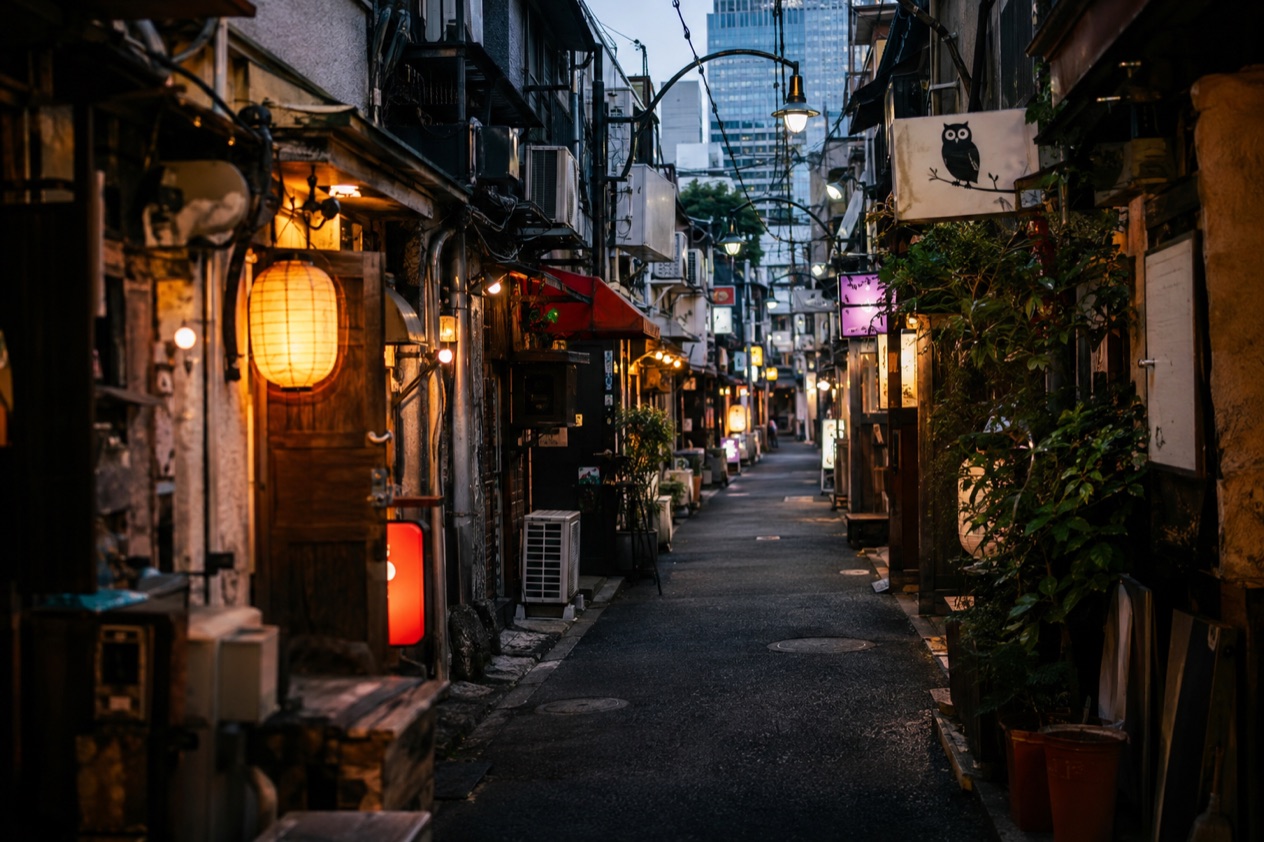
Walk into the lanes behind Shinjuku Station after dark and the glow of hand-painted signs and paper lanterns pulls you into passages barely wider than your shoulders. Behind the narrow doors are tiny bars, some with room for only five or so customers. Golden Gai is a night-time visit in the middle of Tokyo, built around conversation, a drink and the feeling of squeezing into someone’s very small living room.
Is visiting Golden Gai worth it?
Yes, if you like atmosphere more than monuments and are happy to spend an evening on your feet and then on a stool, with a drink in hand. It suits curious travelers, music fans, and anyone who wants to see a side of Tokyo that has nothing to do with skyscrapers. It is less suited to people who want a large table, a quiet dinner or a big group night out, since the bars are tiny by design.
What sets it apart from the other nightlife districts of Tokyo is the scale. Ginza is an upscale downtown area of high-end restaurants and luxury shops, and Roppongi has its own late-night reputation, but Golden Gai is a network of six narrow alleys where some bars hold only five or so customers at a time.
Each one has its own personality, often a theme such as jazz, R&B, karaoke, punk rock or flamenco. You are not choosing a venue so much as choosing a mood, and you can change it by walking ten steps.
There is also a layer of history in the walls. The district was known for prostitution before 1958, when the practice became illegal in Japan, and the cramped wooden buildings still carry that postwar, back-street feel. Today the bars are about music, talk and drinking, and the old structure is a large part of the appeal. Those who enjoy it tend to leave with a story about a stranger at the next stool.
What to see at Golden Gai
The six alleys
The heart of Golden Gai is its layout: six narrow alleys, linked by passageways so tight that they are about wide enough for one person to pass through. You move in single file, sometimes pausing to let someone come the other way, and the sense of being in a maze is part of the fun. Doors open straight onto the lane, so a burst of music or laughter arrives and fades as you walk.
Look up as well as ahead. Signs are stacked on top of each other, stairs climb to second-floor rooms, and small handwritten notices announce a bar’s name, its style or its prices. Walking the whole network once, before you decide where to sit, gives you a feel for which doors suit your taste.
The bars and their themes
Many of the bars have a particular theme. You may find a room devoted to jazz, another to R&B, one to karaoke, one to punk rock, one to flamenco.
The decor follows the music: records on the shelves, posters pasted layer upon layer, instruments hanging from the wall. With room for only five or so customers in the smallest bars, the bartender is often part of the conversation, and the whole room can end up talking together.
Not every door is open to a newcomer. Many of the bars only welcome regular customers, who initially should be introduced by an existing patron. Some, however, make efforts to attract overseas tourists, with signs and price lists in English. Those signs are the easiest clue to where a first-time visitor will be at home, and reading them before you step in saves awkward moments.
Shinjuku Golden Street Theatre
In one corner of Golden Gai sits a tiny theater, Shinjuku Golden Street Theatre, which puts on mainly comedy shows. It fits the district’s spirit: a small stage in a place where everything is small, where the audience and the performers are close enough to hear each other breathe. Even if you do not go in, it is a reminder that the alleys are more than a row of bars.
Comedy performed in Japanese may not be easy to follow for every visitor, so think of the theater as a curiosity to notice on your walk, unless you are keen on the experience for its own sake.
Hours, tickets and rules
Golden Gai is a network of narrow alleys lined with individual bars. What matters is the hour. Most of the bars do not open until 9:00 or 10:00 p.m., so the area is very quiet during the day and early evening. Arrive too early and you will find shuttered doors and empty lanes, which is lovely for a look at the architecture but not for a drink.
| Site | Open |
|---|---|
| Golden Gai alleys (most bars) | Most bars open from 9:00 or 10:00 p.m. |
The passageways between the alleys are about wide enough for a single person, and some of the bars can seat only five or so customers at one time, which means that a group may have to split up or try several doors.
How to get to Golden Gai
Golden Gai sits in Shinjuku, in Tokyo, and the way in is on foot from Shinjuku Station. It is a few minutes’ walk from the East Exit of the station, between the Shinjuku City Office and the Hanazono Shrine.
If you are arriving in Tokyo from abroad, the nearest airports to the city are Haneda Airport, officially Tokyo International Airport, and Narita Airport, Japan’s largest international airport. From either you continue into the city and on to Shinjuku Station, then to the East Exit. Tokyo itself lies on Tokyo Bay in the Kanto region, on Honshu.
Other parts of the city connect to your evening plans too. Roppongi and Akasaka can be reached from Shibuya Station in about 10 minutes by train, and Roppongi Station is served by the Tokyo Metro Hibiya Line and Toei Oedo Line. Ginza and Nihonbashi are also in Tokyo. If you plan a night that links several districts, these are the names you will meet on the map.
When to visit Golden Gai
Time of day matters more than season here. The bars come alive late, so the lanes are at their liveliest after the usual dinner hour, once most of them have opened at 9:00 or 10:00 p.m. During the day and early evening the area is very quiet, which suits a look at the buildings and the signs but not much else.
As for the months, the alleys are open to the sky and you walk from bar to bar, so the weather shapes the evening. In October, Tokyo’s highs average in the low 70s and lows in the upper 50s, with rain on about ten days of the month, so a light layer and an umbrella fit the season. In April the highs reach the upper 60s and lows near 50, with rain on about nine days.
January is the cold end of the year, with highs near 50 and lows in the mid-30s, and the occasional day of snow or sleet. July brings highs in the mid-80s and lows in the low 70s, with humidity around three quarters, so the evening air is warm and sticky. Each season gives a different mood to the same lanes, from a winter dash between warm doorways to a summer night when the doors stand open.
| Month | Average high (°F) | Average low (°F) | Rain days | Precipitation (inches) |
|---|---|---|---|---|
| January | 49.6 | 34.2 | 4.5 | 2.35 |
| April | 66.9 | 49.6 | 9.5 | 5.26 |
| July | 85.8 | 72.3 | 10.5 | 6.15 |
| October | 71.6 | 58.6 | 10.5 | 9.24 |
Tips for your visit
Plan Golden Gai as the late part of an evening, not the whole of it. Since most bars open only at 9:00 or 10:00 p.m., an earlier dinner elsewhere in Shinjuku, then a walk to the alleys, fits the rhythm of the place. Take a first lap without stopping, read the signs, and notice which bars display English price lists, since those are the ones that welcome visitors.
Keep your group small. With some bars holding only five or so customers, two or three people fit far more easily than a crowd, and a bigger party may need to split across several doors. If a door does not feel open to you, move on without fuss, because many bars are for regulars introduced by an existing patron.
The Hanazono Shrine and the Shinjuku City Office sit on either side of the district, which gives you something to look for on the way in. The alleys are narrow and the passageways are about wide enough for one person, so a large bag will be a nuisance. This is a place for a small bag, a light jacket in cooler months and a willingness to stand and chat.
Good to know before you go
Golden Gai is a place to go slowly and keep an eye on your own pace, since an evening of several small bars can stretch longer than planned. The October rains are frequent enough that a compact umbrella is useful in the lanes. The district sits in the middle of a dense part of Tokyo, a few minutes’ walk from the East Exit of Shinjuku Station, so the route home is easy to keep in mind as the night goes on.
Sources
- Wikipedia, Golden Gai (https://en.wikipedia.org/wiki/Golden_Gai), checked October 11, 2026
- Japan National Tourism Organization, Tokyo (https://www.japan.travel/en/destinations/kanto/tokyo/), checked October 11, 2026
- Japan Meteorological Agency (JMA), Normal values 1991-2020, monthly (https://www.data.jma.go.jp/stats/etrn/view/nml_sfc_ym.php?prec_no=44&block_no=47662), station Tokyo, elevation 25 m, checked October 11, 2026
To plan your stay
- Best Time to Visit Japan: Cherry Blossoms, Autumn Colors, Weather and Festivals
- Where to Stay in Japan: Ryokan, Temple Stays, Capsule Hotels and the Best Cities to Base In
- Sending Luggage from the Airport in Japan: Hands-Free Travel, Hotel Delivery and Coin Lockers
- Know Before You Go to Japan: Entry, Money, Etiquette and Getting Around