
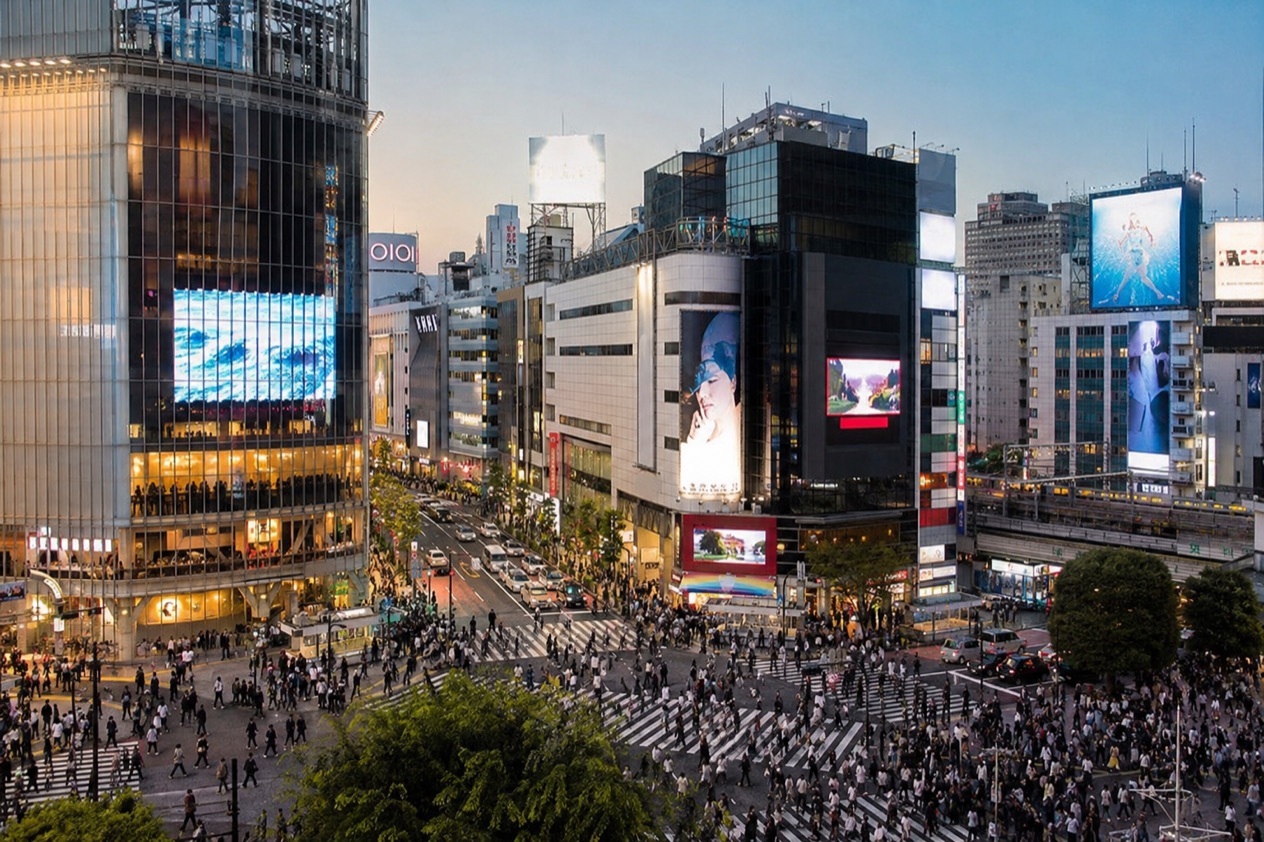
The light turns red, the traffic stops in every direction, and a few thousand people step off the curb at once, crossing in straight lines, in diagonals, around each other without a pause. Giant screens flicker on the buildings above, and the loudspeakers blend with the footsteps. Shibuya Crossing is a place you cross rather than tour, and the visit is as much about watching as about walking.
Is visiting Shibuya Crossing worth it?
Yes, for anyone who wants to see Tokyo at full tilt, and it suits first-time visitors, photographers and people who like to watch a city move. Shibuya Crossing has been described as the world’s busiest pedestrian crossing, with as many as 3,000 people crossing during a single green light cycle. It costs nothing to stand at its edge, and a few minutes are enough to feel what it is about.
What sets it apart from the other busy corners of Tokyo is the way everything stops at once. At many big junctions pedestrians trickle across in waves, but here every signal turns red together and the whole intersection fills from all sides, in a scramble. It sits beside Shibuya Station, so you arrive straight into it, with Hachiko Square right next door.
It is not a place for a long, contemplative stop. It is a moment, repeated every time the lights change, and you can watch it a few times from different angles and then move on to the streets, shops and cafés around it. People who expect a monument may feel underwhelmed, while those who enjoy crowds in motion often find it hard to leave after just one cycle.
What to see at Shibuya Crossing
The scramble itself
The crossing was inaugurated in 1973, and it works on a simple idea: all vehicle lights go red, and pedestrians may cross in any direction, including diagonally. The result is a dense, ever-changing pattern of people meeting in the middle and flowing out the other side. Walk across at least once, then step back and watch.
A 2014 survey by the Shibuya Redevelopment Association estimated around 260,000 pedestrians crossing per day on weekdays, and 390,000 on non-working days. Look for how the crowd mixes: office workers, students, shoppers, visitors with cameras filming the crowd while crossing it. Listen too, because the sound of the place, with its screens, announcements and footsteps, is part of what you remember.
The Statue of Hachiko
The Statue of Hachiko stands at Hachiko Square, adjacent to the crossing. It honors the Akita dog who, by the well-known story, kept returning to the station to wait for his owner. It is a favorite meeting point, so expect people standing around it, phones in hand, waiting for friends.
The statue is small compared with the buildings around it, and it is easy to walk past if you are looking up at the screens. Take a moment to find it, stand beside it, and look back at the crossing from the square. It is a quieter way to take in the same scene, and it pairs naturally with a few minutes at the junction.
The screens, signs and surrounding buildings
The corners of the crossing are lined with tall buildings covered in video screens, advertisements and bright signs. After dark the scene turns into a glowing canvas, and the colors reflect off wet pavement on rainy nights. Look up as well as across, since much of the character of the place is overhead.
Many people like to watch from above, through the windows of cafés and shops that face the intersection. Whether you cross on foot or look down on it, the view changes with each light cycle, so there is no single moment to catch. Give yourself a few cycles and different vantage points.
Hours, tickets and rules
Shibuya Crossing is a public street crossing, not a ticketed site, so there is no gate, no line at a ticket window and no admission to pay. You simply walk up to it, whenever you like, and cross with everyone else when the signal allows.
| Site | Open | Admission |
|---|---|---|
| Shibuya Crossing | Public crossing, open at all hours | Free |
| Statue of Hachiko, Hachiko Square | Public square, open at all hours | Free |
One rule is in force around the crossing: in June 2024, Shibuya Ward passed an ordinance extending the public drinking ban year-round, from 6 p.m. to 5 a.m. nightly. For New Year’s Eve in 2023, alcohol consumption was restricted from 6 p.m. to 5 a.m. on 1 January around the crossing, and stores were asked not to sell alcohol in that window.
How to get to Shibuya Crossing
The crossing is in Shibuya, Tokyo, near Shibuya Station, so the station is your starting point. Hachiko Square, with its statue, sits next to the crossing and makes an easy landmark when you step out of the station.
From Roppongi and Akasaka, Shibuya Station can be reached in about 10 minutes by train. Roppongi Station is served by the Tokyo Metro Hibiya Line and Toei Oedo Line, Nogizaka Station by the Tokyo Metro Chiyoda Line, and Roppongi-Itchome Station by the Tokyo Metro Namboku Line.
Tokyo’s nearest airports are Haneda Airport (officially Tokyo International Airport) and Narita Airport, Japan’s largest international airport. Ginza and Nihonbashi are also in Tokyo, in the Kanto region, if you are staying in one of those districts. Once you reach Shibuya Station, the crossing is right beside it, so there is nothing further to plan.
When to visit Shibuya Crossing
The crossing runs through the day and into the night, and it looks different in each. In daylight you see the full scale of the crowd and the buildings around it. After dark the screens and signs take over, and the scene turns into the glowing, layered picture most people have in mind.
Crowds follow the calendar: weekdays see around 260,000 people crossing per day, and non-working days around 390,000. If you want the fullest, busiest scene, a weekend or holiday delivers it. For a slightly less packed crossing, a weekday is the better bet.
As for the seasons, Tokyo in April has highs in the upper 60s, a comfortable time to stand outside and watch, with rain on around nine or ten days. October brings highs in the low 70s but the wettest month of the four, so an umbrella is wise. July is warm and humid, with highs in the mid-80s, while January is cooler, with highs near 50 and occasional snow or sleet.
New Year’s Eve has its own rules around the crossing, with the alcohol restriction described earlier, so the night is shaped by those limits if you plan to be there.
Tips for your visit
Bring a camera or phone, comfortable shoes and, in the wetter months, an umbrella. The crossing rewards a bit of wandering: cross it, return to Hachiko Square, then cross again from another corner to see how the view changes.
Pair it with Hachiko Square, which is adjacent, and with the streets around Shibuya Station. If you are staying elsewhere, districts such as Roppongi and Akasaka lie about 10 minutes away by train, and Ginza, with its high-end restaurants and luxury shops, offers a very different side of Tokyo for another part of the day.
Keep your belongings close and your eyes on the signal, since the crowd moves in every direction at once. Because the drinking ban applies from 6 p.m. to 5 a.m., an evening visit means enjoying the scene without a drink in hand on the street.
Good to know before you go
There is nothing to pay at the crossing, so the main practical point is timing and weather. Tokyo sees its heaviest rain in October among the months considered here, and humidity is high in July, so plan breaks in cafés or shops nearby. Cross with the signal, stay with the flow of the crowd, and keep to the street drinking rules after 6 p.m.
Sources
- Wikipedia, Shibuya Crossing (https://en.wikipedia.org/wiki/Shibuya_Crossing), checked October 11, 2026
- Japan National Tourism Organization, Tokyo (https://www.japan.travel/en/destinations/kanto/tokyo/), checked October 11, 2026
- Japan Meteorological Agency (JMA), Normal values 1991-2020, monthly (https://www.data.jma.go.jp/stats/etrn/view/nml_sfc_ym.php?prec_no=44&block_no=47662), station Tokyo, elevation 25 m, checked October 11, 2026
To plan your stay
- Best Time to Visit Japan: Cherry Blossoms, Autumn Colors, Weather and Festivals
- Where to Stay in Japan: Ryokan, Temple Stays, Capsule Hotels and the Best Cities to Base In
- Sending Luggage from the Airport in Japan: Hands-Free Travel, Hotel Delivery and Coin Lockers
- Know Before You Go to Japan: Entry, Money, Etiquette and Getting Around