
At the check-in counter, with the beach bag already packed and the sunscreen buried under the sandals, someone always asks whether a passport card will do. For anyone flying to the Bahamas, the answer is a passport, a real one, and a visa is not part of the picture for U.S. citizens on a visit. Cruise passengers follow a slightly different rule, and the details are worth sorting out before the trip.
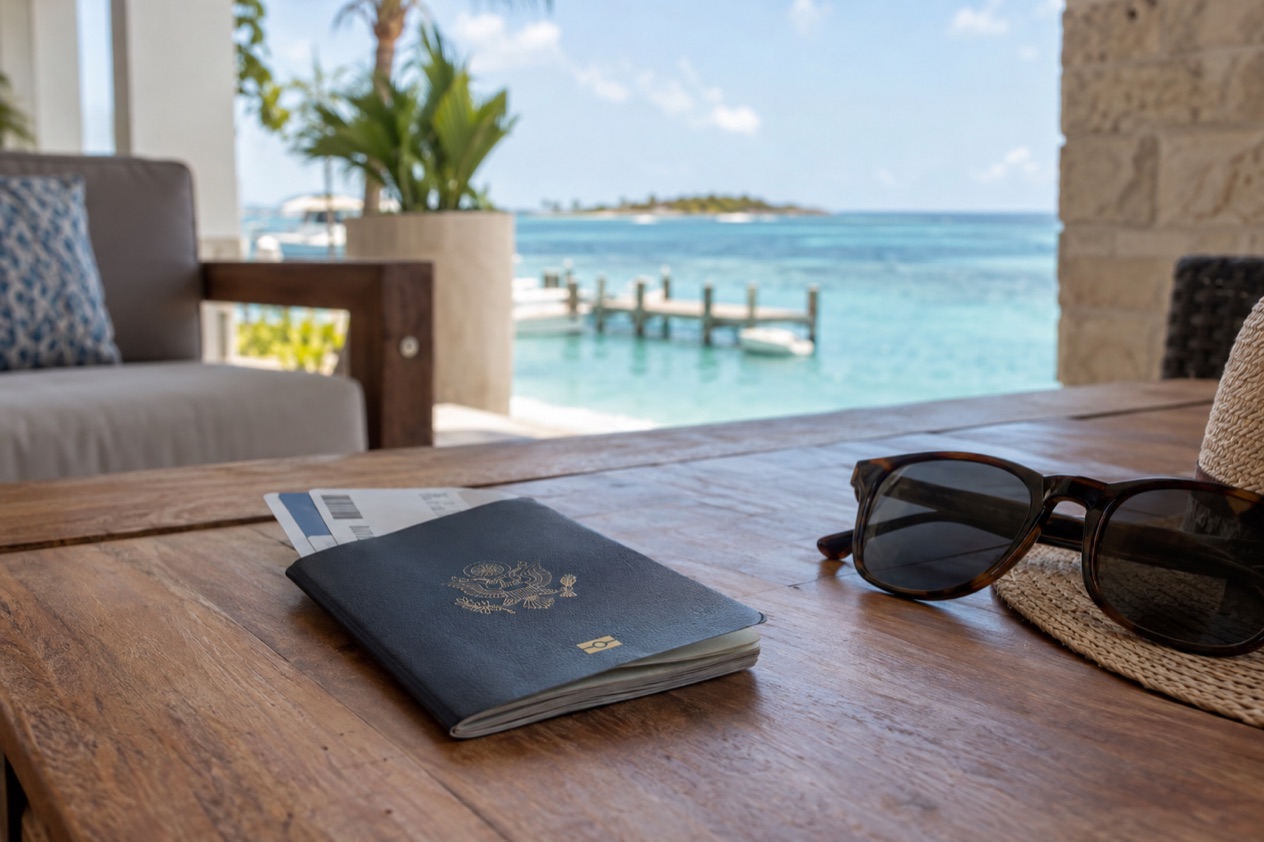
Do you need a passport to go to the Bahamas?
Yes, a passport is required: the Bahamas Department of Immigration states that passports are required by all persons entering the country, and the U.S. State Department says U.S. citizens are generally required to present a valid U.S. passport. That includes children, who each need their own. A birth certificate on its own does not replace it for a flight.
The passport also has to be in good shape for the trip itself. The Bahamas Department of Immigration requires one that is valid for at least six months, and it does not accept passport cards when you arrive by air. If yours expires in the coming months, renewing it before booking saves a very unpleasant surprise at the airport.
Arriving by air
Flying in, the rule is simple and strict: a passport book, valid for at least six months, for every traveler in the party, from the grandparents to the toddler. Passport cards, which work for some land and sea crossings, are not accepted by the Bahamas Department of Immigration at the port of entry.
Coming home matters too. U.S. citizens entering the United States by air must present a valid U.S. passport (or one of a short list of other documents such as a Trusted Traveler card for those who hold one), and children need their own passport for air travel. Lawful permanent residents of the United States carry their Permanent Resident Card instead.
Arriving on a cruise
Cruise passengers have a little more room. The State Department says those traveling to the Bahamas on a cruise may use another Western Hemisphere Travel Initiative compliant document, such as a U.S. passport card. Even so, it strongly recommends a passport, in case an emergency forces you to leave the ship and fly home.
On closed-loop cruises, which begin and end at the same U.S. port, U.S. citizens can reenter the United States with a birth certificate and a government-issued photo ID. The foreign countries on the route may still ask for a passport, so the cruise line is the one to confirm the exact papers with. Travelers without compliant documents are likely to be delayed while officers verify identity and citizenship.
| How you arrive | Document for the Bahamas |
|---|---|
| By air | Passport valid at least six months (passport cards not accepted) |
| By cruise ship | WHTI-compliant document such as a passport card allowed; passport strongly recommended |
| By private boat | Passport; the master of the vessel completes the Inward Passenger and Crew Manifest |
Do U.S. citizens need a visa for the Bahamas?
No, U.S. citizens do not need a Bahamian visa when they enter as a bona fide visitor for a stay not exceeding eight months. That covers the usual vacation, whether it is a long weekend in Nassau or a month of lazy days on an out island.
The word that matters is visitor. The exemption is for tourism and similar stays, not for employment. Visitors are not allowed to engage in any form of gainful occupation while in the Bahamas, and non-citizen travelers must not intend to take up work during their stay. Remote work for a home employer is not something the rules spell out either way, so the safe reading is to treat the trip as a vacation.
Travelers who are not U.S. citizens
The visa exemption described here belongs to U.S. citizens. The State Department notes that all other travelers to the Bahamas will need a visa and/or work permit, so a friend or relative with a different passport should check their own situation rather than assume the same rule applies.
One more point applies to everyone: admittance is not automatic. Even a traveler who meets every entry requirement can be refused leave to land if extenuating circumstances arise, which is why having the documents in order, and the plan for the stay clear in your head, makes the arrival desk a short stop.
Families and children
Children follow the same passport rule when flying. The State Department adds that the Bahamas requires compliance with regulations meant to divert child abduction, similar to U.S. policies. Parents traveling alone with a child, or grandparents bringing grandchildren, are the ones most likely to want to read up on that before leaving home.
How long can you stay?
Visitors may remain in the Bahamas for a maximum of eight months, provided they can support themselves or indicate other means of support for that period. That is a ceiling, not a promise: the actual period stamped in the passport may vary at the discretion of the immigration officer at the port of entry.
So the number to trust is the one written in your passport on arrival. If you plan to stay for a week or two, the stamp will rarely be a concern. If you hope for a long winter on one of the islands, it is worth looking at what the officer gives you before you leave the airport.
Extending your visit
To stay beyond the period granted, visitors must seek permission from the Department of Immigration. The request has to be made before the time runs out: visitors who want to stay beyond the period granted must apply for a visitor extension before it expires.
Overstaying is a punishable offence in the Bahamas. A boat that has been delayed by weather or a flight that was rebooked is a good reason to deal with the extension early rather than on the last day.
Where you clear in
Travelers who arrive by their own boat clear in at a designated port of entry. On Abaco these include Leonard M Thompson International Airport at Marsh Harbour, Great Abaco Beach Resort Marina, Marsh Harbour Public Dock, Baker’s Bay Marina on Guana Cay, and the public docks at Treasure Cay and Green Turtle Cay.
Sandy Point Airport and Sandy Point Public Dock are ports of entry upon request. Passengers arriving by sea must also have the master of the vessel complete the Inward Passenger and Crew Manifest for everyone aboard.
What else do you need to show on arrival?
Beyond the passport, the Bahamas Department of Immigration asks every visitor for a return or onward ticket, a completed Bahamas Immigration Disembarkation/Embarkation Card, and, if requested, evidence that you can pay your own way. The State Department likewise says U.S. citizens must present proof of anticipated departure.
Return or onward ticket
All visitors must hold a return or onward ticket, along with a valid travel document, such as a passport and visa, that would allow entry into another country as applicable. For most Americans that simply means the flight home, kept where you can reach it without digging through the bag.
Proof of funds
Visitors may be asked to produce evidence of sufficient funds to be self-sustaining while in the Bahamas. Non-citizen travelers must have financial means to sustain themselves during their stay or identify a local sponsor who will receive them. Most arrivals are never asked, but the officer is entitled to, and a hotel confirmation for the first nights is the kind of thing people tend to have ready.
The arrival card and health papers
Every traveler must present a completed Bahamas Immigration Disembarkation/Embarkation Card. Filling it out with the pen in your bag before the line forms keeps the arrival hall moving.
Yellow fever is a narrow point. Travelers who must show a certificate need to be vaccinated at least 10 days before entering the country for it to be considered valid, and proof is no longer required for travelers arriving from Trinidad and Tobago. The State Department is unaware of any HIV/AIDS entry restrictions for visitors or foreign residents.
Good to know before you go
The U.S. State Department rates the Bahamas Level 2, “Exercise increased caution”, and says most crime occurs in Nassau on New Providence and in Freeport on Grand Bahama.
Travel with the passport in a place you can reach, a copy of the return flight, and the card filled out before landing. The Atlantic hurricane season runs from June 1 to November 30, so a trip that falls inside those dates deserves a flexible mindset and a look at the forecast as departure approaches.
Sources
- Bahamas Department of Immigration, Entry requirements (https://www.immigration.gov.bs/entry-requirements/), checked October 10, 2026
- Bahamas Department of Immigration, Before your arrival (https://www.immigration.gov.bs/entry-requirements/before-your-arrival/), checked October 10, 2026
- U.S. Department of State, The Bahamas Travel Information, Entry and exit requirements (https://travel.state.gov/), checked October 10, 2026
- U.S. Customs and Border Protection, Western Hemisphere Travel Initiative (https://www.cbp.gov/travel/us-citizens/western-hemisphere-travel-initiative), checked October 10, 2026
- Bahamas Customs and Excise, Ports of entry (https://www.bahamascustoms.gov.bs/customs-ports-of-entry/), checked October 10, 2026
- U.S. Department of State, The Bahamas Travel Advisory, Level 2 (https://travel.state.gov/), checked October 10, 2026
- NOAA National Hurricane Center, Climatology (https://www.nhc.noaa.gov/climo/), checked October 10, 2026
To plan your stay
- Best Time to Visit the Bahamas: Weather, Hurricane Season, Sea Temperatures and Junkanoo
- Where to Stay in the Bahamas: Best Islands, Resorts, Boutique Stays and How to Choose
- Getting Around the Bahamas: Flights, Ferries, Mailboats and Taxis in Nassau
- Know Before You Go to the Bahamas: Entry Rules, Money, Getting Around and Local Customs