
On a February morning at Arawak Cay, a plate of stew lobster arrives in its brown gravy while the harbor breeze is still soft and the sun is already warm on the tables outside. Farther out, boats slip away from the cays toward sandbars and sleepy harbors, and the evening air asks for nothing heavier than a light sweater. February in the Bahamas is a month of sunny days, mild nights and lobster in season, and it suits travelers who want island time without the heat of summer.
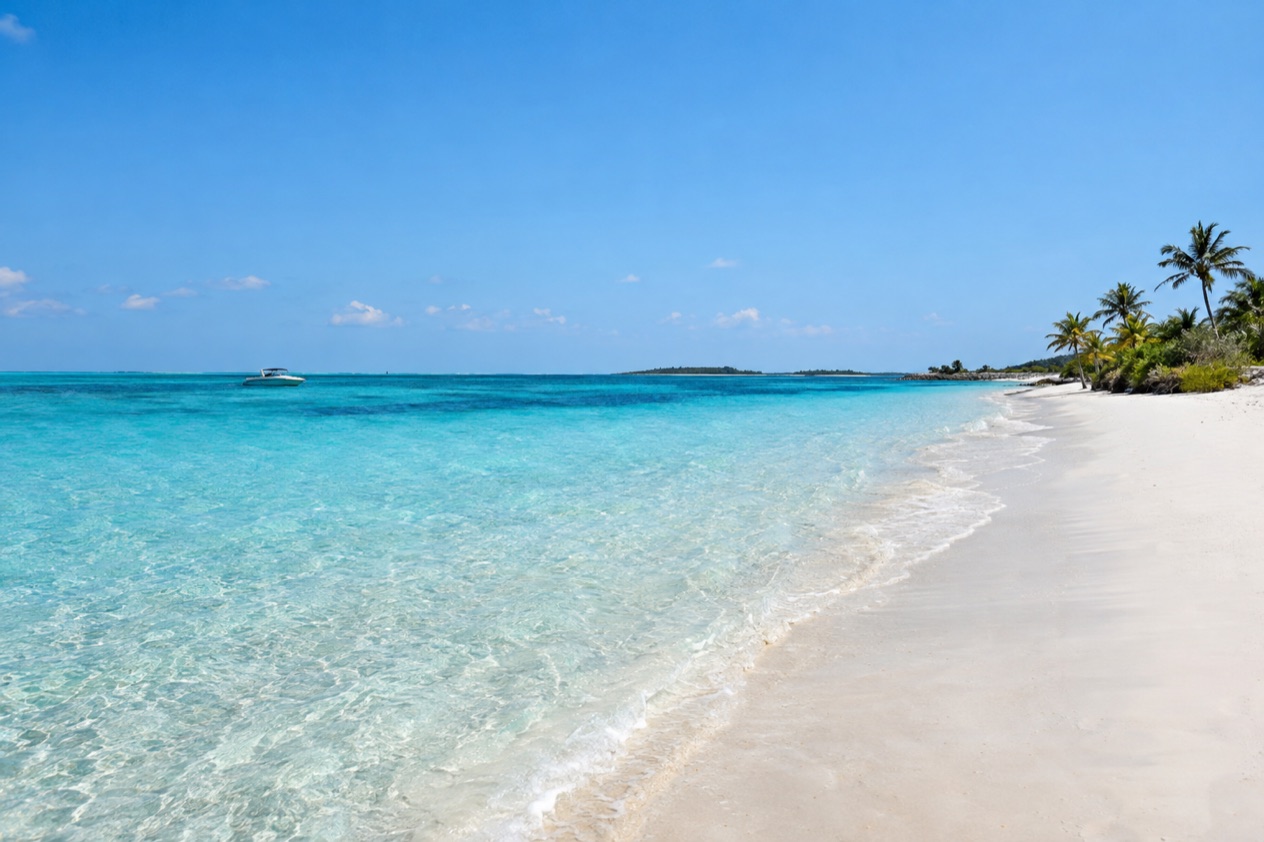
What is the weather like in the Bahamas in February?
In Nassau, February brings warm, bright days and mild evenings, and the water around the islands stays in the upper 70s, a shade warmer around the Exumas than anywhere else in the table.
| Month | Nassau average high (°F) | Nassau average low (°F) | Nassau rain days | Sea at Nassau (°F) | Sea at the Exumas (°F) | Sea at Grand Bahama (°F) | Sea at Bimini (°F) |
|---|---|---|---|---|---|---|---|
| January | 79.4 | 65.1 | 4.3 | 77.0 | 78.3 | 77.1 | 76.3 |
| February | 80.0 | 65.0 | 4.3 | 76.0 | 77.2 | 76.7 | 76.2 |
| March | 81.3 | 66.0 | 4.5 | 77.5 | 78.9 | 77.6 | 78.6 |
Afternoons in Nassau are warm enough for the beach or a long walk through the old town, and nights settle into the mid-60s, which is when a thin layer comes out at a waterfront table. Rain arrives as a few passing showers rather than gray weeks, and February is the driest of the three months in the table.
The sea dips slightly everywhere from January to February, then climbs again in March, with Bimini showing the biggest jump. Around George Town and the Exumas the water is the warmest of the four places listed, while Nassau, Bimini and Grand Bahama sit close together, a degree or so apart. It is pleasant water for people who like the sea cool and clear rather than bathtub warm.
Daylight lasts about 11 hours 22 minutes at Nassau in mid-February, noticeably longer than in January and a little shorter than in March. That gives a full day of ferries, markets and beach time, with the evenings left for dinner and a stroll.
Where to go in the Bahamas in February
The Bahamas is a scatter of about 700 islands and many more cays, so choosing a base matters more than choosing a month. February suits a city-and-beach stay in Nassau just as well as a boat-led week in the Exumas, and the smaller islands keep a slower rhythm. Bimini, with its sea a shade cooler than the Exumas and its harbor town of Alice Town, is a separate option for travelers who like a small-island feel.
Nassau and Paradise Island
Nassau is the capital and the largest city, on the island of New Providence, and it is where February feels most like a city break with a beach attached. You walk the pastel streets of the old town, browse the straw market, climb up to Fort Fincastle and the Queen’s Staircase, then head to Cable Beach or across to Paradise Island for sun.
Food is a reason all its own. Arawak Cay is the place for conch and fried fish, and Gone Fishing there serves stew lobster at breakfast. The airport offers U.S. Border Preclearance, and Nassau Cruise Port is the country’s largest and busiest, so the waterfront has a busy, mixed crowd on ship days.
Grand Bahama: Freeport and Lucaya
Grand Bahama has a quieter, more spread-out feel than Nassau, with the resort strip of Lucaya, the shops and restaurants of Port Lucaya and long stretches of coast beyond. The sea in February sits close to Nassau’s, so beach days are comfortable for people who prefer a fresh start to a swim.
Port Lucaya is where evenings gather, with live music drifting from the waterfront bars and fresh seafood on the menus. Away from town, the island’s pine woods, mangrove creeks and caves reward anyone who likes nature more than shopping.
The Exumas
The Exumas are the pick for travelers who want water above all, and February gives them the warmest sea of the places in the table. The world-famous swimming pigs live on Big Major Cay, sometimes called Pig Beach, which is accessible only by boat and easily reached from nearby Staniel Cay. On Little Exuma, Tropic of Cancer Beach is the longest beach on the island, named for the line of latitude it sits on.
George Town on Great Exuma is the main base, with small shops, local restaurants and a harbor full of sailboats. The days here revolve around boats, sandbars and lunches on the sand, and the evenings are for rum punch and an early night.
The Abacos: Marsh Harbour, Elbow Cay and Hope Town
The Abacos are for people who like harbors, painted cottages and boats tied up in front of the house. Marsh Harbour is the hub, and Elbow Cay is accessible from there by private boat or regularly scheduled ferry.
On Elbow Cay, Hope Town is the draw, with its narrow lanes and the Elbow Reef Lighthouse, a candy-striped manually operated lighthouse built in 1862 and the last of its kind in the Bahamas. Green Turtle Cay offers a similar small-town feel for those with time to go farther.
What to do in the Bahamas in February
February’s biggest draw is the table rather than a parade. Junkanoo’s great street parades belong to Boxing Day and New Year’s Day, and no Bahamian public holiday falls in February, so the month has an unhurried feel. American travelers add their own occasions, with Valentine’s Day dinners on the beach and the long Presidents’ Day weekend.
Crawfish season on the plate
In the Bahamas, crawfish season runs from August 1 to March 31, so February falls squarely inside it. On many menus the words crawfish and lobster are used interchangeably, and if another lobster variety is used, it will be noted by name.
Look for stew lobster, big chunks of crawfish simmered in a rich brown gravy, or the Bahamian crawfish salad of onions, sweet peppers, lime juice and diced lobster. It comes on a bed of greens or all by itself, and it also makes a delicious sandwich. Pair either with conch fritters and a cold local beer.
Boat days: pigs, sandbars and cays
A boat day is the classic February outing. From Staniel Cay you reach Big Major Cay and its swimming pigs, then continue past small cays where the water shifts from deep blue to pale green over the sand. Photographers love the early light, and the middle of the day is for a picnic on a beach with few footprints.
Back on land, Little Exuma’s Tropic of Cancer Beach rewards a long, slow walk along its length. Whales, rays and turtles are chances in the open water rather than promises, so treat any sighting as a bonus.
Lighthouse and harbor time on Elbow Cay
A ferry from Marsh Harbour carries you to Elbow Cay, where the red-and-white stripes of the Elbow Reef Lighthouse rise above Hope Town’s harbor. The village is made for wandering, with white picket fences, bright cottages and boats bobbing at their moorings.
Stop for a seafood lunch near the water, then spend the afternoon on the nearby beaches or simply watching the harbor traffic. Evenings are quiet, and the sky is wide open for stars.
Is the Bahamas busy in February?
February is a lively month in the Bahamas, because it sits in the winter stretch when travelers from colder states look south for sunshine, but the feeling changes a lot from island to island. Presidents’ Day weekend and Valentine’s Day give Americans two natural reasons to go, and couples and families fill the beach restaurants at sunset.
Nassau is where you feel the traffic most. It has the country’s largest and busiest cruise port, and the airport’s U.S. preclearance makes the capital a convenient gateway for a short stay. On days when ships are in, the waterfront and the straw market have a bustling, mixed crowd, while the beaches of Cable Beach and Paradise Island lean toward resort guests.
Out on the Family Islands the pace is set by boats and ferries rather than by tour buses. A cay such as Elbow Cay, reached from Marsh Harbour by private boat or by regularly scheduled ferry, feels different from the Nassau docks, and Big Major Cay is reached only by boat. In George Town, the harbor fills with sailboats and the days settle into a gentle rhythm of markets, beaches and lunch.
Grand Bahama and Bimini sit somewhere in between, with resort areas and quieter stretches nearby. If you prefer fewer people around you, choose a base outside the capital and plan your sightseeing around the daylight hours, which are a little longer than in January. If you like a lively scene, Nassau and Lucaya will give you plenty of evening energy.
What to pack for the Bahamas in February
Packing for February is mostly beach clothes with a layer for the evening, because days run warm and nights in Nassau settle into the mid-60s. Boat days on the Exumas or ferry rides to Elbow Cay add wind and spray, while a city day in Nassau means more walking and a lot of sun.
The water is pleasant rather than warm, so bring something to wear after a swim. A few passing showers are possible, so a light rain layer earns its place in the bag.
- Swimsuits and a cover-up, since the sea is in the upper 70s and beach time is the point of the trip.
- A light sweater or thin jacket for evenings on the waterfront, when nights drop into the mid-60s.
- A sun hat, sunglasses and sunscreen for days on boats and sandbars.
- Sandals for the beach and sturdier shoes for the old streets of Nassau or the lanes of Hope Town.
- A light rain jacket or compact umbrella for a passing shower.
- A waterproof pouch for a phone and camera on boat days.
Good to know before you go
The U.S. State Department rates the Bahamas Level 2, “Exercise increased caution”, and says most crime occurs in Nassau on New Providence and in Freeport on Grand Bahama.
February falls outside the official hurricane season, which runs from June 1 to November 30 in the Atlantic, so the month is part of the quieter stretch of the year.
U.S. citizens arriving by air need a passport valid for at least six months, since the Bahamas Department of Immigration does not accept passport cards. They do not require a Bahamian visa for a visit, but they must have a return or onward ticket and may be asked for proof of sufficient funds. A completed Bahamas Immigration Disembarkation/Embarkation Card is also required, and visitors may stay up to eight months, with the officer at the port of entry setting the period noted in the passport.
Is February a good time to visit the Bahamas?
Yes, February is a good time to visit the Bahamas, especially for travelers who want sunshine, mild evenings and time on the water, and the Exumas stand out for their warm sea. Nassau is the better pick for a first trip that blends a city, a beach and a lot of restaurants, while Elbow Cay and Hope Town are made for harbor wandering.
Compared with January, the month is a touch warmer and a little drier in Nassau, and the days stretch longer, though the sea dips slightly. Compared with March, February feels a shade cooler on land and in the water, and the days are a bit shorter, but you also get a more settled, winter-escape mood before the spring crowds build.
February also sits inside crawfish season, which is a real reason to plan around meals. A stew lobster breakfast at Arawak Cay, a crawfish salad on a Hope Town porch and a lobster sandwich on a beach in the Exumas make good anchors for the days.
If you are weighing island against island, think in terms of what you want to do. Nassau and Paradise Island give you the markets, forts and restaurants. Grand Bahama gives you Port Lucaya’s evenings. The Exumas give you pigs, sandbars and Tropic of Cancer Beach. The Abacos give you a lighthouse built in 1862 and a ferry ride to a harbor village.
What sets February apart is the mix of lobster in season, mild nights and a month without a Bahamian public holiday. It is a quiet gap between the Junkanoo parades of the new year and the spring holidays, and it belongs to the plate of stew lobster, the boat out to Big Major Cay and the striped lighthouse above Hope Town.
Sources
- NOAA NCEI, GHCN-Daily station BF000078073 (Nassau Airport), normals 1991-2020 computed from the daily record (https://www.ncei.noaa.gov/access/services/data/v1?dataset=daily-summaries&stations=BF000078073), checked October 10, 2026
- Open-Meteo Marine API, average 2015-2024, checked October 10, 2026
- sunrise-sunset.org, sunrise and sunset calculated for the 15th of the month, checked October 10, 2026
- Bahamas Ministry of Tourism, crawfish season (https://www.bahamas.com/blog/its-crawfish-season), checked October 10, 2026
- Wikipedia, Geography of the Bahamas (https://en.wikipedia.org/wiki/Geography_of_the_Bahamas), checked October 10, 2026
- Wikivoyage, The Bahamas (https://en.wikivoyage.org/wiki/The_Bahamas), checked October 10, 2026
- Bahamas Ministry of Tourism, Investments & Aviation (bahamas.com), Island FAQ (https://www.bahamas.com/plan-your-trip/island-faq), checked October 10, 2026
- Wikipedia, The Bahamas (https://en.wikipedia.org/wiki/The_Bahamas), checked October 10, 2026
- Bahamas Ministry of Tourism, Investments & Aviation (bahamas.com), Nassau and Paradise Island (New Providence) (https://www.bahamas.com/islands/nassau-paradise-island), checked October 10, 2026
- Bahamas Ministry of Tourism, Investments & Aviation (bahamas.com), The Exumas (https://www.bahamas.com/islands/the-exumas), checked October 10, 2026
- Bahamas Ministry of Tourism, Investments & Aviation (bahamas.com), The Abacos (https://www.bahamas.com/islands/abacos), checked October 10, 2026
- Bahamas Department of Immigration, Entry requirements (https://www.immigration.gov.bs/entry-requirements/), checked October 10, 2026
- Bahamas Department of Immigration, Before your arrival (https://www.immigration.gov.bs/entry-requirements/before-your-arrival/), checked October 10, 2026
- U.S. Department of State, The Bahamas Travel Information, Entry and exit requirements (https://travel.state.gov/), checked October 10, 2026
- U.S. Department of State, The Bahamas Travel Advisory, Level 2 (https://travel.state.gov/), checked October 10, 2026
- NOAA National Hurricane Center, Climatology (https://www.nhc.noaa.gov/climo/), checked October 10, 2026
To plan your stay
- Things to Do in the Bahamas: Beaches, Blue Holes, Swimming Pigs and Fish Fry
- Where to Stay in the Bahamas: Best Islands, Resorts, Boutique Stays and How to Choose
- Getting Around the Bahamas: Flights, Ferries, Mailboats and Taxis in Nassau
- Know Before You Go to the Bahamas: Entry Rules, Money, Getting Around and Local Customs