
At the government dock in Nassau, crates of groceries, cases of water and the occasional mattress go aboard while passengers settle along the rail. A few hours later a low line of palms and pastel houses rises out of water that shifts from deep blue to glass green.
That is island hopping in the Bahamas: separate islands, each with its own pace, linked by small planes, fast ferries and mailboats. It suits travelers who would rather see several shores than unpack in one.
How does island hopping work in the Bahamas?
Island hopping in the Bahamas means treating the country as a string of separate stops, each reached by its own short flight or boat ride, because no road or bridge joins them. The archipelago holds about 700 islands and cays, and only 30 of them are inhabited, so the trip is really a choice of a few places where people live and where there is a dock or an airstrip to meet you.
The word you will hear for most of those places is Out Islands. In the Bahamas it covers any island that is not New Providence, where Nassau sits, or Freeport on Grand Bahama. That one definition shapes the whole experience: you move from the two busiest centers toward quieter, smaller communities, and the pace changes with every hop.
Starting in Nassau or flying straight to an Out Island
Nassau is the country’s gateway for air travel, so many trips begin with a connection there. Most travelers land, change to a smaller aircraft or a boat, and carry on to the first island of the trip. The airport hums with islanders heading home with shopping bags and visitors in beach clothes, which sets the tone before you have left the terminal.
You do not have to pass through Nassau at all. Some Out Islands can be reached by a direct flight, which lets you begin a trip on the island you actually came for. That works well when you want a single base first and plan to add a second island later, instead of spending the first morning in transit.
What the Out Islands feel like
The Out Islands are small, and the small populations show. Visitors find miles of empty beach and long stretches of coast with no building in sight. Settlements are a handful of streets, a church, a dock, a bar where everyone knows the bartender and a bakery that sells out of coconut bread before noon.
Local people are friendly, and on some islands a conversation on a porch can turn into an invitation to lunch and a cold beer. Say yes when it feels right, and expect fish, peas and rice or a bowl of conch salad. This is the part of the trip no schedule captures, and it is the reason many people come back to the same island.
Setting a rhythm for the trip
The best island-hopping trips stay put long enough to notice the place. Two or three islands, with a few nights on each, give you time for a morning walk before the heat, a long lunch and a late afternoon on the water. Trying to see too many makes the trip a series of departures, and in the Bahamas the departures are the slow part.
Pair a livelier island with a quieter one so the trip has contrast. Start with somewhere that has restaurants and nightlife while you adjust, then move to an island where the main events are a sunset, a boat ride and a hammock. Leave a little slack on moving days, because boats and small planes keep island time and the schedule is only part of the story.
Which islands combine well?
The easiest pairings are islands that sit near each other and already have a boat or air link, such as Harbour Island with Eleuthera and Spanish Wells, the Abacos with their own cays, or Grand Bahama with the Abacos. Each pairing gives you two or three different moods without a long day of travel in between.
Eleuthera, Harbour Island and Spanish Wells
This is the grouping that works almost like a single trip. Eleuthera is long and thin, with quiet settlements strung along its length. Harbour Island, with the colonial-era streets of Dunmore Town and its well-known pink-tinged sand, has a polished, easygoing feel. Spanish Wells is a working fishing community, tidy and proud, where boats matter more than beach clubs.
The islands around Harbour Island and Eleuthera are best understood from the water. A boat day takes you past sandbars, small cays and shallow flats that you simply cannot see from a road. Together the three places offer a lively town, a fishing village and a long stretch of rural coast, and the ferry from Nassau reaches Spanish Wells and Harbour Island on its way.
The Abacos and their cays
The Abacos form a 120-mile chain, with Great Abaco and Little Abaco treated as the mainland and a ribbon of cays offshore. Marsh Harbour is the hub, a working town with marinas, groceries and the ferry dock. Hope Town, on Elbow Cay, is the picture many people carry of the Bahamas, with its candy-striped lighthouse, clapboard cottages and a harbor full of small boats.
Green Turtle Cay brings a slower, village feel with narrow lanes and a long boating tradition. In the Abacos you explore by local ferry, hopping from the mainland to nearby cays and back. Treasure Cay adds a second airport and a long beach on the mainland side, so you can arrive in one place and leave from another.
Grand Bahama to the Abacos
Grand Bahama, with Freeport and Lucaya, can be paired with the Abacos by sea. Pinder’s Ferry runs twice a day from McLean’s Town on Grand Bahama to the Abacos, which makes a relaxed route for travelers who want a town with restaurants and a marina first, then a quiet cay chain afterward.
Grand Bahama and Nassau are the two centers where, according to the State Department, most crime occurs, so the Out Islands that follow tend to feel like a change of pace as well as a change of scenery. Spend a day or two on Grand Bahama for its harbors and dining, then continue east across the water.
Smaller, quieter pairings
Bimini is small enough that visitors can walk wherever they are going, and a rented bicycle lets you roll between local eateries at your own speed. Ferries link South Bimini Airport with the resort town on North Bimini, so the arrival itself is a short boat hop. The Exumas have water taxis, which suit travelers who want to move between cays rather than settle on one.
Farther out, the pace slows again. Acklins, Crooked Island and Long Cay are connected by ferries, and Mayaguana, with a population of just 277, is the sort of island where an empty beach really is empty. These places reward travelers with time, curiosity and no fixed agenda.
How do you move between islands?
You move between Bahamian islands by plane, by ferry or by mailboat, and sometimes by your own boat. Which one you use depends on how far you are going, how much time you have and whether you want the trip itself to be part of the day. A flight is quick, while a ferry or mailboat turns the crossing into an outing.
Scheduled and chartered flights
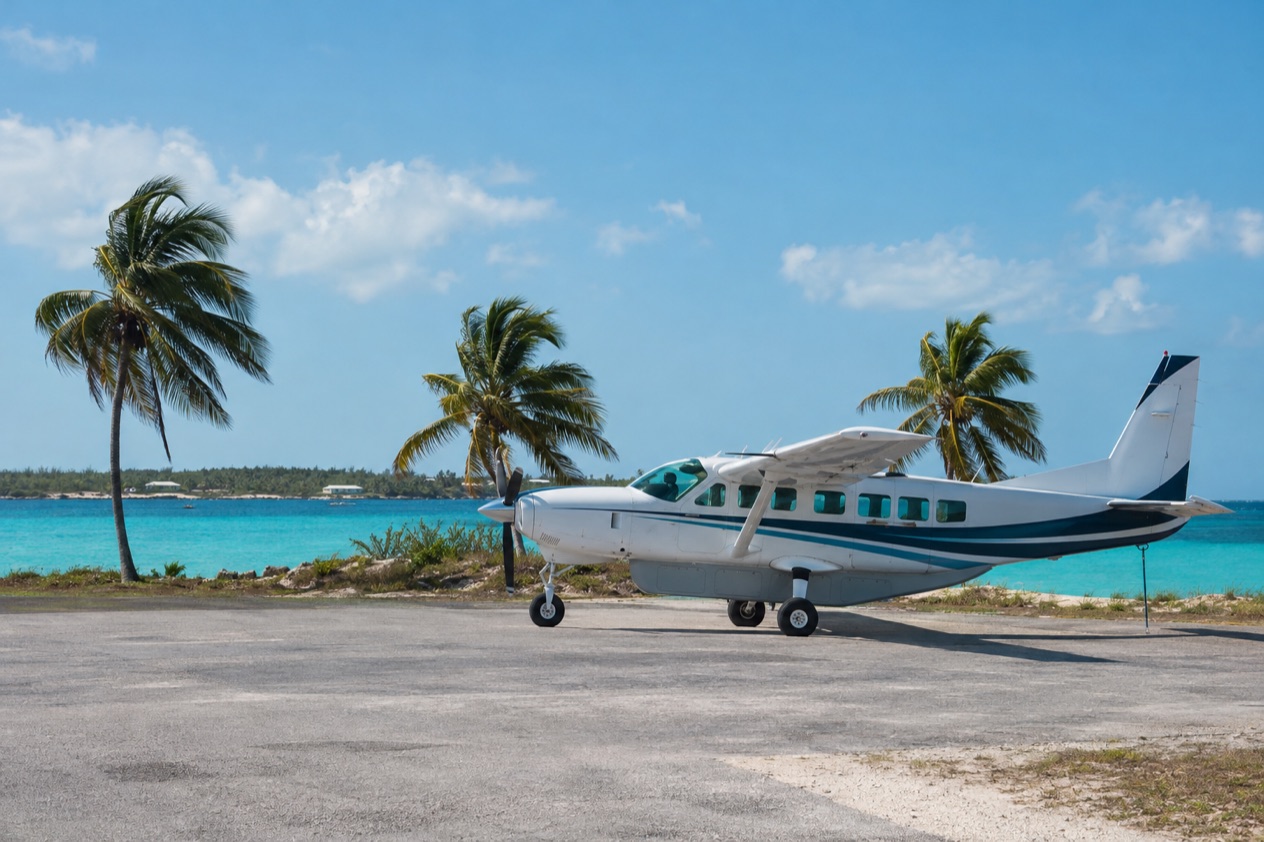
Scheduled air service between islands is run by certified domestic and international carriers, and chartered flights are available too. Bahamasair, the national carrier, lists a frequent flyer programme that rewards each flight taken. A small plane is the practical choice for the far islands, and the view of pale shallows and dark channels from the window is a highlight of its own.
| Route | Bahamasair fare from |
|---|---|
| Nassau to North Eleuthera | $80.50 |
| Nassau to Fort Lauderdale | $172.99 |
| Marsh Harbour to West Palm Beach | $226.99 |
In the Abacos, commercial flights arrive at Leonard M. Thompson International Airport in Marsh Harbour (MHH) or at Treasure Cay International Airport (TCB). Choosing between them can decide which end of the chain you begin and finish on.
Ferries and water taxis
Bahamas Ferry Services connect major islands, and ferries and water taxis are found throughout the country, especially between New Providence and the Out Islands. They also join Downtown Nassau to Paradise Island, Great Abaco to its nearby cays, and several of the southern islands to one another. The high-speed M/V Bo Hengy III links Nassau with Spanish Wells and Harbour Island on three days of the week.
| Bo Hengy III, Nassau to Spanish Wells and Harbour Island | Time |
|---|---|
| Check-in on Wednesdays, Fridays and Saturdays | 6:45 a.m. to 7:45 a.m. |
| Departs Nassau | 8:00 a.m. |
| Arrives Spanish Wells | 10:10 a.m. |
| Arrives Harbour Island | 11:10 a.m. |
| Return departs Harbour Island | 3:40 p.m. |
| Return arrives Nassau | 6:30 p.m. |
The return timing makes a long day trip possible, though most travelers prefer to stay the night. In the Abacos the local ferries do the daily work: Albury’s runs from Marsh Harbour to Hope Town, a short trip across the sound that is part commute, part sightseeing. The Exumas, meanwhile, rely on water taxis to cover the gaps between cays.
Mailboats and the slow way to travel
Regularly scheduled mailboats connect major islands, carrying freight, supplies and passengers together. Travel on one and you share the deck with islanders and cargo, which makes it the most local way to cross. It is slower than flying and rewards travelers who are happy to let the journey take the day.
Your own boat, a charter or a rental
In the Abacos, small boat rentals let you spend a day nosing between cays at your own speed, and a guided day trip from Marsh Harbour covers the same water with a crew. Travelers arriving in their own boats must clear customs at an official port of entry, such as Marsh Harbour, Green Turtle Cay, Harbour Island, Spanish Wells, George Town or Alice Town in Bimini.
| Option | Cost |
|---|---|
| Abaco Dorado boat rental, cheapest rate | $215 per day off-season, $310 per day in season |
| Seahorse Boat Rental, 17′ Boston Whaler | $175 per day |
| Cruise Abaco Day Trip, Marsh Harbour, 9:30 a.m. to 4 p.m., up to 12 people | $1,520 total, $126.67 per person |
| Albury’s Ferry, Marsh Harbour to Hope Town, round trip | $30 adults, $17 children |
| Jitneys on the main islands | $1 to $3 per ride |
On the ground once you arrive
Privately operated, licensed jitneys carry passengers on set routes, and you identify them by the route and number on the vehicle. Drivers in the Bahamas keep to the left side of the road, which is worth remembering when you step off a ferry and cross the street. On Bimini you can often skip transport altogether and walk.
Private cruise-line islands, such as Great Stirrup Cay, Coco Cay, Half Moon Cay and Castaway Cay, are uninhabited and owned by the cruise corporations. Only Castaway Cay has a pier for docking, while the others use tender boats. They sit outside the island-hopping circuit for independent travelers.
Good to know before you go
The U.S. State Department rates the Bahamas Level 2, “Exercise increased caution”, and says most crime occurs in Nassau on New Providence and in Freeport on Grand Bahama.
The Atlantic hurricane season runs from June 1 to November 30, and island hopping depends on boats and small planes, so a storm in the area can reshuffle a plan more than a hotel stay would. Leave a day of slack at the end of the trip. Carry some cash for small purchases on the Out Islands, where a jitney ride, a bike rental or a local lunch is a small, everyday transaction.
Sources
- Bahamas Ministry of Tourism, Investments & Aviation (bahamas.com), Island hopping (https://www.bahamas.com/getting-here/island-hopping), checked October 10, 2026
- Bahamas Ministry of Tourism, Island hopping (https://www.bahamas.com/getting-here/island-hopping), checked October 10, 2026
- Bahamasair, home (https://www.bahamasair.com/), checked October 10, 2026
- Bahamas Ferries, Your travel (https://bahamasferries.com/your-travel/), checked October 10, 2026
- Bahamas Ministry of Tourism, Investments & Aviation (bahamas.com), travel blog, island hopping in the Abacos (https://www.bahamas.com/blog/the-ultimate-guide-to-island-hopping-in-the-abacos-without-breaking-the-bank), checked October 10, 2026
- Bahamas Ministry of Tourism, Investments & Aviation (bahamas.com), travel blog, the Out Islands (https://www.bahamas.com/blog/bahamian-out-islands-our-best-kept-secret), checked October 10, 2026
- Wikipedia, Transport in the Bahamas (https://en.wikipedia.org/wiki/Transport_in_the_Bahamas), checked October 10, 2026
- U.S. Department of State, The Bahamas Travel Advisory, Level 2 (https://travel.state.gov/), checked October 10, 2026
- NOAA National Hurricane Center, Climatology (https://www.nhc.noaa.gov/climo/), checked October 10, 2026
To plan your stay
- Best Time to Visit the Bahamas: Weather, Hurricane Season, Sea Temperatures and Junkanoo
- Where to Stay in the Bahamas: Best Islands, Resorts, Boutique Stays and How to Choose
- Getting Around the Bahamas: Flights, Ferries, Mailboats and Taxis in Nassau
- Know Before You Go to the Bahamas: Entry Rules, Money, Getting Around and Local Customs