
On a Friday evening at Arawak Cay, the fryers hiss, conch is being cracked with a mallet, and a speaker somewhere is playing rake-n-scrape with a saw rasping out the rhythm. Out past the harbor the water turns from pale green to deep blue in a few strokes of a boat engine. The Bahamas is an island nation spread across the Atlantic, and it suits travelers who want to pick one island and settle in, or string several together by boat and small plane.
What are the best things to do in the Bahamas?
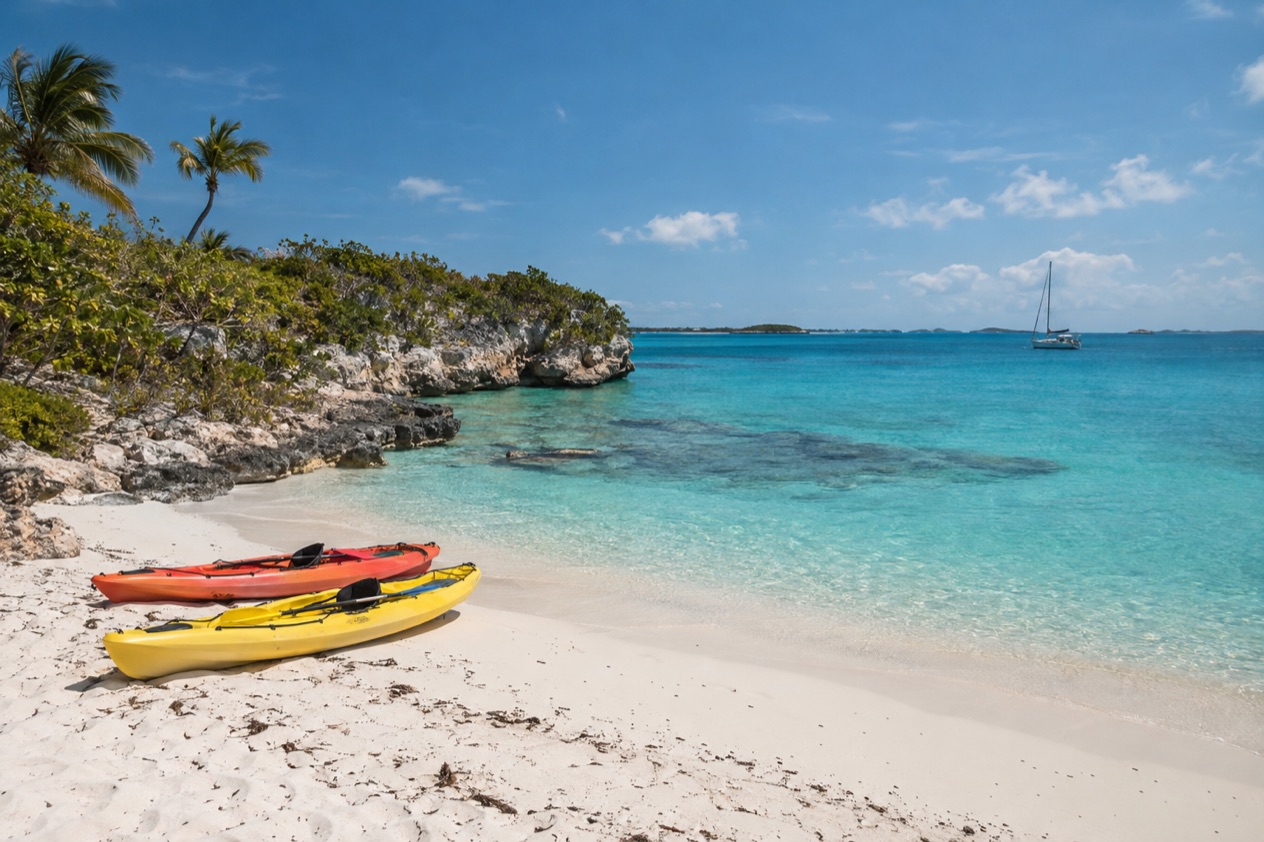
The best things to do in the Bahamas happen on and under the water, and each island has its own version of them: a reef to dive, a cay to anchor beside, a beach to settle on, a settlement to wander. The country is an archipelago, so the real planning question is which island suits you. Nassau and Paradise Island are the busy center, while the Out Islands are slower and quieter.
You can fly directly into one of the Out Islands without going through Nassau, which is the gateway for air travel into the country. That makes it easy to build a trip around two or three places rather than trying to see everything. The list below gives the essentials in a line each, and the sections after it develop them.
- Climb into the history of Nassau at the Queen’s Staircase and the pink-and-white Government House.
- Spend a day on the beaches of Paradise Island and western New Providence, where jet skis and chairs are close at hand.
- Dive or snorkel along the Andros Barrier Reef, one of the great reefs of the world.
- Visit the swimming pigs of Big Major Cay in the Exumas, reached only by boat.
- Look down into Dean’s Blue Hole on Long Island, the world’s second deepest.
- See the red-and-white Elbow Reef Lighthouse in Hope Town, still burning kerosene.
- Eat cracked conch and fritters at the Arawak Cay Fish Fry in Nassau.
- Fish the open Atlantic for big game, a pastime available every day of the year.
A first trip often pairs one lively base with one quiet island. Nassau or Paradise Island supplies the museums, the food stalls and the nightlife, and a second stop in the Exumas, the Abacos or Long Island supplies the cays, the lighthouse or the blue hole. Golfers, anglers and boaters will find the country organized around them too, with courses on several islands and marinas catering to visiting boats.
Sights and landmarks in the Bahamas
The landmarks of the Bahamas are modest in scale and strong in character: a limestone staircase cut by hand, a lighthouse that runs on kerosene, a hill that counts as the high point of the nation. They reward a slow visit more than a checklist. Nassau holds the greatest concentration, and the Out Islands hold the most memorable single sights.
Nassau’s Queen’s Staircase and Government House
The Queen’s Staircase, also known as the 66 steps, is a limestone staircase carved out of the rock by enslaved laborers over 16 years. It rises 102 feet and gave soldiers quick access to the fort above. Palms and ferns close in on the walls, and the cool shade at the bottom is a pleasant change from the sunny streets nearby.
Government House sits on Duke Street atop Mount Fitzwilliam, a pink and white colonial mansion that serves as the official residence of the Governor General. Even from the gates, the color stands out against the town. Together the staircase, the fort and the mansion make a good morning of walking through colonial Nassau, with a stop for a cold drink along the way.
Elbow Reef Lighthouse in Hope Town
On the banks of Hope Town in the Abacos stands the Elbow Reef Lighthouse, the last working kerosene-burning lighthouse in the world. Its red and white stripes rise above a harbor of pastel cottages, picket fences and boats tied up bow to stern. The setting looks like a New England village that has been moved to the tropics.
Hope Town is best explored on foot, along narrow lanes with small shops, a bakery or two and views back across the water to the tower. Golf carts and bicycles are how many islanders get around, and the pace matches. Photographers tend to wait for the soft light of late afternoon, when the stripes glow against the sky.
Mount Alvernia on Cat Island
Mount Alvernia on Cat Island is the highest point in all the islands of the Bahamas, at 206 feet above sea level. That sounds modest, but in a country this flat the hill stands out, and the views run over scrubland and coast. It is a quiet island, with few crowds and a feeling of being far from anywhere.
The island also keeps living traditions. A mother-daughter duo on Cat Island keeps family customs alive through basket weaving and bush medicine, a reminder that the best sights here are sometimes people at work with their hands rather than buildings.
Crafts and fabrics
Androsia Batik, called the unofficial fabric of the Bahamas, is handmade on Andros Island, in bold tropical prints of sea shells, fish and flowers. You will see it in shirts, sarongs and dresses across the islands, and the Andros workshop is the source. Straw work, woven baskets and carved shells fill market stalls in Nassau and in settlements throughout the Out Islands.
Beaches and outdoor things to do in the Bahamas
Beaches in the Bahamas range from busy strips with jet skis and chairs to empty crescents where the only footprints are yours. Outdoors, the draw is the water itself: reefs, cays, blue holes and open ocean. The water is clear, and the scuba diving here is the stuff of legend among divers.
Beaches of New Providence and Paradise Island
Cabbage Beach on Paradise Island sits a stone’s throw from New Providence, and it has jet skis, beach chairs and all the usual beaching amenities close to hand. It is a social place, with music drifting from nearby resorts and vendors working the sand. Visitors who like a little action with their sunbathing tend to gravitate here.
Goodman’s Bay in western New Providence lies not far from Baha Mar and feels more like a local beach, with a long, open stretch of sand. Junkanoo Beach, just minutes from downtown Nassau, is a favorite with cruise ship passengers and locals alike. It is the easy option when you have only a few hours and want sand, a drink and a view of the harbor.
Diving and snorkeling
The Andros Barrier Reef runs 190 miles, making it the world’s third-largest barrier reef, and Andros is a destination in its own right for divers. Underwater visibility can reach 150 to 200 feet, so the reef walls, coral heads and passing fish appear sharp and close. The Bahamas is a scuba diver’s paradise, with sites near most islands.
Swimming with sharks is part of the offer too, described by those who try it as transformative and even spiritual. Bimini runs hammerhead shark dives, one of the more thrilling encounters in the islands. Boaters, meanwhile, may see dolphins leaping and playing alongside their hull in the clear blue water.
Blue holes of Andros and Long Island
There are over 180 blue holes in Andros, circular pits of deep indigo set in pale shallows. From the air or the water they look like pupils in the sea floor. They are a signature of the Bahamian landscape and an unforgettable sight even if you never go below the surface.
On Long Island, Dean’s Blue Hole drops to 663 feet, the second deepest blue hole in the world. Taxis can take visitors right to the beach that partly encircles it, where they can take photos or snorkel. The contrast between the white sand and the dark water is the whole show.
Fishing, boating and golf
Fishing in the Bahamas is available 365 days a year, and big game fishing starts under 50 miles from Miami. Bimini alone has more than 50 record-setting catches to its name. Boaters crossing from Florida, 50 nautical miles away, find a $300 Boating Fuel Credit at participating resorts and marinas if they cruise on to the Out Islands.
Several islands have golf courses that challenge both novices and professionals, and some line the clear blue Atlantic waters. Nassau and Paradise Island offer golf as part of their island adventures, so a round can fit into a trip that is otherwise about beaches and sightseeing.
Day trips in the Bahamas
Because the islands are separated by sea, a day trip here is really an outing by boat or small plane to another piece of the archipelago. The outings below are the ones that give the Bahamas its postcard images, and each one rewards an early start.
Big Major Cay and the Exuma cays
The famous swimming pigs of the Bahamas live on Big Major Cay, also known as Pig Beach, in the Exumas. The cay is home to about 20 pigs and piglets, and they trot down the sand toward arriving boats. Seeing them splash into the shallows is as funny as it sounds.
The cay is accessible only by boat, whether a private vessel, a chartered one or a booked boat tour. Around it, the Exuma Cays Land and Sea Park covers 176 square miles and was the first land and sea park in the world. It is a no-take reserve where all fishing is prohibited, so the surrounding waters are a protected stretch of reef, sandbars and small islands.
Long Island and Dean’s Blue Hole
Long Island is an 80-mile-long island, just a 45-minute flight from Nassau or a 3-hour charter flight from Fort Lauderdale, Florida. It is a place of long empty roads, small settlements and quiet coastline. Visiting means committing to a day of flights, which suits travelers who like quiet and scenery over entertainment.
The main stop is Dean’s Blue Hole, where a taxi can take you to the beach that partly encircles the hole. You can take photos or snorkel. Bring a camera and enough time to simply look at the color of the water, which shifts from turquoise to ink.
Andros and its reefs
Andros has the world’s third-largest fringing barrier reef and more than 180 blue holes, and it is the island for nature rather than nightlife. Its wetlands are part of the conservation work of the Bahamas National Trust, and its workshops turn out the batik fabric seen across the country. A visit pairs naturally with diving and with time watching the shallow flats.
Andros suits people who like wild landscape and are happy without crowds. Its scale is large and its settlements are few, so a day there is spent mostly outdoors. The reef and the blue holes are the reasons to go.
Smaller outings
- Inagua, home to the largest remaining breeding colony of West Indian flamingos, for birdwatching among pink flocks.
- Hope Town in the Abacos, for the lighthouse and a walk through the harbor lanes.
- Little Exuma, where three small family-owned dining businesses work together to offer unique meals.
- Cat Island, for Mount Alvernia and the basket weavers.
What to eat in the Bahamas
Eating in the Bahamas starts with conch, the large sea snail that appears in every form: raw in a salad with lime, onion and pepper, battered in fritters, cracked and fried until crisp. The flavors are bright and salty, with hot peppers on the side. It is food built around the sea and eaten with the fingers.
Conch and fresh seafood
Conch salad is assembled to order, often at a stand by the water, with the conch chopped and tossed with citrus. The cracked version is pounded thin and fried, served with fries or peas and rice. Grilled or steamed fish, stewed fish and spiny lobster show up on menus, from beach shacks to dining rooms.
Boiled fish with grits is a traditional breakfast, a comforting dish with onion, lime and thyme in the broth. Souse, a clear spicy stew, is another local favorite. Along the Out Islands, the day’s catch dictates the menu, and the dishes are as simple as they are good.
The Fish Fry at Arawak Cay
Nassau’s Fish Fry is located at Arawak Cay, a row of colorful stands and small restaurants serving fried and fresh seafood. Locals and visitors share long tables, and the air smells of oil, lime and peppers. Order a few things and share them: conch fritters, fried snapper, a side of mac and cheese.
A cold Kalik beer is the usual companion, or a glass of sky juice, a sweet mix of gin and coconut water. The atmosphere grows livelier as the evening goes on. It is a place to eat slowly rather than quickly.
Sides, sweets and drinks
Peas n rice, made with pigeon peas and spices, accompanies almost everything, and johnnycake, a dense sweet bread, is another staple. Baked macaroni, plantains and coleslaw round out a plate. For dessert, guava duff is a rolled, steamed pastry served with a warm sauce, and rum cake comes in slices at every gift shop.
Rum is the spirit of the islands and appears in punches and in the Goombay Smash, a fruity cocktail. Fresh coconut water, cut open with a machete, is the daytime drink. On Little Exuma, the family-run dining businesses give a home-cooked taste of the islands that bigger places rarely match.
Things to do in the Bahamas at night
Nights in the Bahamas are either lively or very quiet depending on the island. In Nassau and on Paradise Island, evenings revolve around food, music and resort entertainment, while on the Out Islands, nights are spent on a porch, a dock or a beach under a sky full of stars. The contrast is part of the appeal.
Music and Junkanoo spirit
The sound of the Bahamas is Junkanoo, a festival of brass, cowbells and goatskin drums, with dazzling costumes of crepe paper and cardboard. The big parades take place on Boxing Day and New Year’s Day, in the early hours of the morning. Outside those dates, you hear the rhythms in bars and live shows, and echoes of them in rake-n-scrape bands.
Rake-n-scrape uses a saw scraped with a screwdriver alongside accordion and drum, and it is the music of settlement parties. A band playing in a small bar is one of the most authentic ways to spend an evening. Dancing is encouraged, and nobody minds if you are not an expert.
Dinner and drinks in Nassau
The Fish Fry at Arawak Cay keeps going into the evening, with music from the stands and cold drinks flowing. Downtown Nassau has bars and restaurants with outdoor tables, some of them in old colonial buildings. Paradise Island and Cable Beach add casinos, lounges and live shows for those who want more energy after dark.
A common pattern is an early dinner of seafood, a stroll by the water and then a bar with live music. The mood is relaxed and sociable rather than formal. Many places stay open late, especially on weekends.
Quiet nights on the Out Islands
On islands like Cat Island, Long Island or in the Abacos, an evening means a rum drink on a dock, a plate of grilled fish and a sky with very little light pollution. In Hope Town, the lighthouse beam sweeps across the harbor, and lamplit cottages glow along the shore. Conversation, not nightlife, fills the hours.
Boaters often gather at a marina bar to swap stories of the day’s crossing. Stargazing is a main event, and so are late dinners at small family-run restaurants. The islands reward those who slow down.
Things to do in the Bahamas with kids
Children in the Bahamas usually remember the animals first: pigs trotting into the water on Big Major Cay, dolphins that may leap beside a boat, fish flickering past a snorkel mask. The islands offer a lot of outdoor adventure and plenty of sand, which suits families who like to be active and outside.
Animals and boats
The swimming pigs are the star attraction, and the pig-and-piglet crowd on Big Major Cay makes for a memorable day out. The cay is reached only by boat, so the trip itself becomes part of the fun. Boaters may also meet dolphins playing alongside, a moment that children tend to talk about for weeks.
At Inagua, flamingos gather in the largest remaining breeding colony of West Indian flamingos, a pink spectacle that even young children appreciate. Nature outings like these give kids a close look at wildlife in a way that feels like an adventure rather than a lesson.
Beaches and castle-sized history
Cabbage Beach on Paradise Island has chairs, jet skis and the usual amenities close to hand, and Junkanoo Beach near downtown Nassau is a short hop from town. Sand, shells and tide pools keep younger children busy for hours. Families should stay close to the water’s edge with small ones and watch the sea.
The Queen’s Staircase gives older children a hands-on bit of history, with a fort at the top and a story about the people who cut the steps. Hope Town’s striped lighthouse and its small, walkable lanes make a gentle outing too. The pastel houses look like something out of a storybook.
Keeping children comfortable
The sun is strong across the islands, so hats, shade and plenty of water matter, particularly on boat days where there is little cover. The hurricane season runs from June 1 to November 30 on the Atlantic, and families planning around it should keep plans flexible. Distances between islands are covered by boat or plane, so build in time for the travel.
Pace the days with a morning outing and a long, quiet afternoon. Children enjoy a stop for fritters or a fruit drink, and a lazy hour on the beach. Mixing one active excursion with one rest day works well on island trips.
Good to know before you go
The U.S. State Department rates the Bahamas Level 2, “Exercise increased caution”, and says most crime occurs in Nassau on New Providence and in Freeport on Grand Bahama.
The Bahamas is an archipelago, so getting around means flying or sailing between islands, and Nassau is the country’s gateway for air travel. You can also fly directly into one of the Out Islands.
The Atlantic hurricane season runs from June 1 to November 30, so travelers in those months should keep their plans flexible. The Bahamas tourism website lets you filter activities by island and by category, from diving and snorkeling to historical sites and water sports, and offers downloadable itineraries for different travel styles.
Sources
- Bahamas Ministry of Tourism, Investments & Aviation (bahamas.com), Things to do (https://www.bahamas.com/plan-your-trip/things-to-do), checked October 10, 2026
- Bahamas Ministry of Tourism, Investments & Aviation (bahamas.com), Itineraries (https://www.bahamas.com/itineraries), checked October 10, 2026
- Bahamas Ministry of Tourism, Investments & Aviation (bahamas.com), Fishing (https://www.bahamas.com/plan-your-trip/fishing), checked October 10, 2026
- Bahamas Ministry of Tourism, Investments & Aviation (bahamas.com), Diving (https://www.bahamas.com/plan-your-trip/diving), checked October 10, 2026
- Bahamas Ministry of Tourism, Investments & Aviation (bahamas.com), Getting here by boat (https://www.bahamas.com/getting-here/boating), checked October 10, 2026
- Bahamas Ministry of Tourism, Investments & Aviation (bahamas.com), Golf (https://www.bahamas.com/golf), checked October 10, 2026
- Bahamas Ministry of Tourism, Investments & Aviation (bahamas.com), Culture (https://www.bahamas.com/experiences/culture), checked October 10, 2026
- Bahamas Ministry of Tourism, Investments & Aviation (bahamas.com), Ecotourism (https://www.bahamas.com/plan-your-trip/ecotourism), checked October 10, 2026
- Bahamas Ministry of Tourism, Investments & Aviation (bahamas.com), Island hopping (https://www.bahamas.com/getting-here/island-hopping), checked October 10, 2026
- Bahamas Ministry of Tourism, Investments & Aviation (bahamas.com), Landmarks (https://www.bahamas.com/experiences/landmarks), checked October 10, 2026
- Bahamas Ministry of Tourism, Investments & Aviation (bahamas.com), travel blog, what to do in Nassau (https://www.bahamas.com/blog/top-10-things-to-do-in-nassau), checked October 10, 2026
- Bahamas Ministry of Tourism, Investments & Aviation (bahamas.com), travel blog, island of natural wonder (https://www.bahamas.com/blog/island-of-natural-wonder), checked October 10, 2026
- Bahamas Ministry of Tourism, Investments & Aviation (bahamas.com), travel blog, wildlife by island (https://www.bahamas.com/blog/bahamian-wildlife-and-where-to-find-them), checked October 10, 2026
- Bahamas Ministry of Tourism, Investments & Aviation (bahamas.com), travel blog, beaches of New Providence (https://www.bahamas.com/blog/the-best-bahamian-beaches-to-visit-on-new-providence), checked October 10, 2026
- Bahamas Ministry of Tourism, Investments & Aviation (bahamas.com), Exuma Cays Land And Sea Park (https://www.bahamas.com/natural-wonders/exuma-cays-land-and-sea-park), checked October 10, 2026
- Bahamas Ministry of Tourism, Investments & Aviation (bahamas.com), Official Home Swimming Pigs (https://www.bahamas.com/experiences/official-home-swimming-pigs), checked October 10, 2026
- U.S. Department of State, The Bahamas Travel Advisory, Level 2 (https://travel.state.gov/), checked October 10, 2026
- NOAA National Hurricane Center, Climatology (https://www.nhc.noaa.gov/climo/), checked October 10, 2026
To plan your stay
- Best Time to Visit the Bahamas: Weather, Hurricane Season, Sea Temperatures and Junkanoo
- Where to Stay in the Bahamas: Best Islands, Resorts, Boutique Stays and How to Choose
- Getting Around the Bahamas: Flights, Ferries, Mailboats and Taxis in Nassau
- Know Before You Go to the Bahamas: Entry Rules, Money, Getting Around and Local Customs