
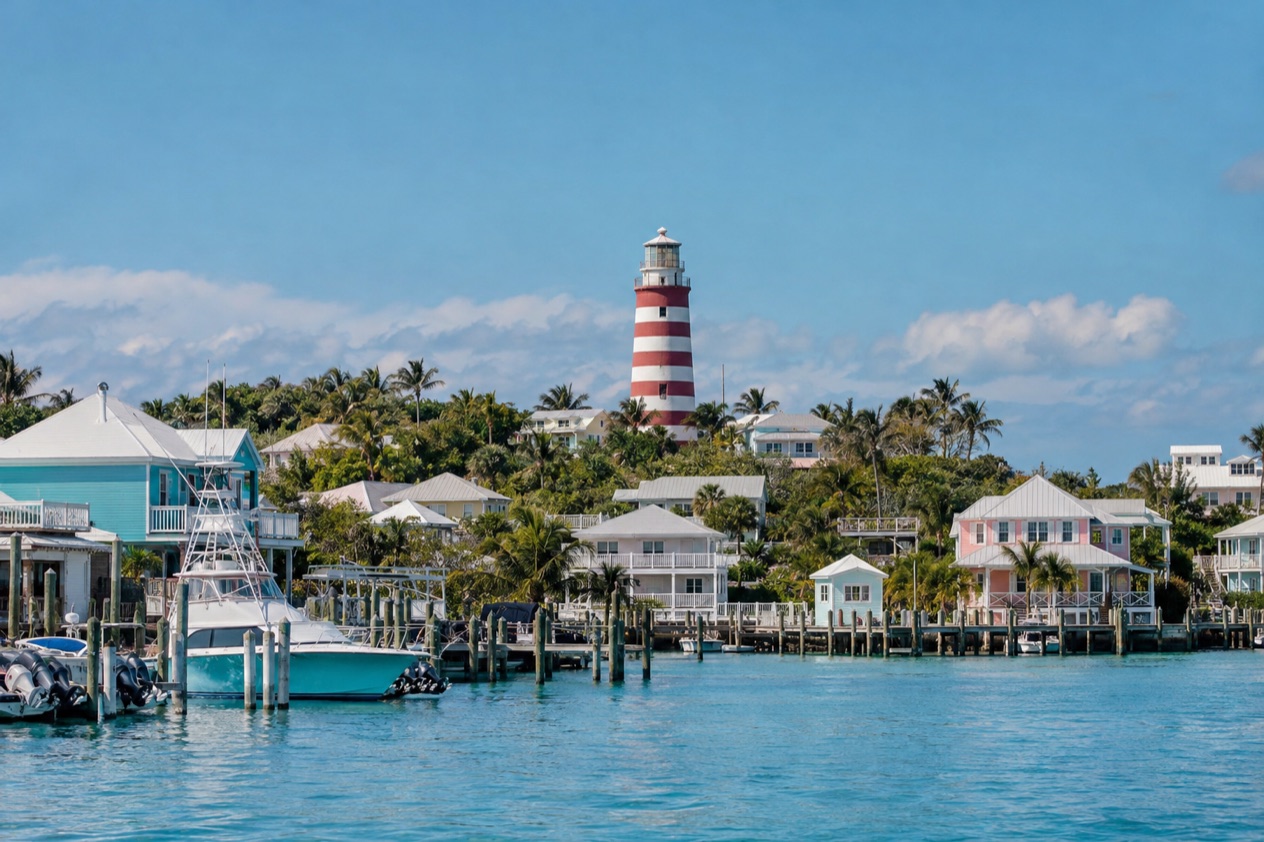
The red and white stripes show over the rooftops of Hope Town before you have worked out which lane leads to them. Pastel cottages crowd the narrow streets, the harbor sits at the foot of the village, and the tower stands above it all like a barber’s pole made for ships. This is the Elbow Reef Lighthouse on Elbow Cay in the Abacos, a visit built around a working light and a village that has looked after it for generations.
Is visiting the Hope Town Lighthouse worth it?
Yes, if you like places with a story and a slow pace: the lighthouse suits travelers who enjoy history, photography and wandering a car-free village, and it suits couples and families who want one clear landmark to organize an Abaco day around. If you want a long list of attractions, Elbow Cay will feel quiet, and that quiet is the point.
What sets this tower apart from other lighthouses is that it still works the old way. It is one of the last operational kerosene-fueled lighthouses in the world, run by a Bahamian non-profit, and the people of Hope Town have turned from opponents into guardians. When the tower went up in the 1860s, residents resisted it because it threatened their wrecking trade, the salvage of ships that struck the reef.
Today they embrace it and resist the automation of its remaining beacons. You are not looking at a museum piece switched on for show. You are looking at a landmark the whole village still cares about, set among Loyalist-style wooden houses, a small museum, shops and waterfront restaurants, all within walking distance of each other.
Across the Bahamas, other lighthouses stand on lonely points or inside resort grounds. Here the lighthouse belongs to a living settlement, so the visit grows into an afternoon of lanes, harbor views and local history rather than a single photo stop.
What to see at the Hope Town Lighthouse
The lighthouse is the headline, but the best visits take in the whole harbor village around it. Start with the tower itself, then let the lanes carry you toward the museum, the old graveyard and the waterfront.
The candy-striped tower and its lens
Elbow Reef, next to Elbow Cay, is home to the candy-striped lighthouse, one of the most recognizable landmarks in the Bahamas. Seen from the harbor, from a lane between cottages or from the water, the bold bands stand out against the sky and the pale sand. The beam is thrown by a first order Fresnel lens, the largest class of these glass lenses, built from rings of prisms that bend a small flame into a signal that carries over the sea.
Look at the proportions of the tower, the way it rises from the land above the village, and the simple lines of the keeper-era buildings around it. It is a photograph that works in morning light and again near dusk, when the stripes warm up.
| The light | Detail |
|---|---|
| Built | 1862 |
| Operational | 1864 |
| Signal | Five white flashes every 15 seconds |
| Visible from | 23 nautical miles (43 km) |
| Lens | First order Fresnel |
| Fuel | Kerosene, about 1 gallon per night |
| Operated by | Elbow Reef Lighthouse Society |
The kerosene light at night
The tower is most interesting after dark, when the lamp does the work it was built for. The signal is a fixed rhythm of flashes that sailors read like a name, and the fuel is burned slowly through the night, a very small amount for a beam that reaches a long way out to sea.
From the village the flashes sweep over the harbor and the rooftops, and from a boat in the anchorage they become a steady, reassuring pulse. It is easy to understand why residents protect the old mechanism instead of swapping it for an automated beacon.
The Wyannie Malone Museum
The Wyannie Malone Museum keeps the story of the settlement through memorabilia, artifacts, old photographs and documents. Hope Town was co-founded in 1785 by Wyannie Malone, a widow from South Carolina who arrived with her four children after the American Revolution, and her name still anchors the village identity.
Go here to understand the lighthouse in context. Before Marsh Harbour Airport was built in 1959, fishing and shipwreck salvage kept Elbow Cay going, and the old photographs make the wrecking-trade dispute over the light easy to picture. The museum pairs well with the walk back toward the water.
Loyalist houses, the old graveyard and dinghy builders
The pastel wooden homes and businesses of Hope Town are fine examples of Loyalist architecture, with shutters, porches and picket fences in sherbet shades. Gift shops, restaurants and cottages line the narrow streets, and art galleries and beachside cafés appear as you go.
The community has also kept two traditions alive: the cholera graveyard, a quiet reminder of harder times, and the building of Abaco dinghies, the boats you see at regattas throughout the Bahamas. Pausing at these places adds a human layer to the red and white tower overhead.
Hours, tickets and rules
The lighthouse is run by the Elbow Reef Lighthouse Society, a Bahamian non-profit, and that shapes the experience: it is a community-kept landmark rather than a ticketed attraction park, and its real schedule is the one the lamp keeps every night. The tower is visible from the village at any time you are on the lanes, and the museum, shops and restaurants of Hope Town fill the rest of the day.
The one rule that decides how you move around is about wheels. In the town center of Hope Town, cars are forbidden, and visitors get around on foot or by bicycle. Golf carts and cars are permitted outside the town center, on the outskirts of the village. That means the closest approach to the lighthouse and the harbor is a walk, which suits the scale of the place.
How to get to the Hope Town Lighthouse
The lighthouse stands on Elbow Reef, next to Elbow Cay, a small island in the Abaco Islands of the Bahamas, and Hope Town is the only settlement on that island. Getting to the lighthouse therefore means getting to Elbow Cay and then to the harbor village, where the tower is the landmark you aim for.
Abaco has a long air connection through Marsh Harbour Airport, built in 1959, which changed the livelihoods of Elbow Cay by bringing in visitors and goods. Once you are on Elbow Cay, the village is small, and the last stretch is made on foot or bicycle because cars are not allowed in the town center.
Bicycles are the local way to cover ground, and couples can rent them to pass colorful cottages, shops, art galleries and beachside cafés on the way. Golf carts and cars are allowed only outside the town center, so plan to leave them at the edge and walk the final lanes. Hope Town had a population of 458 in 2010, a reminder of how compact the place is.
When to visit the Hope Town Lighthouse
Time your visit around the light itself. By day the stripes are the draw, bright against the sky and the harbor, and good for photographs from the lanes and the waterfront. Toward evening the village changes mood: the sun lowers, the cottages turn warm colors, and the lamp begins its work at night with five white flashes at a steady rhythm.
Hope Town is described as a cay of pastel-hued cottages and sunny weather, which suits a walking day, but there is no single best month to call. If you travel in autumn, remember that the Atlantic hurricane season runs through the end of November, and keep your plans flexible. A sunset beach walk along the shore, with the quiet sound of waves, is one of the gentler ways to end a day on the cay before heading for dinner.
A good day runs like this: a morning wander through the lanes and the museum, a waterfront lunch of fresh local seafood, time on a bicycle in the afternoon, then the harbor at dusk when the tower earns its keep. That order lets the lighthouse be the last thing you see, and the first light of the night.
Tips for your visit
Plan for a slow half day or more rather than a quick stop. The pleasure of Hope Town is the walk between things: the tower, the museum, the graveyard, a gift shop, a harbor-side table. Bring a camera, walking shoes for narrow lanes and something to carry, since you will be on foot or on a bike for most of it.
Combine the lighthouse with what Elbow Cay offers nearby. Tahiti Beach, on the southernmost portion of the cay, has a sand pathway that stretches far into the ocean at low tide, and it offers soft sands and gentle waves, an ideal spot for a picnic and beach games.
It makes a fine afternoon after the village. For those who like waves, one of the only safe breaks to surf in the Elbow Keys is found in the center of the island, outside the Abaco Inn.
Families and travelers with limited mobility should know that the town center is for walkers and cyclists, with narrow streets, so the pace is set by your feet. Waterfront restaurants serving fresh local seafood give a candlelit setting for dinner, and the many cottages mean you can stay close to the lane rather than travel far. For more local information, the Abaco Tourist Office can be reached at (242) 367-3067 or [email protected].
Good to know before you go
The U.S. State Department rates the Bahamas Level 2, “Exercise increased caution”, and says most crime occurs in Nassau on New Providence and in Freeport on Grand Bahama.
Elbow Cay is a small island community, so think of Hope Town as a place to stroll, eat and unwind rather than a place with big-town services. Keep ordinary travel habits, such as watching your belongings in busy spots and taking care on the lanes after dark.
The Atlantic hurricane season runs from June 1 to November 30, so a trip in those months deserves a flexible plan. Beyond that, the lighthouse asks little of you: a walk to the water, a look up at the stripes and a quiet moment when the lamp comes on.
Sources
- Bahamas Ministry of Tourism, Investments & Aviation (bahamas.com), Hope Town (https://www.bahamas.com/natural-wonders/hope-town), checked October 10, 2026
- Wikipedia, Hope Town (https://en.wikipedia.org/wiki/Hope_Town), checked October 10, 2026
- Bahamas Ministry of Tourism, Investments & Aviation (bahamas.com), travel blog, Hope Town (https://www.bahamas.com/blog/the-top-5-most-romantic-things-to-do-in-hope-town-abaco), checked October 10, 2026
- U.S. Department of State, The Bahamas Travel Advisory, Level 2 (https://travel.state.gov/), checked October 10, 2026
- NOAA National Hurricane Center, Climatology (https://www.nhc.noaa.gov/climo/), checked October 10, 2026
To plan your stay
- Best Time to Visit the Bahamas: Weather, Hurricane Season, Sea Temperatures and Junkanoo
- Where to Stay in the Bahamas: Best Islands, Resorts, Boutique Stays and How to Choose
- Getting Around the Bahamas: Flights, Ferries, Mailboats and Taxis in Nassau
- Know Before You Go to the Bahamas: Entry Rules, Money, Getting Around and Local Customs