
At Hope Town, a red-and-white lighthouse rises over a harbor full of moored boats, and pastel cottages line lanes where the loudest sound is a bicycle bell. Across the water, ferries slip between the cays and the sand flats glow turquoise at low tide. The Abacos are a sailor’s corner of the Bahamas, made of small Loyalist villages, boatyards and beaches, for travelers who like their island time slow and a little salty.
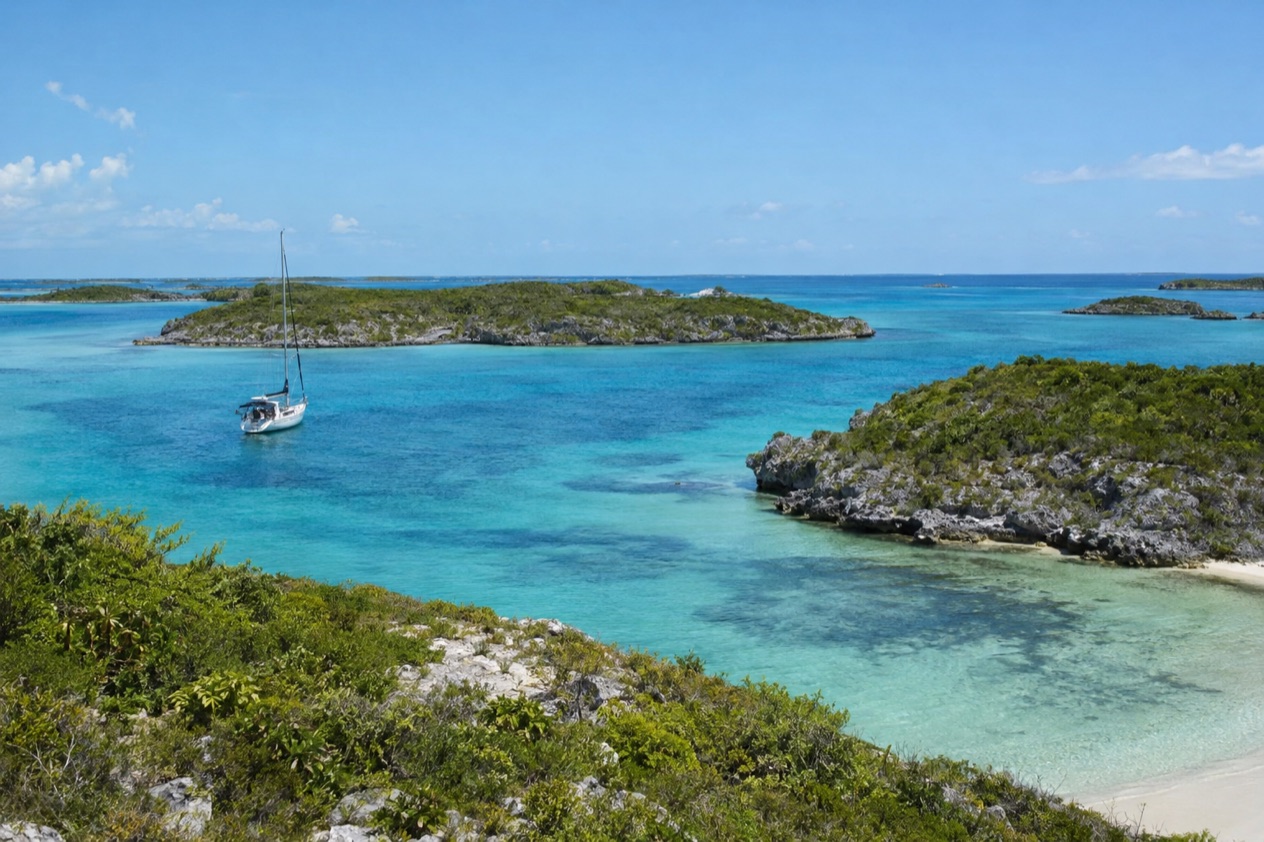
Where is the Abacos and what is it like?
The Abacos sit in the north of the Bahamas, in the Atlantic about 193 miles east of Miami, as a long chain of islands and cays strung along a sheltered stretch of water. The chain runs for 120 miles and is divided into North, Central and South Abaco. Great Abaco and Little Abaco, just west of Great Abaco’s northern tip, form the mainland, while the small cays sit offshore like beads.
The character of the place comes from its boats and its history. Marsh Harbour is the commercial hub, a working town with marinas, stores and the only stop light in the Out Islands.
The villages on the cays feel very different, since they were settled by Loyalists who came after the American Revolution. You see it in the steep roofs of New Plymouth, in the family names, and in the dinghies that are still built by hand.
The pace is unhurried. Days here are organized around the water: a ferry to a cay, a walk to a beach, a long lunch of conch salad or Bahamian rock lobster, and a Bahama Mama on a dock in the evening. Golf carts and bicycles stand in for cars on the cays, and lanes are often only as wide as a cart.
The Abacos suit couples, sailors, families who like beaches without big-resort machinery, and anyone who enjoys small villages and boats. They suit less well anyone looking for nightlife, casinos or a large resort scene. Hurricane Dorian made landfall here in 2019, on Great Abaco and on Elbow Cay, and the islands carry the memory of that storm. The cays still keep their lighthouses, their cottages and their boat-building traditions.
What is there to do in the Abacos?
The Abacos reward people who like moving from cay to cay. Each village has its own personality, and the water between them is the main road. Compared with the bigger Bahamian islands, there is no resort strip to speak of: what you do here is wander, ride, swim, eat seafood and look at boats.
Hope Town and the candy-striped lighthouse
Hope Town is the only settlement on Elbow Cay, reached from Marsh Harbour by private boat or by the regularly scheduled ferry. Its landmark is the Elbow Reef Lighthouse, built in 1862 and the last manually operated one of its kind in the Bahamas. It is one of the last kerosene-fueled lighthouses in the world still in operation, and visitors can climb it for a view over the harbor and the reef.
Below the tower, bicycles are the favored way to pass the colorful cottages, local shops, art galleries and beachside cafés. The Wyannie Malone Museum keeps the story of the village, co-founded by a widow from South Carolina, through old photos, documents and artifacts. Waterfront restaurants serve fresh local seafood at the end of the day.
Green Turtle Cay and New Plymouth
Green Turtle Cay is a barrier island off Great Abaco, reached only by ferry or boat since there is no airport. The ferry leaves from the dock at Treasure Cay. New Plymouth, the main settlement, is known for New England–influenced architecture, with steep-pitched roofs found nowhere else in the Bahamas, and many residents trace their ancestry to the Loyalists.
You can rent a golf cart or a bicycle to tour the island, which is only a few miles long and a fraction of a mile wide. Expect beaches, shops and restaurants, and a boat repair yard that reminds you the cay lives off the sea. It is a place to spend a day wandering lanes and looking into churchyards and front gardens.
Man-O-War Cay and its boat builders
Man-O-War Cay has a population of only a few hundred, served by three churches, and it is the only dry island in the Bahamas, with no public sale or consumption of alcohol. Boat building is the biggest and oldest industry, and the island is known as the boat-building capital of the islands of the Bahamas. Many family-owned businesses are run by descendants of Benjamin Albury, a shipwrecked sailor who married Eleanor Archer in 1821.
A visit here is about the quiet harbor, the craft of wooden boats, and a village that keeps its own rhythm. Bring your own drinks plans elsewhere, since none will be on offer, and enjoy a calm afternoon walking past boatsheds and neat houses.
Tahiti Beach and the sand bars
At the southern tip of Elbow Cay, Tahiti Beach has soft white sand lined with coconut trees, arcing out into calm clear water. It is secluded and reached only on foot, by bike or by boat, which gives it the feel of a destination at the end of a trail. Swimming, shell collecting, and looking for starfish and sand dollars fill the hours.
At low tide an endless sand bar appears, and people wander far out across it. In Hope Town, couples use the beach for a picnic and beach games, and others come for a sunset walk along the shore. Pack lunch if you plan a long stay.
Parrots, reefs and marinas
On Great Abaco, Abaco National Park protects the northern breeding grounds of the Bahama Parrot across 20,500 acres of pine forest. The parrots nest in underground cavities, and four endemic birds, the Bahama Yellowthroat, Bahama Warbler, Bahama Swallow and Bahama Woodstar, live in the park. It was established in 1994 and draws birders.
Back at Marsh Harbour, full-service marinas let boaters dock their own vessel or rent live-aboard sailboats and powerboats, and well-stocked stores supply whatever a boat needs. Farther north, Walker’s Cay, the northernmost island in the Bahamas, is fringed by its own barrier reef, with sharks, barracudas, turtles and eagle rays in the surrounding waters.
How many days do you need in the Abacos?
A long weekend gives you a taste of one or two cays, and a week lets you really settle into the rhythm of the chain. The Abacos are spread out and separated by water, so each move between islands takes part of a day. Trying to see everything in a few days leaves you on ferry docks rather than on beaches.
With a long weekend, pick a base and stay with it. Hope Town works well for it: you can climb the lighthouse in the morning, wander the lanes and museum, bike to Tahiti Beach for a swim and a picnic, and eat seafood on the waterfront at dusk. It is a full stay without a single long transfer, and the pace is the point.
A week lets you add Green Turtle Cay for its New England–style village and beaches, and Man-O-War Cay for its boatyards. You might spend a few nights on one cay and then change to another, or stay on Great Abaco and make day trips by ferry or boat. Time in Marsh Harbour, around the marinas and the shops, fits at the beginning or end of the trip.
With more time, add the nature side of Great Abaco, such as the park where the Bahama Parrots nest, and a longer boat day among the cays. Sailors and anglers can spend weeks here without repeating themselves. In March, Treasure Cay hosts the Great Abaco Family Fitness Weekend, which suits a stay built around that event.
Where to stay in the Abacos
The main choice is between Marsh Harbour, Treasure Cay and the villages on the cays. Marsh Harbour is the commercial center of the Abacos and the place to be if you want stores, marinas and a base with services close at hand. It suits boaters especially, since you can dock your own boat or rent a live-aboard there. It is more a working harbor than a seaside postcard.
Treasure Cay is connected to Great Abaco and offers resort-style stays, with two resorts, condos, villas and private homes, many for rent. A large marina hosts seasonal fishing tournaments, and there are tennis courts and a golf course. The Green Turtle Cay ferry dock is here too, so it works as a launch point for that island, and Treasure Cay Airport is nearby.
For atmosphere, the cays win. Hope Town is a village of pastel-hued cottages under a lighthouse, where you walk or ride a bicycle to cafés, galleries and beaches.
Green Turtle Cay has the old Loyalist village of New Plymouth and the outstanding beaches of an island that feels apart from everything else. Choose Hope Town if you want walkable charm and sunsets, Green Turtle if you like a larger village with shops and restaurants, and Treasure Cay if you want resort amenities and a marina.
How do you get to the Abacos and get around?
Most visitors fly in, since two international airports serve the chain: Leonard M. Thompson International Airport at Marsh Harbour (MHH), the larger of the two, and Treasure Cay International Airport (TCB). Abaco air travel connects or originates in Florida or Atlanta. From Grand Bahama, Pinder’s Ferry runs twice a day from McLean’s Town to the Abacos.
Once you arrive, the water is the road. Elbow Cay is reached from Marsh Harbour by private boat or by regularly scheduled ferry, and Green Turtle Cay by ferry from the dock at Treasure Cay or by boat. Man-O-War Cay and the others sit across the same sheltered water, which is why so many visitors are sailors.
On the cays, you move on foot, by bicycle or by golf cart. Hope Town’s center is a place for walking and biking, with cars and golf carts permitted on the outskirts. On Green Turtle Cay you can rent a golf cart or a bicycle to tour the island. Tahiti Beach can only be reached on foot, by bike or by boat, so plan to arrive under your own power.
If you want to sail, Marsh Harbour is where you rent a live-aboard sailboat or powerboat or dock your own, and the well-stocked stores there supply a boater’s needs. Treat each hop between cays as a small trip of its own and build your days around it. Do not count on spontaneous plans late in the day.
When is the best time to visit the Abacos?
The winter and spring months, roughly December through May, are the natural choice for most visitors, and they fall outside the official hurricane season, which runs from June 1 to November 30. In Nassau, January afternoons reach the high 70s with few rainy days, and the sea around Marsh Harbour sits in the high 70s too. That is pleasant for a bike ride or a sunset walk, though not the warmest for swimming.
March brings the Great Abaco Family Fitness Weekend to Treasure Cay, which draws both domestic and international visitors. Spring is also a natural season for boating and for fishing tournaments at the large marina there. Birders can head to Abaco National Park, where the Bahama Parrots nest in underground cavities, though a sighting is never guaranteed.
Summer is hot and wetter. In Nassau, July highs reach the low 90s, and rain falls on about twelve days of the month, often in a stormy afternoon rather than a whole gray day. The sea near Marsh Harbour is in the mid-80s, which suits long swims at Tahiti Beach. Summer sits inside the hurricane season, as does autumn, so anyone traveling then should keep an eye on the forecast.
Good to know before you go
The U.S. State Department rates the Bahamas Level 2, “Exercise increased caution”, and says most crime occurs in Nassau on New Providence and in Freeport on Grand Bahama.
Money and logistics are simple if you plan around the water: the Bahamian dollar is the local currency, and the cays are small, so settle in rather than rushing. Man-O-War Cay is dry, with no alcohol sold or consumed in public. The Atlantic hurricane season runs from June 1 to November 30, and Hurricane Dorian struck the Abacos in 2019, so check the forecast if you travel in those months.
The Abacos are separated from Nassau by more than 90 miles of sea, and every island here has its own services, so plan each stop on its own terms.
Sources
- Bahamas Ministry of Tourism, Investments & Aviation (bahamas.com), The Abacos (https://www.bahamas.com/islands/abacos), checked October 10, 2026
- Wikipedia, Abaco Islands (https://en.wikipedia.org/wiki/Abaco_Islands), checked October 10, 2026
- Bahamas National Trust, Abaco National Park (https://bnt.bs/explore/abaco/abaco-national-park/), checked October 10, 2026
- Wikipedia, Hope Town (https://en.wikipedia.org/wiki/Hope_Town), checked October 10, 2026
- Bahamas Ministry of Tourism, Investments & Aviation (bahamas.com), Hope Town (https://www.bahamas.com/natural-wonders/hope-town), checked October 10, 2026
- Bahamas Ministry of Tourism, Investments & Aviation (bahamas.com), travel blog, Hope Town (https://www.bahamas.com/blog/the-top-5-most-romantic-things-to-do-in-hope-town-abaco), checked October 10, 2026
- Wikipedia, Green Turtle Cay (https://en.wikipedia.org/wiki/Green_Turtle_Cay), checked October 10, 2026
- Bahamas Ministry of Tourism, Investments & Aviation (bahamas.com), Green Turtle Cay (https://www.bahamas.com/natural-wonders/green-turtle-cay), checked October 10, 2026
- Bahamas Ministry of Tourism, Investments & Aviation (bahamas.com), Marsh Harbour (https://www.bahamas.com/natural-wonders/marsh-harbour), checked October 10, 2026
- Bahamas Ministry of Tourism, Investments & Aviation (bahamas.com), Man O War Cay (https://www.bahamas.com/natural-wonders/man-o-war-cay), checked October 10, 2026
- Bahamas Ministry of Tourism, Investments & Aviation (bahamas.com), Tahiti Beach (https://www.bahamas.com/natural-wonders/tahiti-beach), checked October 10, 2026
- Bahamas Ministry of Tourism, Investments & Aviation (bahamas.com), Walkers Cay (https://www.bahamas.com/natural-wonders/walkers-cay), checked October 10, 2026
- Bahamas Ministry of Tourism, Investments & Aviation (bahamas.com), travel blog, island hopping in the Abacos (https://www.bahamas.com/blog/the-ultimate-guide-to-island-hopping-in-the-abacos-without-breaking-the-bank), checked October 10, 2026
- Bahamas Ministry of Tourism, Investments & Aviation (bahamas.com), travel blog, Abaco (https://www.bahamas.com/blog/the-ultimate-romantic-escape-to-abaco-bahamas), checked October 10, 2026
- Wikipedia, Treasure Cay (https://en.wikipedia.org/wiki/Treasure_Cay), checked October 10, 2026
- Wikipedia, Marsh Harbour Airport (https://en.wikipedia.org/wiki/Leonard_M._Thompson_International_Airport), checked October 10, 2026
- Wikipedia, Hurricane Dorian (https://en.wikipedia.org/wiki/Hurricane_Dorian), checked October 10, 2026
- Wikipedia, Geography of the Bahamas (https://en.wikipedia.org/wiki/Geography_of_the_Bahamas), checked October 10, 2026
- Open-Meteo Marine API, average 2015-2024, checked October 10, 2026
- NOAA NCEI, GHCN-Daily station BF000078073 (Nassau Airport), normals 1991-2020 computed from the daily record (https://www.ncei.noaa.gov/access/services/data/v1?dataset=daily-summaries&stations=BF000078073), checked October 10, 2026
- U.S. Department of State, The Bahamas Travel Advisory, Level 2 (https://travel.state.gov/), checked October 10, 2026
- NOAA National Hurricane Center, Climatology (https://www.nhc.noaa.gov/climo/), checked October 10, 2026
All our pages
When to go
- Best Time to Visit the Abacos: Weather by Month, Sea Temperatures, Crowds and Festivals
- The Abacos in January: Sea Temperatures, Hope Town, Crawfish Season and a Two-Day Plan
- The Abacos in February: Weather, Swimming, Hope Town and Crawfish Season
- The Abacos in March: Crawfish Season's Last Weeks, Sea Temperatures and Island Hopping
- The Abacos in April: Weather, Sea, Cays to Visit and a Two-Day Plan
- The Abacos in May: Warm Sea, Hope Town Lighthouse, Treasure Cay and Island Days
- The Abacos in June: Warm Sea, Hope Town, Boat Days and Summer Showers
- The Abacos in July: Sea Temperature, Boating Days, Hope Town and Where to Go
- The Abacos in August: Crawfish Season, Sea Temperatures and Boat Days
- The Abacos in September: Hurricane Season, Warm Seas, Crawfish and Hope Town
- The Abacos in October: Sea Warmth, Crawfish Season, Hope Town and Island Hopping
- The Abacos in November: Weather, Sea, Crawfish Season and a Two-Day Plan
- The Abacos in December: Weather, Sea Temperature, Hope Town and Holiday Season
Things to do
- Things to Do in the Abacos: Hope Town Lighthouse, Tahiti Beach, Cays and Conch
- Day Trips from the Abacos: Hope Town, Green Turtle Cay, Tahiti Beach and Man-O-War Cay
- 3 Days in the Abacos: Hope Town, Tahiti Beach, Green Turtle Cay and Where to Stay
Where to stay
Getting there
- The Abacos from Miami: Flights to Marsh Harbour, Island Connections and Hope Town
- Marsh Harbour Airport to Hope Town: Elbow Cay, the Lighthouse and Getting Around the Village