
A pink line lifts off a salt pan at the far end of the Bahamas, and the sound of it carries first: a low, goose-like honking from thousands of throats, then the beat of wings over flat, bright water. Inagua is the place where that happens on a scale few places on earth can match. It is a remote, flat, salt-crusted island at the southern edge of the archipelago, made for birders, naturalists and travelers who would rather watch a lake than a pool deck.
Where is Inagua and what is it like?
Inagua is the southernmost district of the Bahamas, made up of two islands, Great Inagua and Little Inagua, and it sits so far south that Cuba is only about 55 miles from the eastern tip of Great Inagua. Great Inagua is the one with people, a settlement, an airport and a national park. Little Inagua lies beside it, uninhabited and wild. It is a place of wide horizons, salt ponds, scrub and sky.
The land is mostly flat, with some sand hills. The highest points are modest, East Hill reaching 132 feet, and from almost anywhere you see a long way across low brush and shining water.
Great Inagua encloses several lakes, and the biggest, Lake Windsor (also called Lake Rosa), stretches about 12 miles and takes up nearly a quarter of the interior. That much open water in a dry, flat landscape explains why so many birds gather here.
The pace is slow, and the population is small, just 913 people at the 2010 census. Days here are not organized around nightlife, shopping streets or beach clubs. They are organized around light, birds, tides and the salt industry that has shaped the island for generations. Matthew Town, the island’s settlement, is a quiet place where a lighthouse and the working salt landscape matter more than any attraction list.
Inagua suits people who get excited by a rare bird, a long empty road and a sky full of color at dusk. It also suits travelers who like to see how a remote Bahamian community lives.
It will not suit anyone who wants a resort, a long stretch of lounge chairs or a lively evening scene. The Bahamas has about 700 islands and cays and only a few dozen are inhabited. Inagua is one of the most out-of-the-way of them, and that is exactly its appeal.
What is there to do in Inagua?
The big reason to come is wildlife, and above all birds. Nearly half of Great Inagua is protected as Inagua National Park, a wetland of such value that it is included on the Ramsar list of Wetlands of International Importance. Everything else here, the quiet roads, the turtles, the boat trips to a neighboring island, is built around that protected land and water.
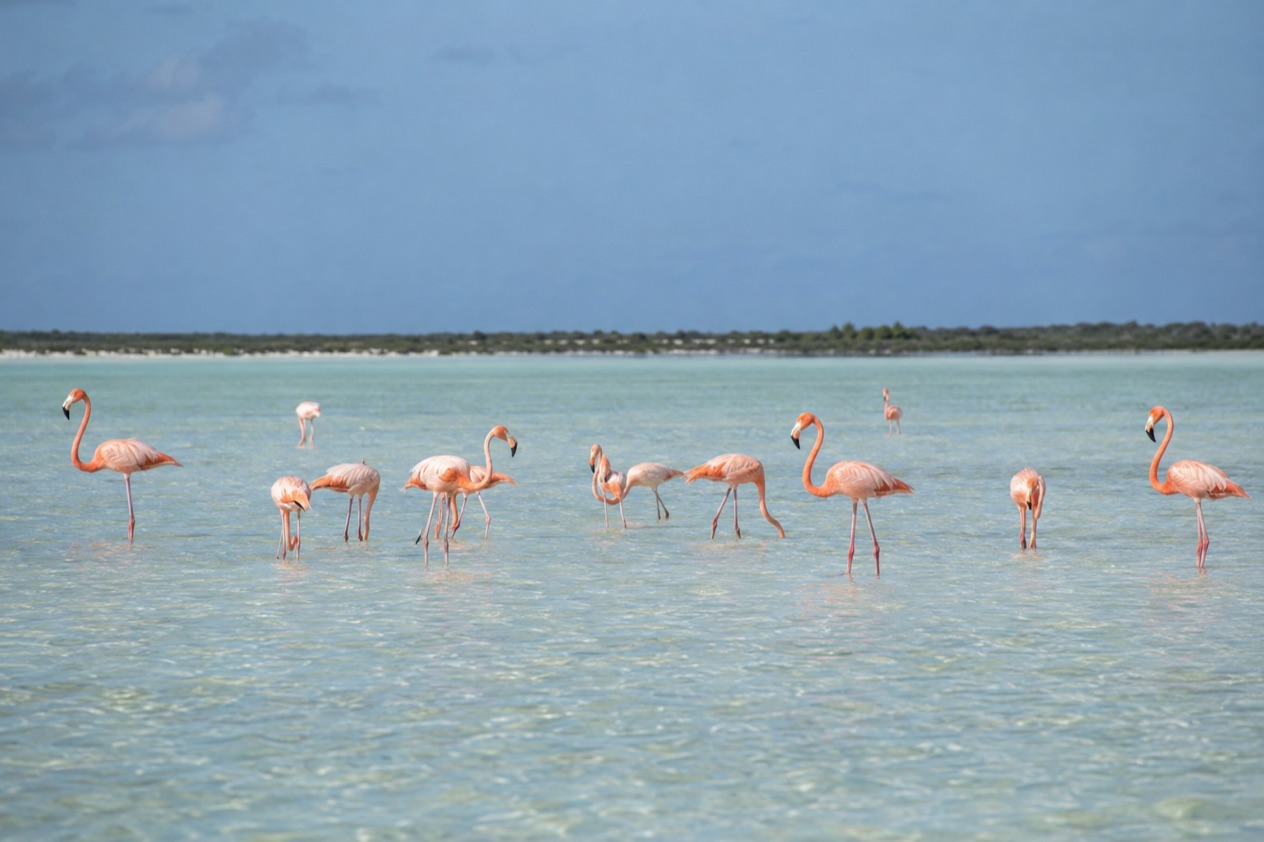
Flamingos at Lake Rosa
Inagua National Park is home to the world’s largest breeding colony of West Indian flamingos, tens of thousands of birds. They nest at Lake Rosa, the island’s largest salt pan, a pale, glaring flat where the birds stand in tight pink crowds. The sight is as much sound as color: constant calls, shuffling feet, and the sudden movement when a group takes off together.
The colony has a story. As early as 1905, hunting and disturbance caused a drastic decline in flamingo numbers across the region, and the Inagua population fell close to extinction.
It recovered over about forty years, and birds from here have since helped repopulate Andros, Acklins and Crooked Island, and Mayaguana, as well as Cuba and Grand Cayman. Protection is strict. It is illegal to eat flamingos on Inagua, and aircraft may not fly below 2,000 feet above ground, so the birds are not frightened off their nests.
Early morning and late afternoon are the hours when the light turns the water gold and the birds look their brightest, and a pair of binoculars matters more than a camera lens. Expect to watch from a distance and in silence. Flamingos reward patience, and the best moments often come after twenty minutes of standing still.
Union Creek and the sea turtles
Part of Inagua National Park takes in the Union Creek Reserve, an enclosed tidal creek that also serves as a sea turtle research station. It is a natural habitat for green and hawksbill turtles, which makes it a rare place to learn what scientists are studying rather than only to look.
A creek like this is a calm, shallow world of mangrove edges, tidal flow and quiet. It suits travelers who enjoy nature at a patient pace and who like to understand what they are looking at. Pair it with a flamingo morning and you have covered two of the island’s most distinctive habitats in a single day, one a glaring salt flat, the other a sheltered tidal creek.
More than flamingos: the birdlife
Flamingos draw the attention, but Inagua is home to over 140 species of native and migratory birds. That makes the island a destination for serious birders as well as casual watchers. The mix of salt ponds, scrub, lake shore and coast gives different birds different places to feed and rest.
Wading birds at the edge of the water, shorebirds on the flats and songbirds in the scrub all keep a visitor busy. The island is mostly flat, so you spot movement from far off, and a slow drive with frequent stops can be as productive as a long walk. Bring a field guide if you have one, and keep your voice low near the water.
Little Inagua by boat
Little Inagua is the largest uninhabited island in the Wider Caribbean, and it is accessible only by boat. It has no freshwater sources, which makes it hostile to human life, and that is precisely why it stays untouched. In 2002 the government established Little Inagua National Park, covering the entire island and its surrounding waters.
This is not a place with facilities or an itinerary. It is an idea as much as a destination: a wild island across the water, protected from top to bottom. Even if you never set foot near it, knowing it is there gives the whole district a sense of scale and wildness that few other parts of the Bahamas can offer.
What sets Inagua apart from its neighbors is simple. Elsewhere in the Bahamas, the draw is the sea, the beach, the marina or the party. Here it is the wetland, the bird colony and the distance from everything. Nothing else in the archipelago feels quite like it.
How many days do you need in Inagua?
A long weekend is enough to see the essentials of Inagua, and a few more days let you slow down to the island’s real rhythm. The island does not have a list of sights to rush through. What it offers needs time and patience, not a packed schedule.
In a short stay, the priorities are clear. Give one morning or late afternoon to the flamingos at Lake Rosa, when the light is softest and the birds are active. Give another outing to Union Creek and its turtles. Fit in a drive or a walk around Matthew Town, with its lighthouse and the salt works that have long defined the island’s economy and landscape.
A short stay also benefits from a flexible plan. Birdwatching depends on weather, light and the birds’ own movements, so a morning that disappoints can be followed by an afternoon that does not. If a shower comes in, the flat landscape means you can see it coming and wait it out, then return to the water when the sky clears and the colors sharpen.
With a longer stay, you can take in more of the island’s range. Spend an extra day on the birds beyond the flamingos, working through the habitats one by one, from lake shore to scrub to coast.
Take time to sit on the shore at dusk and watch the sky change. Allow a day for the boat trip toward Little Inagua if a way to go becomes available, since the island can be reached only by sea.
A longer stay also lets you talk to the people who live here. The community is small, and the conversations you have in Matthew Town, about salt, birds, hurricanes and island life, often become the part of the trip you remember best. Inagua rewards unhurried travelers, and anyone who tries to squeeze it into a single rushed day will miss what makes it special.
Because the island is far from the rest of the Bahamas, travel days also matter. Plan arrival and departure so that neither eats into your best light. A mail boat or a domestic flight sets the rhythm of the trip, and a day of buffer on either side is a gift rather than a waste on an island with this little to hurry for.
Where to stay in Inagua
Your base is Great Inagua, because Little Inagua is uninhabited, has no freshwater and is reachable only by boat. Within Great Inagua, the natural center of gravity is Matthew Town, the island’s settlement, home to most of its 913 residents. Staying here puts you near the island’s daily life, its lighthouse and its working salt landscape, and it keeps you close to the roads that lead out toward the national park.
This is not a resort destination, and nobody should come expecting the range of hotel areas found on the busier islands of the archipelago. Think instead of a small island community where lodging is part of the local scale of things. The question is less which district to choose than how to fit your days around the park, the lake and the birds.
The stay suits people who want quiet nights, early starts and a landscape that changes with the light. Birders will like being up before dawn, when the lake and the salt pans are best. Nature photographers will like the long evenings. Travelers who need a lively evening scene, shopping or a beach club should look to other islands in the Bahamas for that and treat Inagua as a separate, focused trip.
It also helps to think of your lodging as a base for the whole district. The park covers a large part of the island, the lake takes up nearly a quarter of the interior, and the distances on a flat island add up when you travel slowly and stop often. A base in the settlement means you return each evening to the company of other people, a meal and a bed, after days spent in some of the emptiest country in the Bahamas.
If you come for the birds, plan the whole stay around them, and let the rest of the island fill the gaps. Meals, conversation and a slow walk through Matthew Town become the evening counterpart to the wildlife of the day, and they give the trip a human side that the wetlands alone cannot.
How do you get to Inagua and get around?
You get to Great Inagua by air or by sea. Great Inagua Airport services domestic routes to Nassau and Mayaguana, so most travelers connect through the capital. The island can also be reached by weekly mail boat from Nassau, a slower way in that suits anyone who treats the journey as part of the trip.
Because the flights are domestic routes within the Bahamas, an international trip from the United States first lands elsewhere in the country and then continues south. Think of Inagua as the last leg of a longer journey rather than a place with its own direct links. That is part of why it stays so quiet and so unspoiled, and it is a good reason to build in a spare day on each end.
The mail boat deserves a word of its own. It runs weekly from Nassau, so your time on the island follows its rhythm, and it offers a view of the Bahamas as a working archipelago, where boats carry goods and people between islands. It is the traditional lifeline for remote communities, and Inagua is one of them.
Once on Great Inagua, the island’s flat landscape and small population shape how you move. Matthew Town is a settlement where distances are small, and the national park, the lake and the creek lie beyond it across open, flat country. Little Inagua is another matter entirely, since it is accessible only by boat and has no settlement to reach.
What matters for getting around is to plan each outing around the place and the light rather than the clock. The things worth seeing, the flamingo flats, the turtle creek, the shore at dusk, are spread across a large island, so a day works best when it has one or two clear goals and plenty of time to stop along the way.
When is the best time to visit Inagua?
The winter and spring months, roughly December through May, are the best time for most travelers, because they fall outside the hurricane season and bring the milder air that makes long days outdoors comfortable. For a destination built on watching wildlife in open, flat country with little shade, comfortable air counts for a great deal. The flamingos nest at Lake Rosa, and the nesting season generally runs through the spring, which makes the later part of that window especially rewarding for birders.
Summer is a different experience. In Nassau, July highs reach about 90°F, and the same season brings more rain days, with short heavy showers that interrupt the sun. On a flat island with open water and few trees, the sun is strong and shade is scarce, so the middle of the day is for resting, and the early morning and late afternoon become the working hours for any outing.
The Atlantic hurricane season runs from June 1 to November 30, so the late summer and autumn months carry the greatest chance of tropical weather. Travelers who come then should keep their plans flexible, since a tropical system can disrupt flights and boats on an island so far from the rest of the country. January, February and March sit well outside that window.
There are no big festivals or crowded weeks to plan around here, and that is part of the point. Inagua is quiet in every season, and the real calendar belongs to the birds, the weather and the tides. Pick your month for the light and the air, and the island will do the rest.
Good to know before you go
The U.S. State Department rates the Bahamas Level 2, “Exercise increased caution”, and says most crime occurs in Nassau on New Providence and in Freeport on Grand Bahama.
Inagua is a long way from the busier islands of the Bahamas, and the money, the supplies and the services that visitors take for granted elsewhere are part of a small community’s daily life here. Plan with that in mind, bring what matters to you, and treat the island’s quiet as a feature of the place rather than a gap in it.
Respect for the wildlife is the unwritten rule of the island. The flamingos, the turtles and the wetlands are protected, and the colony took decades to recover. Keep your distance, keep your voice low and leave the birds and the water as you found them. The hurricane season, from June 1 to November 30, is the other thing to keep in view when you choose your dates.
Sources
- Bahamas Ministry of Tourism, Investments & Aviation (bahamas.com), Inagua (https://www.bahamas.com/islands/inagua), checked October 10, 2026
- Wikipedia, Inagua (https://en.wikipedia.org/wiki/Inagua), checked October 10, 2026
- Bahamas Ministry of Tourism, Investments & Aviation (bahamas.com), travel blog, Inagua flamingos birds (https://www.bahamas.com/blog/inagua-a-bird-lovers-paradise), checked October 10, 2026
- Bahamas Ministry of Tourism, Investments & Aviation (bahamas.com), travel blog, flamingos Inagua (https://www.bahamas.com/blog/how-the-bahamas-rescued-the-flamingo), checked October 10, 2026
- Wikipedia, Geography of the Bahamas (https://en.wikipedia.org/wiki/Geography_of_the_Bahamas), checked October 10, 2026
- NOAA NCEI, GHCN-Daily station BF000078073 (Nassau Airport), normals 1991-2020 computed from the daily record (https://www.ncei.noaa.gov/access/services/data/v1?dataset=daily-summaries&stations=BF000078073), checked October 10, 2026
- Open-Meteo Marine API, average 2015-2024, checked October 10, 2026
- U.S. Department of State, The Bahamas Travel Advisory, Level 2 (https://travel.state.gov/), checked October 10, 2026
- NOAA National Hurricane Center, Climatology (https://www.nhc.noaa.gov/climo/), checked October 10, 2026
To plan your stay
- Best Time to Visit the Bahamas: Weather, Hurricane Season, Sea Temperatures and Junkanoo
- Where to Stay in the Bahamas: Best Islands, Resorts, Boutique Stays and How to Choose
- Getting Around the Bahamas: Flights, Ferries, Mailboats and Taxis in Nassau
- Know Before You Go to the Bahamas: Entry Rules, Money, Getting Around and Local Customs