
The last morning of a Bahamas trip often ends in the same place: a taxi pulling up to the curb at Nassau’s airport, a bag of conch fritters’ worth of leftover change in a pocket, and a quiet question about whether there is still something to pay on the way out. The airport does run published tariffs and fees on the flights that leave from it. What follows explains how those schedules are organized and what the day of departure from Nassau looks like.
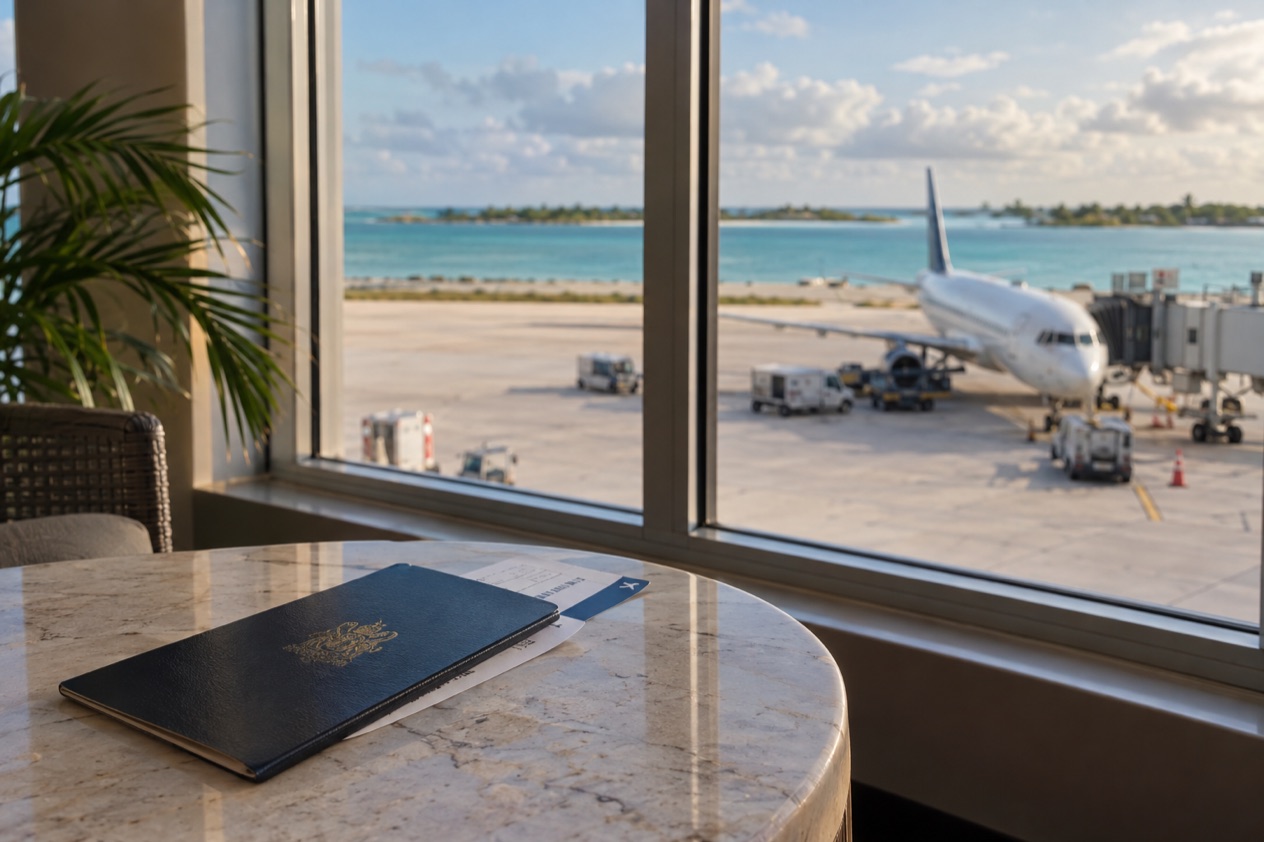
Is there a departure tax in the Bahamas?
Flying out of Nassau does come with airport fees, set out in tariff schedules published by Lynden Pindling International Airport, usually shortened to LPIA. The airport sits on the western end of Nassau, on the island of New Providence, roughly ten miles from downtown, so most travelers meet these fees at the end of a ride along the island’s western road.
The tariffs cover aeronautical charges, the costs tied to aircraft and passengers moving through the terminals. They are the airport’s own paperwork rather than a tourist levy on hotel stays or restaurant bills, and they apply to the kind of trip you are taking. A hop to another Bahamian island falls under one schedule. A flight to the United States falls under another.
What the fees pay for
The airport describes its tariffs and fees as a key source of income. That money lets LPIA maintain its terminals, support the airlines that fly in and out, and invest in the future of the airport. For a visitor, that means the fee side of the trip is tied to the building you walk through: the check-in halls, the security lanes, the gates and the lounges.
It also helps to remember that LPIA handles several kinds of journeys under one roof, domestic flights, U.S.-bound flights and other international routes. Each has its own rhythm, and the airport’s fee documents follow that split rather than treating every passenger the same way.
Two kinds of departure, two schedules
The airport publishes separate documents for domestic travel within the Bahamas and for international travel between the Bahamas and the United States. If your vacation took you from Nassau to another island and then home, you are touching both worlds, and the difference matters when you read about charges.
Travelers who connect through Nassau on the way to the United States also pass through the U.S. Departure terminal, where security and U.S. Customs open at 6AM. That early opening shapes the morning rush, and it is the reason the first flights to the States bring a line of travelers to the curb before breakfast has really started.
What the airport does not treat as a fee
Free Wi-Fi throughout the airport costs nothing: you connect to the network called LPIA Free WiFi and fill out a short form. Smoking is permitted only at designated curbside areas outside the Arrivals and Departure terminals, since there are no smoking areas past security. Those small details are part of how the terminal works, and none of them involves a charge at the door.
The two premium lounges are a separate matter. One is the Lignum Lounge in the Domestic and International Departures terminal, the other is upstairs in the U.S. Departure terminal. Guests get in as part of first-class ticket amenities or as paid guests, which makes a lounge a choice you make rather than a tax you owe.
How much is it and who pays?
The amount depends on the schedule for your type of trip, and each schedule is a document the airport publishes with its own effective date and its own treatment of VAT. Finding the right page for your flight is how you know what applies, and the two line up the way the table lays them out.
| Schedule | Applies to | Effective from | VAT |
|---|---|---|---|
| Domestic tariff of fees and charges | Travel within the Bahamas | May 1, 2024 | Included |
| International U.S. tariff of fees and charges | Travel between the Bahamas and the United States | May 1, 2022 | Excluded |
Reading the VAT line
The one detail that trips people up is the VAT treatment. The domestic schedule includes VAT in its figures, while the U.S. schedule leaves it out. Two documents that look alike on the screen therefore do not describe the amounts in quite the same way, and a traveler comparing them needs to keep that difference in mind.
The effective dates are different too. The domestic schedule is the more recent of the two, and the U.S. one is older. That is a normal feature of airport tariffs, which are revised on their own timetable for each category of traffic rather than all at once.
Who sits behind the charges
The tariffs are the airport’s aeronautical charges, so they sit in the relationship between LPIA and the airlines and passengers who use it. The airport states that this income pays for maintaining the terminals and supporting the carriers. As a visitor, you see the result in the facilities more than in the paperwork: the check-in kiosks, the lounges, the clean curbside pickup areas.
If you are traveling with a group, such as a family reunion or a wedding party flying home on different days, the practical point is that every person leaving on a given kind of flight falls under the same schedule. A couple heading to Miami and a cousin taking a short domestic hop to another island are reading different documents.
Duty-free goods on the way home
Another money question comes up at the same point in the trip: what you can carry home. U.S. citizens returning from abroad, including from the Bahamas, may bring back up to $800 worth of duty-free goods if they have been out of the country for at least 48 hours.
Within that allowance, up to 40 ounces of liquor or wine can come home duty-free. A bottle of Bahamian rum picked up on Bay Street fits comfortably inside that picture, and it travels in checked luggage rather than a carry-on.
How is it collected?
For a traveler, the fee side of departure stays in the background, and what you actually move through is the airport’s sequence of check-in, security and, on U.S. flights, customs. Understanding that sequence is what makes the morning calm, and the first thing to settle is when to arrive.
| Flight | Arrive at the airport |
|---|---|
| U.S.-bound | At least 3 hours before departure |
| Other international (not bound for the U.S.) | At least 2 hours before departure |
| Domestic, within the Bahamas | 2 hours before departure |
Check-in before you reach the curb
Checking in online and using the self-service kiosks at LPIA speeds things up. The Aerocloud mobile app, available on the Google Play Store and the Apple App Store, carries the latest flight information for the airport, which is useful when a gate changes or a departure shifts while you are still finishing a last coffee.
Drop-off happens at designated areas at both the Domestic and International terminals, with handicap zones included. There is no valet parking, though short-term and long-term parking are both available. Public buses are not permitted to operate within the airport grounds, so the ways in and out are taxis, car rentals, ride-sharing services and private shuttles.
Security and the liquids rule
Carry-ons at LPIA follow the 3-1-1 rule. Liquids, gels, creams and pastes go in containers of 3.4 ounces or less, and every container must fit in one quart-sized clear plastic zip-top bag, with one bag per passenger. That affects the bottle of hot sauce or the sunscreen you meant to keep in your tote.
Once through the checkpoint you are in a part of the terminal with no smoking areas, so the last cigarette belongs outside at the curb. Passengers who need disability assistance can contact their airline or the airport ahead of time, and wheelchair assistance is arranged by calling the airline in advance.
U.S. preclearance and Global Entry
Travelers heading to the United States clear U.S. Customs and Border Protection in Nassau itself, before boarding. That is called preclearance, and it means the landing at home feels like a domestic arrival. The U.S. Departure terminal is where it happens, and the early opening of security and customs gives the first flights of the day room to work.
Mobile Passport Control and Global Entry are offered to returning U.S. residents and green card holders in the U.S. Customs hall. Pre-approved Global Entry members can use self-service kiosks to complete U.S. entry processing before departing from LPIA, which shortens the wait for those who have enrolled.
Good to know before you go
The U.S. State Department rates the Bahamas Level 2, “Exercise increased caution”, and says most crime occurs in Nassau on New Providence and in Freeport on Grand Bahama.
The Atlantic hurricane season runs from June 1 to November 30, so a departure day in autumn can be shaped by weather as well as by schedules, and the Aerocloud app is a handy companion for last-minute changes. Keep a little time at the end of the trip for the lounge, the Wi-Fi and a last look at the terminal before boarding, and keep the rum for the checked bag.
Sources
- Lynden Pindling International Airport, Airport fees and tariffs (https://nassaulpia.com/about-lpia/airport-fees-and-tariffs/), checked October 10, 2026
- Lynden Pindling International Airport (Nassau), FAQs (https://nassaulpia.com/help/faqs/), checked October 10, 2026
- Bahamas Department of Immigration, Before your arrival (https://www.immigration.gov.bs/entry-requirements/before-your-arrival/), checked October 10, 2026
- Lynden Pindling International Airport, Airport checklist (https://nassaulpia.com/airport-guide/airport-checklist/), checked October 10, 2026
- U.S. Department of State, The Bahamas Travel Advisory, Level 2 (https://travel.state.gov/), checked October 10, 2026
- NOAA National Hurricane Center, Climatology (https://www.nhc.noaa.gov/climo/), checked October 10, 2026
To plan your stay
- Best Time to Visit the Bahamas: Weather, Hurricane Season, Sea Temperatures and Junkanoo
- Where to Stay in the Bahamas: Best Islands, Resorts, Boutique Stays and How to Choose
- Getting Around the Bahamas: Flights, Ferries, Mailboats and Taxis in Nassau
- Know Before You Go to the Bahamas: Entry Rules, Money, Getting Around and Local Customs