
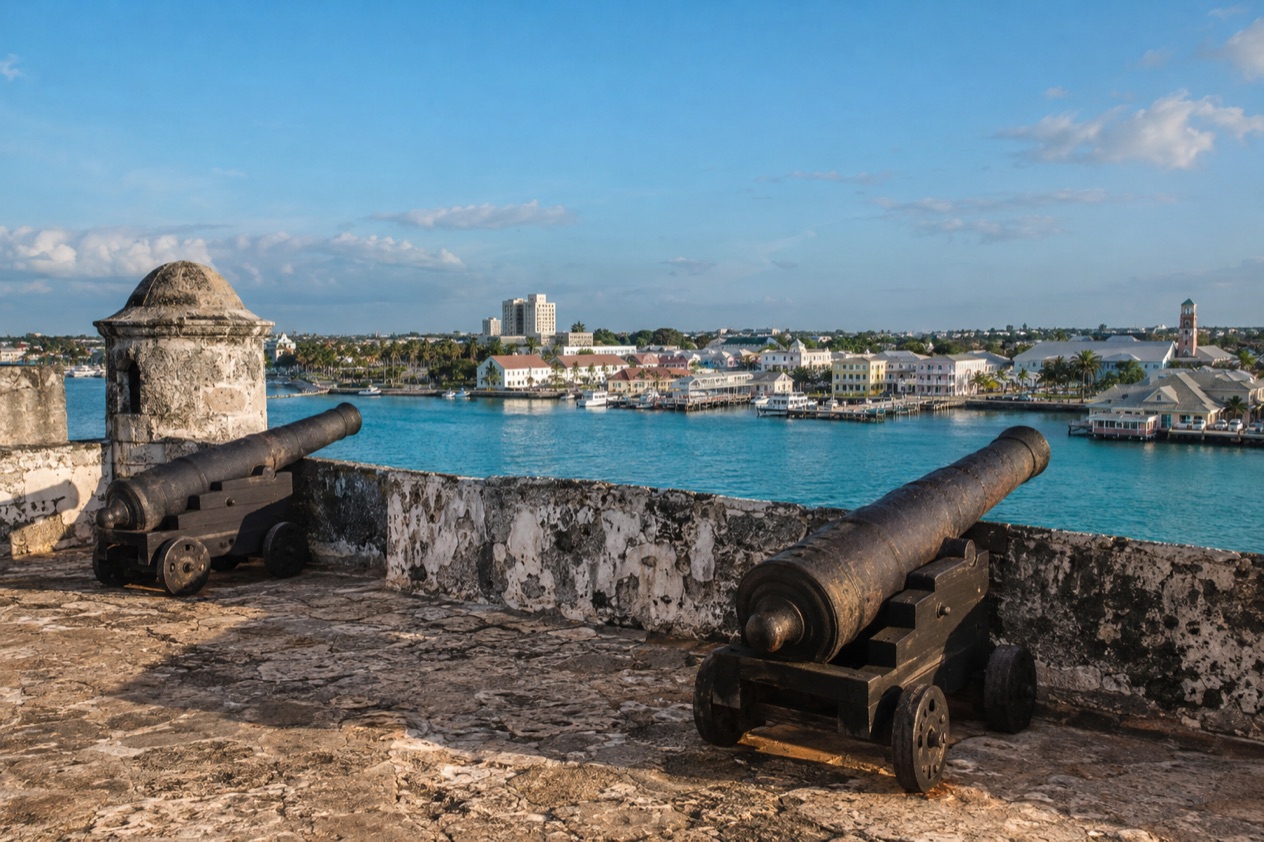
On a Nassau hillside, the stone walls of Fort Charlotte still look down on the harbor entrance, and somewhere in town a goatskin drum and a cowbell are keeping time for a rush of dancers. The Bahamas carries its past in limestone steps, old forts, a lighthouse that still burns kerosene and in the rhythms people play year round. Nassau, on New Providence, is the natural place to begin, and the other islands add their own chapters.
What is the history of the Bahamas?
The history of the Bahamas is the story of an Atlantic archipelago, about 700 islands and more than 2,500 cays, that passed from legend and Spanish ambition to British forts, enslaved labor and finally independence from the United Kingdom on July 10, 1973. That date is still celebrated every year as Independence Day, and Junkanoo-style dancing is performed on it and on other historical holidays.
Much of what you see today dates from the British era, when Nassau was fortified to guard its harbor. The forts were a constant worry for the colony, yet they never saw serious fighting. What they did leave behind is a skyline of ramparts, stairways cut into rock and quiet barracks foundations.
Forts, soldiers and the West India Regiments
The defenses of Nassau included three main forts and six smaller outposts called batteries. They faced threats on many occasions, but they did not see significant action in battle. Walking the ramparts today, you are standing in places built for a showdown that mostly never came.
Life for the garrison was hard. European soldiers housed in the barracks suffered a very high death rate from yellow fever, even after new barracks were built near Fort Charlotte.
In 1801, British military commanders for the West Indies decided to send black troops of the British West India Regiments to garrison the New Providence forts. East of Fort Charlotte you can still see the footprint of the barracks on the ground, though the building itself is gone.
Bimini: a legend, a casino and a hurricane
Bimini tells a different, more playful kind of history. A spot on the island still bears the name Fountain of Youth, the legendary spring that lured Ponce de León in the early 1500s. Offshore lies the Bimini Road, an underwater pathway of giant square blocks stretching 1,500 feet, which keeps visitors and storytellers guessing.
On North Bimini, Thomas Peters built the Bimini Bay Rod and Gun Club in 1920 as a three-story hotel and casino. It had the first casino in the Bahamas and was the largest hotel in the country at the time, with 50 people on staff in high season.
A hurricane destroyed it in 1926, a reminder that this part of the Atlantic has always shaped the islands’ story. On the island, two bronze busts of Martin Luther King Jr. honor his legacy.
The rum estate that goes back to 1789
The Buena Vista Estate in Nassau dates back to 1789, and today it houses John Watling’s Distillery, the only rum distillery in the Bahamas. The rum is made from hand-cut sugarcane molasses brought from neighboring islands, produced in small batches, aged in barrels and blended by a Master Blender. The blending techniques have been passed down through six generations.
Tours are offered daily, which makes the estate an easy way to connect colonial-era Nassau with something you can taste. It suits anyone who likes a story told through a glass rather than a plaque.
Which historic sites can you visit?
The best-known historic sites cluster in Nassau, on New Providence: Fort Charlotte, the Queen’s Staircase with Fort Fincastle above it, and the old estate that now makes rum. Farther out, a working lighthouse in the Abacos and a hilltop on Cat Island give the story a wider setting.
Fort Charlotte
Fort Charlotte stands west of downtown Nassau on a hill overlooking the entrance to the harbor, and it is the largest of the three remaining forts. It is really a complex of three parts: Fort Charlotte itself to the east, a middle bastion called Fort Stanley, and a western auxiliary known as Fort D’Arcy.
The builders gave it a drawbridge, souterrains, an arched bombproof casemate, casemates dug into the rock, magazines, a guard room, a furnace for heating shot and a ditch now usually called the moat. Exploring the passages and rock-cut chambers is the real pleasure here, and the hilltop gives a long view over the harbor that explains why the site was chosen.
The Queen’s Staircase and Fort Fincastle
The Queen’s Staircase is in Nassau, inside the Fort Fincastle Historic Complex, and it leads up to Fort Fincastle. It has 65 steps, though it originally had 66, and climbs a total of 102 feet. Between 1793 and 1794, 600 slaves carved it out of solid limestone to create a direct route from the fort to the town.
It took its name from Queen Victoria in the 19th century. The walls rise on both sides as you go up, so it feels more like a passage cut through the rock than a stairway. Give it a quiet moment, since the labor behind the stone is the point of the visit.
Elbow Reef Lighthouse, Hope Town
On the banks of Hope Town in the Abacos, the Elbow Reef Lighthouse is the last working kerosene-burning lighthouse in the world. Its striped tower is the emblem of the settlement, and it gives the harbor town a postcard look that few other islands can match. Hurricane Dorian struck the Abaco Islands and Grand Bahama at Category 5 intensity in September 2019, devastating the northwestern Bahamas, so the lighthouse also stands as a landmark of endurance for the community around it.
Mount Alvernia on Cat Island
On Cat Island, Mount Alvernia is the highest point in all 16 islands of the Bahamas, at 206 feet above sea level. It is a modest height by mainland standards, and that is part of its charm: the whole archipelago is so low that a small hill becomes a summit. Pair it with a day among the island’s settlements and you get a sense of how far the Bahamas stretches beyond Nassau’s harbor.
| Site | Island | Notable detail |
|---|---|---|
| Fort Charlotte | New Providence | Largest of the three remaining forts |
| Queen’s Staircase | New Providence | 65 steps, 102 feet of rise |
| Elbow Reef Lighthouse | Abacos | Last working kerosene-burning lighthouse |
| Mount Alvernia | Cat Island | 206 feet above sea level |
Where can you learn about Bahamian culture?
You learn Bahamian culture most directly in Nassau’s downtown streets, at the Fish Fry, in a Junkanoo parade and in the homes and workshops of the Out Islands. Downtown Nassau is made up of 20 square blocks that hold monuments, murals and museums, and a new generation of young artists is shaping its streets.
Junkanoo
Junkanoo is celebrated year round in the Bahamas, not only at Christmastime. The dances are choreographed to the beat of goatskin drums and cowbells, and the tradition has grown into a formal, organized parade with intricate costumes, themed music and official prizes in various categories.
The tradition traveled too: Junkanoo parades take place in Miami in June and in Key West in October. The last known celebration in the Southern United States before that was in Wilmington, North Carolina, in the late 1880s.
Eating your way through Nassau
The Fish Fry at Arawak Cay is a strip where deciding what and where to eat is an all-day affair. Potter’s Cay is locally recommended for conch salad that is always flavorful and fresh. Both are places where the food and the conversation run together, and they suit anyone who likes to eat where residents do. At Ardastra Gardens in Nassau, the marching flamingos are the main attraction, a lighter stop for the family after a day of forts and stairs.
Homes, baskets and batik in the Out Islands
On Cat Island, islanders open their doors and offer travelers a glimpse of authentic Bahamian life with a shared plate that tells a story of connection and community. A mother-daughter duo keeps family traditions alive through basket weaving and bush medicine. The People-to-People Experience includes a home visit with fresh conch fritters and conversation with Stephen and Terry Bellot.
On Little Exuma, three small, family-owned dining businesses work together to offer unique meals. On Andros, Androsia Batik, called the unofficial fabric of the Bahamas, has been handmade since the very beginning. Andros is also home to more than 180 blue holes, and Blue Holes National Park lies on the island. In the Exumas, Exuma Cays Land & Sea Park has been protected for more than 60 years, a different kind of heritage that belongs to the sea.
Good to know before you go
The U.S. State Department rates the Bahamas Level 2, “Exercise increased caution”, and says most crime occurs in Nassau on New Providence and in Freeport on Grand Bahama.
The wet season in the Bahamas runs from May to October, so outdoor sites like the forts and the staircase can bring a passing shower, and the Atlantic hurricane season runs from June 1 to November 30. English is the official language, and tourism and offshore finance drive the economy, which means guides and museum staff speak your language easily. Most of the history on this list sits in Nassau, so a few days there can be paired with an Out Island stop for the full picture.
Sources
- Bahamas Ministry of Tourism, Investments & Aviation (bahamas.com), travel blog, Nassau forts (https://www.bahamas.com/blog/historic-forts-of-nassau), checked October 10, 2026
- Bahamas Ministry of Tourism, Investments & Aviation (bahamas.com), travel blog, Bimini landmarks (https://www.bahamas.com/blog/the-historical-landmarks-of-bimini), checked October 10, 2026
- Wikipedia, Queen%27s Staircase (https://en.wikipedia.org/wiki/Queen%27s_Staircase), checked October 10, 2026
- Bahamas Ministry of Tourism, Investments & Aviation (bahamas.com), Landmarks (https://www.bahamas.com/experiences/landmarks), checked October 10, 2026
- Bahamas Ministry of Tourism, Investments & Aviation (bahamas.com), Culture (https://www.bahamas.com/experiences/culture), checked October 10, 2026
- Bahamas Ministry of Tourism, Investments & Aviation (bahamas.com), John Watlings Nassau (https://www.bahamas.com/experiences/john-watlings-nassau), checked October 10, 2026
- Wikipedia, Junkanoo (https://en.wikipedia.org/wiki/Junkanoo), checked October 10, 2026
- Wikipedia, The Bahamas (https://en.wikipedia.org/wiki/The_Bahamas), checked October 10, 2026
- U.S. Department of State, The Bahamas Travel Advisory, Level 2 (https://travel.state.gov/), checked October 10, 2026
- NOAA National Hurricane Center, Climatology (https://www.nhc.noaa.gov/climo/), checked October 10, 2026
To plan your stay
- Best Time to Visit the Bahamas: Weather, Hurricane Season, Sea Temperatures and Junkanoo
- Where to Stay in the Bahamas: Best Islands, Resorts, Boutique Stays and How to Choose
- Getting Around the Bahamas: Flights, Ferries, Mailboats and Taxis in Nassau
- Know Before You Go to the Bahamas: Entry Rules, Money, Getting Around and Local Customs