
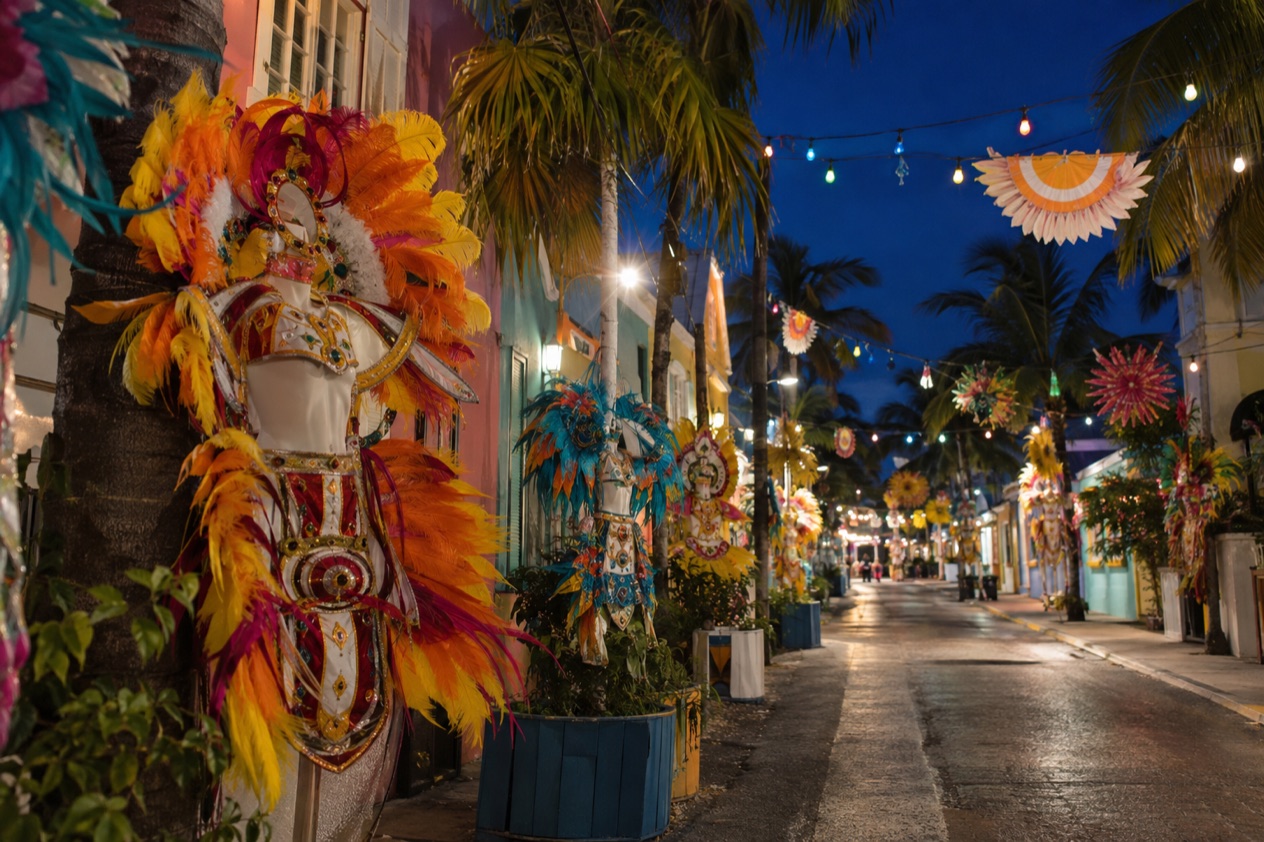
Long after midnight on Boxing Day, Bay Street is still wide awake. Goatskin drums thump against the buildings, cowbells clang, whistles cut through the dark, and a wall of feathers and shimmering paper comes around the corner under the streetlights.
This is Junkanoo, the Bahamian street parade that Nassau stages at the turn of the year and that other islands celebrate on their own terms. It is the festival to plan a winter trip around, and it has a lighter summer side too.
What is Junkanoo?
Junkanoo is a Bahamian street parade of colorful costumes, choreographed dance routines and driving music, and it begins in the small hours after midnight on Boxing Day, the day after Christmas, in Nassau on New Providence. The sound comes from whistles, cowbells, horns and goatskin drums, a steady beat that you feel in your chest before you see the first group. Bahamians on all 16 popular islands claim the tradition as their own, and the Bahamas recognizes it as an Intangible Cultural Heritage through UNESCO.
The roots are said to reach back to the 1700s. A popular belief ties it to the days of slavery, when enslaved people were given a few days off at Christmas and used them to dance, drum and dress up.
Today the parade is a formal, organized contest, with intricate costumes, themed music and official prizes in several categories. Nothing about it feels like a tourist show. It is a community competing with itself, and you are invited to stand at the curb and take it in.
The groups and the year of work behind them
The big Nassau parade is performed by organized groups of up to 1000 people, and they spend almost the whole year preparing. Costumes are built by hand, often in workshops called shacks, from cardboard, crepe paper, glue and a great deal of patience. Each group chooses a theme and keeps its design secret until the night itself. Every costume, song and dance step is meant to fit that theme.
That secrecy explains the tension in the crowd as each group approaches. You are watching months of work arrive all at once, with the music written for that group and the dancers moving to it in step. Costumes can be taller than the people wearing them, and the best ones seem to glow when the lights hit the foil and paper.
The characters you will recognize
Junkanoo has traditional figures, and spotting them is half the fun. The King and Queen wear elaborate costumes of shiny materials and crowns. The Belly Woman is usually a male performer playing a pregnant lady, a figure of fertility and abundance. The Devil appears with a pitchfork and a tail, and the House Head is a house or building carried on the performer’s head, a symbol of hope for a better future.
Alongside them come the dancers, the horn players and the drummers, whose rhythms set the pace of the whole street. The dances are choreographed to the beat of goatskin drums and cowbells, so the music and the movement are never separate. Watch the footwork of the lead dancers, then turn to the brass and drums behind them.
Joining in as a visitor
Anyone is welcome to take part, so long as they follow the rules of the National Junkanoo Association. Visitors who want to be in the parade can make arrangements through their hotel. For most travelers the experience is on the sidewalk, among Bahamian families who have come out to cheer their own group, sing along and trade opinions about who is winning.
When is Junkanoo?
The biggest Junkanoo celebrations in Nassau happen on Boxing Day, the day after Christmas, and again on New Year’s Day. Both parades begin in the early morning hours, after midnight, and run as the night turns to daylight. The highlight of the year is Boxing Day and New Year’s morning, and nothing else in the Bahamian calendar matches them for scale.
Christmas in Nassau builds toward it. Through December, Pompey Square fills with decorations and Christmas caroling, and a tree-lighting event has drawn hundreds of visitors and Bahamians there.
On Arawak Cay, the Christmas Village has offered authentic Bahamian gifts, decorations, Bahamian treats and live entertainment in the evenings on weekdays. The full list of Christmas events across the Bahamas is posted at www.tourismtoday.com/events. Together these make the weeks before Boxing Day a pleasant run of evenings, with Junkanoo as the finale.
Summer Saturdays and Junkanoo Summer Fest
Junkanoo is not only a winter event. In the Bahamas it is celebrated year round, and on many Saturdays through the summer you will find it in Nassau and on other islands. Junkanoo Summer Fest runs through the summer across the Bahamas, and the festival is also part of Independence Day, when Junkanoo-style dancing is performed, along with other historical holidays.
The summer versions are smaller and looser than the Boxing Day parade, which makes them a good choice for travelers who cannot be in Nassau at Christmas. Summer also falls inside the Atlantic hurricane season, which runs from June 1 to November 30, so a summer plan should leave room for the weather to change.
Junkanoo Carnival events
Beyond the street parades, the Bahamas Junkanoo Carnival adds ticketed events, and its website, Bahamasjunkanoocarnival.com, carries the details on events and prices. Tickets bought online come with an emailed invoice number that you can print and redeem later. In Nassau, Music Masters concerts have been offered in general admission, preferred and reserved seating, while in Grand Bahama the Music Masters semi-final events are included in the price of entry to Da Cultural Village.
| Event | Ticket | Price |
|---|---|---|
| Da Cultural Village, Nassau | Day pass | $15 |
| Da Cultural Village, Nassau | Weekend pass | $40 |
| Da Cultural Village, Grand Bahama | Day pass | $30 |
| Da Cultural Village, Grand Bahama | Weekend pass | $50 |
| Music Masters concert, Nassau | General admission (from) | $50 |
| Music Masters concert, Nassau | Preferred seating (from) | $75 |
| Music Masters concert, Nassau | Reserved seating (from) | $125 |
Where can you see it?
The largest Junkanoo celebration takes place on Bay Street in downtown Nassau, on New Providence Island. That is the place to be for the Boxing Day and New Year’s morning parades, with the groups moving along the waterfront street between the crowds. If you only see Junkanoo once, this is the version to choose.
Bay Street, Nassau
Bay Street is the stage for the grand parade, and it turns from an ordinary shopping street into a corridor of sound. The groups come through in turn, each with its own theme, music and costumes, and the crowd lines both sides. The parade begins after midnight, so the best plan is to treat it as a night out that ends with the first light.
Expect to stay on your feet and to hear the drums long before the next group appears. The music and the sheer size of the costumes are what stay with visitors, along with the way the crowd sings back at the performers. If you want to be in the parade rather than watch it, your hotel is where the arrangements start.
The Out Islands and Grand Bahama
Junkanoo also takes place on many of the Out Islands, and Bahamians on all 16 islands celebrate it. These local versions are community events, usually smaller than Nassau’s, and they let you see how the tradition belongs to each island. Grand Bahama has its own Da Cultural Village, with the Music Masters semi-final events included in the entrance price.
Before you travel to an island for a particular celebration, confirm the date for that island and that event, since local celebrations vary. The Bahamas Junkanoo Carnival website is where the carnival events and their prices are posted.
Junkanoo beyond the Bahamas
Junkanoo parades also appear in Florida, in Miami in June and in Key West in October. They are a taste of the tradition for travelers who stay on the mainland, though the Nassau parade remains the full experience. Junkanoo was once held in the Southern United States more widely, and the last known celebration there was in Wilmington, North Carolina, in the late 1880s.
Good to know before you go
The U.S. State Department rates the Bahamas Level 2, “Exercise increased caution”, and says most crime occurs in Nassau on New Providence and in Freeport on Grand Bahama.
The parade is a late-night, early-morning event, so plan the hours around it and expect the street to be crowded and loud. Most crime in the Bahamas, the State Department notes, occurs in Nassau and in Freeport on Grand Bahama, which are the two places where the biggest celebrations happen, so keep your belongings close in a crowd. The Atlantic hurricane season runs from June 1 to November 30, which covers the summer Junkanoo events but not Boxing Day or New Year’s.
Sources
- Bahamas Ministry of Tourism, Investments & Aviation (bahamas.com), Junkanoo (https://www.bahamas.com/events/junkanoo), checked October 10, 2026
- Bahamas Ministry of Tourism, Junkanoo (https://www.bahamas.com/events/junkanoo), checked October 10, 2026
- Wikipedia, Junkanoo (https://en.wikipedia.org/wiki/Junkanoo), checked October 10, 2026
- Bahamas Ministry of Tourism, Christmas season (https://www.bahamas.com/blog/christmas-season-officially-launched-in-the-bahamas), checked October 10, 2026
- U.S. Department of State, The Bahamas Travel Advisory, Level 2 (https://travel.state.gov/), checked October 10, 2026
- NOAA National Hurricane Center, Climatology (https://www.nhc.noaa.gov/climo/), checked October 10, 2026
To plan your stay
- Best Time to Visit the Bahamas: Weather, Hurricane Season, Sea Temperatures and Junkanoo
- Where to Stay in the Bahamas: Best Islands, Resorts, Boutique Stays and How to Choose
- Getting Around the Bahamas: Flights, Ferries, Mailboats and Taxis in Nassau
- Know Before You Go to the Bahamas: Entry Rules, Money, Getting Around and Local Customs