
On the dock under the bridge to Paradise Island, pallets of groceries, stacks of lumber and cases of soda wait beside the hull of a working freighter, and a few travelers with duffel bags stand among them. That scene is how many visitors first wonder whether the boat in front of them is a way to reach an Out Island. A Bahamas mailboat is a cargo vessel that also carries passengers, and it suits travelers who care more about the journey and the island at the other end than about speed.
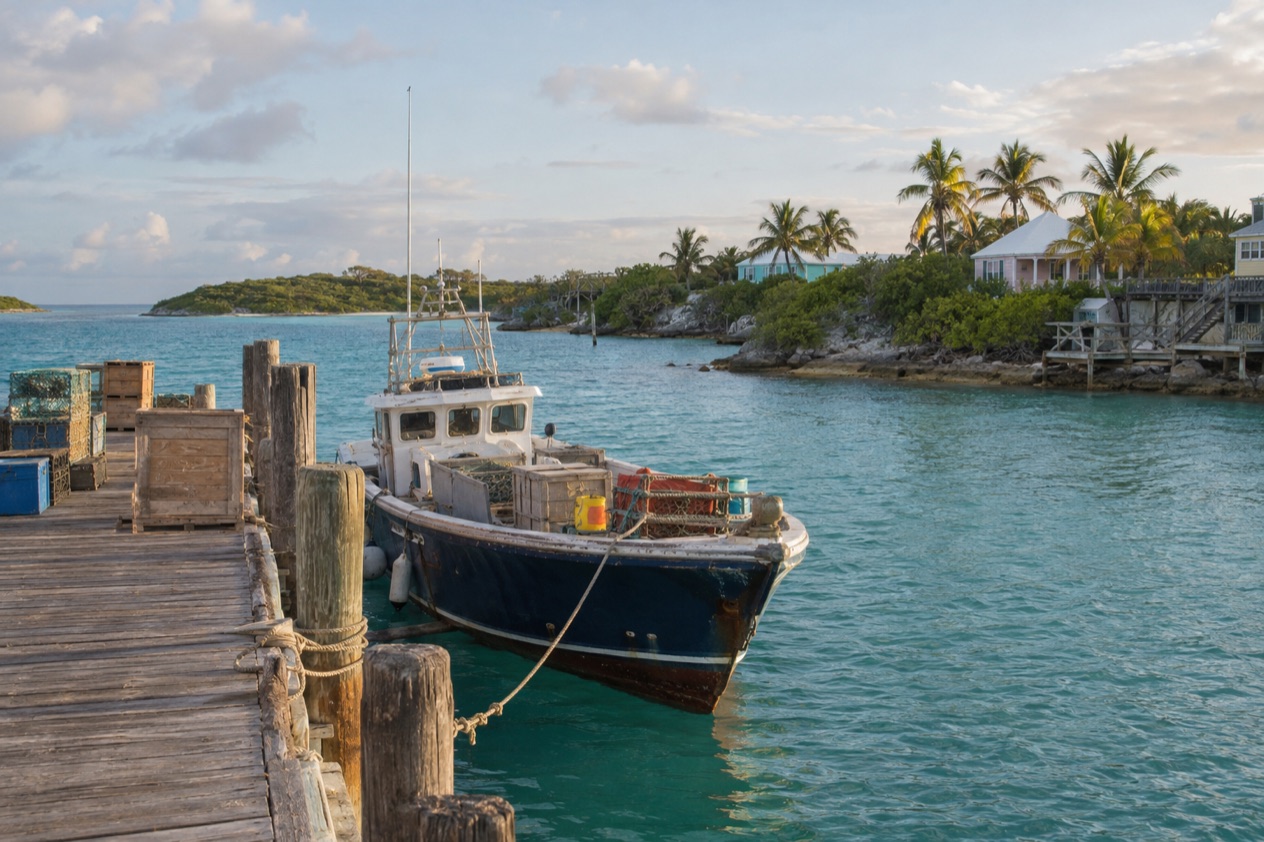
What is a Bahamas mailboat?
A mailboat is a regularly scheduled vessel that connects the major islands of the Bahamas, carrying freight, supplies and mail first and passengers alongside them. The name goes back to the job these boats were created for, which was keeping scattered island settlements in touch with Nassau. They still do that work, and anyone aboard is traveling on a supply line that the islands depend on.
The country is made up of 700 islands and cays, and only 30 of them are inhabited. Between those inhabited islands lie long stretches of open water, so the boats that haul food, building materials and household goods matter far beyond the passenger deck. The mailboat arrives, the dock fills with people, and half the island seems to turn up to collect a delivery or greet a relative.
A working boat first, a passenger boat second
The rhythm of the trip follows the freight. Loading in Nassau takes as long as it takes, trucks and forklifts crowd the quay, and the crew moves crates, appliances and sometimes vehicles on and off at each stop. If you are used to an airline gate or a cruise terminal, the atmosphere is the opposite: casual, loud, practical and very much the daily business of the islands.
That is the charm for travelers who like to see how a place really runs. You share the boat with islanders heading home, workers, families and people carrying everything from fresh bread to engine parts. Conversations start easily, and the ride becomes a first lesson in how the Out Islands are supplied and how closely their communities are tied to Nassau.
How a mailboat differs from a ferry or a flight
Travelers can connect between major islands in three main ways. Scheduled and chartered flights from certified carriers cover the air, Bahamas Ferry Services run passenger boats between major islands, and the regularly scheduled mailboats fill in the working-boat role. Each has its own character, and the mailboat is the one built around cargo rather than around the traveler.
Ferries and water taxis are found throughout the Bahamas, especially between New Providence and the Out Islands. They are passenger services with set departure times, a check-in and a fare. A mailboat shares the water with them but sits in another category, closer to the islands’ own freight network than to a tourist crossing.
What the Out Islands are
In the Bahamas, Out Islands means any island that is not New Providence or Freeport. That covers a wide range, from the Abacos with their sailing harbors and small settlements to quiet islands where a few hundred people live. Mayaguana, for example, has 277 residents spread over 110 square miles, which gives a sense of how thin the population is and why a regular boat matters to the people there.
Those small populations are exactly why visitors go. Out Island beaches stretch for miles without a footprint, and the local people are friendly and may invite you to lunch and a cold beer. A mailboat, with its slow arrival into a small harbor, puts you into that world at the same pace as the islanders.
Where do mailboats go?
Mailboats run between Nassau and the Out Islands, linking the capital’s docks with the settlements that depend on it for supplies. The archipelago has 16 islands that visitors usually count, and Nassau is its gateway for air travel, so the capital is also the natural hub for the boats. From there the lines of service fan out across the water to the island communities.
Think of the network as a set of working routes rather than sightseeing circuits. Each boat serves the islands on its line, calling at the docks where freight needs to land, and a passenger rides along for the whole line or gets off at the stop that matters. The destinations are real communities with harbors, churches, small stores and a beach nearby, not tourist stops.
Starting from Nassau
Nassau sits on New Providence, and it is where most travelers first land. Lynden Pindling International Airport is the main airport on the island, and the city’s waterfront is where the boat story begins. Potter’s Cay, the dock beneath the bridge to Paradise Island, is the place where much of the inter-island freight is loaded, a scene of crates, fish stalls and boat crews.
Ferries and water taxis also tie Downtown Nassau to Paradise Island, so the harbor is busy with boats of every type. A first look at the working side of the waterfront, even without boarding, tells you a good deal about how the islands are connected and why the mailboat remains part of everyday life.
The Abacos and the cays around them
In the Abacos, local ferries are the way to explore the region, and they connect Great Abaco to its nearby cays. That tells you something about the geography. Settlements sit on small islands close to one another, and boats are the normal way to move between them, whether for a day of wandering through a colorful village or to reach a quiet beach.
Marsh Harbour International Airport is one of the country’s main airports, so travelers can fly into the Abacos directly. Once there, the boat becomes part of the trip itself. Green Turtle Cay, Hope Town and Elbow Cay are the names many visitors keep in mind, and each is reached across the water.
Eleuthera, Harbour Island and the islands nearby
The best way to explore and understand the islands around Harbour Island and Eleuthera is by boat. Travelers who want to see how those places fit together find that the water is the connecting thread, with Spanish Wells, Harbour Island and the long spine of Eleuthera all linked by short crossings and the sea itself.
A high-speed passenger ferry also serves Spanish Wells and Harbour Island from Nassau, a different kind of boat from the freight-hauling mailboat. The ferry’s published schedule shows what a scheduled crossing looks like so you can compare the two styles of travel.
Bimini, the Exumas and the long islands
On Bimini, a ferry links South Bimini Airport with the resort town on North Bimini. The island is small, so visitors can walk to wherever they want to go, or rent a bicycle and ride around the island, stopping at local eateries along the way. Alice Town is the name to know there.
In the Exumas, water taxi services help travelers move between the cays, and George Town is the main settlement. Ferry service also reaches Acklins, Crooked Island and Long Cay. These are far-flung places with few visitors, and the connections by water are part of why they feel so removed from the busier ports.
Should you travel by mailboat?
A mailboat is worth it if you want to see the Out Islands the way islanders do and you are happy to let the boat set the pace. It is a poor match for anyone with a tight schedule, because a vessel that loads freight at every stop does not run like an airline. The reward is atmosphere, conversation and a slow, honest approach to an island.
Who the mailboat suits
It suits curious travelers, people who enjoy a long day on the water, and those who like to watch a harbor come alive when the boat ties up. If you want to know how groceries reach a small island, who waits at the dock and what gets unloaded first, a mailboat answers those questions in a way no brochure can.
It also suits travelers heading to places where the Out Island pace is the point. On islands where locals may invite you to lunch and a cold beer, arriving on the same boat that brings the week’s supplies is a good introduction. You step off as part of the day’s activity rather than as a visitor dropped from the sky.
When a flight or a ferry makes more sense
Scheduled air service between islands is provided by certified domestic and international carriers, and chartered flights are available too. Travelers can also fly directly into one of the Out Islands without going through Nassau. If time is short, or you have a connection to make, the air routes are the sensible choice, and the boat can wait for another trip.
The passenger ferry between Nassau and Spanish Wells and Harbour Island shows what a fixed timetable looks like. The M/V Bo Hengy III runs on Wednesdays, Fridays and Saturdays, and the day follows a clear pattern from check-in to arrival and back again.
| Ferry stage | Time or detail |
|---|---|
| Check-in in Nassau | 6:45 a.m. to 7:45 a.m. on departure days |
| Departs Nassau | 8:00 a.m. |
| Arrives Spanish Wells | 10:10 a.m. |
| Arrives Harbour Island | 11:10 a.m. |
| Returns from Harbour Island | 3:40 p.m. |
| Arrives back in Nassau | 6:30 p.m. |
| Adult round-trip fare | $257.00, including VAT |
That kind of schedule lets you plan a day around a crossing, with time on Harbour Island between the morning arrival and the afternoon return. A mailboat works differently, and its rhythm is the freight, so treat it as part of the adventure rather than as a service to fit around a tight itinerary.
Pairing the boat with the rest of the trip
Many travelers combine methods, flying in one direction and going by sea in the other, or using a ferry for one island and a mailboat for another. The archipelago is large, and each island is separated by water, so mixing air and sea lets you see more of how the country holds together without leaving yourself stranded.
Once you land on an Out Island, the pace changes again. On Bimini you can walk almost everywhere, while on other islands the empty beaches and quiet roads are the draw. Driving in the Bahamas is on the left, which is worth remembering if you plan to explore beyond the dock.
Good to know before you go
The U.S. State Department rates the Bahamas Level 2, “Exercise increased caution”, and says most crime occurs in Nassau on New Providence and in Freeport on Grand Bahama.
The Atlantic hurricane season runs from June 1 to November 30, and boats and flights across the islands are part of the picture when weather moves through. Once you are on an island, privately operated licensed jitneys carry riders for $1 to $3 and show their route and number on the vehicle, which helps when you step off the dock and need to get around.
Sources
- Bahamas Ministry of Tourism, Island hopping (https://www.bahamas.com/getting-here/island-hopping), checked October 10, 2026
- Wikipedia, Transport in the Bahamas (https://en.wikipedia.org/wiki/Transport_in_the_Bahamas), checked October 10, 2026
- Bahamas Ministry of Tourism, Investments & Aviation (bahamas.com), Island hopping (https://www.bahamas.com/getting-here/island-hopping), checked October 10, 2026
- Bahamas Ministry of Tourism, Investments & Aviation (bahamas.com), travel blog, the Out Islands (https://www.bahamas.com/blog/bahamian-out-islands-our-best-kept-secret), checked October 10, 2026
- Bahamas Ferries, Your travel (https://bahamasferries.com/your-travel/), checked October 10, 2026
- U.S. Department of State, The Bahamas Travel Advisory, Level 2 (https://travel.state.gov/), checked October 10, 2026
- NOAA National Hurricane Center, Climatology (https://www.nhc.noaa.gov/climo/), checked October 10, 2026
To plan your stay
- Best Time to Visit the Bahamas: Weather, Hurricane Season, Sea Temperatures and Junkanoo
- Where to Stay in the Bahamas: Best Islands, Resorts, Boutique Stays and How to Choose
- Getting Around the Bahamas: Flights, Ferries, Mailboats and Taxis in Nassau
- Know Before You Go to the Bahamas: Entry Rules, Money, Getting Around and Local Customs