
On a platform in Tokyo, a train slides in exactly where the painted marks on the floor said it would, and a line of commuters steps aboard as if choreographed. Visitors who watch this for the first time usually start wondering how it all fits together: the many companies, the cards, the bullet trains. Trains in Japan run on a network of JR lines and private railways, you pay by ticket or by a rechargeable card, and the fast trains carry a supplement on top of the fare.
How do trains work in Japan?
Trains in Japan are run by many companies sharing one dense network, and you pay a fare for the distance, plus a supplement on the faster services. Japan Railways, known as JR, is the main operator, and its network stretches across the whole country, covering all four main islands. Alongside it, private railways and city subways fill in the rest, so a single day in a big city can easily involve more than one company.
The trains have a reputation for being on time, and travelers can plan their trips to the minute. Public transport in Japan, shinkansen and regional trains included, is punctual enough that people say you could set your watch by it. For route planning, apps such as Japan Travel by NAVITIME, Japan Transit Planner by Jorudan and Google Maps calculate routes and fares.
JR and the private railways
The JR Group was formed when the government-owned Japanese National Railways was divided and privatized on April 1, 1987. It now comprises six regional passenger companies, a freight company and two non-service entities. Because JR kept the common ticketing rules it inherited, a passenger can ride across several JR companies without changing trains and without buying separate tickets.
Private companies serve the places JR does not, or reach them by a different route. Odakyu provides direct access to Hakone and Enoshima, Keisei to Narita Airport, and Tokyu and Keikyu to Yokohama and Haneda Airport. Seibu and Keio go to Chichibu and Mount Takao, Meitetsu to Inuyama and Centrair Airport. In the Kansai region, Kintetsu, Nankai, Hankyu, Keihan and Hanshin link Osaka, Kyoto, Nara and Koyasan.
IC cards for everyday rides
An IC card is a rechargeable card you tap at the gate instead of buying a ticket for each ride. The deposit for most of them is 500 yen, and you get that money back if you return the card at the counter at the end of your stay. Tourists visiting certain parts of the Kanto region can also use Welcome Suica, a deposit-free card valid for up to 28 days.
The cards also pay for items in many vending machines, stores and station coin lockers, so a card left with some balance turns into a way to buy a drink on the platform. Mobile versions of PASMO or Suica on a smartphone do not work on every phone.
An IC card cannot be used to travel between two different regions, for example from JR East’s Suica region into JR Central’s TOICA region. Other cards stay valid for 10 years after last use.
Tickets, children and stopovers
A paper ticket works on a fare based on distance, and children aged 6 to 12 pay half the adult fare. On long trips of more than 63 miles, the ticket allows unlimited stopovers along the route within its validity period, which suits a journey where you want to step off in a town and carry on later.
Some passes are issued as valid for all JR lines and are accepted by all the passenger JR companies. The Japan Rail Pass and the Seishun 18 Ticket are two of them. JR also runs an integrated reservation system called MARS, developed with Hitachi, which handles seat reservations across the group.
What kinds of trains are there?
Japan has five main kinds of trains, from local trains that stop everywhere to shinkansen bullet trains, and the faster ones usually add a supplement. The names appear on the signs and timetables at every station, and they tell you how many stops to expect and whether the ticket costs extra.
| Train type | Stops | Supplement |
|---|---|---|
| Local | Every station | None |
| Rapid | Skips smaller stations | None required |
| Express | Fewer stops | May apply |
| Limited Express and Special Express | Intercity, reserved seats | Typically required |
| Shinkansen | High-speed intercity lines | Required |
Local, rapid and express trains
Local trains stop at every station, which suits short distances and means you can watch a neighborhood change stop by stop. They also let passengers enjoy the scenery and discover local traditions on regional lines, with fields, small harbors and wooden station buildings passing the window.
Rapid trains skip the smaller stations and do not require a supplement, so they cover ground faster on the same fare. Express trains serve even fewer stops, and a supplement may be applied. Reading the destination board for the train type before you board saves you from riding a slow local past the stop you wanted to skip ahead of.
Limited Express trains
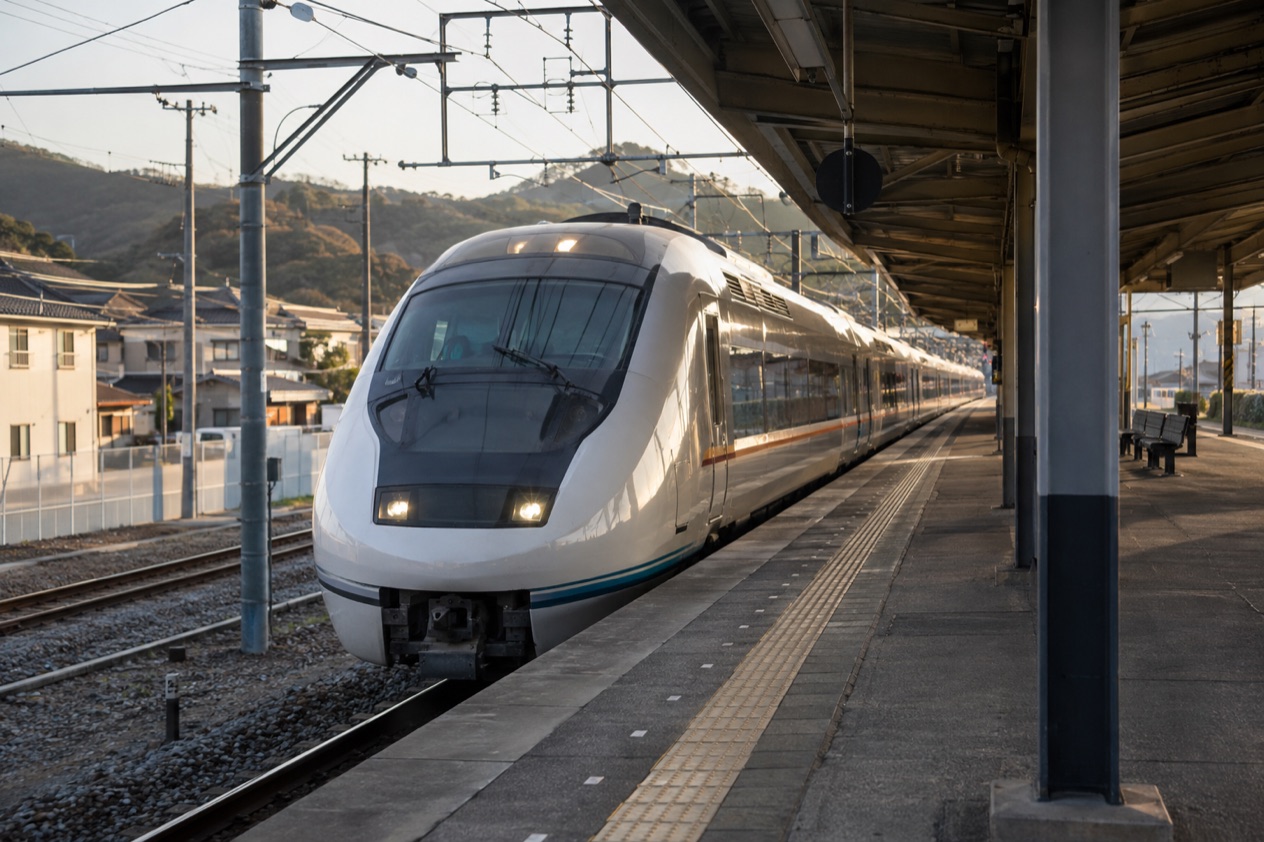
Limited Express and Special Express trains have reserved seats and offer faster intercity travel, and they typically require a supplement. They are the step between the commuter lines and the bullet trains, linking cities on the older network where no shinkansen runs.
The seat reservation changes how a trip feels: you have a place waiting, with luggage space and a window, and the ride becomes part of the vacation instead of a scramble. Conventional trains, express services included, are limited to a top speed of 81 mph because of the legislation on emergency stopping distances.
The shinkansen
The shinkansen are high-speed intercity trains that operate on several lines across the country, running on completely separate tracks from the commuter trains. The fastest, the JR East E5 and E6 series, reach 200 mph. The first line opened between Tokyo and Osaka in 1964, and trains now make that journey in 2 hours and 25 minutes.
Riding one requires two things: a fare ticket for the distance and a shinkansen special express ticket. The Shinkansen never runs overnight, and all lines have banned smoking entirely since March 2024. On a long-distance train like this, the corridor between cars is where phone calls are made, so the seats stay quiet.
With the Japan Rail Pass on the Tokaido, San’yo or Kyushu Shinkansen, Nozomi and Mizuho services are not covered unless you buy a supplemental Nozomi Mizuho ticket. The Shinkansen has had no passenger fatalities in accidents since operations began.
What do you need to know first?
The first thing to know is that the trains stop at night, so your last ride of the evening needs planning. In Tokyo, most trains do not run in the early morning hours from 1:00 to 5:00, and the Shinkansen does not run overnight at all. Regional and long-distance buses do operate both day and night, and they fill that gap.
City trains and subways
In Tokyo you will find JR trains, Tokyo Metro lines and Toei Subway lines, among others, and in Osaka there are JR, Hankyu Railway, Hanshin Electric Railway and Keihan Railway, to name a few. Each company has its own gates and sometimes its own station buildings, so a transfer can mean walking between two different sets of ticket barriers.
An IC card tapped at the gate makes the switch between companies natural, because you do not have to work out a fare for each. The metro itself is a quick way to get around Japanese cities, and the route apps help you choose between the lines when several companies serve the same stretch.
Station food and small habits
Station food is part of the journey. The ekiben, the boxed lunch sold at stations, goes back to Utsunomiya Station in 1885, and today regions compete with boxes built around local ingredients: grilled eel, crab, pickled vegetables, rice shaped and wrapped in leaves. Many travelers choose a seat first and a box second, then open it as the countryside starts to scroll by.
If a train is delayed, passengers can apply for a delay certificate from the station or the rail company’s website. It is a reminder of how rare delays are: the Tokaido Shinkansen had an average delay of 0.7 minutes in fiscal 2018. Some lines also vanish for good, as the Sanko Line, serving Shimane and Hiroshima prefectures, did when it closed on March 31, 2018 due to poor patronage.
Where the network goes
JR serves major tourist areas such as Kyoto, Hiroshima, Kanazawa and Sendai, and its network covers over 17,000 miles of track. Ferries connect Hokkaido to Honshu, and Okinawa Island to Kyushu and Honshu, for the places where rails stop at the water.
A trip that links Tokyo, Kyoto and Hiroshima therefore leans on JR and its high-speed lines, while a side trip to Hakone, Nara or Mount Takao leans on the private companies. Thinking in those two layers makes the map less confusing, and the apps will do the arithmetic once you pick the destinations.
Good to know before you go
Carry some cash for the moments the trains do not reach: Japanese taxis are clean and reliable, but not all of them accept cards. On buses with a fare that depends on distance, coins put in beyond the exact fare are not returned as change. On a bus where you enter through the rear and pay when exiting through the front, you take a numbered ticket as you board, and the fare depends on where you board and get off.
Sources
- U.S. Department of State, Japan travel information, travel and transportation (https://travel.state.gov/content/travel/en/international-travel/International-Travel-Country-Information-Pages/Japan.html), checked October 11, 2026
- Japan National Tourism Organization, trains and buses (https://www.japan.travel/en/guide/how-to-travel-by-train-and-bus-in-japan/), checked October 11, 2026
- Japan National Tourism Organization, traveling by rail (https://www.japan.travel/en/guide/traveling-by-rail/), checked October 11, 2026
- Japan National Tourism Organization, getting around Japan: trains, subways, buses, taxis (https://www.japan.travel/en/plan/getting-around/), checked October 11, 2026
- Wikipedia, Japan Railways Group (https://en.wikipedia.org/wiki/Japan_Railways_Group), checked October 11, 2026
- Wikipedia, Rail transport in Japan (https://en.wikipedia.org/wiki/Rail_transport_in_Japan), checked October 11, 2026
- Wikipedia, Transport in Japan (https://en.wikipedia.org/wiki/Transport_in_Japan), checked October 11, 2026
- Wikivoyage, Rail travel in Japan (https://en.wikivoyage.org/wiki/Rail_travel_in_Japan), checked October 11, 2026
To plan your stay
- Things to Do in Japan: Kyoto Temples, Onsen, Street Food and Day Trips
- Where to Stay in Japan: Ryokan, Temple Stays, Capsule Hotels and the Best Cities to Base In
- Sending Luggage from the Airport in Japan: Hands-Free Travel, Hotel Delivery and Coin Lockers
- Know Before You Go to Japan: Entry, Money, Etiquette and Getting Around