
Leaving Osaka in the morning means crossing a city that is already awake, with commuters streaming through the big stations and the platforms humming. Kobe sits across the bay, a port town where the hills drop almost to the water and the harbor is never far from view. The trip makes a day out of Osaka, and this is how the road runs and what waits at the end of it.
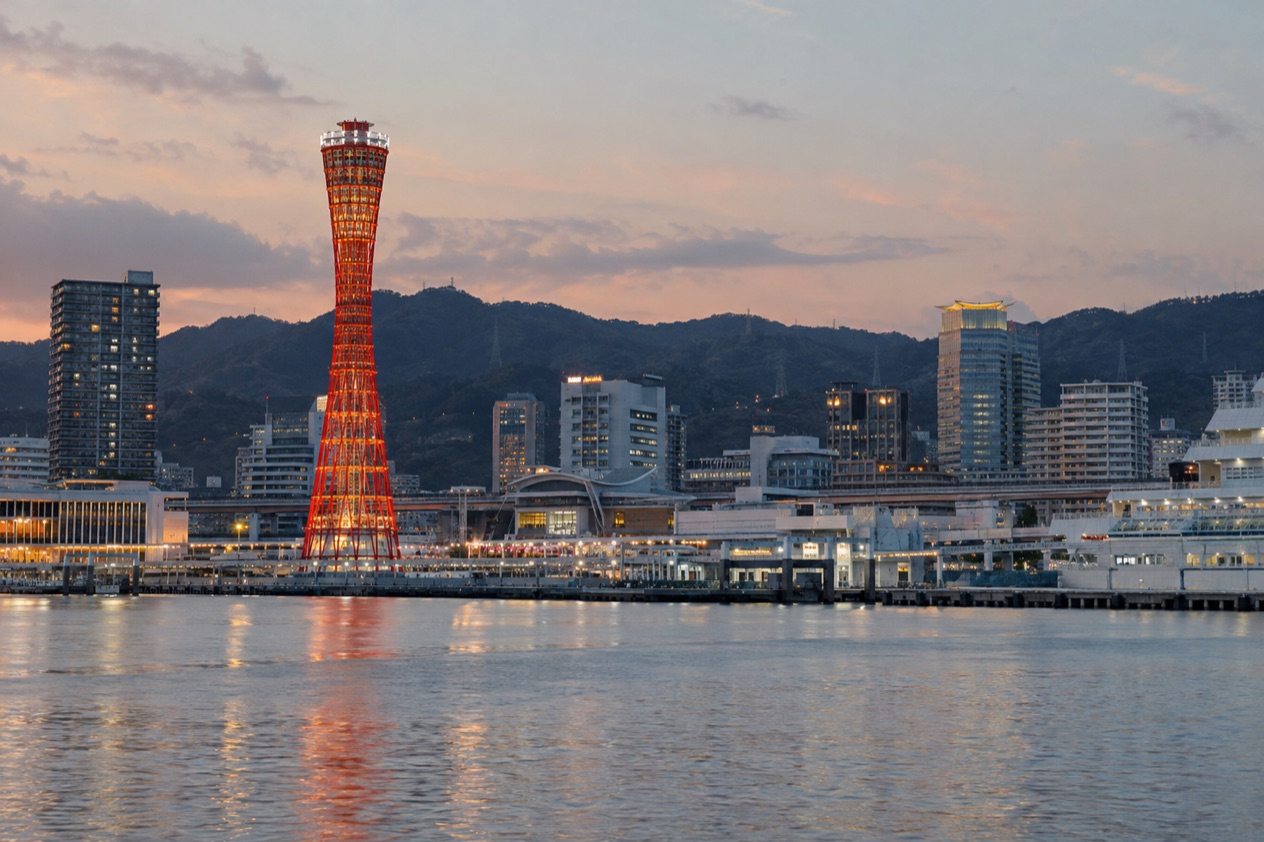
How do you get to Kobe from Osaka?
Kobe lies across the bay from Osaka, on the north shore of Osaka Bay, and you reach it by rail, which brings you into one of two very different stations. One is Kobe Station, in the port district on the Tokaido Main Line and the Sanyo Main Line. The other is Shin-Kobe Station, the bullet train stop set to the north of the city center, at the foot of Mount Rokko.
What decides your route is where you want to wake up in Kobe, and where you start in Osaka. If your day is built around the waterfront, the shopping streets and the harbor, Kobe Station puts you in the middle of that.
If you want the hillside end of town, or you are already at Shin-Osaka for the bullet train, Shin-Kobe is the stop. Shin-Osaka, the Osaka station of the Sanyo Shinkansen, sends trains toward Kobe from its own platforms, while the ordinary lines leave from the big downtown station, Osaka Station, run by JR West.
Many travelers reach that downtown area on the Hankyu lines. Hankyu’s Osaka-umeda Station connects with JR West lines at Osaka Station, so a stay near Umeda lets you change from one company to another without leaving the district. From there the choice is between the bullet train, the regular JR trains that stop at Kobe Station, and a bus to the bus terminal beside it.
Japanese trains have a reputation for running on time, which means you can plan the day around your arrival rather than around a cushion for delays. Once you arrive, the harbor, Chinatown, the hillside neighborhoods and the city hall observation deck are all part of the same city, so the first decision is simply which station suits your plan best.
Ways to get to Kobe from Osaka
The Sanyo Shinkansen to Shin-Kobe
The Sanyo Shinkansen is the high-speed line that connects Shin-Osaka with Hakata in Fukuoka, and it is operated by West Japan Railway Company. Kobe’s stop on it is Shin-Kobe Station, run by JR West for the shinkansen and by the Kobe Municipal Transportation Bureau for the city subway that shares the building. At Shin-Kobe, trains from platform 2 head toward Shin-Osaka, Nagoya and Tokyo, so that is the side you wait on for the ride back toward Osaka.
Trains on the line reach a top speed of 186 miles per hour for most of the way between Hakata and Osaka, though a ride between two neighboring cities never gets to stretch its legs the way a long trip does. It suits travelers who are already at Shin-Osaka, for example after arriving on a Tokaido Shinkansen from Tokyo, and who want to step straight onto the next train.
One detail for rail pass holders: a Japan Rail Pass does not cover the express Nozomi or Mizuho services on the Sanyo Shinkansen without a special ticket. Hikari trains are the ones that carry pass holders on this stretch of the line. Shin-Kobe also connects to the Kobe subway, which carries you down from the hillside into the rest of the city.
JR trains to Kobe Station
Kobe Station is the one that puts you at the harbor. It stands on the Tokaido Main Line and the Sanyo Main Line, and it is an elevated station, with one side platform and two island platforms serving five tracks. In the fiscal year 2023 it handled an average of 103,098 passengers a day, so expect a station that is busy rather than sleepy.
Local trains in Japan stop at every station, which makes them a fit for shorter distances, while rapid trains skip the smaller stops and need no extra fee. Both kinds of service show up on the boards in the big stations, and the choice between them is a trade between more stops and fewer. For this trip the ordinary rail line suits anyone who wants to arrive downtown, close to the waterfront and the shops.
The area south of Kobe Station is Harborland, a waterfront commercial center, so a walk out of the station toward the sea takes you to the part of town most people picture when they think of Kobe. The Sanyo Main Line itself runs on west from here along the Seto Inland Sea, a reminder that this station is the starting point of a very long line.
The bus to the Kobe Station terminal
Kobe Station has a bus terminal connection, and that is where a bus journey from Osaka can end. A bus appeals to travelers who like to watch the landscape slide by from a seat, with the bay and the built-up shoreline between the two cities passing the window. It is also a way to skip the platforms and the stairs of a big rail station.
A bus ride suits a relaxed traveler with a loose schedule and a light bag. Because the terminal sits at the same station as the trains, you can change your mind later in the day and take a train back to Osaka instead, which gives you one way out by bus and another by rail.
Options compared
| Option | Arrives at | Best for | What to know |
|---|---|---|---|
| Sanyo Shinkansen | Shin-Kobe Station | Travelers already at Shin-Osaka, the hillside side of Kobe | Trains from platform 2 go back toward Shin-Osaka; Nozomi and Mizuho need a special ticket with a Japan Rail Pass |
| Rapid train on the JR lines | Kobe Station | Reaching the harbor and Harborland | Skips smaller stations and needs no supplement |
| Local train on the JR lines | Kobe Station | Short distances with stops at every station | Stops at every station |
| Bus | Kobe Station bus terminal | Travelers who prefer a seat and a view from the road | The terminal connects to the station |
The big choice is the station, not the vehicle. Kobe Station is in the port district and Shin-Kobe is on the slope at the foot of Mount Rokko, so the two put you in different parts of the same city. If your plans are the waterfront, Harborland and the shopping streets, choose the one that lands you there. If the hills and the subway are your plan, take the bullet train.
Two or three ways can also be combined in a single day. You can ride the bullet train one way and a regular JR train the other, or take the bus out and a train back. The rapid train and the local train follow the same lines, so the difference between them is how many stops you make along the way.
Making a day of it
Kobe rewards a day that starts at the harbor and climbs. From Kobe Station, Harborland lies just to the south, a waterfront commercial center where the day naturally begins with a coffee or a pastry, since Kobe has long had a reputation for its bakeries and cafés. It is also a place to wander along the water and look out at the port, which is the third-largest in Japan after Tokyo and Yokohama.
The city’s food is the best reason to stay for a meal. Kobe beef is the dish people travel for, served as steak or in thin slices in a hot pot, and the city also has Chinese food in its Chinatown, sweets and bread, and sake from the brewing district nearby. Lunch is a good moment to choose one of these and give the rest of the day a rhythm.
For a view, the observation deck on the 24th floor of Kobe City Hall looks out over the city. It keeps these hours:
| Site | Open |
|---|---|
| Kobe City Hall observation deck (24th floor) | Monday to Friday 08:15-22:00; Saturdays, Sundays and holidays 10:00-22:00 |
If you arrived by bullet train, Shin-Kobe is the natural base for a hillside afternoon, set at the foot of Mount Rokko, the mountain that stands behind the city. The Kobe subway runs from the same building, so you can ride down into town without going back to Osaka first.
Bring comfortable shoes for a day that mixes waterfront paths and sloping streets, and a light layer for the evening, when the harbor air cools. A day is enough to see the harbor, eat well and pick one view. Anyone who wants the hills, a long meal and a slow walk along the water can take a second day without feeling they are repeating themselves.
Good to know before you go
Kobe is a city where you will want some yen for the small restaurants, bakeries and market stalls around the station and the harbor. In October the weather is mild enough for walking, though typhoon season runs into autumn, so a look at the forecast the evening before a day trip is a sensible habit. Trains run to a reputation for punctuality, so a connection at Osaka Station or Shin-Osaka is easy to plan around the clock.
Sources
- Wikipedia, Hankyu Kyoto Main Line (https://en.wikipedia.org/wiki/Hankyu_Kyoto_Main_Line), checked October 11, 2026
- Wikipedia, Kōbe Station (https://en.wikipedia.org/wiki/K%C5%8Dbe_Station), checked October 11, 2026
- Wikipedia, San'yō Main Line (https://en.wikipedia.org/wiki/San%27y%C5%8D_Main_Line), checked October 11, 2026
- Wikipedia, Sanyō Shinkansen (https://en.wikipedia.org/wiki/Sany%C5%8D_Shinkansen), checked October 11, 2026
- Wikipedia, Shin-Kobe Station (https://en.wikipedia.org/wiki/Shin-Kobe_Station), checked October 11, 2026
- Japan National Tourism Organization, Kobe (https://www.japan.travel/en/destinations/kansai/hyogo/kobe-and-around/), checked October 11, 2026
- Visit Kobe, the official travel guide (https://www.feel-kobe.jp/en/), checked October 11, 2026
- Wikipedia, Kobe (https://en.wikipedia.org/wiki/Kobe), checked October 11, 2026
- Wikivoyage, Kobe (https://en.wikivoyage.org/wiki/Kobe), checked October 11, 2026
- Japan National Tourism Organization, trains and buses (https://www.japan.travel/en/guide/how-to-travel-by-train-and-bus-in-japan/), checked October 11, 2026
- Japan National Tourism Organization, traveling by rail (https://www.japan.travel/en/guide/traveling-by-rail/), checked October 11, 2026
- Japan National Tourism Organization, getting around Japan: trains, subways, buses, taxis (https://www.japan.travel/en/plan/getting-around/), checked October 11, 2026
- Wikipedia, Shinkansen (https://en.wikipedia.org/wiki/Shinkansen), checked October 11, 2026
- Wikipedia, Tōkaidō Shinkansen (https://en.wikipedia.org/wiki/T%C5%8Dkaid%C5%8D_Shinkansen), checked October 11, 2026
To plan your stay
- Best Time to Visit Kobe: Cherry Blossoms, Autumn Leaves, Weather and Festivals
- Things to Do in Kobe: Kobe Beef, Kitano's Foreign Houses, Arima Onsen and Harbor Night Views
- Where to Stay in Kobe: Shin-Kobe, the City Center, Harborland and Arima Onsen
- Kobe vs Osaka: Beef, Dotonbori Nights, Getting Around and Weather