
At a rental counter in Japan, the clerk slides your paperwork back and asks for one particular booklet, the one many travelers left in a drawer at home. The question usually comes up weeks earlier, over a map of Hokkaido or Okinawa and a daydream of driving with the windows down. The short answer is that Americans who want to drive in Japan need an international driving permit, and it has to be in hand before the plane lands.
Do you need an International Driving Permit for Japan?
Yes, if you plan to drive, a short-term visitor from the United States needs an international driving permit, usually shortened to IDP, and your regular U.S. license alone does not replace it. The U.S. State Department says the permit must come from the American Automobile Association and be obtained before you arrive in Japan. Japan requires a license for anyone operating a car, motorcycle or moped on public roads, and the permit is the document that lets a foreign license holder meet that rule for a visit.
The Japan National Tourism Organization puts the same point in slightly different words: you must get the permit before departure, and it counts only if it was issued by the competent authority of your own country. In practice that means the paperwork cannot be sorted out after landing at Narita, Haneda or Kansai.
If you are only riding trains and subways between Tokyo, Kyoto and Osaka, none of this affects you. The permit matters once a rental car, a motorcycle or a moped enters the plan.
What the permit has to look like
Japan accepts a paper international driving permit. Card-type permits and digital versions are not valid there, which is worth knowing because some services abroad sell cards or phone-based documents that look official. The booklet you carry should be the paper one, kept together with your U.S. license whenever you are behind the wheel.
The permit has a limited life. It is valid for one year from the date of issue and for one year from the date of arrival in Japan, and your arrival is confirmed by the entry stamp in your passport. Both clocks matter, so a permit that was issued many months before your trip has less time left on it than you might expect.
The entry stamp and rental counters
The entry stamp is tied directly to renting. If you want to rent a car, the Japan National Tourism Organization says to use a non-automated gate at immigration so that an officer stamps your passport. Travelers who went through an automated gate instead should go to the customs inspection office and have a stamp affixed there.
It is a small detail, but it shows how closely the permit and the passport work together. The stamp is the proof of the date your permit’s second year begins, so the rental company looks at the passport as well as the booklet.
Driving a motorcycle or moped
Japan treats cars, motorcycles and mopeds as vehicles that all call for a license. A moped is defined as any motorcycle with a power of 0.6 kW or less, which corresponds to an engine of 50cc or less. Those definitions come from Japanese licensing categories, and they are the language you meet on any paperwork for a two-wheeler.
A separate point concerns transmissions. In Japan, a license can carry an automatic-transmission limitation, and removing it takes a separate driving test on a manual vehicle. That is a rule for Japanese licenses, but it is a reminder that vehicle categories are taken seriously at the counter.
Which convention applies to Americans?
The permit has to be issued under the 1949 Geneva Convention on Road Traffic, and that is the convention Japan names for visitors. The Japan National Tourism Organization states that the permit must be issued by a country participating in that convention and conform to its provisions. For an American, the practical meaning is simple: the booklet must be the genuine one issued in the United States, and the State Department names the American Automobile Association as the source.
It helps to think of the convention as the reason the paper booklet looks the way it does. A permit built to its provisions carries your details in a standard format that foreign authorities, including Japanese rental companies and police, can read. A homemade translation of your license, a card from a private website or an app does not fill that role.
Why a card or a digital permit does not work
Japan says in plain terms that card-type and digital international driving permits are not valid. Only the paper permit counts. Because the convention sets the form, an item that looks modern but does not match it is simply not accepted, however official the packaging seems.
This is the most common place for confusion on the way to Japan. A traveler who orders something online with a photo and a barcode may feel prepared, and then discover at the counter that the document has no standing. Sticking to the paper booklet issued by the American Automobile Association avoids that.
The countries that follow a different procedure
Japan lists a few countries whose visitors do not use the permit route at all. Visitors from Switzerland, Germany, France, Belgium, Monaco and Taiwan carry their original license together with a Japanese translation, and this lets them drive for up to one year from arrival.
That arrangement is for citizens of those places, so it does not apply to Americans. It does explain why you may read conflicting advice online, since a German or French traveler’s checklist looks different from yours. For a U.S. license holder, the checklist is the paper permit, the U.S. license and the passport with its entry stamp.
Where do you get one?
You get it from the American Automobile Association in the United States, before you travel. The State Department states this directly for short-term visitors, and the Japan National Tourism Organization adds that the permit must be in your hands before departure. Nothing in Japan lets you pick up the permit once you arrive, so the task belongs on the planning list alongside flights and hotels.
Since the permit counts for one year from issue and one year from arrival, timing is straightforward: get it as part of preparing the trip, keep the paper booklet with your U.S. license, and pack both in the bag you carry on the plane rather than in checked luggage. Having them in your hands also saves you at the airport on the way out, when a rental plan may start the same day you land.
What a rental car costs once the permit is in your bag
Japan’s national tourism organization gives average rates for a 24-hour rental with unlimited mileage. A compact car, the kind with an engine in the 1500 to 1800 cubic centimeter range, and a standard car with a 3000 cubic centimeter engine sit in very different brackets.
| Car class | Average rate per day (24 hours, unlimited mileage) |
|---|---|
| Compact (1500-1800 cm³) | 9,000 to 13,500 yen |
| Standard (3000 cm³) | 29,500 to 31,000 yen |
Budget car rental is one company that can be contacted at 0570-054-317. The Japan National Tourism Organization names it as a contact, and the rates above are averages across rental companies, so a specific quote may differ.
What driving is like once you are on the road
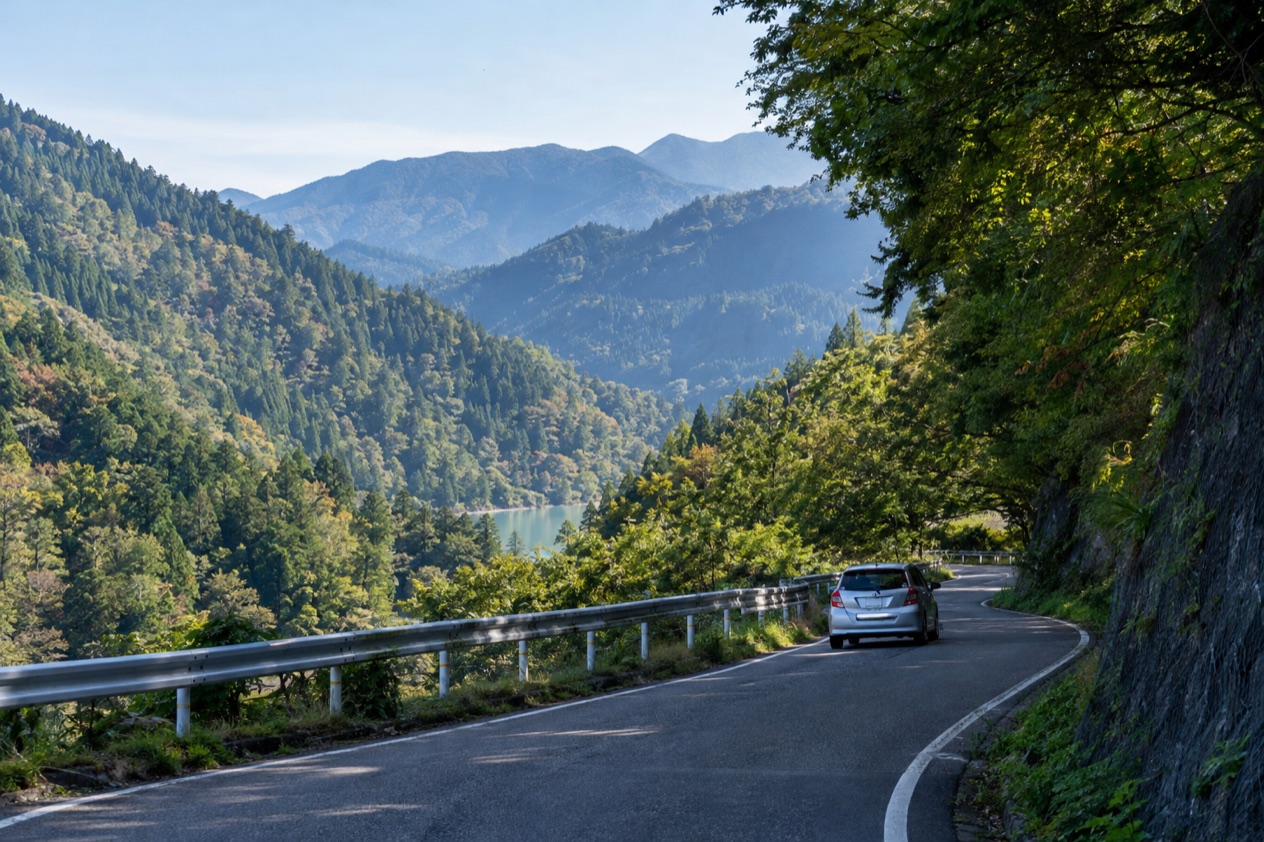
Traffic moves on the left side of the road in Japan, and roads are much narrower than those in the United States. Turning right or left on a red light is not permitted, which differs from the habit many Americans bring from home. All passengers must wear seat belts.
If you do not read Japanese, road signs can be hard to follow. There is virtually no legal roadside or curbside parking, although traffic is commonly blocked or partly blocked by people parked illegally at the curb. In mountainous areas roads are often closed in winter, and cars there should carry tire chains. Hokkaido and Okinawa are described as notably more accessible by car, with generally pleasant roads to drive.
Good to know before you go
Japan’s national blood-alcohol standard for driving is 0.03%, and a driver found guilty of drunk driving, speeding or reckless driving that injures another person could face up to 15 years in prison. Traffic laws also apply to cyclists, who can be arrested for using a cellphone while riding or for riding under the influence.
On the money side, fuel cost about 170 yen per liter in 2022, and highway tolls can be very high. A drive between Tokyo and Kyoto carries tolls of about 10,070 yen, and city traffic is often very congested.
Sources
- U.S. Department of State, Japan travel information, travel and transportation (https://travel.state.gov/content/travel/en/international-travel/International-Travel-Country-Information-Pages/Japan.html), checked October 11, 2026
- Japan National Tourism Organization, driving, car rental, permit, tolls (https://www.japan.travel/en/plan/getting-around/cars/), checked October 11, 2026
- Wikipedia, Driving license in Japan (https://en.wikipedia.org/wiki/Driving_license_in_Japan), checked October 11, 2026
To plan your stay
- Best Time to Visit Japan: Cherry Blossoms, Autumn Colors, Weather and Festivals
- Where to Stay in Japan: Ryokan, Temple Stays, Capsule Hotels and the Best Cities to Base In
- Sending Luggage from the Airport in Japan: Hands-Free Travel, Hotel Delivery and Coin Lockers
- Know Before You Go to Japan: Entry, Money, Etiquette and Getting Around