
Leave Tokyo behind and the rail map of Honshu stops mattering. Somewhere out over the water the cities give way to a scatter of green islands ringed in pale reef, and the landing at Naha comes with a change in the air itself.
Okinawa was once the Ryukyu Kingdom, with its own language and culture, and the trip south feels like crossing into a different chapter of Japan.
How do you get to Okinawa from Tokyo?
You fly. Okinawa Island lies roughly 400 miles south of Kyushu, the southernmost of Japan’s four main islands, so there is no bridge, tunnel or shinkansen line to follow. Naha Airport is the gateway to all of Okinawa’s islands, and it is served by flights from dozens of cities across Japan, including low-cost carriers.
What decides the trip is where you want to end up. Travelers land at Naha, the prefecture’s capital and the largest city in Okinawa, home to about a fifth of the main island’s residents. From there the choice is between staying in the city, heading up the island toward the beaches and the aquarium, or catching another flight to one of the smaller islands.
The airport and the city sit close together. Naha is only a 15-minute drive from the terminal, or a few stops on the monorail. That means you can be in a hotel room, or standing in a market lane, before the first meal of the day is properly digested. If you are carrying on to a distant beach, the airport is where the next leg begins, not the city.
Okinawa is a subtropical island chain between mainland Japan and Taiwan, and it is one of Japan’s 47 prefectures. Nothing about the geography invites an overland journey. The sea is the dividing line, and the airport is the doorway.
Ways to get to Okinawa from Tokyo
By plane to Naha Airport
Flying is the way to reach Okinawa from Tokyo. Naha Airport is a public and military airport, owned and operated by Japan’s Ministry of Land, Infrastructure, Transport and Tourism, and it is the sixth busiest airport in the country. It operates around the clock, every day of the week, so an arrival does not depend on a daytime schedule the way a ferry or a regional bus might.
Both full-service and low-cost carriers serve Naha from cities across Japan. The airport is also the hub for Japan Transocean Air and Ryukyu Air Commuter, the two airlines whose names you will see on the island-hopping routes. Scheduled international flights also leave from here to Taiwan, Hong Kong, South Korea, Thailand, Malaysia, Singapore and mainland China, which gives the terminal a pleasantly regional feel.
Naha Airport sits at number 91 in Skytrax’s World Top Airports 100 for 2024. For a traveler, that translates into a terminal that is used to visitors arriving from all over Asia. Once through, the monorail and the road into Naha are both right there.
By train, shinkansen or limited express
No train, whether shinkansen, limited express or local, runs to Okinawa. What the rail network does give you is the start of the journey inside Tokyo, where Japan Railways (JR) trains, Tokyo Metro lines and Toei Subway lines all operate. Japanese trains have a reputation for being always on time, which suits the first leg to an airport very well.
Rail returns at the other end, in a small way. Naha has Okinawa’s only public rail network, the Okinawa Urban Monorail, known as Yui Rail. It is a city line, not an island-wide one, so it covers Naha and not the beaches or the northern coast. Think of it as the first train you ride on arrival rather than a way of crossing the sea.
Local trains in Japan stop at every station, and rapid trains skip the smaller ones without charging a supplement. Both are useful on the mainland side of the trip, getting you across Tokyo to a departure point. Neither crosses the water to the south.
By bus or on the ground
There is no bus from Tokyo to Okinawa, for the same reason there is no train. Buses become part of the picture only after you land, when you travel around the main island. Naha city itself is only a 15-minute drive from the airport, so even a first night in town needs no long transfer.
Okinawa Island is large enough that the northern beaches and the aquarium lie well beyond the monorail. Travelers arrange a vehicle or a road transfer for that side of the island. If the plan is to stay in Naha for the first days, the monorail and your own feet are enough to begin.
Onward to the other islands
Okinawa Prefecture is more than one island. Of its 160 islands, 49 are inhabited, grouped into the Okinawa Islands, the Sakishima Islands and the Daito Islands. Naha Airport is the gateway to all of them, and its hub airlines, Japan Transocean Air and Ryukyu Air Commuter, are the names tied to the shorter hops.
This matters if your plan is bigger than Okinawa Island. A trip from Tokyo can become a two-step journey, first the flight to Naha, then a smaller flight onward.
Options compared
| Option | Best for | What to know |
|---|---|---|
| Plane to Naha Airport | Reaching Okinawa from Tokyo | Served by flights from dozens of cities across Japan, including low-cost carriers. The airport operates 24 hours a day. |
| Shinkansen, limited express or local train | Getting across Tokyo to the airport | No rail line reaches Okinawa. Trains in Tokyo include JR, Tokyo Metro and Toei Subway. |
| Okinawa Urban Monorail (Yui Rail) | Getting from the airport into Naha | Okinawa’s only public rail network. A few stops from the airport. |
| Road transfer from Naha Airport | Reaching Naha city | A 15-minute drive from the airport. |
| Onward flight from Naha | Other islands of the prefecture | Japan Transocean Air and Ryukyu Air Commuter use Naha as their hub. |
The table reduces to one choice and one decision. The choice, getting from Tokyo to Okinawa, has a single answer, the flight into Naha. The decision is what you do on arrival: stay in the capital, move north across the main island, or keep flying to a smaller island.
A traveler who likes to keep the first day light will find Naha the gentlest landing, since the monorail is right there and the city is close to the terminal. Someone aiming for a beach on the main island will think of Manza Beach, Emerald Beach, Okuma Beach, Zanpa Beach, Moon Beach or Sunset Beach in Chatan-cho. Each of those is a destination in its own right rather than something the airport gives access to directly.
If your trip also runs to Taiwan or elsewhere in East Asia, Naha’s international routes may fit into the plan. Scheduled flights leave the airport for Taiwan, Hong Kong, South Korea, Thailand, Malaysia, Singapore and mainland China, which turns Okinawa into a stop rather than an end point.
Making a day of it
The city is the capital of Okinawa Prefecture and the place where visitors begin. A ride on the monorail is part of the experience, because it is the only public rail on the island and it moves you over the rooftops rather than under them.
In Naha you can taste the food of the former Ryukyu Kingdom. Okinawa soba, with its thick wheat noodles in a clear pork broth, is the everyday bowl. Goya champuru, a stir-fry of bitter melon, tofu and egg, appears on lunch menus, and awamori, the local distilled spirit, is poured in the evening. The culture of the islands runs through the plates as much as the museums.
Okinawa Churaumi Aquarium
Its tanks hold the marine life of the surrounding waters, and recent news from the aquarium includes a baby bottlenose dolphin, which visitors can watch swimming with its mother, and a new female Japanese sawshark brought in to try to breed the species.
The aquarium also cautions visitors about an increase in bite-wound injuries from white-banded triggerfish during their breeding season. That is a note about the fish in the water, not about the tanks you walk past, but it is a reminder that Okinawa’s sea life deserves respect.
| Site | Open |
|---|---|
| Okinawa Churaumi Aquarium | 08:30 to 18:30, last admission 17:30 |
The aquarium lies on the main island, beyond the reach of the monorail, so it pairs with a road trip rather than a stroll from the hotel. Treat the sea itself with the same respect as the aquarium’s warning suggests.
Beaches and the island’s shape
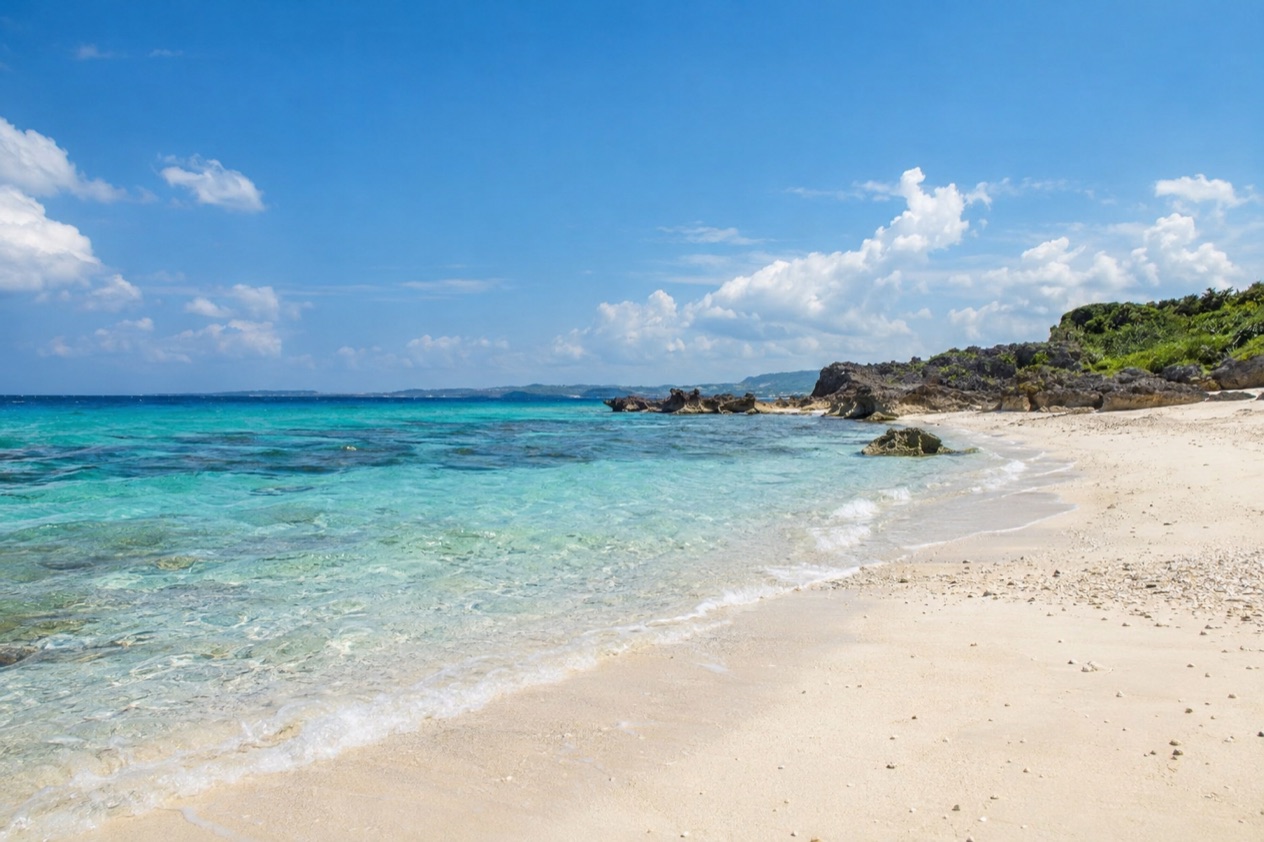
Okinawa Island has several beaches, and the names are worth carrying with you: Manza Beach, Emerald Beach, Okuma Beach, Zanpa Beach, Moon Beach and Sunset Beach in Chatan-cho. The island’s highest point is Mount Omoto, at 1,724 feet, with Mount Yonaha the second highest, so the interior has hills and forest as well as the coast.
The climate is humid subtropical, bordering on tropical rainforest, with a rainy season in late spring. Visitors arriving then should expect a good deal of wet weather and plan some indoor hours. At other times of year the island’s mix of beach, forest and city lets you adjust the day to what the sky is doing.
For a first stay, one day in Naha and one day heading north covers the two sides of Okinawa: the city with its monorail and markets, and the coast with its beaches and aquarium. Anyone with more time can add an island flight from the same airport.
Good to know before you go
Okinawa is far enough from the mainland that planning the airport end of the journey is worth a moment. Naha Airport runs around the clock, which helps if a flight arrives late.
The late spring rainy season is the one weather pattern the island is known for, and the aquarium’s note about triggerfish in their breeding season is a reminder to treat the water with care.
Sources
- Wikipedia, Naha Airport (https://en.wikipedia.org/wiki/Naha_Airport), checked October 11, 2026
- Japan National Tourism Organization, Okinawa (https://www.japan.travel/en/destinations/okinawa/okinawa/naha-and-the-main-island/), checked October 11, 2026
- Okinawa Churaumi Aquarium (https://churaumi.okinawa/en/), checked October 11, 2026
- Wikipedia, Okinawa Island (https://en.wikipedia.org/wiki/Okinawa_Island), checked October 11, 2026
- Wikipedia, Okinawa Prefecture (https://en.wikipedia.org/wiki/Okinawa_Prefecture), checked October 11, 2026
- Wikivoyage, Okinawa (https://en.wikivoyage.org/wiki/Okinawa), checked October 11, 2026
- Japan National Tourism Organization, trains and buses (https://www.japan.travel/en/guide/how-to-travel-by-train-and-bus-in-japan/), checked October 11, 2026
- Japan National Tourism Organization, traveling by rail (https://www.japan.travel/en/guide/traveling-by-rail/), checked October 11, 2026
- Japan National Tourism Organization, getting around Japan: trains, subways, buses, taxis (https://www.japan.travel/en/plan/getting-around/), checked October 11, 2026
To plan your stay
- Best Time to Visit Okinawa: Weather by Month, Sea Temperatures, Festivals and Seasons
- Things to Do in Okinawa: Churaumi Aquarium, Shuri Castle, Kerama Reefs and Okinawan Food
- Where to Stay in Okinawa: Naha, Chatan, the Aquarium Coast and Beach Resorts
- Know Before You Go to Okinawa: Entry, Money, Getting Around and Local Etiquette