
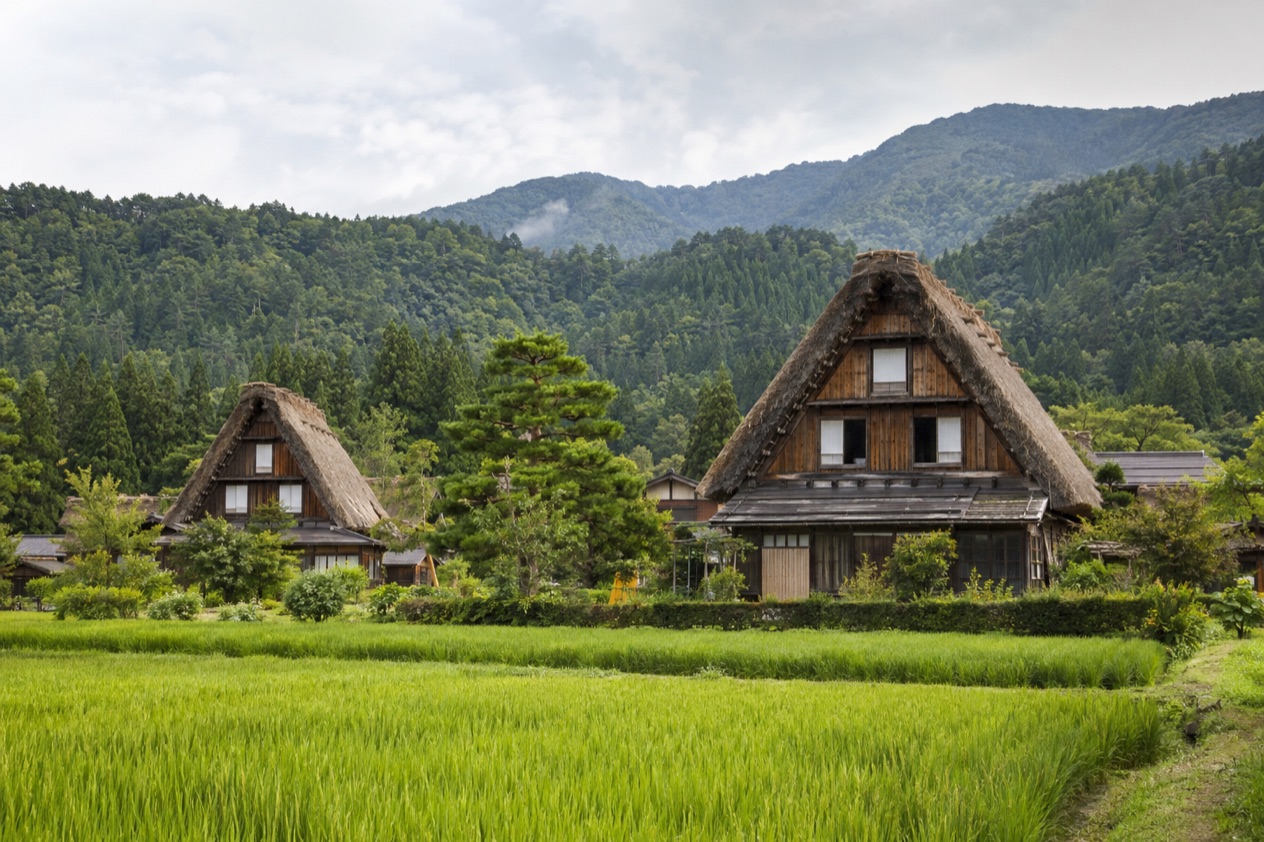
Leaving Takayama, the old merchant lanes of Sanmachi give way to a road that climbs into the mountains of Gifu and disappears into a long tunnel. On the far side comes a valley of steep thatched roofs, rice paddies and wooden farmhouses with their rooflines pitched like hands pressed together.
It makes a natural day away from the old town for anyone curious about how people lived under that much snow.
How do you get to Shirakawa-go from Takayama?
You can reach Shirakawa-go from Takayama within 50 minutes since the Hida Tunnel opened, and the highway bus is the way the sources describe for getting there. Before the tunnel, the same journey was a drive of about three hours, which is why Takayama and the thatched village now feel like neighbors rather than separate trips.
The tunnel is the heart of the story. The village itself, with the farmhouses of Ogimachi at its center, is spread out enough to deserve a few unhurried hours once you arrive.
What decides how you travel is mostly where you are starting from and how much of the day you want to spend at the village. From Takayama, the highway bus keeps things simple: one ride out, one ride back, and the time between them is yours to spend among the houses. If you are continuing to Kanazawa, Toyama or Nagoya afterward, the same kind of highway bus links those cities with Shirakawa-go, so the village can sit in the middle of a longer route instead of at the end of a round trip.
The village is also a place with real weight behind it. Together with Gokayama in neighboring Toyama, Shirakawa-go was registered as a UNESCO World Heritage Site on December 9, 1995. That recognition is why the farmhouses are kept so carefully, and why a visit feels less like a theme park and more like a walk through a working landscape of fields, irrigation channels and homes with deep, dark timber interiors.
Think about the season, too, because the village changes character with it. Summer brings green paddies around the houses, autumn turns the surrounding slopes to color, and winter wraps the roofs in thick snow. Shirakawa is counted among the snowiest places in Japan, with yearly snowfall in excess of 390 inches, so the winter version of the trip looks nothing like the summer one.
Ways to get to Shirakawa-go from Takayama
The sources point to one dependable way in from Takayama: a highway bus. It runs along the road made much shorter by the tunnel, and it sets you down at the village so the rest of the day is spent on foot among the houses.
Highway bus from Takayama
Shirakawa-go can be reached by highway bus from Takayama, and this is the connection that matters for visitors based in the Hida area. The ride follows the road through Hida Tunnel, the passage that cut the journey from roughly three hours to within 50 minutes. You step off in a valley of thatched farmhouses, with the mountains close on every side.
From Takayama, Shirakawa-go can be reached by highway bus. Families, solo travelers and couples all use it the same way: ride out, wander, ride back.
A good habit is to treat the return as the fixed point of your day and plan the village around it. Walk the lanes, look at the houses from the fields, and leave yourself enough time to come back to the stop without rushing. That way the outing stays relaxed instead of becoming a race against the clock.
Highway bus from Kanazawa, Toyama and Nagoya
Takayama is not the only city with a highway bus to Shirakawa-go. The same type of service connects the village with Kanazawa, Toyama and Nagoya, which opens up useful routes if Takayama is one stop on a larger loop through central Japan. Kanazawa, with its Kenrokuen garden, and Toyama sit on the Sea of Japan side, while Nagoya lies toward the Pacific.
This matters for planning. A traveler can come into the mountains from one city, spend time in the village, and leave toward another instead of retracing the road to Takayama. Gokayama, the sister site in Toyama, shares the World Heritage listing and the same thatched building tradition, so a route that touches both feels coherent.
The road through Hida Tunnel
The tunnel is the reason the whole trip has changed. Where travelers once faced a three-hour drive, the road now delivers you to Shirakawa within 50 minutes from Takayama. It is not a separate way of traveling so much as the stretch of road that every highway bus relies on, but it explains why Shirakawa-go has become a comfortable day trip instead of an overnight commitment.
The mountains here are the very thing that shaped the village. The same heavy snow that once cut communities off made the people of Shirakawa build steeply pitched thatched roofs. Seen from the road as the valley opens, those roofs make sense at once.
Options compared
| Option | Time each way | Best for | What to know |
|---|---|---|---|
| Highway bus from Takayama | Within 50 minutes | A day trip based in Takayama | Runs through Hida Tunnel and drops you at the village |
| The road before Hida Tunnel | About three hours by drive | Understanding how remote the valley once was | Replaced in practice by the tunnel route |
The comparison is lopsided, and that is the point. The tunnel changed the trip so completely that the old drive is now a piece of history rather than a choice. For anyone staying in Takayama, the highway bus is the straightforward answer, and the time saved is time you can spend wandering the village instead of sitting on the road.
If your plans reach beyond Takayama, think of the bus as a link in a chain. Highway buses also run from Kanazawa, Toyama and Nagoya, so Shirakawa-go can be an overland stop between cities. That flexibility is worth weighing against the simplicity of a single round trip, and it depends on whether Takayama is your base or just one night on a longer journey.
A final consideration is the season. The valley looks and feels different in snow than in green summer, so the same bus ride can lead to two very different days. Choose the version of the village you most want to see, then fit the transport around it.
Making a day of it
Because the trip from Takayama is so brief, you have room to do more than tick off a photograph. Pair a slow morning in the lanes of Takayama with the afternoon in Shirakawa-go, or spend most of the day in the village and return to Takayama for dinner and a late soak. The valley rewards a pace of wandering rather than rushing between viewpoints.
Walking the village
The farmhouses are built in the gassho style, a word that means hands together as in prayer, a reference to the steep roofs that shed snow in winter. Walking between them, you see how thick the thatch is and how the gable ends face the same way across the valley, a pattern shaped by wind and weather. Rice paddies and small irrigation channels run between the houses, so the village feels lived in rather than preserved under glass.
Look for details: the heavy timber frames, the smoke-darkened beams inside houses that are open to visitors, the vegetable plots tucked beside the walls. Stopping at a café or a small shop for a hot drink or a bowl of local noodles is part of the rhythm. Seasonal rice and mountain vegetables turn up on menus in the valley, and regional dishes from the Hida side are easy to enjoy after Takayama.
Stories in the landscape
The valley holds older stories than the thatched roofs. Kaerikumo Castle once stood here, and it vanished into the ground, along with its surrounding town, when a great earthquake struck one night in 1586. It is a reminder that the quiet fields were shaped by forces far larger than a farming village.
The snow gives the valley its other great story. Heavy winters meant isolation, and the gassho houses grew out of that need, with large roof spaces that could be used for work. When you stand among them, the architecture answers a question you may not have thought to ask: why do these roofs look the way they do?
Adding Gokayama or a longer route
Gokayama in Toyama shares the same World Heritage listing and architectural tradition.
For a gentler plan, stay with Shirakawa-go and let the day unfold without a second destination. Walk the lanes, sit by a paddy, look at a house from several angles, then take the bus back to Takayama and the town’s evening lanterns. The contrast between the two places, a merchant town and a farming valley, is part of the pleasure.
Good to know before you go
The seasons shape this trip more than anything else, so think about whether you want green paddies, autumn color or a village under deep snow.
Shirakawa-go is a lived-in village as well as a World Heritage Site, so be considerate of residents.
Sources
- Wikipedia, Shirakawa-gō (https://en.wikipedia.org/wiki/Shirakawa-g%C5%8D), checked October 11, 2026
- Wikivoyage, Shirakawa-go (https://en.wikivoyage.org/wiki/Shirakawa-go), checked October 11, 2026
- Japan National Tourism Organization, trains and buses (https://www.japan.travel/en/guide/how-to-travel-by-train-and-bus-in-japan/), checked October 11, 2026
- Japan National Tourism Organization, traveling by rail (https://www.japan.travel/en/guide/traveling-by-rail/), checked October 11, 2026
- Japan National Tourism Organization, getting around Japan: trains, subways, buses, taxis (https://www.japan.travel/en/plan/getting-around/), checked October 11, 2026