
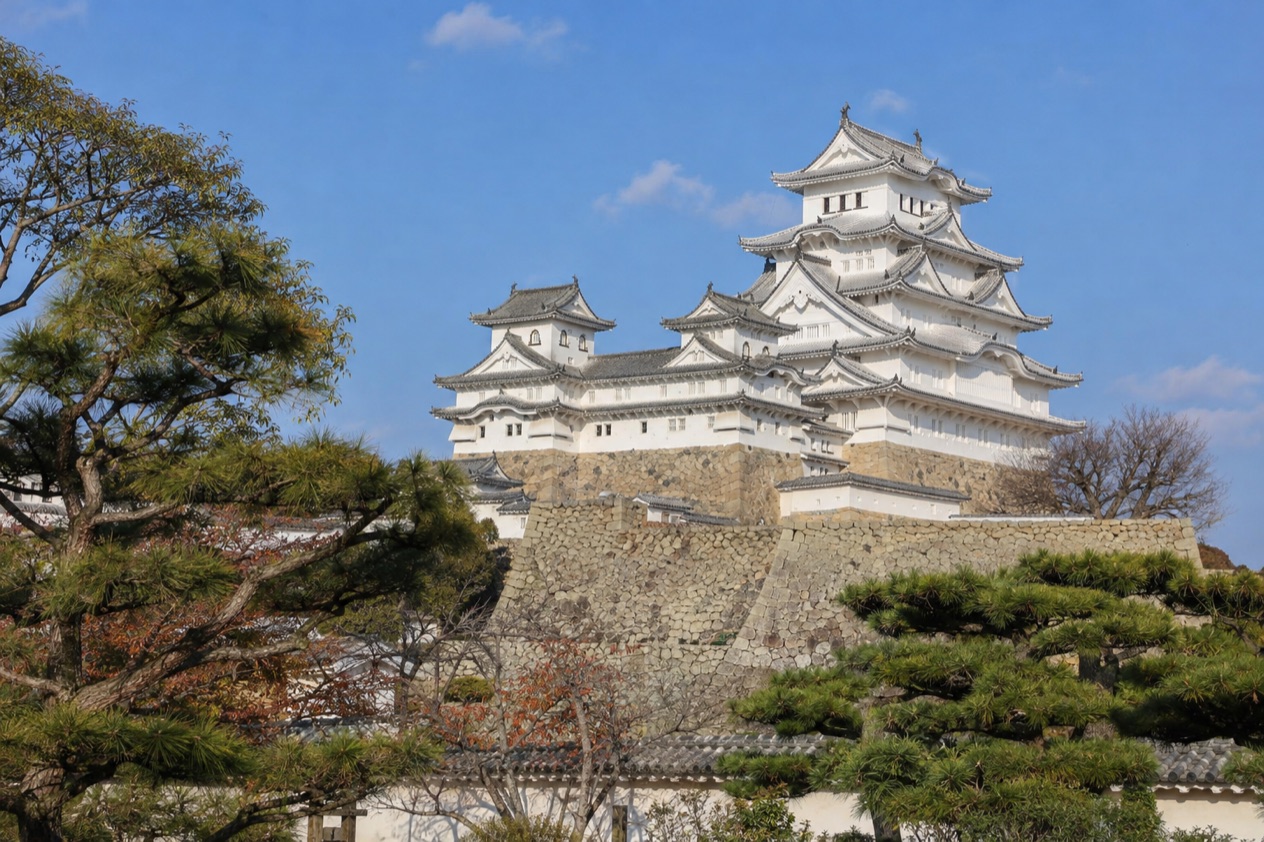
The morning crowd on the Osaka platforms is a mix of office workers, school groups and travelers with day packs, all heading in different directions along the same rails. For those going west, the stop at the end is a white castle with a roofline like wings, standing over a town that goes about its business around it. Himeji works as a day out from Osaka, and the way there is mostly a matter of choosing which train to board.
How do you get to Himeji from Osaka?
The rails run along the coast of the Seto Inland Sea, and the route follows a corridor of western Japan that has carried passengers for well over a century.
What decides your choice is mostly where you start and what kind of train you want to sit on. A traveler leaving from Shin-Osaka station is next to the Sanyo Shinkansen, the high-speed line operated by West Japan Railway Company.
A traveler staying in the center of the city may find the conventional line, the San’yo Main Line, a more natural fit. Rapid trains on conventional lines skip the smaller stations and do not require a supplement, while local trains stop at every station and suit short distances more than a trip like this one.
A second question is what else the day includes. If you plan to ride more than one line around Kansai, a regional pass can change the arithmetic, and Himeji sits within the area it covers. If you plan to fly in or out of the region, the two airports nearest to Himeji matter for a different reason, and they are described below along with the rails.
Japanese trains have a reputation for being always on time, which lets travelers plan their trips to the minute. In practice that means you can pick a departure from Osaka and a return from Himeji with confidence, and fit the castle visit in between around its opening hours rather than around the uncertainty of the train.
Ways to get to Himeji from Osaka
The Sanyo Shinkansen
The Sanyo Shinkansen is a high-speed line connecting Shin-Osaka in Osaka with Hakata Station in Fukuoka, the two largest cities in western Japan. It is operated by West Japan Railway Company and runs at up to 186 miles/h for most of the journey between Hakata and Osaka, on a line stretching for 344 miles. The trains are the same family of bullet trains you see on postcards, with long pointed noses and seats arranged in rows facing forward.
The line opened in two stages, the first segment from Shin-Osaka to Okayama on March 15, 1972, and the rest on March 10, 1975. That history explains why the western rail corridor feels so well served today. It suits travelers who are already at Shin-Osaka, perhaps after arriving on the Tokaido Shinkansen from Tokyo, and want to continue west without changing stations.
One detail for holders of a Japan Rail Pass: the express Nozomi and Mizuho services on the Sanyo Shinkansen require a special ticket in addition to the pass. It is worth knowing before you stand at the gate rather than at the ticket office.
Rapid and local trains on the San’yo Main Line
The San’yo Main Line is a major railway of western Japan that connects Kobe Station and Moji Station and parallels the coast of the Seto Inland Sea. It first opened in 1888 as a section between Hyogo Station and Akashi Station, and it grew westward from there. Between Kobe and Himeji the maximum speed on the line is 81 miles/h, a pace that gives you plenty of time to watch towns, rice fields and glimpses of water slide past the window.
Rapid trains skip smaller stations and do not require a supplement, so a rapid service is the version of the conventional line that makes sense for this trip. Local trains stop at every station and are made for short distances, which is why they are a poor match for the length of this journey. The upside of the conventional line is that the ride is part of the day: you see the working side of the Kansai region, with its harbors, apartment blocks and small shrines tucked between them.
This way suits travelers who like to see the landscape change gradually, who are happy with an ordinary seat, and who may already hold a regional pass that includes the line.
The Kansai Area Pass
The Kansai Area Pass provides unlimited rides in major Kansai areas, including Osaka, Kyoto, Kobe, Nara, Himeji, Wakayama and Otsu. Himeji is on that list, so the pass can cover a trip west from Osaka and bring in other cities on the following days. An adult or child pass holder can also accompany up to two children aged 1 to 5 for free, and from the third infant onward each one needs a child’s rail pass.
| Kansai Area Pass | Adult (12 and over) | Child (6 to 11) |
|---|---|---|
| 1 day | 2,800 yen | 1,400 yen |
| 2 days | 4,800 yen | 2,400 yen |
| 3 days | 5,800 yen | 2,900 yen |
| 4 days | 7,000 yen | 3,500 yen |
By air: Kobe Airport and Kansai International
The closest airports to Himeji are Kobe Airport, 41 miles east, and Kansai International Airport, 79 miles southeast. Kansai provides a large number of international and domestic destinations, so it is the gateway for travelers who then head to Osaka first and take the train from there.
Flying does not take the place of the rails for the Osaka to Himeji leg. It matters when you are arriving from abroad or from elsewhere in Japan and want to know which airport sits nearer to the castle town. From either airport you finish the trip by rail, joining the same lines described above.
Options compared
| Option | Line or operator | Best for | What to know |
|---|---|---|---|
| Shinkansen | Sanyo Shinkansen, West Japan Railway Company | Travelers starting at Shin-Osaka | Japan Rail Pass holders need a special ticket for Nozomi and Mizuho services |
| Rapid train | San’yo Main Line | Travelers who want to watch the coast and towns go by | Rapid trains skip smaller stations and need no supplement |
| Local train | San’yo Main Line | Short hops along the line | Stops at every station |
| Kansai Area Pass | Rail pass covering Osaka, Kyoto, Kobe, Nara, Himeji, Wakayama and Otsu | Travelers adding other Kansai cities | 1-day pass is 2,800 yen for adults |
| Plane | Kobe Airport or Kansai International Airport | Travelers arriving by air | Both airports are reached by rail afterward |
Put side by side, the choices come down to a few habits. The high-speed line suits people who treat the train as a way to get somewhere and then spend their energy on the castle.
The San’yo Main Line suits people who like the ride to be part of the outing, and who are comfortable with a trip that takes about as long as a long movie. The pass is a question of what comes before and after Himeji, not of Himeji itself.
None of these options asks for much planning. Japanese trains are known for being on time, and that lets you pencil in a lunch or a garden walk without padding the schedule. The part of the day that does need thought is the castle itself, which has opening hours and a daily cap on one of its areas.
Making a day of it
A good day in Himeji starts with the castle and lets everything else arrange itself around it. Himeji Castle is both a Japanese national treasure and a UNESCO World Heritage site, and it dates back more than 400 years as one of the 12 original castles in Japan.
It has been spared for four centuries from war, earthquakes and fires, surviving World War II bombing and the 1995 Great Hanshin earthquake. Locals sometimes call it the White Heron for its pale walls and sweeping roofs.
| Site | Open |
|---|---|
| Himeji Castle | Daily 9:00 to 17:00, admission until 16:00. May to August 9:00 to 18:00, admission until 17:00. Closed December 29 to 31 |
Inside the castle grounds
The castle consists of 83 buildings, which means the visit is more than one tower. You pass through gates, turn corners built to slow down attackers, and climb past storehouses and watch posts before reaching the main keep. Entry to the main keep is limited to the first 15,000 visitors each day, so the time of your arrival matters if the keep is the part you want most.
A free guided tour in English is included if a guide is available, and no reservations are possible. Listening to a guide explain the layout turns a set of white walls into a story of defense and daily life, and it costs nothing beyond your time.
Eating and wandering in town
Himeji has its own food habits. Local oden, the simmered stew of radish, egg and fish cake, comes here with a dipping sauce flavored with ginger, and many cafés near the station serve a breakfast-style set with thick toast and a boiled egg. Conger eel, called anago, also appears on lunch menus around the region, grilled over charcoal or laid over rice.
After the castle, take the covered shopping arcades near the station for a slower hour, with stalls selling sweets, tea and small gifts. Bring a light bag, comfortable shoes for the gravel and stone paths of the grounds, and something to keep off the sun or a shower, since you spend much of the visit outdoors.
When to leave and how long to stay
Leave Osaka early enough to arrive while the castle is open and while admission is still running, since the final entry comes an hour before closing. From May to August the hours stretch later, which gives you extra room for a slow afternoon. Then return to Osaka by whichever train you came on, or continue to another Kansai city if a pass is in your pocket.
Good to know before you go
Carry some yen for small purchases in town, and keep your usual city habits of watching your bag on crowded platforms and trains. Bring a rain layer in case a shower arrives during the outdoor walk through the castle grounds, and remember that typhoon season can affect travel plans in western Japan. Closing dates at the castle fall at the end of the year, so a late December visit needs care.
Sources
- West Japan Railway Company, Kansai Area Pass (https://www.westjr.co.jp/global/en/ticket/pass/kansai/), checked October 11, 2026
- Wikipedia, San'yō Main Line (https://en.wikipedia.org/wiki/San%27y%C5%8D_Main_Line), checked October 11, 2026
- Wikipedia, Sanyō Shinkansen (https://en.wikipedia.org/wiki/Sany%C5%8D_Shinkansen), checked October 11, 2026
- Japan National Tourism Organization, Himeji (https://www.japan.travel/en/destinations/kansai/hyogo/himeji-and-around/), checked October 11, 2026
- Wikipedia, Himeji (https://en.wikipedia.org/wiki/Himeji), checked October 11, 2026
- Wikivoyage, Himeji (https://en.wikivoyage.org/wiki/Himeji), checked October 11, 2026
- Japan National Tourism Organization, trains and buses (https://www.japan.travel/en/guide/how-to-travel-by-train-and-bus-in-japan/), checked October 11, 2026
- Japan National Tourism Organization, traveling by rail (https://www.japan.travel/en/guide/traveling-by-rail/), checked October 11, 2026
- Japan National Tourism Organization, getting around Japan: trains, subways, buses, taxis (https://www.japan.travel/en/plan/getting-around/), checked October 11, 2026
- Wikipedia, Shinkansen (https://en.wikipedia.org/wiki/Shinkansen), checked October 11, 2026
- Wikipedia, Tōkaidō Shinkansen (https://en.wikipedia.org/wiki/T%C5%8Dkaid%C5%8D_Shinkansen), checked October 11, 2026