
The platforms at Tokyo Station fill with commuters, bento boxes and suitcases, and somewhere among them are the travelers bound for the Sea of Japan coast. The train slips out of the capital, crosses the mountains, and by the time the window shows rice fields and a gray-blue sky, you are in a castle town of tea houses, gold leaf and moss-covered gardens. This is the trip from Tokyo to Kanazawa, and what follows is how the rails, the pass options and the airport fit together.
How do you get to Kanazawa from Tokyo?
From Tokyo Station, Kanazawa is approximately 2 hours 30 minutes by Hokuriku Shinkansen, with stops at Nagano and Toyama stations along the way. That is the route that has served the city since the line was extended from Nagano to Kanazawa on March 14, 2015, shortening the trip from Tokyo to around two and a half hours.
The Hokuriku Shinkansen is a high-speed line jointly operated by East Japan Railway Company (JR East) and West Japan Railway Company (JR West). It first opened in sections from Takasaki to Nagano, ahead of the Nagano Winter Olympics, and it has been growing westward ever since. A further extension from Kanazawa to Tsuruga opened on March 16, 2024, which means Kanazawa is no longer the end of the line but a stop along it.
What decides your choice is mostly where the rest of your trip goes. If Kanazawa is one stop on a loop that also takes in Kyoto and Osaka, a rail pass built for that loop changes the picture.
If you plan to stay in the Hokuriku region and wander between Toyama, Ishikawa and Fukui, a regional pass covers the local legs. If you arrive by air from elsewhere, the nearest airport is Komatsu, in the city of Komatsu, and not in Kanazawa itself.
Kanazawa is the capital of Ishikawa Prefecture, on a narrow strip of land along the Sea of Japan on Honshu, Japan’s main island. During the Edo period it was one of the most important cultural and artistic centers in the country, and that history is the reason people make the trip: craft workshops, garden paths, old merchant and tea house districts, and a table built around seafood from the nearby coast.
Ways to get to Kanazawa from Tokyo
Hokuriku Shinkansen
The Hokuriku Shinkansen is the line that links Tokyo with Tsuruga in the Hokuriku region, and Kanazawa sits on it between Toyama and Tsuruga. The ride from Tokyo Station reaches Kanazawa with stops at Nagano and Toyama stations. The line runs at a top speed of 162 miles/h between Tsuruga and Takasaki, and because it crosses Japan’s frequency boundary between 50 Hz and 60 Hz electrical systems three times, it needs dual-frequency trains.
Japanese trains have a reputation for being always on time, which lets travelers plan a day to the minute, and that suits an outing where you want to reach the gardens with a full afternoon ahead. It suits anyone who wants to cross the country in a single seated ride, watching the landscape change from suburbs to mountain valleys to the northern coast. Tip: since the train also continues to Tsuruga, check the station names on the board so you leave at Kanazawa.
Rail passes for the Hokuriku region
Two passes touch this route, and they do different things. The JR Hokuriku Arch Pass offers unlimited travel between Tokyo, Kyoto and Osaka via Toyama and Kanazawa for seven consecutive days. That shape, an arch from the capital up the coast and back down to the Kansai cities, makes Kanazawa a stop in a longer journey and not a round trip.
The West JR Hokuriku Area Pass is narrower. It gives unlimited rides only in Toyama, Ishikawa and Fukui prefectures, so it covers the Kanazawa side of the trip and not the Tokyo end. For adults aged 12 or over, the 4-day pass costs 7,000 yen. For children aged 6 to 11 it costs 3,500 yen, and a pass holder can bring up to two children aged 1 to 5 for free.
The pass is valid for non-reserved seats on the Hokuriku Shinkansen between Tsuruga and Kurobe-Unazukionsen, and on limited express trains, rapid services and local trains on JR West conventional lines. It also works on West Japan JR Bus route buses within the valid area, but not on expressway buses. On the IR Ishikawa Railway Line between Kanazawa and Tsubata, travel must cover the full stretch between those two stations, since getting off at an intermediate station is not covered.
Limited express and local trains
Local trains in Japan stop at every station, which makes them suited to short distances, while rapid trains skip the smaller stations and do not require a supplement. Within the Hokuriku area they are the trains that tie smaller towns to Kanazawa, and the area pass above is valid on limited express, rapid and local services on JR West conventional lines.
For the Tokyo leg itself, the shinkansen is the line that serves Kanazawa. Local and rapid trains belong to the second half of a trip, once you are in Ishikawa and want to reach a smaller town or stay on a conventional line. They are the right idea for travelers who like to watch stations go by and are not in a hurry.
Flying into Komatsu Airport
The nearest airport to Kanazawa is Komatsu Airport (KMQ), in the city of Komatsu. It is the airport to look at if you are arriving from another part of Japan or from abroad and want to land close to the coast and not in Tokyo first. From the airport you continue into Kanazawa itself.
Flying suits travelers whose trip starts or ends in another region, or who are building a one-way route across Japan and do not want to double back to the capital. The shinkansen from Tokyo Station remains the line that connects the two cities directly, and the airport is best understood as the other door into the same region.
Options compared
| Option | Best for | What to know |
|---|---|---|
| Hokuriku Shinkansen, Tokyo Station to Kanazawa | A single seated ride between the two cities | Stops at Nagano and Toyama stations |
| Hokuriku Shinkansen, Tokyo to Tsuruga | Travelers continuing beyond Kanazawa | Kanazawa lies on this line |
| JR Hokuriku Arch Pass | A loop through Tokyo, Kyoto and Osaka | Runs via Toyama and Kanazawa |
| Hokuriku Area Pass | Moving around Toyama, Ishikawa and Fukui | Valid in those three prefectures only |
| Flight to Komatsu Airport | Arriving from outside the Tokyo area | The nearest airport to Kanazawa |
Put side by side, the choices are less about speed than about the shape of your trip. The shinkansen is the straight line between Tokyo and Kanazawa.
The airport is a different kind of answer. It is for the traveler whose starting point is not Tokyo at all.
Making a day of it
Kanazawa rewards a stay as much as a visit, but if you are leaving Tokyo and arriving the same morning, the city is built for walking between its main gardens and districts. Start with Kenrokuen Garden, one of Japan’s most iconic landscape gardens, which was opened to the public in 1875. Free admission is offered to Kenrokuen Garden, so the stroll through its ponds, bridges and pines costs nothing.
Next to the garden stands Kanazawa Castle Park, and both are illuminated at night, as promoted by the Kanazawa Tourist Information Guide. That is a reason to think about staying overnight and not rushing back to the station: you can see the grounds under lights after dinner, with the city quiet around you.
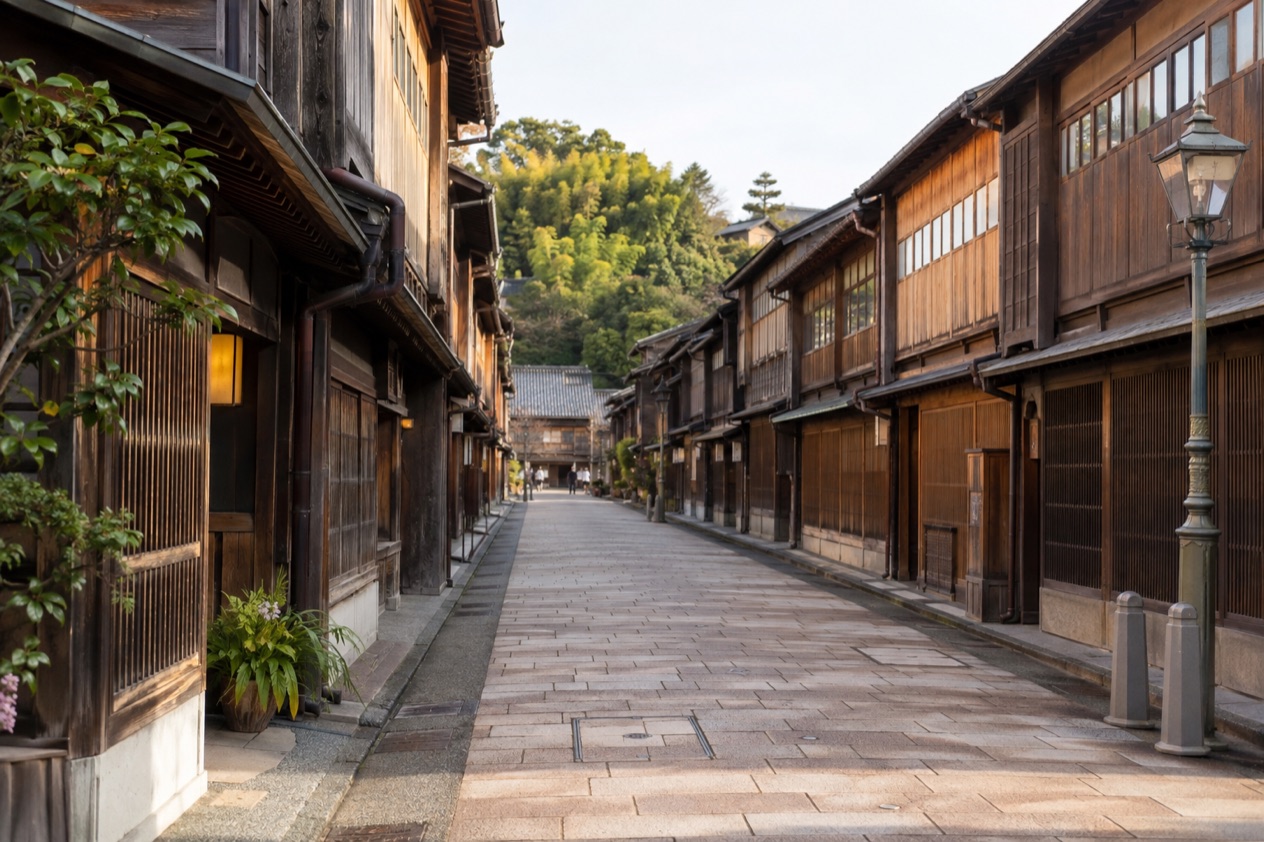
Kanazawa is part of the UNESCO Creative Cities Network as a City of Crafts and Folk Art, and the craft side of the city is worth building a plan around. Gold leaf, lacquerware, dyed silks and ceramics are what the city is known for in general knowledge, and shops and small museums show them in the old districts. The old tea house streets, with their wooden latticed fronts, are where people spend the middle of the day.
Food is the other half of the day. Being on the Sea of Japan coast, Kanazawa leans on seafood: sushi counters, the market stalls where crab and shellfish are sold in season, and bowls of rice topped with fresh fish. Sweets covered in gold leaf are a local souvenir, and the tea houses serve matcha with wagashi, the delicate Japanese confections, in rooms that look onto small gardens.
For the travelers who want more, the Kanazawa Tourist Information Guide lists tourist spots across the city, and the strip of land between the mountains and the sea means you can reach the coast without leaving town. A stay of one night lets you see the garden by day and under the lights, and a second night gives time for the craft shops and the market. If you plan to carry on toward Kyoto or Osaka, the Arch Pass is the one that follows that route, and Tsuruga lies at the end of the shinkansen line you are already on.
Good to know before you go
Prices on the passes are given in yen, and the Japanese yen is the currency you will handle on the trip. Keep your pass details and your seat selection with you as you move between stations, and keep an eye on your belongings in busy stations the way you would anywhere. The shinkansen calls at Nagano and Toyama before Kanazawa, so listen for the station name and leave at the right stop.
Sources
- West Japan Railway Company, Hokuriku Area Pass (https://www.westjr.co.jp/global/en/ticket/pass/hokuriku/), checked October 11, 2026
- Wikipedia, Hokuriku Shinkansen (https://en.wikipedia.org/wiki/Hokuriku_Shinkansen), checked October 11, 2026
- Japan National Tourism Organization, Kanazawa (https://www.japan.travel/en/destinations/hokuriku-shinetsu/ishikawa/kanazawa-and-around/), checked October 11, 2026
- Kanazawa Tourist Information Guide (https://www.kanazawa-tourism.com/), checked October 11, 2026
- Wikipedia, Kanazawa, Ishikawa (https://en.wikipedia.org/wiki/Kanazawa,_Ishikawa), checked October 11, 2026
- Wikivoyage, Kanazawa (https://en.wikivoyage.org/wiki/Kanazawa), checked October 11, 2026
- Japan National Tourism Organization, trains and buses (https://www.japan.travel/en/guide/how-to-travel-by-train-and-bus-in-japan/), checked October 11, 2026
- Japan National Tourism Organization, traveling by rail (https://www.japan.travel/en/guide/traveling-by-rail/), checked October 11, 2026
- Japan National Tourism Organization, getting around Japan: trains, subways, buses, taxis (https://www.japan.travel/en/plan/getting-around/), checked October 11, 2026
To plan your stay
- Best Time to Visit Kanazawa: Cherry Blossoms, Autumn Color, Winter Snow and Festivals
- Things to Do in Kanazawa: Kenrokuen, Samurai Streets, Gold Leaf and Day Trips
- Where to Stay in Kanazawa: Station Area, Tea House Streets, Downtown and Ryokan Choices
- Know Before You Go to Kanazawa: Entry, Money, Getting Around and Local Etiquette