
A Tokyo morning that starts on a Shinkansen platform has its own rhythm: a bento and a canned coffee in hand, the capital’s towers thinning out, then rice country and mountains filling the windows. The journey north ends under the sea and comes up on Hokkaido, the northernmost island of Japan. At the far end waits Sapporo, a city of ramen counters, beer halls and wide parks, and a very different pace from the capital.
How do you get to Sapporo from Tokyo?
The rail route north is a single through line of bullet trains: the Hayabusa runs from Tokyo to Shin-Hakodate-Hokuto, the first Shinkansen station on Hokkaido, in just under four hours. It uses the Tohoku Shinkansen first, then the Hokkaido Shinkansen, which is operated by JR Hokkaido and passes through the Seikan Tunnel to reach the island.
The Tohoku Shinkansen is Japan’s longest Shinkansen line, and it opened in stages, with the first section between Omiya and Morioka starting in 1982 and the last stretch to Shin-Aomori completed in 2010. For a long run of that line the trains can reach their top speed, which makes the first half of the day feel fast. The Hokkaido Shinkansen then picked up where Shin-Aomori ends and opened on March 26, 2016, linking Honshu with Hokkaido by high-speed rail.
What decides how you travel is how much of the day you want to spend on the train and how you like to cross the strait.
Japanese trains have a reputation for running exactly on time, so the connections you plan at home tend to hold on the ground. Sapporo itself is a place to arrive without a rush: its parks, food and nightlife work well as a first evening after a long ride.
Two kinds of Shinkansen serve the Hokkaido leg. The express Hayabusa carries through services to Tokyo or Sendai, and the local Hayate stops at more stations between Shin-Hakodate-Hokuto and Shin-Aomori. Which one you board is largely a question of where you start, and from Tokyo it is the Hayabusa.
Ways to get to Sapporo from Tokyo
The Hayabusa through train from Tokyo
The Hayabusa is the express service of both the Tohoku and Hokkaido Shinkansen lines, and it is the train that links Tokyo directly with Shin-Hakodate-Hokuto without a change. Between Utsunomiya and Morioka it runs at the top speed of the Tohoku line, a stretch of 241 miles where the countryside turns into a blur of rice fields, river valleys and small towns under the mountains.
Further north the pace changes. Through the dual-gauge section that includes the Seikan Tunnel, trains are limited to 99 miles/h, because the shock wave of a full-speed Shinkansen could destabilize a narrow-gauge freight train traveling in the opposite direction.
Around 50 freight trains use the section every day, so the slower stretch is the price of sharing the tunnel with the cargo that keeps Hokkaido supplied. For passengers it is a quiet interlude: the windows go dark and the train slides beneath the strait between the two islands.
This is the option for travelers who like to watch the country change in a single sweep, from the capital to the far north, and who want to arrive with a day’s worth of landscape behind them. Bring something to read and food for the road, and keep in mind that the fastest trip on this route is the one that does not stop for long at any intermediate point.
The Hayate local Shinkansen
The Hayate is the local Shinkansen between Shin-Hakodate-Hokuto and Shin-Aomori, and on some runs it continues to Morioka. It stops at more stations than the Hayabusa, so it suits a traveler who is already in the north of Honshu, in Aomori or Morioka, and wants to cross to Hokkaido without a change of line.
From Tokyo it is not the usual starting point, since the Hayabusa already goes the whole way. Still, it matters if you split the trip with a night in the Tohoku region: the Tohoku Shinkansen also carries the all-stop Hayate and the Nasuno, as well as the limited-stop Yamabiko, so you can break the journey at a town along the way and rejoin the northbound line the next day.
Local and rapid trains
Local trains in Japan stop at every station, which makes them a fit for short distances rather than a long run north. Rapid trains skip the smaller stations and do not require a supplement, so they are an everyday way to cover the stretches between a city and a nearby town.
In practice, you meet these trains at the two ends of the trip. In Tokyo, Japan Railways (JR) trains share the network with the Tokyo Metro and Toei Subway lines, which is how travelers reach the Shinkansen platforms in the first place. Once in Hokkaido, local and rapid services are what you use for the shorter hops around the island, with the Shinkansen doing the long haul.
Options compared
| Option | Route | What to know |
|---|---|---|
| Hayabusa express | Tokyo to Shin-Hakodate-Hokuto, through service | Fastest journey time of 3 hours 57 minutes, run by the Tohoku and Hokkaido Shinkansen lines |
| Hayabusa express | Sendai to Shin-Hakodate-Hokuto | Through service that also uses the Hokkaido Shinkansen |
| Hayate local | Shin-Aomori to Shin-Hakodate-Hokuto | Local service, with some trains continuing to Morioka |
| Local and rapid trains | Short distances | Local trains stop at every station, rapid trains skip smaller stations with no supplement |
Read together, the choices come down to where you board. From Tokyo, the Hayabusa is the through train, and it carries you across the whole Honshu stretch and under the strait in one sitting. From Sendai or farther north, the other services shorten the trip, and the all-stop trains of the Tohoku line let you build in an overnight stop if you prefer a slower pace.
A word on the line itself helps in planning. The Hokkaido Shinkansen is 92 miles long from Shin-Aomori to Shin-Hakodate-Hokuto, a short section compared with the Tohoku Shinkansen, but it is the piece that turns Hokkaido into a destination reachable by bullet train.
The Tohoku line has also grown branches, the Yamagata and Akita mini-Shinkansen, which use widened track so their trains can run on conventional lines. The Tsubasa on the Yamagata branch is coupled to a Yamabiko between Tokyo and Fukushima, then decoupled to continue to Shinjo. They matter if you want to detour into those regions on the way north.
Making a day of it
A trip this long rewards a plan for the arrival. Sapporo is a city you can settle into at once, and the first evening is usually spent eating.
The local cuisine is built around ramen, soup curry and jingisukan, the grilled lamb dish named after Genghis Khan, and each of them has its own counters and loyal followers. Soup curry comes in a bowl of broth with large pieces of vegetables and chicken, and jingisukan is cooked at the table over a domed grill.
Beer, lamb and nightlife in Sapporo
The Sapporo Beer Museum has a pub, the Sapporo Beer Garden, where visitors can enjoy a beer with a lamb barbecue. It is a natural way to tie the city’s drinking and eating traditions together, and it works as a reward after a day on the train.
Afterward, Susukino is the largest entertainment and nightlife district north of Tokyo. Its streets are lined with izakaya (Japanese pubs), ramen shops and bars under neon signs, and an evening here can run from dinner to a late bowl of noodles. It is the part of Sapporo where the day’s travel melts into a long night out.
Odori Park and the seasons
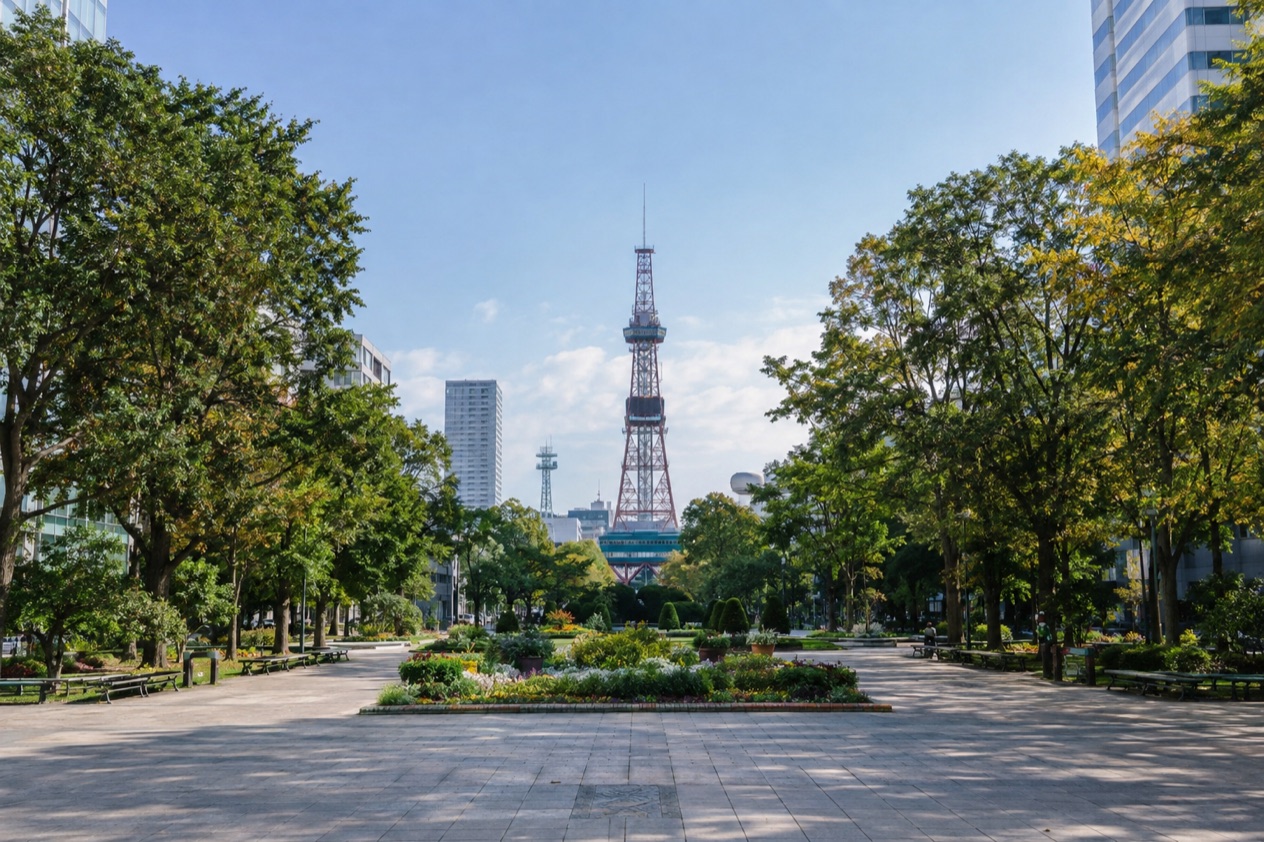
Odori Park sits in the center of Sapporo and gives the city its open, green middle. In summer, which in Sapporo lasts from June to August, the park hosts several outdoor events in June, and beer gardens are set up for the season. In May the Lilac Festival takes place in Chuo-ku, which brings flowers and a spring mood to the city.
February belongs to the Sapporo Snow Festival, a winter event with three sites: Odori, Susukino and Tsudome. The Odori Site stretches across about 0.9 miles of the park and features snow sculptures of all sizes, projection mapping, Sapporo Citizen Snow Sculptures and a snow slide. Sapporo also hosted the first Winter Olympic Games in Asia, in 1972, and the city’s winter identity runs deep.
Excursions on Hokkaido
Hokkaido is the second largest island of Japan, and it pulls travelers toward skiing, trekking, hot springs, gourmet food, and Ainu and Jomon culture. Otaru Canal is one of the places that draws visitors, with glowing gas lamps and stone warehouses that make a nostalgic scene at dusk.
Further afield, Ningle Terrace is a craft village of about 15 shops tucked into the forests of Furano. And from late January each year, drift ice reaches the coast of Abashiri and covers the Sea of Okhotsk, a winter spectacle for those who extend their stay. Whichever of these you add, the train ride north gives you the right sense of scale for how large and varied the island is.
Good to know before you go
Trains in Japan have a reputation for punctuality, so a long day of connections can be planned to the minute, and a loose end of an hour in Tokyo or in a northern station is time for a bento or a coffee. Winter brings the Snow Festival and a very different Hokkaido from the summer one, so the season you choose shapes the whole trip. Pack for the place you are going rather than the one you leave: the capital and the north can feel like different countries on the same day.
Sources
- Wikipedia, Hokkaido Shinkansen (https://en.wikipedia.org/wiki/Hokkaido_Shinkansen), checked October 11, 2026
- Wikipedia, Tōhoku Shinkansen (https://en.wikipedia.org/wiki/T%C5%8Dhoku_Shinkansen), checked October 11, 2026
- Japan National Tourism Organization, Sapporo (https://www.japan.travel/en/destinations/hokkaido/hokkaido/sapporo-and-around/), checked October 11, 2026
- Hokkaido Love, the official Hokkaido tourism site (https://www.visit-hokkaido.jp/en/), checked October 11, 2026
- Hokkaido Love, what to see and do (https://www.visit-hokkaido.jp/en/spot/), checked October 11, 2026
- Sapporo Snow Festival official website (https://www.snowfes.com/english/), checked October 11, 2026
- Sapporo official sightseeing website (https://www.sapporo.travel/en/), checked October 11, 2026
- Japan National Tourism Organization, trains and buses (https://www.japan.travel/en/guide/how-to-travel-by-train-and-bus-in-japan/), checked October 11, 2026
- Japan National Tourism Organization, traveling by rail (https://www.japan.travel/en/guide/traveling-by-rail/), checked October 11, 2026
- Japan National Tourism Organization, getting around Japan: trains, subways, buses, taxis (https://www.japan.travel/en/plan/getting-around/), checked October 11, 2026
To plan your stay
- Best Time to Visit Sapporo: Snow Festival, Summer Weather and Seasonal Highlights
- Things to Do in Sapporo: Snow Festival, Odori Park, Ramen and Day Trips
- Where to Stay in Sapporo: Sapporo Station, Odori, Susukino and Ryokan Stays
- Know Before You Go to Sapporo: Entry, Money, Getting Around and Local Customs