
Leaving Kagoshima for Yakushima means turning your back on the city and its smoking volcano and heading for the water. The island rises from the East China Sea as a single dark mass of mountain, wrapped in cloud and green to its edges. This is the way across from Kagoshima, by sea or by air, and what you step into once you arrive.
How do you get to Yakushima from Kagoshima?
The jetfoil is the crossing travelers picture: the Toppy and Rocket ferries leave Kagoshima and reach Yakushima in approximately two hours, depending on whether the boat calls at Ibusuki and Tanegashima along the way. A car ferry also makes the crossing, and Yakushima Airport receives direct flights from Kagoshima.
No rail line or road runs the whole way, because the island sits off the south east coast of Kyushu, next to Tanegashima and north of Okinawa. Every route ends in the sea or the sky.
What decides between them is mostly what you carry and how you like to arrive. A jetfoil puts you on deck-level with the water and lets you watch Kagoshima’s skyline shrink behind you. A car ferry suits a trip built around a vehicle.
A flight skips the sea altogether and drops you onto the island’s own airstrip. Because the jetfoil can stop at Ibusuki and Tanegashima, the clock on your ticket matters: check whether your sailing calls at those ports before you plan the rest of the day around an arrival time.
Whichever you pick, the arrival is a shift of scale. Most of the island is mountain and forest, and a large share of it lies inside Yakushima National Park.
Even from the harbor, the slopes behind the villages look steep and heavily wooded, and the weather tends to gather around them. The journey is the doorway to a landscape that has been a natural UNESCO World Heritage Site since 1993, and it sets the tone for everything that follows.
Ways to get to Yakushima from Kagoshima
The Toppy and Rocket jetfoils
The jetfoils are the fast boats of the Kagoshima to Yakushima run. Two services, named Toppy and Rocket, make the crossing in approximately two hours. The time depends on whether the boat stops at Ibusuki and Tanegashima, so a sailing that calls at both ports will not match one that runs more directly. The seats are inside, in a cabin, with windows onto a sea that changes color as the mainland drops away.
It suits anyone who likes the feeling of an island being separate from the mainland, since you really do cross open sea to reach it. The one thing to keep in mind is those intermediate stops: they are part of how the route works, and they explain why the same ferry name can come with different durations.
The car ferry
Besides the jetfoils, Yakushima can be reached by car ferry. It is a different kind of crossing: a larger vessel, built to carry vehicles as well as people, and a more deliberate way to approach an island of forest and mountain. If your plan is to roam the coast road and park at trailheads, arriving with wheels already on the island has an obvious logic.
There is a slower mood on board than on the jetfoil, with room to move around and watch the coastline of Kyushu fade. Nothing here fixes a specific duration or fare, so treat the car ferry as the option to weigh against the jetfoil when your luggage, your vehicle or your preference for a bigger boat is the main question.
Flying to Yakushima Airport
Yakushima Airport has direct flights from Kagoshima, Fukuoka and Osaka Itami. That makes the plane the one option that also connects the island to cities beyond Kagoshima without going through it first. For someone already in Kagoshima, the flight replaces the sea crossing with a hop over the water and a landing among the island’s green hills.
It suits travelers coming from Fukuoka or Osaka who would rather not detour, and anyone who prefers to cross by air. Seen from the window, the island looks like what it is: a mountain thrust out of the sea, with forest running almost to the shoreline. The airport is the island’s front door by air, and from here you continue by whichever way you have arranged to reach your lodging.
Options compared
| Option | Best for | What to know |
|---|---|---|
| Toppy and Rocket jetfoil | Crossing the sea in approximately two hours | Duration depends on stops at Ibusuki and Tanegashima |
| Car ferry | Travelers who want a larger boat that takes vehicles | Runs alongside the jetfoils as a second sea route |
| Flight to Yakushima Airport | Arriving by air from Kagoshima, Fukuoka or Osaka Itami | Direct flights from all three |
Set side by side, the three ways come down to a simple split between sea and air. The two sea routes give you a real sense of leaving the mainland, and the jetfoil in particular is the one with a clear time attached. The flight is the choice when your journey starts in Fukuoka or Osaka, since the airport takes direct arrivals from both as well as from Kagoshima.
Trains and buses play their part only on the mainland side, getting you to Kagoshima before the island leg begins. Once you are at the water, the question is what you want the crossing to feel like.
One thread runs through all three: the island is large in feeling and small in access. There is no bridge and no tunnel, so every plan is a plan around a boat or a plane. Think of the crossing as the first part of the trip rather than the gap before it, and the choice between jetfoil, car ferry and plane becomes a matter of taste.
Making a day of it
The jetfoil’s stops at Ibusuki and Tanegashima turn part of the crossing into a small tour of the water around southern Kyushu. Tanegashima is the island that sits right beside Yakushima, and seeing it slide past gives you a sense of the chain you are entering. These calls are part of the approximately two hours, so you don’t add a separate trip, you simply watch the harbors come and go from your seat.
Once on Yakushima, the first thing to do is look up. The island’s slopes are covered in forest, and the high ground includes Mount Miyanoura, the highest mountain in Kyushu.
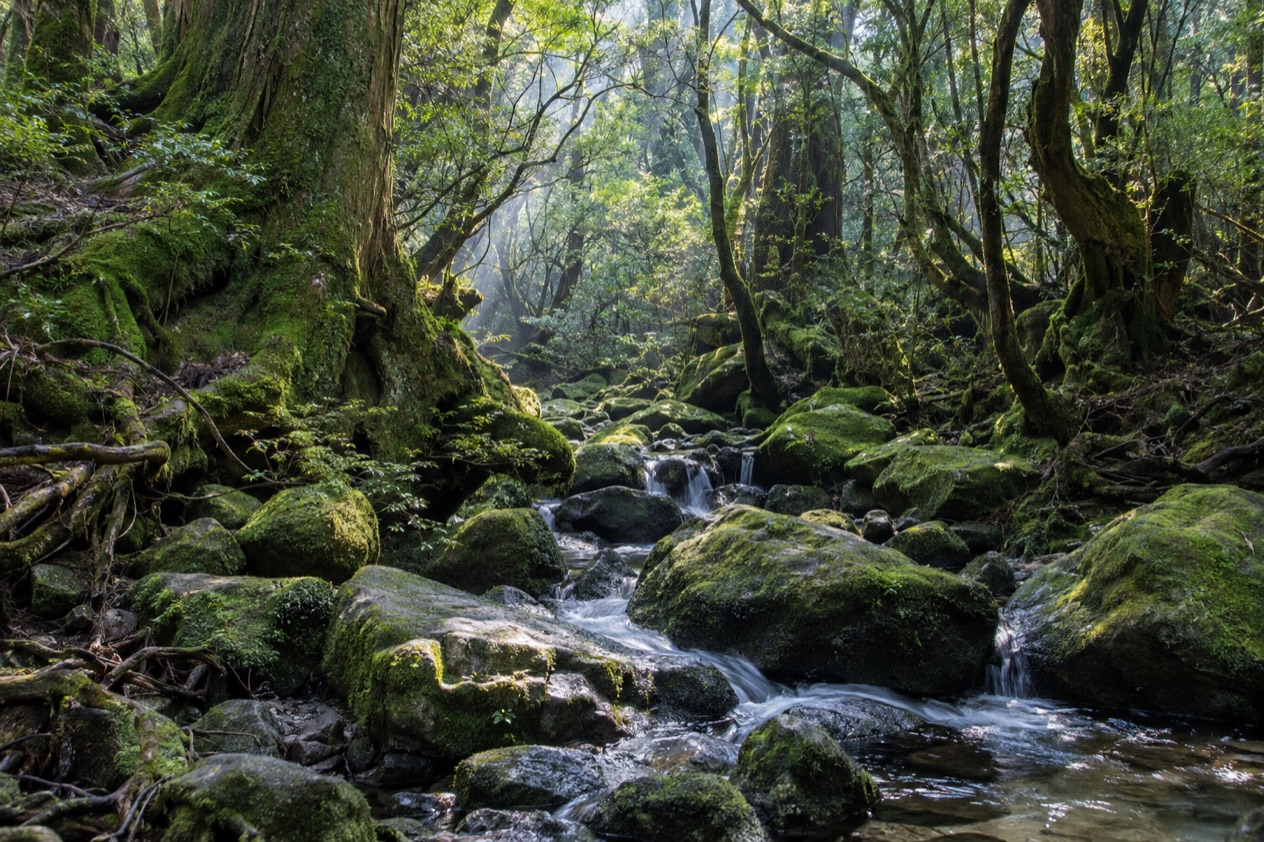
The ancient forest is the reason for the island’s World Heritage listing, and cedars, moss and mist are what travelers come for. If you’re staying more than a night, you have time to let the island show itself in more than one kind of weather.
The great trek is to the Jomon Sugi, a cedar reached only on foot, by a hike of four to five hours. Plan the rest of your stay around that walk rather than the other way round. Around the coast, Okonotaki Falls drop in a long ribbon of white water and were recognized in 1990 among Japan’s best waterfalls, a sight that fits neatly between longer outings.
A day on the island works best when it has one main outing and a slow edge. Walk a forest path, then spend the later hours in a village, over a bowl of noodles or a plate of fish from the surrounding sea. The island is wet and green, so you carry the habit of an island traveler: let the weather set the pace, and treat each break in the cloud as part of the visit rather than a delay.
Good to know before you go
Yakushima is an island of mountain and forest, and the weather that gathers around those slopes is part of what you travel for. Rain is woven into the character of the forest, and the moss and cedars owe their look to it. Pack your plans with that in mind, and let the jetfoil’s approximately two-hour crossing or your flight be the calm opening to a trip that follows the island’s own rhythm.
A good part of the island, 42 percent, lies within Yakushima National Park, which means that much of what you see from the road and the trail is protected land. Arrive with that in mind, move through the forest the way the island’s other visitors do, and you will find the trip rewards patience as much as distance.
Sources
- Japan National Tourism Organization, Yakushima (https://www.japan.travel/en/destinations/kyushu/kagoshima/yakushima/), checked October 11, 2026
- Wikipedia, Yakushima (https://en.wikipedia.org/wiki/Yakushima), checked October 11, 2026
- Wikivoyage, Yakushima (https://en.wikivoyage.org/wiki/Yakushima), checked October 11, 2026
- Japan National Tourism Organization, trains and buses (https://www.japan.travel/en/guide/how-to-travel-by-train-and-bus-in-japan/), checked October 11, 2026
- Japan National Tourism Organization, traveling by rail (https://www.japan.travel/en/guide/traveling-by-rail/), checked October 11, 2026
- Japan National Tourism Organization, getting around Japan: trains, subways, buses, taxis (https://www.japan.travel/en/plan/getting-around/), checked October 11, 2026