
The morning begins under the big departure boards of Shin-Osaka, where commuters, school groups and travelers with rolling suitcases funnel toward the platforms of the bullet trains. A few stops of rice fields, tunnels and Inland Sea towns later, the tracks bring you to a river city of tram bells and sizzling griddles.
How do you get to Hiroshima from Osaka?
The shinkansen is the way to go: Hiroshima is about 90 minutes from Osaka by bullet train, according to the Japan National Tourism Organization. The trains leave from Shin-Osaka Station, which opened in 1964 as the point where the Tokaido Shinkansen from Tokyo ends and the Sanyo Shinkansen begins.
Shin-Osaka is not the same station as Osaka Station, the big terminal in the middle of the city. It was built a short distance away, about 1.9 miles, to avoid the engineering problems of pushing a high-speed line into the center.
In practice this means you first reach Shin-Osaka on a conventional JR West line or another city route, then change to the bullet train. The shinkansen platforms sit on the fourth level, while the conventional JR West lines run at ground level, so expect a vertical journey through the station on your way up.
What decides the choice is mostly the kind of day you want. The Sanyo Shinkansen is operated by West Japan Railway Company (JR West) and links Shin-Osaka with Hakata Station in Fukuoka, with Hiroshima among its stops.
If you want the Peace Park, the museum and a plate of okonomiyaki in a single day, the bullet train leaves the most hours on the ground. If you would rather watch the towns go by and have no schedule to keep, the slower trains of the conventional network trade speed for scenery at the windows.
One point matters for rail pass holders. Travelers using a Japan Rail Pass need a special ticket to ride the express Nozomi or Mizuho services on the Sanyo Shinkansen. Other trains on the same line fall outside that rule.
Ways to get to Hiroshima from Osaka
Sanyo Shinkansen from Shin-Osaka
This is the bullet train line that runs west from Shin-Osaka to Hakata, and Hiroshima sits along it. Trains reach a top speed of 186 mph over most of the line, which is why the stretch from Osaka feels like one long glide past tunnels, hills and glimpses of the Inland Sea country. The line opened in two stages, the first part to Okayama in 1972 and the rest in 1975, and it carries the same kind of long, smooth rides as the Tokaido line it connects to.
The ride suits nearly everyone who is going to Hiroshima for a single day or a weekend, and it is the way travelers continue on toward Hakata too. Japanese trains have a reputation for running on the minute, so a timetable here is something you can plan around rather than hope for. The Nozomi and Mizuho services are the express trains of this line, and the Japan Rail Pass special-ticket rule applies to those two only.
A good way to use the ride is to treat Shin-Osaka as part of the trip. It is a huge interchange, busy with travelers heading in both directions along the two shinkansen lines, so give yourself time to find your platform and pick up something for the train. A station bento, a rice box packed with grilled fish, pickles and egg, is a very Japanese way to start the day.
Local and rapid trains on the conventional lines
JR also runs conventional trains, and they work differently from the bullet train. Local trains stop at every station, which makes them best for short distances, while rapid trains skip the smaller stops and do not require a supplement. For a long trip toward Hiroshima, this means a slower ride in which the towns and the coastline of western Japan pass by at street level rather than in a blur.
That slower rhythm suits travelers who are not racing the clock, who like to watch ordinary Japan from a window seat, or who plan to break the journey somewhere along the way. It makes less sense for a day trip with a lot to see, since every stop adds time. The conventional JR West lines start from the ground-level platforms at Shin-Osaka, ten tracks across five island platforms, so you can switch between the two kinds of train in the same station.
Other ways: bus and plane
Highway buses and flights also serve Hiroshima, and they belong to a different kind of trip. Hiroshima Airport receives flights from Haneda in Tokyo, a flight of about an hour and a half, so the plane is more of a Tokyo option than an Osaka one. For a traveler starting in Osaka, the rail lines are the way to go, and the airport comes into play mostly when you continue from Hiroshima to somewhere else in Japan.
Options compared
| Option | Time each way | Best for | What to know |
|---|---|---|---|
| Sanyo Shinkansen from Shin-Osaka | About 90 minutes | A full day in Hiroshima | Operated by JR West. Japan Rail Pass holders need a special ticket for Nozomi and Mizuho |
| Conventional JR lines, rapid trains | Longer than the bullet train | Watching the coast go by | Rapid trains skip small stations with no supplement |
| Conventional JR lines, local trains | Longer than rapid trains | Short hops along the way | Local trains stop at every station |
| Plane from Tokyo Haneda | 90 minutes | Arriving from Tokyo rather than Osaka | Hiroshima Airport receives the flights |
The table says what each option is for. If your main goal is time in Hiroshima itself, the bullet train wins, and the Peace Park, the museum and an evening meal fit into the same day.
The conventional lines make sense when the ride is part of the pleasure or when you plan to stop in a town along the way. The plane only matters if you are arriving from Tokyo, and the rail lines remain the route from Osaka. Whichever you pick, you step off in a city that sits on a river delta, laid out around its tram lines.
Making a day of it
Hiroshima rewards a day that moves slowly from the heavy to the delicious. Start at the Peace Memorial Park, which holds one of the two UNESCO World Cultural Heritage sites in the city.
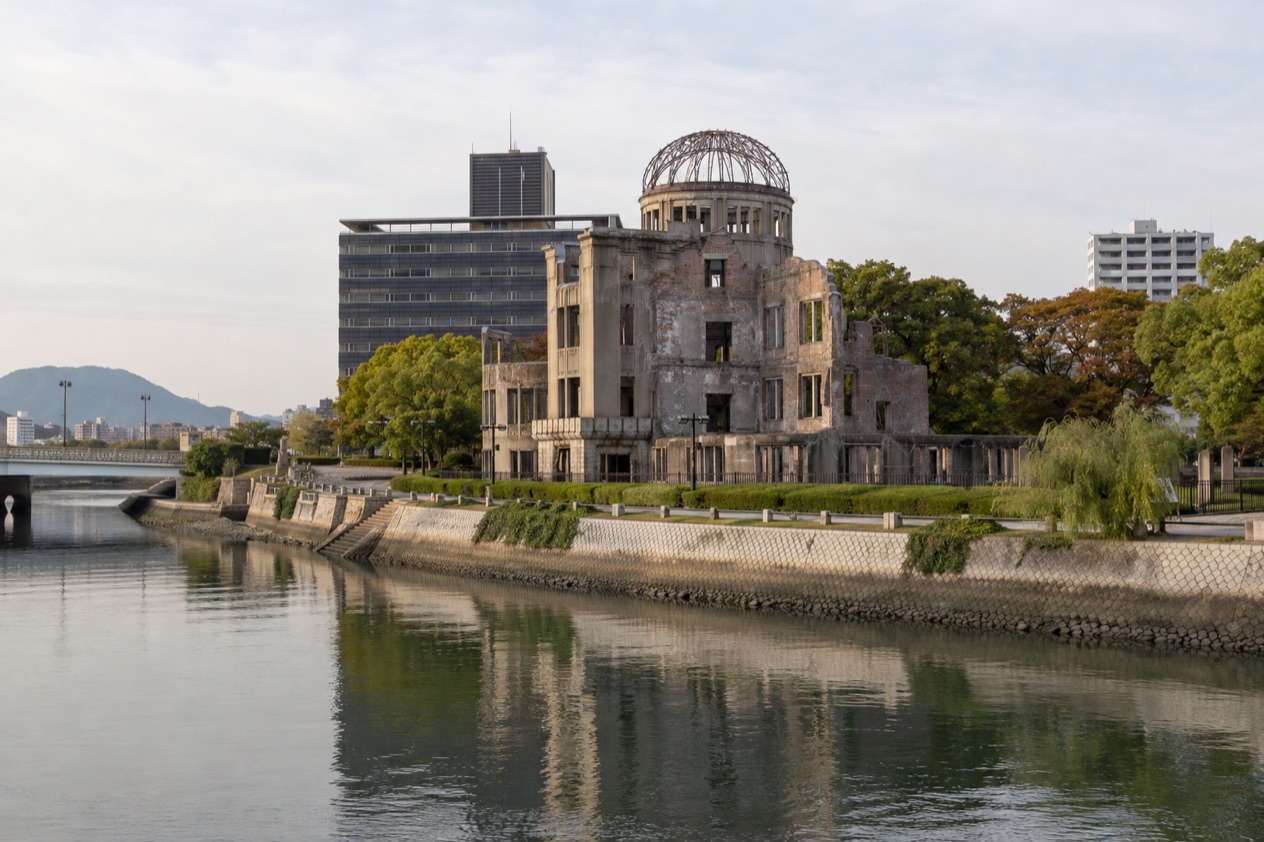
The other is the Atomic Bomb Dome, the ruined building beside the river, and it cannot be entered, so you see it from the outside. Walking past it, with the water on one side and the park on the other, is a quiet and sobering way to begin.
The museum and the river
The Peace Memorial Museum holds belongings left by victims, artifacts from the bombing and survivor testimonies, and its message is summed up in the words No More Hiroshimas. Visitors go through slowly and then sit by the river afterward, with no plan except to breathe. On August 6, the date of the annual ceremony, thousands of people write peace messages on lanterns that are lit at sunset and floated along the river in front of the Dome.
Give the museum the time it asks for, and leave the rest of the afternoon open instead of squeezing in more sights straight after.
Trams and a plate of okonomiyaki
Hiroshima is a city to ride by streetcar. The local operator, Hiroshima Electric Railway, known as Hiroden, has a mix of trams made across Japan and Europe, which earned it the nickname The Moving Streetcar Museum. It has run streetcars and buses around Hiroshima Prefecture since 1910. The PASPY smart card that Hiroden accepted from 2008 was replaced in spring 2025 by a QR code ticketing system called MOBIRY DAYS.
Lunch or dinner is the other half of the day. Hiroshima is famous for its okonomiyaki, a savory griddle crepe layered with cabbage, noodles, egg and sauce, cooked in front of you on a hot iron plate. It also has anago, saltwater eel, grilled or laid over rice. Eating at the counter, with the spatula scraping and the steam rising, is as much a part of the visit as any monument.
Miyajima and other excursions
If you have more than a day, the excursion that travelers take from Hiroshima is Miyajima Island, with its deer and its floating shrine. Itsukushima Shrine has a red torii gate standing in the sea, and it was registered as a World Heritage Site in 1996.
Elsewhere in the prefecture, Sandankyo is known for its autumn leaves from late October to late November, which makes it a candidate for a trip at this time of year. Okunoshima has wild rabbits, and visitors must not chase or pick them up and should offer appropriate food in a safe place. Each of these is a separate outing, so settle on one rather than trying to fit them all into a single day from Osaka.
Good to know before you go
Bring a sense of unhurried time rather than a long list. Hiroshima’s main sights are meant to be absorbed slowly, and the Peace Memorial Museum asks for a quiet frame of mind. The ride back to Osaka is part of the day too, a good moment to let the visit settle as the lights of the Inland Sea towns slide past.
| Fee | Amount | Who pays |
|---|---|---|
| Hiroshima Peace Memorial Museum admission | ¥200 | Adults |
| Hiroshima Peace Memorial Museum admission | ¥160 per person | Adults in groups of 30 or more |
| Hiroshima Peace Memorial Museum admission | ¥100 | High school students |
| Hiroshima Peace Memorial Museum admission | Free | Junior high school students and younger, and groups of 20 or more high school students |
Sources
- Wikipedia, Sanyō Shinkansen (https://en.wikipedia.org/wiki/Sany%C5%8D_Shinkansen), checked October 11, 2026
- Wikipedia, Shin-Ōsaka Station (https://en.wikipedia.org/wiki/Shin-%C5%8Csaka_Station), checked October 11, 2026
- Japan National Tourism Organization, Hiroshima (https://www.japan.travel/en/destinations/chugoku/hiroshima/), checked October 11, 2026
- Visit Hiroshima, the official guide (https://visithiroshima.net/), checked October 11, 2026
- Hiroshima Peace Memorial Museum (https://hpmmuseum.jp/?lang=eng), checked October 11, 2026
- Wikipedia, Hiroden (https://en.wikipedia.org/wiki/Hiroden), checked October 11, 2026
- Japan National Tourism Organization, trains and buses (https://www.japan.travel/en/guide/how-to-travel-by-train-and-bus-in-japan/), checked October 11, 2026
- Japan National Tourism Organization, traveling by rail (https://www.japan.travel/en/guide/traveling-by-rail/), checked October 11, 2026
- Japan National Tourism Organization, getting around Japan: trains, subways, buses, taxis (https://www.japan.travel/en/plan/getting-around/), checked October 11, 2026
- Wikipedia, Shinkansen (https://en.wikipedia.org/wiki/Shinkansen), checked October 11, 2026
- Wikipedia, Tōkaidō Shinkansen (https://en.wikipedia.org/wiki/T%C5%8Dkaid%C5%8D_Shinkansen), checked October 11, 2026
To plan your stay
- Best Time to Visit Hiroshima: Cherry Blossoms, Autumn Weather, Rainy Season and Festivals
- Things to Do in Hiroshima: Peace Memorial Park, Miyajima, Okonomiyaki and Day Trips
- Where to Stay in Hiroshima: Peace Park, Station Area, Castle District and Miyajima Island
- Know Before You Go to Hiroshima: Entry, Money, Getting Around and Local Etiquette