
A rental counter in Sapporo or Naha, a map spread out with a coastline road that no train follows, and the question arrives: could we just drive this ourselves? Americans can, as long as the right paperwork is in hand before the flight. The details are specific, and a few of them catch visitors out at the counter.
Can Americans drive in Japan?
Yes, short-term visitors from the United States can drive in Japan, provided they carry an international driving permit obtained before arriving. The U.S. State Department says so plainly, and the Japan National Tourism Organization (JNTO) adds that the permit must be issued by the competent authority of your own country, which for Americans means the American Automobile Association (AAA). A home license alone is not enough.
Whether you should drive is a different question. Japan’s cities are laced with rail, and the roads inside them are often congested, with almost no legal curbside parking. A car earns its place elsewhere.
Where a car makes sense
JNTO singles out two places: Hokkaido and Okinawa. Both islands are described as notably more accessible by car, with generally pleasant roads to drive. That fits what the maps suggest. Hokkaido is a land of long farm roads, lakes and volcanic scenery, and Okinawa has coastal routes strung between beaches, castle ruins and fishing towns.
In both, a car lets you stop where you want, at a roadside produce stand, a lighthouse, a bakery in a small town. It suits travelers who prefer to set their own pace over matching a timetable. In the big cities, most visitors will find the car adds little beyond a parking problem.
Renting a car
Rental is where the paperwork meets reality. If you plan to rent, JNTO says to use a non-automated gate when you enter the country so that an entry stamp goes into your passport. If you passed through an automated gate, go to the customs inspection office and have a stamp affixed there. The stamp matters because the permit’s validity is counted from your arrival date.
Rates are quoted for a 24-hour rental with unlimited mileage. JNTO gives average ranges for two sizes of car, and the gap between them is wide.
| Car class | Average rate per day |
|---|---|
| Compact (1500-1800 cm³) | ¥9,000 to ¥13,500 |
| Standard (3000 cm³) | ¥29,500 to ¥31,000 |
One of the companies JNTO names is Budget car rental, reachable at 0570-054-317. Compact cars also happen to suit the narrow roads described below, which is worth keeping in mind when a counter offers an upgrade.
What permit do you need?
You need an international driving permit issued under the 1949 Geneva Convention on Road Traffic, in the form of a paper booklet, and you carry it with your U.S. license. JNTO states that the permit must come from a country that participates in that convention and conform to its provisions. For Americans, AAA is the issuer named by the State Department.
The right format, and the wrong ones
Format is where trips go wrong. A paper permit is valid in Japan. Card-type or digital permits are not, and the card-sized version is refused even when it was issued under the 1949 convention. The permit for Japan must be a cardboard booklet.
Permits issued under the 1968 Vienna Convention on Road Traffic are not accepted either. If you collect your permit before the trip, look at the cover and the booklet format before you pack it, because once you are standing at a rental desk in Japan there is no way to fix it.
How long the permit lasts
JNTO describes the permit as valid for one year from the date of issue and one year from the date of arrival in Japan, confirmed by the entry stamp in your passport. Another source puts it slightly differently, valid for one year after issue or until your home license expires, whichever comes first. In practice, that means checking the expiry date of your own license as well as the date on the booklet.
The permit must be obtained before you leave. The State Department is explicit that it has to be in hand prior to arriving in Japan, so there is no sorting it out after landing.
Licenses from other countries, and a Japanese license
A special route exists for visitors from Switzerland, Germany, France, Belgium, Monaco and Taiwan. They can drive on their original license with an accredited Japanese translation, for up to one year from arrival. That route does not apply to U.S. license holders, who follow the permit procedure above.
A Japanese license is a separate matter, meant for residents. Japan requires a license to operate a car, motorcycle or moped on public roads. The minimum age for an ordinary vehicle license is 18, and graduates of a designated driving school skip the practical exam but still sit the written one. None of that applies to a short visit, but it explains why the permit, rather than a local license, is the key document.
What are the main rules?
Traffic keeps to the left, turns on red lights are not allowed in either direction, seat belts are required for all passengers, and the alcohol limit is strict. Those are the rules that change how an American behaves behind the wheel from the first minute.
Left side, narrow roads and signs
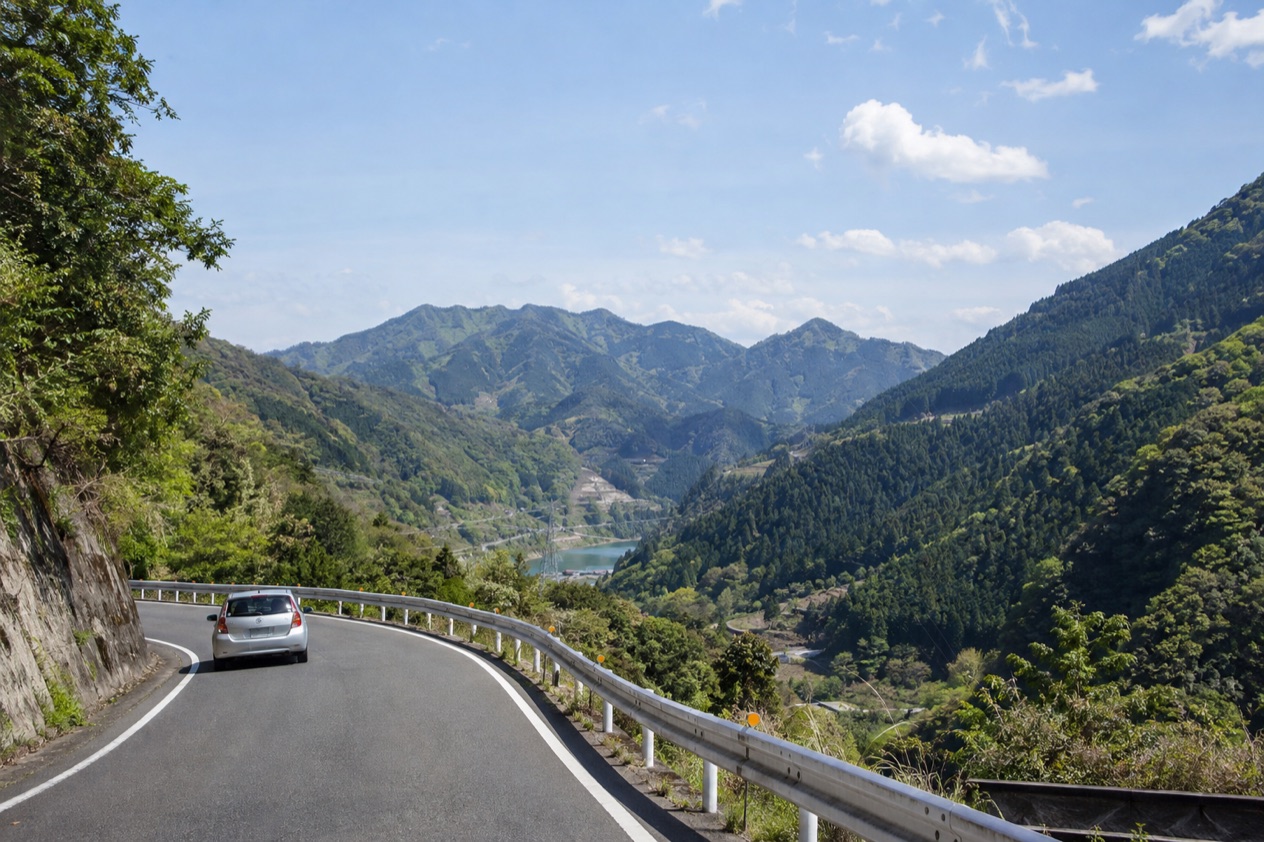
Driving on the left takes concentration at every intersection, especially turning, when the instinct is to swing into the wrong lane. Roads are also much narrower than those in the United States, which is why a smaller rental car tends to be less stressful on village lanes and mountain bends.
Signs are another hurdle. The State Department notes that without Japanese you will have trouble understanding road signs. A navigation system or a map app set to English helps with directions, but the signs themselves remain in Japanese. Turning right or left on red is not permitted, so a red light means waiting, even at an empty crossing.
Speed limits
Limits are posted in kilometers per hour. Towns are the slowest, the countryside a little faster, and expressways the fastest, with the figure depending on the type of road.
| Road | Speed limit (km/h) |
|---|---|
| Towns | 40 |
| Countryside | 50 to 60 (60 if unmarked) |
| Expressways, general | 100, with some sections at 110 or 120 |
| Divided national expressways | 120 unless a lower limit is posted |
| Two-lane expressways | 70, or 80 if divided by a cable barrier |
Drinking, seat belts and cyclists
Japan has a national blood-alcohol standard of 0.03%, lower than many U.S. drivers expect, so the sensible habit is to skip the drink if you are the one driving. The consequences are heavy. Guilty of DUI, speeding or reckless driving that injures another person, you could face up to 15 years in prison.
Seat belts apply to everyone in the car, front and back. Cyclists are covered by traffic laws too, and the State Department notes that you can be arrested for using a cellphone while cycling or for riding under the influence of alcohol. That matters if a rented bicycle is part of your plan.
Tolls, parking and winter roads
Highway tolls can be very high, and when there are two or more possible routes between an entrance and an exit, the toll is calculated on the shortest one. JNTO gives one example to give a sense of scale.
| Route | Approximate tolls |
|---|---|
| Tokyo to Kyoto | ¥10,070 |
Parking needs planning. There is virtually no legal roadside or curbside parking, yet traffic is commonly blocked or partly blocked by people parked illegally at the curb. In practice, that means looking for a lot or garage at your destination rather than hoping to find a space on the street.
In mountainous areas, roads are often closed during the winter, and cars should be equipped with tire chains. A winter drive in the mountains therefore depends on closures as much as on the car.
Good to know before you go
Fuel is a running cost to set against the rental rate, and in 2022 it cost about ¥170 per liter. Add the tolls and a lot or garage at each stop, and a road trip across Hokkaido or along the Okinawa coast comes with a budget of its own.
The cities reward patience in a different way, with traffic that is often congested, so many travelers pick up the car only when they leave the urban core. Keep the paper permit, your U.S. license and your passport together in the glove box, since the entry stamp is the proof of arrival that the permit’s validity is counted from.
Sources
- U.S. Department of State, Japan travel information, travel and transportation (https://travel.state.gov/content/travel/en/international-travel/International-Travel-Country-Information-Pages/Japan.html), checked October 11, 2026
- Japan National Tourism Organization, driving, car rental, permit, tolls (https://www.japan.travel/en/plan/getting-around/cars/), checked October 11, 2026
- Wikipedia, Driving license in Japan (https://en.wikipedia.org/wiki/Driving_license_in_Japan), checked October 11, 2026
- Wikipedia, Expressways of Japan (https://en.wikipedia.org/wiki/Expressways_of_Japan), checked October 11, 2026
- Wikivoyage, Driving in Japan (https://en.wikivoyage.org/wiki/Driving_in_Japan), checked October 11, 2026
To plan your stay
- Best Time to Visit Japan: Cherry Blossoms, Autumn Colors, Weather and Festivals
- Where to Stay in Japan: Ryokan, Temple Stays, Capsule Hotels and the Best Cities to Base In
- Sending Luggage from the Airport in Japan: Hands-Free Travel, Hotel Delivery and Coin Lockers
- Know Before You Go to Japan: Entry, Money, Etiquette and Getting Around