
Leaving Sapporo for the south, you trade the wide avenues and the ramen alleys of Susukino for a coast of fishing towns and a harbor that has looked out at ships for a very long time. At the end of the journey, Hakodate smells of grilled squid and salt air, and its hillside streets drop toward the water in rows of old churches and wooden warehouses. This is how to make the trip from Hokkaido’s biggest city to its southern port, by rail or by air, and what to do once you arrive.
How do you get to Hakodate from Sapporo?
You can go by train along the direct route that runs through the Chitose and Muroran lines, or fly from Sapporo’s two airports straight to Hakodate Airport. Hakodate sits at the southern tip of Hokkaido, so either way you are crossing most of the island from one end to the other.
The train route has a quirk worth knowing. The Hakodate Main Line is the railway that links Hakodate and Asahikawa by way of Sapporo, and JR Hokkaido runs it. Yet the direct passenger services between Sapporo and Hakodate do not follow it the whole way.
They travel via the Chitose and Muroran lines and join the Hakodate Main Line again at Oshamambe Station. On a map, that means the journey bends around the coast rather than cutting straight across.
What decides between train and plane is mostly what you want from the day. The train gives you hours of window time, with the landscape changing from city to farmland to shoreline, and it lets you stop somewhere on the way.
The plane suits a tight schedule, with a choice of two airports in the Sapporo area and a landing at Hakodate Airport. Neither option needs a transfer to the Shinkansen, because the bullet train that reaches Hakodate comes up from Honshu, not from Sapporo.
If you are building a longer Hokkaido trip, think about which direction you are traveling. Arriving from Tokyo, you would reach Hakodate by Shinkansen and could then head up to Sapporo. Starting from Sapporo, as here, you are going the other way, and the trip becomes the first leg of a southbound loop or a one-way run to the Honshu border.
Ways to get to Hakodate from Sapporo
By train on the direct route
The direct trains between the two cities are run by JR Hokkaido and take the Chitose and Muroran lines before rejoining the Hakodate Main Line at Oshamambe. That detour is why a glance at the line’s name on a map can mislead you. The Hakodate Main Line itself is a long railway of 76 stations, opened in 1880, and only its southern end is part of your trip.
What you see from the window is the real reason to choose rail. Past the suburbs of Sapporo, the line runs along flat farmland and then toward the Pacific coast, with stretches of shoreline, small harbors and the volcanic landscape of southwestern Hokkaido.
Sit on the side that faces the water when you can. Bring something to eat for the ride, since a Hokkaido ekiben (a boxed station lunch with crab, salmon roe or scallops) is part of the pleasure.
This way suits travelers who like the journey as much as the arrival and who have a day to spare. It is also the natural choice if you want to break the trip with a stop at a coastal town or a hot spring and then carry on.
By plane to Hakodate Airport
Hakodate Airport has direct flights from Sapporo on two routes. JAL flies from Okadama, the smaller airfield in the city, and ANA flies from Shin-Chitose, the large airport that most visitors know. Hakodate Airport also receives flights from Tokyo-Haneda, Nagoya-Centrair, Osaka-Itami and Taipei-Taoyuan, so it works as a gateway if you are continuing on to other parts of Japan.
Flying suits anyone who wants to reach Hakodate with the rest of the day free, or who is combining the trip with a flight out. If you are already at Shin-Chitose for an arrival or departure, the ANA route fits neatly into that. If your hotel is in central Sapporo, Okadama on JAL’s route keeps you close to the city.
By Shinkansen, once the line reaches Sapporo
For now it stops there, so it does not carry you from Sapporo. The extension to Sapporo is planned to open in 2030, and the municipalities along the Hakodate Main Line have agreed that the Oshamambe to Otaru section will close after it does.
The line matters to this trip in two ways. First, anyone coming from Tokyo reaches Hakodate by it, and that explains why many visitors approach the city from the south. Second, Shin-Hakodate-Hokuto is the northernmost terminal for the bullet train, 11 miles north of Hakodate Station, and from there a local train takes you the last leg to the city.
The Hokkaido Rail Pass
JR Hokkaido, the operator of the line, sells a Hokkaido Rail Pass to foreign visitors. These are the prices as the operator gives them.
| Pass | Adult | Child |
|---|---|---|
| 5 consecutive days, bought outside Japan | 19,000 yen | 9,500 yen |
| 5 consecutive days, bought in Japan | 20,000 yen | 10,000 yen |
| 7 consecutive days, bought in Japan | 26,000 yen | 13,000 yen |
Options compared
| Option | Best for | What to know |
|---|---|---|
| Direct train | Watching the coast and stopping on the way | Runs via the Chitose and Muroran lines and rejoins the Hakodate Main Line at Oshamambe |
| Flight from Okadama | Leaving from central Sapporo | JAL flies this route to Hakodate Airport |
| Flight from Shin-Chitose | Connecting with other flights | ANA flies this route to Hakodate Airport |
| Shinkansen | Trips coming up from Honshu | Ends at Shin-Hakodate-Hokuto for now, with a local train to Hakodate for the last leg |
Put simply, the train is the way to see Hokkaido and the plane is the way to save the day for Hakodate itself. If you love long rail journeys and have the time, the direct route gives you the coast and the choice of a stop. If you are short on time, a flight from either Sapporo airport lands you in Hakodate with energy left for an evening on the hill.
A few other things shape the choice. The train asks you to carry your own bags through stations and onto platforms but lets you stretch out and watch the scenery, while the airport routes send you through check-in and security.
Japanese trains have a reputation for always being on time, which lets you plan connections to the minute. And if you are leaving Hakodate for Honshu afterward, the Shinkansen from Shin-Hakodate-Hokuto and the airport’s flights to Haneda, Nagoya and Osaka give you good ways onward.
Making a day of it
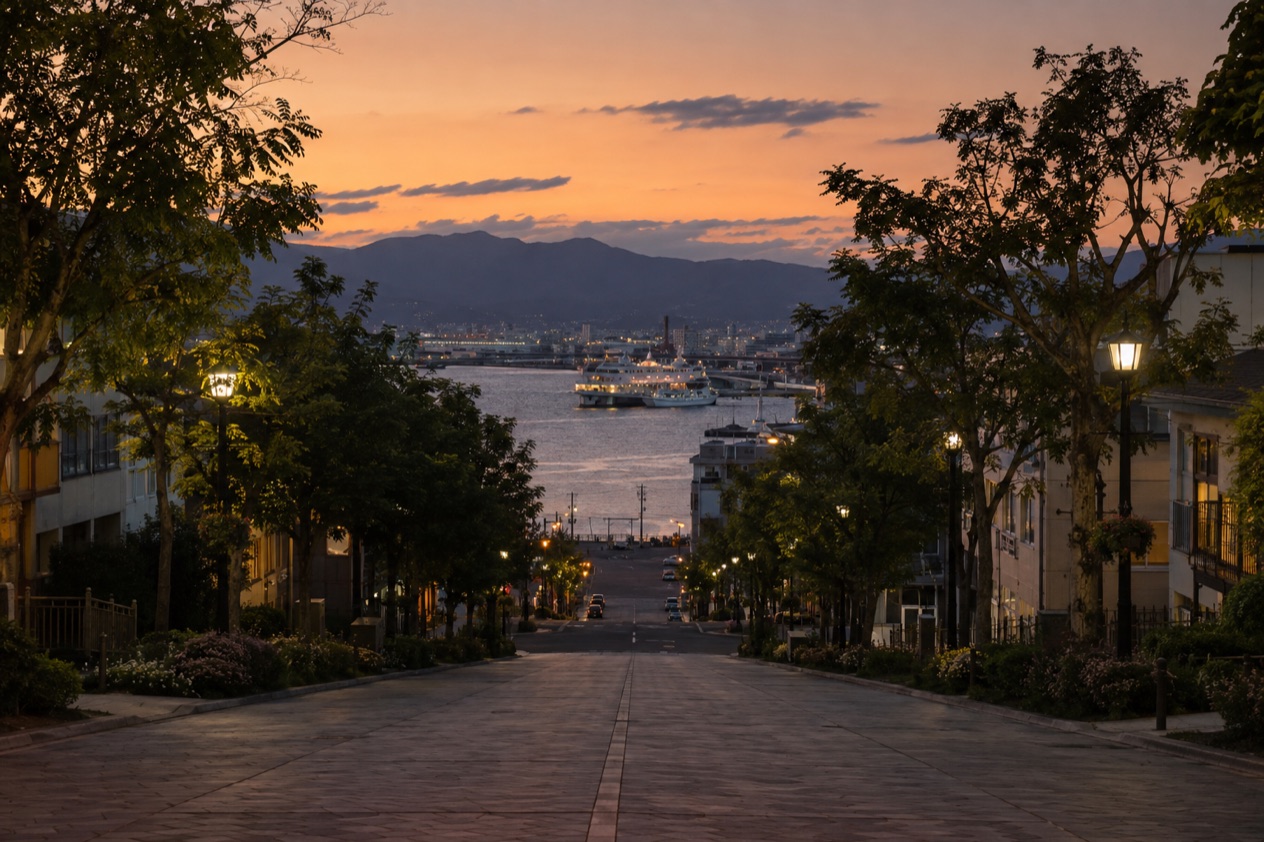
A trip from Sapporo to Hakodate rewards a plan built around the arrival, because the city is made for walking at the end of the day. Hakodate was Japan’s first city whose port opened to foreign trade, in 1854, and you can still feel that in the slopes of Motomachi, where churches and old Western-style houses stand on the hillside above the harbor.
What to see once you arrive
Start by the water, where the red-brick warehouses along the bay have been turned into shops, cafés and restaurants. Wander the lanes of Motomachi, with its churches and old consulates, then head up Mount Hakodate for the view over the narrow neck of land that holds the city between two bays. After dark, the lights below take on the shape of an hourglass, which is why travelers plan an evening here.
Goryokaku, the star-shaped fort, is another stop in the city. From December 1 to 25 the red-brick warehouse area also hosts the Hakodate Christmas Fantasy festival, with a giant Christmas tree floating on the sea.
What to eat
Hakodate is a port, and the food shows it. Squid is the signature, served as sashimi, grilled or over rice, and the morning market near the station is where many visitors go for seafood bowls piled with crab, sea urchin and salmon roe. Salt-based shio ramen is the local noodle style, with a clear, light broth that suits a cool day by the sea.
If you take the train, plan a snack for the ride and keep your appetite for the evening. If you fly, you can land hungry and go straight to the harbor.
How long to stay
The city’s main sights sit close enough to one another for an overnight stay to feel unhurried, with a night on the hill and a morning at the market. A longer stay gives you room for the countryside around Hakodate and for the onward trip across the strait to Honshu by Shinkansen, since Hakodate is separated from it by the 20-kilometer Tsugaru Strait. Bring layers for the sea breeze and shoes that handle slopes and cobbled lanes.
Good to know before you go
Trains and stations in Japan follow a strict timetable, so a connection at Oshamambe or at Shin-Hakodate-Hokuto can be planned closely.
Local trains stop at every station, while rapid trains skip the smaller ones and do not need a supplement. If you are traveling in the colder months, dress for wind off the water when you get to the harbor, and remember that the typhoon season, when it applies, can disrupt travel by both rail and air.
Sources
- JR Hokkaido, Rail passes and tickets (https://www.jrhokkaido.co.jp/global/english/ticket/index.html), checked October 11, 2026
- Wikipedia, Hakodate Main Line (https://en.wikipedia.org/wiki/Hakodate_Main_Line), checked October 11, 2026
- Wikipedia, Hokkaido Shinkansen (https://en.wikipedia.org/wiki/Hokkaido_Shinkansen), checked October 11, 2026
- Japan National Tourism Organization, Hakodate (https://www.japan.travel/en/destinations/hokkaido/hokkaido/hakodate-and-hokkaido-south/), checked October 11, 2026
- Wikivoyage, Hakodate (https://en.wikivoyage.org/wiki/Hakodate), checked October 11, 2026
- Japan National Tourism Organization, trains and buses (https://www.japan.travel/en/guide/how-to-travel-by-train-and-bus-in-japan/), checked October 11, 2026
- Japan National Tourism Organization, traveling by rail (https://www.japan.travel/en/guide/traveling-by-rail/), checked October 11, 2026
- Japan National Tourism Organization, getting around Japan: trains, subways, buses, taxis (https://www.japan.travel/en/plan/getting-around/), checked October 11, 2026