
On a long-distance ferry in Japan, shoes come off, a blanket gets unrolled on a tatami floor, and a motorcyclist in a riding jacket sleeps a few feet from a family with a picnic. The ride has a slow, lived-in rhythm that no bullet train offers. Ferries still link Hokkaido and Honshu, and Okinawa Island with Kyushu and Honshu, and they now serve mostly sightseeing passengers and truck drivers.
Where do ferries run in Japan?
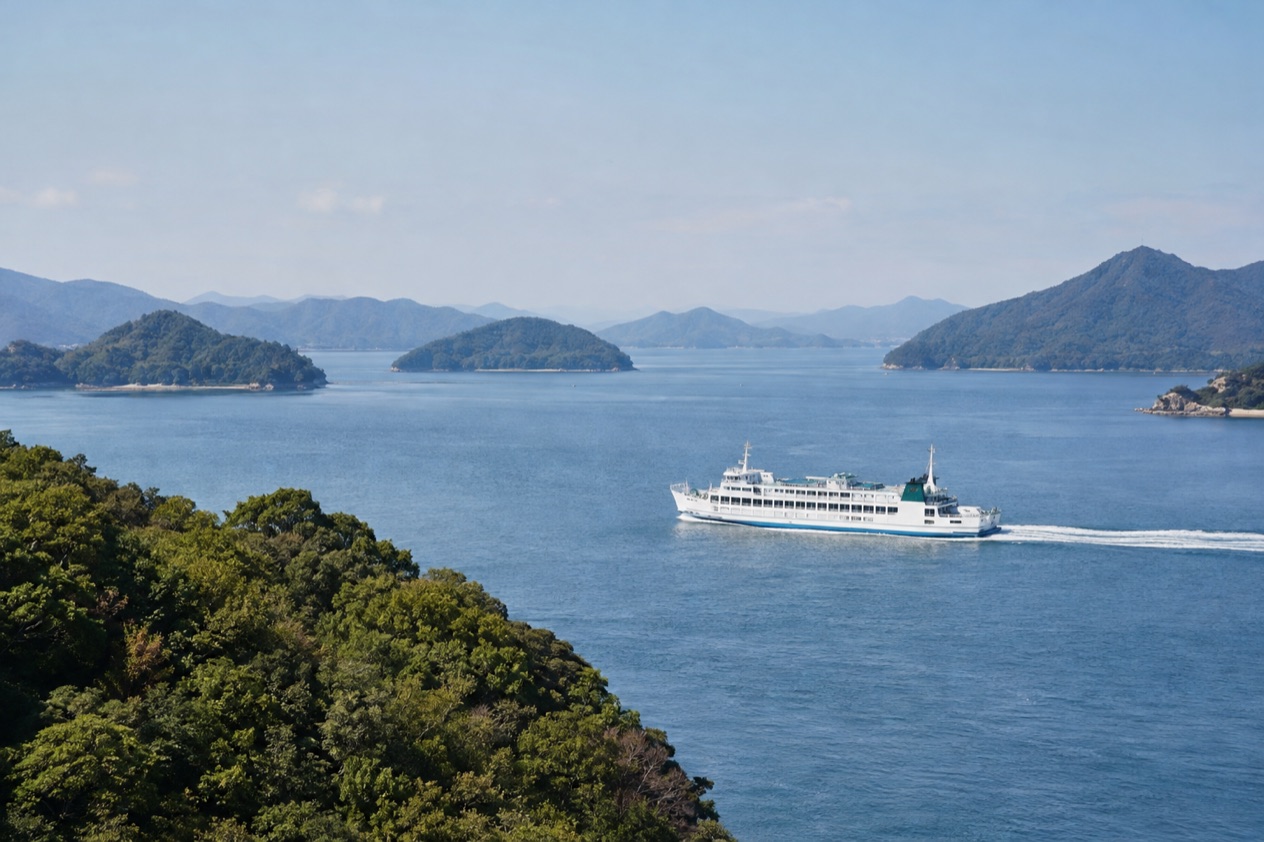
Ferries run between the four main islands, Hokkaido, Honshu, Shikoku and Kyushu, and out to Okinawa, though they play a smaller part than they once did. For a long time they carried passengers and goods among those islands, and a crossing by water was the ordinary way to get from one to the next. That history explains why Japan still has such a varied ferry culture, from big overnight ships to small boats that cross a bay.
What changed is the map. Highway and railway bridges and undersea tunnels were built, and the water crossings that had been essential became optional. Ferry travel in Japan is now a different kind of trip from the one grandparents remember.
From the main link to a sightseeing ride
Today ferry transportation in Japan has become a matter of short-distance sightseeing for passengers, with or without a car, and of long-distance hauling for truck drivers. For a visitor, that means a ferry is usually a chosen experience, not a necessity. You step aboard to feel the water under you, to watch a coastline slide past from the deck, and to arrive somewhere by a route most rail passengers never see.
The sightseeing side suits travelers who like the journey to be part of the trip. A crossing gives you time to sit with a drink from the onboard vending machines, walk the outer decks in the sea wind, and watch gulls follow the wake. It is a change of pace after days of platforms and transfers.
Short crossings such as Yamagawa-Nejime
The Yamagawa-Nejime Ferry in Kagoshima is a short-distance ferry, and it shows the smaller end of the scale. Crossings like this one are not overnight voyages with cabins and dining rooms. They are working links across a stretch of water, the kind of boat where the trip is over almost as soon as you have settled in.
Short crossings give a glimpse of the ferry as part of local life. Cars roll aboard, passengers stand at the rail, and the whole thing has the unhurried feel of a service that has simply always been there. They suit anyone who wants a taste of ferry travel without committing a night to it.
Long-distance ships and the people who use them
Long-distance ferries are used by truck drivers hauling goods, and also by motorcyclists, as on the Ocean Tokyu Ferry. That mix gives the ships their character. You may share a lounge with riders who have their helmets beside them and drivers whose cargo is parked on a lower deck, while sightseers fill the rest of the space.
The seating is not what many travelers expect. Passenger ferries in Japan have traditionally had very few actual seats. Larger spaces are given over to tatami or broadloom (carpeted) areas where passengers can sit or lie down, so the lounge feels more like a shared room than a rows-of-chairs cabin.
Which routes matter for visitors?
The routes that matter most are the ferries between Hokkaido and Honshu, the ferries from Okinawa Island to Kyushu and Honshu, the long ferry between Tokyo and Kitakyushu, and the short crossings used for sightseeing. Each has a different feel, and each suits a different kind of trip.
Hokkaido and Honshu
Ferries connect Hokkaido to Honshu, joining the northern island to the main one by sea. This is one of the two big water links that survive in Japan’s network, and it belongs to the long-distance side of ferry travel, where trucks and travelers share the ship.
For a visitor, choosing the ferry over other ways across is a matter of taste. The sea passage lets you arrive on Hokkaido the way people did before the tunnels and bridges changed the habits of the whole country. You get deck time, a lounge with a tatami floor to stretch out on, and the sense of crossing a real stretch of water between islands.
Okinawa Island, Kyushu and Honshu
Ferries also connect Okinawa Island to Kyushu and to Honshu. Okinawa sits out in the sea, and these ships are the sea link that ties it to the larger islands. They belong to the ferry tradition of the whole archipelago, where water has always been part of the route.
Travelers drawn to the slow way of arriving will find the idea appealing. The voyage is a counterpart to the flight, a way to turn the approach to Okinawa into part of the journey, with open water on every side and the long hours aboard shaping the trip.
Tokyo to Kitakyushu
A ferry connects Tokyo and Kitakyushu, and it is the one long-distance ship whose accommodation the details describe. Its second-class cabin has a simple bed with curtains, a plain berth where you pull the curtain across and rest. It is a modest, practical space, built for sleeping on a passage that runs through the night.
This is the ferry for travelers who want to cross a large part of the country by sea. The curtained berth, the shared lounge and the deck make it feel like a different kind of travel from the rail lines that run on completely separate tracks from commuter trains. Here the journey is slow on purpose.
Short sightseeing crossings
Beside the long ships are the short crossings, such as the Yamagawa-Nejime Ferry in Kagoshima. These are the routes where sightseeing passengers, with or without a car, make up the traffic. A short crossing can fit into a day of exploring without changing the plan, and it adds a stretch on the water between two stops on land.
How do you book?
A ferry in Japan is booked through the operator of the route you choose, and the list of Japanese ferry operators is the place to look for information on each company. Each route belongs to its own operator, so the details of a Hokkaido crossing are not those of the Tokyo to Kitakyushu ship or of a short ferry in Kagoshima.
Start with the operator
Because every route has its own company, the question to settle first is which crossing you want. Once you know whether it is the Hokkaido link, the sea route to Okinawa Island, the Tokyo to Kitakyushu ship or a short sightseeing ferry, you know which operator’s information applies. The operators list gathers those companies in one place.
Keep each route’s details together and do not carry assumptions from one ship to another. A short ferry across a bay and a long overnight voyage are different services, with different kinds of spaces on board.
Choosing where you will sit or sleep
What you pick on board shapes the trip. On Japanese passenger ferries the proper seats are few, and the large spaces are tatami or broadloom areas where you can sit or lie down. That is the shared-room style of travel, with luggage beside you and a floor to stretch out on.
For more privacy there are cabins. The second-class cabin on the Tokyo and Kitakyushu ferry has a simple bed with curtains, a small step up from the open floor. It suits travelers who want a place that is their own for the night without any frills.
Bringing a car or a motorcycle
Ferries in Japan carry passengers and occasionally vehicles and cargo, and sightseeing passengers travel with or without a car. Motorcyclists also use the long-distance ships, as on the Ocean Tokyu Ferry. If you plan to bring a vehicle, it is the operator of your route who can tell you how it works on that ship.
Remember that traffic in Japan drives on the left. A vehicle that rolls off a ferry onto Japanese roads joins that left-hand traffic, which matters for anyone arriving on wheels and heading inland from the port.
Good to know before you go
Ferry life runs on the sea, so a crossing is part of the weather as much as of the timetable, and the rainy and typhoon seasons shape what the water is like. Bring the ordinary habits of Japanese travel aboard, such as taking your shoes off where there is tatami and keeping to the shared spaces with quiet courtesy.
Pack for a deck in the wind as well as a lounge with a floor to sit on. Yen is the currency for anything you buy on the way.
Sources
- Wikipedia, Ferry (https://en.wikipedia.org/wiki/Ferry), checked October 11, 2026
- Wikipedia, Transport in Japan (https://en.wikipedia.org/wiki/Transport_in_Japan), checked October 11, 2026
To plan your stay
- Best Time to Visit Japan: Cherry Blossoms, Autumn Colors, Weather and Festivals
- Where to Stay in Japan: Ryokan, Temple Stays, Capsule Hotels and the Best Cities to Base In
- Sending Luggage from the Airport in Japan: Hands-Free Travel, Hotel Delivery and Coin Lockers
- Know Before You Go to Japan: Entry, Money, Etiquette and Getting Around