
The last train has gone, or the rain is coming down in sheets, or you are standing outside a station with two suitcases and a hotel address written in Japanese. That is when a taxi comes to mind. In Japan the ride is clean and reliable, you do not tip, and you should carry cash because not every cab takes a card.
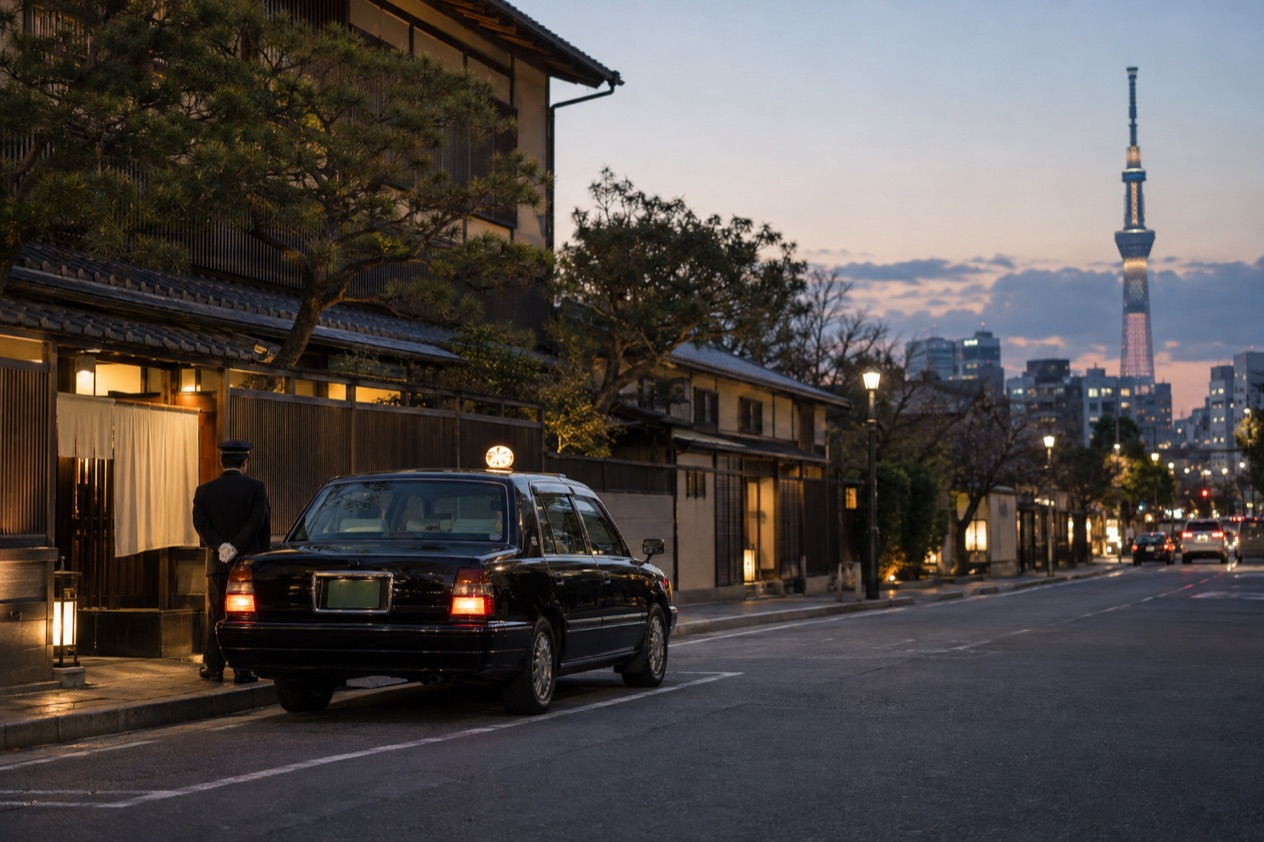
How do taxis work in Japan?
A Japanese taxi works much as it does elsewhere, you get in, name your destination and pay what the meter says at the end, but the small rituals around it are different. The cars are clean and reliable, and the drivers handle the whole ride with a calm routine that travelers find easy to fall into.
The details that surprise first-timers are physical ones: who opens the door, where the car stops, and how much of the street the driver has to negotiate to reach you.
Getting in and out
Visitors from the U.S. often reach for the handle out of habit, and the polite move is simply to wait and step in once the door has opened. The same happens at the end of the ride, when the driver releases the door again.
Many drivers wear a uniform, and seat covers in white lace are a familiar sight inside Japanese cabs. , so having the name of your hotel or sight written out helps the exchange along.
Streets a driver has to handle
Traffic keeps to the left side of the road, which means you will be getting in and out on the left. Roads in Japan are much narrower than those in the United States, and city traffic is often very congested. A cab slipping down a tight side street toward a small inn is a normal sight, and the pace is set by what the street allows.
There is virtually no legal roadside or curbside parking in Japan, yet traffic is commonly blocked or partially blocked by people illegally parked at the curb. Turning on a red light is not permitted either, so drivers wait out each signal in full.
Seat belts and the ride itself
All passengers in Japan are required to wear seat belts, and that includes the back seat of a taxi. Buckle up as you settle in, and expect a smooth, unhurried drive. Conversation is optional, and many drivers keep quiet unless you start talking.
Highway tolls can be very high in Japan, which is one more reason the route and the roads a driver chooses are part of the trip. You are riding with someone who deals with these streets every day, so there is little for you to do except watch the city go by.
Where taxis fit among other ways of getting around
Public transport in Japan, including the shinkansen and regional trains, is extremely punctual, to the point that you could set your watch by it. The metro in Japanese cities is a quick and easy way to get around, and regional and long-distance buses run both day and night. Taxis sit alongside all of this as another choice, the one that takes you to a door.
Short-term visitors who drive must hold an international driving permit from the American Automobile Association, obtained before arriving in Japan. A taxi asks nothing of the sort from you, and you are free to look out the window.
Do you tip?
No, tipping is not part of the custom in Japan, and that holds in a taxi as much as in a restaurant or a hotel lobby. The fare on the meter is the fare, and the driver does not expect anything on top of it. A traveler who leaves extra money may find the driver trying to hand it back.
Service here is treated as part of the job rather than something to be rewarded afterward. The clean cabin, the opened door and the careful driving are simply how a ride is meant to go. For a visitor, that removes one small calculation from the end of every trip.
Saying thanks the Japanese way
A word of thanks does the work a tip would do at home. Arigato gozaimasu, said as you step out, is the usual phrase, and a small nod goes a long way with it. Drivers tend to answer with a bow of the head or a brief word of their own.
You do not need more Japanese than that. A smile and a clear thank you carry the same warmth, and the exchange takes only a second before the door closes behind you.
Change and small gestures
When you pay with a larger bill, the driver counts out the change and hands it back, and the habit is to take it rather than say keep it. Money is often passed over in a small tray, and you place your payment there instead of pressing it into a hand. It is a tidy, quiet moment that suits the rest of the ride.
If the driver steps out to help with a suitcase, thanks are still the right response. The gesture comes with the job. Rounding up the fare as you would at home is not how it works, and a clear arigato is enough.
Why this feels different from home
Americans are used to adding a percentage in a cab, so the first few rides can feel a little strange, as though something is left unsaid. That feeling passes quickly. After a day or two, stepping out of a taxi with nothing more than a thank you becomes second nature.
The same logic runs through the rest of a trip. At an inn, a restaurant or a shop, the price you are shown is the price you pay, and gratitude is spoken rather than left on the table.
How do you pay?
That single fact shapes how you handle every ride, and it is worth having bills in your wallet before you wave one down. A cab that takes cards is a bonus, not something to count on.
Carrying cash
Withdraw or exchange money before a day that might involve a taxi, rather than reaching the curb at night with an empty wallet. The end of an evening is when cabs are most tempting, and it is the worst moment to start hunting for a machine. Keep a few bills and some coins in a pocket you can reach without unpacking your bag.
A trip across town and a trip from a station to a distant ryokan can end in very different totals, and the meter decides which. Having enough on hand means the end of the ride is a calm moment, not a scramble.
If you would rather use a card
Some taxis do take cards, but since not all do, the sensible plan is to treat cash as the default and a card as a fallback you hope for. If you are counting on plastic, look for a sign on the car or the window that signals it, and confirm with the driver before you set off. Learning that a cab is cash only at the end of the ride leaves you with few options.
This matters most for travelers whose accounts are mostly digital. Planning your cash around the days you expect to use taxis keeps the arrangement simple and spares you any awkward moment at the curb.
Paying at the end of the ride
The meter runs throughout, and the total appears at the front of the cab. The driver names the amount, you pass over your payment, and change comes back in return. Nothing is added afterward, and there is no tip line to fill in.
If your destination is a hotel, the doorman or staff may greet the car, and . Take your belongings, give your thanks and step out onto the curb.
Good to know before you go
Keep the cash habit beyond the taxi rank, since cab fares are just one of the places where bills and coins come in handy. Japanese taxis stay reliable on a wet day, though rain tends to make the streets slower and the cars harder to find.
, which spares you the search. Plan your cash around the rides you expect, and the rest takes care of itself.
Sources
- U.S. Department of State, Japan travel information, travel and transportation (https://travel.state.gov/content/travel/en/international-travel/International-Travel-Country-Information-Pages/Japan.html), checked October 11, 2026
- Japan National Tourism Organization, getting around Japan: trains, subways, buses, taxis (https://www.japan.travel/en/plan/getting-around/), checked October 11, 2026
To plan your stay
- Best Time to Visit Japan: Cherry Blossoms, Autumn Colors, Weather and Festivals
- Where to Stay in Japan: Ryokan, Temple Stays, Capsule Hotels and the Best Cities to Base In
- Sending Luggage from the Airport in Japan: Hands-Free Travel, Hotel Delivery and Coin Lockers
- Know Before You Go to Japan: Entry, Money, Etiquette and Getting Around