
Leave Hakata Station in Fukuoka with a bento in your bag, and the day starts to feel like a hot-spring day before you have even arrived. The train threads through Kokura and then on to Kyushu’s eastern side, where Beppu announces itself with steam rising from rooftops, hillsides and drains. This is the transfer from Fukuoka to Beppu, for travelers who want to trade the big city for a town built around hot water.
How do you get to Beppu from Fukuoka?
The direct way is the Sonic limited express, which leaves Hakata Station in Fukuoka, calls at Kokura, stops at Beppu and finishes its run at Oita, about 2 hours in all to the end of the line. Beppu comes before Oita, so you step off earlier than that full journey. The train is operated by JR Kyushu, and it runs twice an hour, which means you do not have to build your morning around a single departure.
What decides the choice is mostly what else you want from the trip. If you are putting together a longer loop through Kyushu, the picture widens.
The Kyushu Shinkansen runs a different route from Hakata to Kagoshima-Chuo, and a pass for foreign visitors can tie several Kyushu cities together. Local and rapid trains also exist across the region, and they behave very differently from a limited express.
The rest of the day is about what you do once you arrive. Beppu is a city of hot springs, with eight major zones and thousands of steam vents, and the famous hells sit on the far side of town from the station. Knowing that before you leave Fukuoka helps you picture the day: a morning on the rails, then a town where the ground itself seems to exhale.
Ways to get to Beppu from Fukuoka
The Sonic limited express
The Sonic is the train that links Hakata and Oita along the Kagoshima Main Line and the Nippo Main Line, with Kokura and Beppu among the stops. JR Kyushu runs it, and two generations of train work the route.
The 883 series has been on Sonic services since 1997, and the 885 series, known as White Sonic, joined in 2001. Both are limited express sets, which is a different class of train from the local services that stop at every station.
It suits anyone who wants to arrive in Beppu without piecing together a route. The train runs at a speed of 81 miles/h (80 mph), and Japanese trains have a reputation for keeping to their timetable, so a plan made to the minute usually holds. A good habit is to settle into a window seat for the stretch after Kokura, when the line begins to follow the landscape of eastern Kyushu and the ride becomes part of the day rather than a gap in it.
The Kyushu Shinkansen
The Kyushu Shinkansen is the bullet train of the island, operated by JR Kyushu over a line of 160 miles (159.6 mi). It runs between Hakata and Kagoshima-Chuo at up to 162 miles/h (162 mph), and it cut the Hakata to Kagoshima trip from four hours to about 1 hour 20 minutes. Three services share the line, Mizuho, Sakura and Tsubame, listed from fastest to slowest, and all trains stop at Hakata, Kumamoto and Kagoshima-Chuo.
It is a separate line from the one that serves Beppu, so it belongs in a bigger Kyushu itinerary rather than in this transfer. Travelers who start in Fukuoka and plan to continue to Kumamoto or Kagoshima will use it, while the Sonic is the train for the hot-spring leg. The Mizuho also makes two round trips in the morning and two in the evening between Shin-Osaka and Kagoshima-Chuo, which matters mainly if you are arriving from the Osaka side.
Local and rapid trains
Local trains in Japan stop at every station, which makes them a fit for short distances rather than for a trip between cities. Rapid trains skip the smaller stations and do not require a supplement. These are the everyday trains you will see on the platforms of Kyushu, and on a route as long as Fukuoka to Beppu they are the slower, stop-by-stop alternative to the limited express.
They suit someone who enjoys watching a region go by one small station at a time, or who is travelling in pieces and wants to get off along the way. Since Beppu sits on a line with limited express service, the Sonic remains the train that the schedule is built around.
The JR Kyushu Rail Pass
The JR Kyushu Rail Pass is a ticket for foreign visitors to Japan, allowing travel between multiple cities in Kyushu. It comes in an All Kyushu version and a Northern Kyushu version, each sold for a number of consecutive days, with lower prices for children.
| Pass | Days | Adult (yen) | Child (yen) |
|---|---|---|---|
| All Kyushu | 3 | 22,000 | 11,000 |
| All Kyushu | 5 | 24,000 | 12,000 |
| All Kyushu | 7 | 26,000 | 13,000 |
| Northern Kyushu | 3 | 15,000 | 7,500 |
| Northern Kyushu | 5 | 17,000 | 8,500 |
Options compared
| Option | Time each way | Best for | What to know |
|---|---|---|---|
| Sonic limited express | About 2 hours from Hakata to Oita, with Beppu on the way | A direct ride from Fukuoka to the hot-spring city | Runs twice an hour through Kokura and Beppu, operated by JR Kyushu |
| Kyushu Shinkansen | About 1 hour 20 minutes from Hakata to Kagoshima | A longer Kyushu loop beyond the Beppu line | Mizuho, Sakura and Tsubame, all stopping at Hakata, Kumamoto and Kagoshima-Chuo |
| Local and rapid trains | Stops at every station (local), fewer stops (rapid) | Short hops and slow travel | Rapid trains need no supplement |
Put side by side, the three look like answers to different questions.
The shinkansen answers a question about the south of the island, and the local trains answer one about short distances and small stations.
One thing the table cannot show is the feel of each. The limited express is a train you board with a destination in mind, while a local or rapid service is something you drift along on. If the point of the morning is to arrive in the steam as soon as you reasonably can, you will know which column to read.
Making a day of it
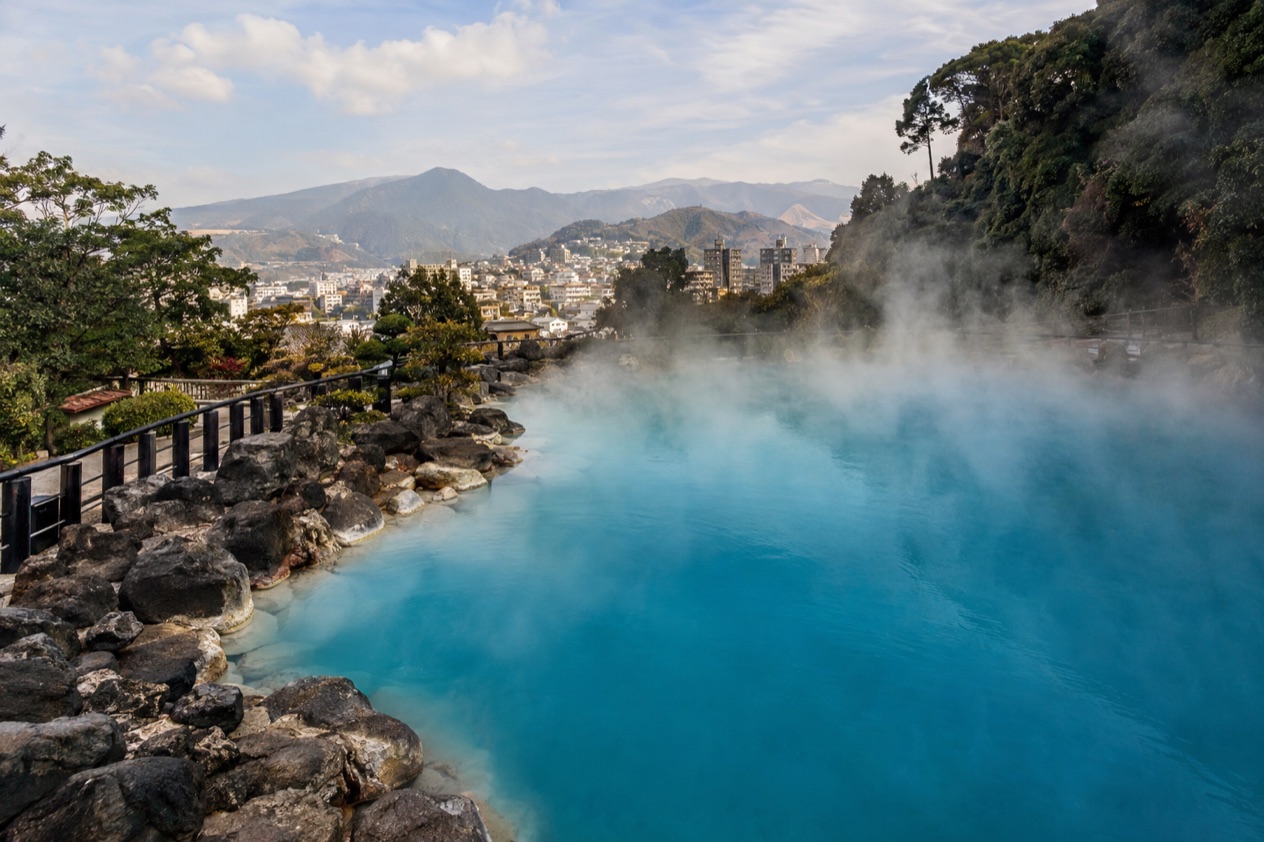
Beppu is the largest hot spring resort in western Japan, and the day is built around that fact. The city has eight major hot spring zones and about 3,000 steam vents, so wherever you walk you are likely to see plumes lifting from the ground, from vents in the street and from the roofs of bathhouses. The town is famous for its onsen, the Japanese hot springs, and there are over 150 individual onsen facilities for bathing, which gives you plenty of choice for a soak.
The Beppu Hells
The Jigoku, or hells, are the sights that make people come from Fukuoka for the day. They are thermal waters reaching temperatures of around 98°C, and they cannot be bathed in.
They are for looking: pools of strange color, clouds of steam, bubbling mud, all laid out like a garden of the earth’s heat. Most of them are in the Kannawa area, almost on the opposite side of the city from the train station, so plan the day as two halves, the town near the station and the hills of Kannawa.
Tatsumaki-Jigoku, the tornado hell, is one of the most active geysers in the world, and it erupts in bursts that you watch from a seating area.
| Site | Open |
|---|---|
| The eight hells | 08:00-17:00 |
| Tatsumaki-Jigoku | 08:00-17:00, and it may stay open a little later after its geyser’s last eruption |
Soaking and stamps
Bathing is the other half of the day. Beppu has a stamp rally for onsen visitors, where you collect stamps from the baths you try, and those who collect 88 are considered an onsen expert, an onsen meijin.
Nobody expects that of a day trip, but it tells you how seriously the city takes its water. A bath is a quiet reward after a morning of steam and walking, and .
Beppu’s food follows the heat. Steam from the ground is used for cooking, and the idea of food steamed in a vent is part of the local character, along with the usual Kyushu pleasures of a good lunch near a bathhouse. A light bag helps, since you will be on and off trains and walking between baths and sights.
If you are heading back to Fukuoka the same day, the trains that brought you there run twice an hour from Beppu’s side as well, ending the day on the same line you started on. If you stay overnight, a yukata, the light cotton robe handed out by inns, is the usual way to wander in the evening steam.
Good to know before you go
Prices for the JR Kyushu Rail Pass are in yen, and the table earlier on the page gives them by adult and child. Bring a light layer, since the hells and bathhouses are warm and the walk between them is outdoors.
Japanese trains have a reputation for being always on time, so a plan made to the minute is a reasonable one when you are linking a morning departure to a bath or a geyser.
Sources
- JR Kyushu, Rail passes (https://www.jrkyushu.co.jp/english/railpass/), checked October 11, 2026
- Wikipedia, Kyushu Shinkansen (https://en.wikipedia.org/wiki/Kyushu_Shinkansen), checked October 11, 2026
- Wikipedia, Sonic (train) (https://en.wikipedia.org/wiki/Sonic_(train)), checked October 11, 2026
- Japan National Tourism Organization, Beppu (https://www.japan.travel/en/destinations/kyushu/oita/beppu-and-yufuin-around/), checked October 11, 2026
- Wikipedia, Beppu, Ōita (https://en.wikipedia.org/wiki/Beppu,_%C5%8Cita), checked October 11, 2026
- Wikivoyage, Beppu (https://en.wikivoyage.org/wiki/Beppu), checked October 11, 2026
- Japan National Tourism Organization, trains and buses (https://www.japan.travel/en/guide/how-to-travel-by-train-and-bus-in-japan/), checked October 11, 2026
- Japan National Tourism Organization, traveling by rail (https://www.japan.travel/en/guide/traveling-by-rail/), checked October 11, 2026
- Japan National Tourism Organization, getting around Japan: trains, subways, buses, taxis (https://www.japan.travel/en/plan/getting-around/), checked October 11, 2026